








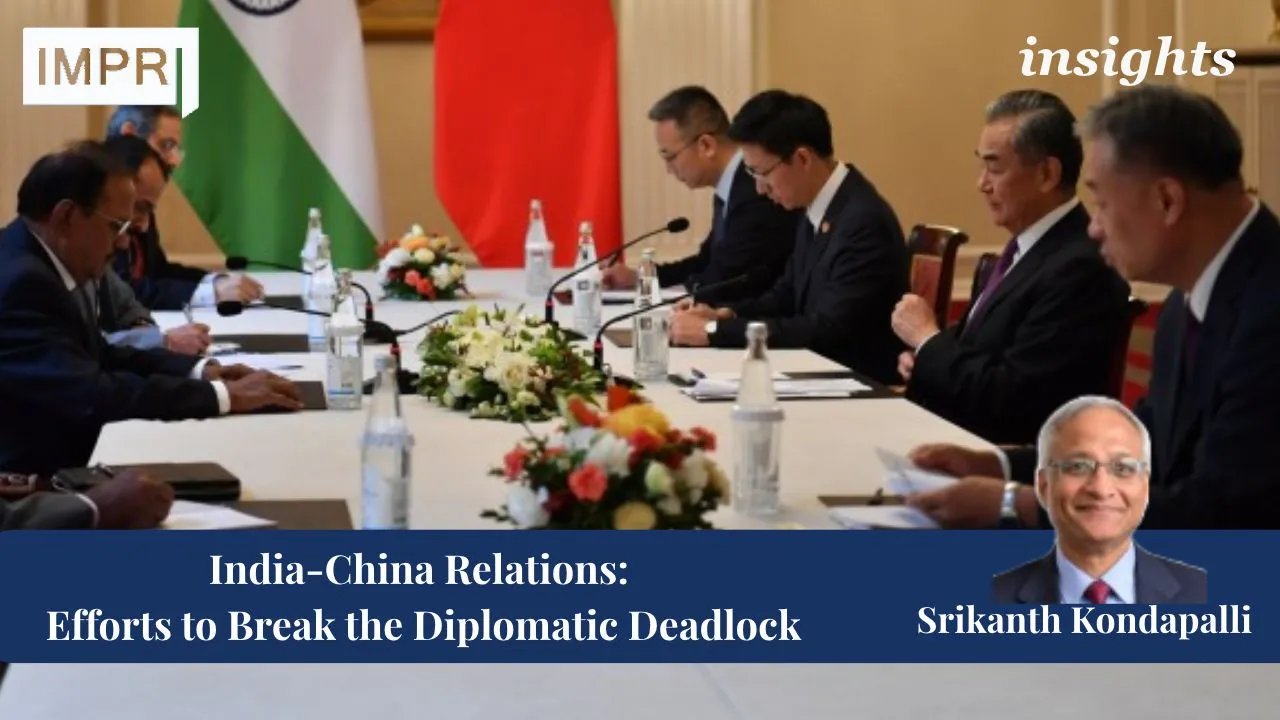
Srikanth Kondapalli
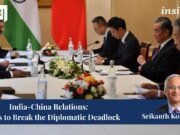
Xi brought in asymmetrical power play by stating that India should have ‘strategic cognition’ and ‘strategic judgement made on the basis of the stage of development the two countries are at’.
This is a very nuanced way of asserting China’s coercive diplomatic posture and reflects Beijing’s penchant to unleash border instability at will, restrict rare earth metal exports, exert pressure on India at global and regional orders, asserts China expert Srikanth Kondapalli.
Key Points
- Xi Jinping’s one-day New Delhi visit produced positive signals but no major announcements or explicit bilateral commitments.
- India insisted border peace, tranquillity and stability remain preconditions for normalising bilateral relations with China.
- Xi urged India to adopt strategic cognition, highlighting Beijing’s asymmetrical approach to bilateral power dynamics.
- India is pursuing free trade agreements to strengthen capabilities, reduce supply-chain vulnerabilities and limit Chinese dependence.
Stalemate, albeit with positive signals, continue to bedevil the bilateral relations between India and China despite President Xi Jinping’s quick one-day visit to New Delhi over the weekend.
There were no major announcements made nor any explicit commitments while the optics of leaders meeting should assuage the critics.
Xi delivered a speech at the 18th BRICS summit, interacted with Prime Minister Narendra Modi and other leaders and at the bilateral level on the sidelines of the summit meeting and made a quick return to Beijing.
Xi’s visit, nevertheless, is significant for his physical presence, charting out a new course at the multilateral and bilateral interactions, although marred by reports on his health and his quick exit.
Xi landed in India after seven years, after his visit to Mahabalipuram in October 2019 to conduct the 2nd ‘informal summit’ meeting with Modi.
Xi visited Ahmedabad and Delhi in September 2014, but skipped the G20 meeting at Delhi in 2023. In 2020, troops of both countries clashed at Galwan, killing 20 Indian soldiers and 4 Chinese.
During Modi’s visit to Tianjin to attend the Shanghai Cooperation Organisation summit meeting last year, reciprocal arrangement was made to support each other’s hosting of the BRICS meetings at Delhi this year and in China in 2027.
Xi came with a 67-member delegation, including Cai Qi, the 5th ranking member in China’s political pantheon, and who received Modi during the Tianjin SCO summit meeting in 2025.
Cai, who was recently nominated to prepare for the 21st communist party congress to be held in October 2027, is a close confidante of Xi and known to have prepared back-channel communications with India.
During the BRICS Kazan meeting in Russia in 2024, Modi and Xi set in motion disengagement and allowing patrols in border areas.
However, de-escalation and de-induction of troops have not been completed, even though both sides mentioned ‘overall stability’ in the border areas.
In this context, India and China’s careful power play was visible at the summit. India’s diplomatic cards were also on display.
India’s careful handling of West Asian leaders and arriving at a compromise formula in New Delhi Declaration on the conflict in the region was not lost on the Chinese delegation.
India-China Border Stability Challenge
In the bilateral interactions, India insisted on peace and tranquillity and border stability as preconditions for normalising bilateral relations and that both countries should take a ‘strategic long term perspective’.
This is a position that India took two days after the Galwan clashes.
Modi also reiterated that bilateral ‘differences should not become disputes’. He underlined observing ‘three mutuals’ — mutual respect, mutual sensitivity and mutual interest as the basis to improve relations.
Xi made four points in his interactions with the Indian delegation. Xi brought in asymmetrical power play by stating that India should have ‘strategic cognition’ and ‘strategic judgement made on the basis of the stage of development the two countries are at’.
This is a very nuanced way of asserting China’s coercive diplomatic posture and reflects Beijing’s penchant to unleash border instability at will, restrict rare earth metal exports, exert pressure on India at global and regional orders.
India is currently countering this with a slew of nine free trade agreements with 38 countries to enhance capabilities, reduce supply chain vulnerabilities and distance from the Chinese sphere of influence.
Alluding to the role of the United States and its impact on India and China, Xi argued for removal of ‘interference’ in bilateral relations.
Xi countenanced that both countries should ‘work together in the same boat’. However, no concrete proposals were announced and thus remain anodyne.
In the light of India distancing from joining politically-constraining China-led initiatives like the Belt and Road Initiative, Community of Shared Destiny and ‘four Global Initiatives’ (Development, Security, Civilisation and the latest Governance), in the backdrop of controlled and limited interdependence, bilateral relations are expected to be difficult for the short term.
BRICS Trade, Supply Chain Tensions
However, both sides agreed to enhancing bilateral trade which is currently more than $155 billion last year (with a deficit of $99 billion in Beijing’s favour), investments (which are a paltry $2 billion from China), protecting supply chains and removing trade barriers.
Nevertheless, the New Delhi Declaration insisted that the BRICS should ‘promote reliable, responsible, diversified, resilient, fair, sustainable, and just supply chains of critical minerals’.
After gallium, germanium and others were restricted by China, Indian automobile and other sectors suffered considerably, only to be relaxed after External Affairs Minister Dr S Jaishankar’s visit to Beijing in June last year.
Eventually, the New Delhi Declaration also did not endorse renminbi-based local currency transactions. China’s renminbi today constitutes over 47 percent of intra-BRICS trade and most of the West Asian and Russian energy sales are in renminbi, which is not a convertible currency.
The Declaration noted ‘respecting national priorities and acknowledging that there is no one-size-fit-all approach’, thus throwing a spanner in the works of de-dollarisation, local currency transactions or digital currencies.
Xi’s proposals to the Summit that BRICS countries should have market integration and China’s AI be implemented, was also taken with caution as these bring nations into the Sinosphere, with market domination, trade deficits and lack of transparency and a level playing field
About the Author:
Srikanth Kondapalli is Professor in Chinese Studies at Jawaharlal Nehru University.
This article was first published in Rediff as Modi, Xi Struggle To Break Stalemate on September 16, 2026
Disclaimer: All views expressed in the article belong solely to the author and not necessarily to the organisation.
Read more at IMPRI:
From Protest to Policy: Ten Years After Bengaluru’s Human Chain
Delhi Student Housing Crisis: Lessons from Satya Niketan
Acknowledgement: This article was posted by Tanisha Hooda, a Research and Editorial Intern at IMPRI.