




Avneet Kaur
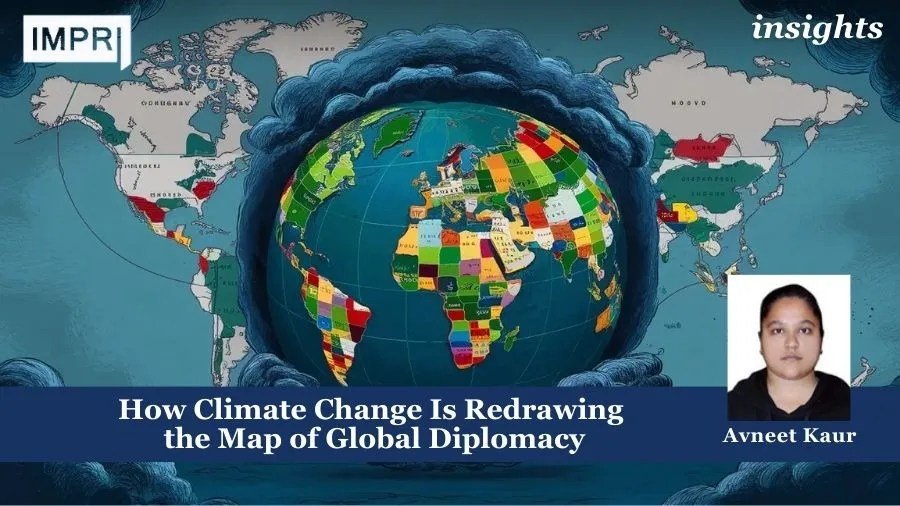
In recent years, a new force has crept into the heart of international politics—not a rising power or a radical ideology, but the changing climate itself. From the Arctic’s melting ice to devastating floods in South Asia, environmental changes are now shaping diplomatic agendas and geopolitical rivalries across the globe.
The New Language of Power: Climate
Traditionally, global diplomacy revolved around trade deals, military alliances, or ideological influence. But today, climate change is influencing how states see their own interests—and each other.
For example, the Arctic, once a frozen no-man’s-land, is now a potential economic corridor as melting ice opens up new sea routes. This has drawn in not just Arctic nations like Russia, Canada, and Norway, but also outsiders like China, seeking access to shipping lanes and natural resources. In this way, the environment has become a strategic asset—or a point of friction.
Climate Threats = National Security Concerns
States aren’t just looking at opportunities—they’re also bracing for risks. Rising sea levels, water shortages, and climate-induced migration are sparking security concerns. Island nations like the Maldives fight for their very existence, while countries like Bangladesh face mass displacement threats. Even global powers like the U.S. now officially recognize climate change as a national security threat.
Diplomacy’s Double Challenge
So, how are diplomats reacting?
On one hand, we’ve seen major international cooperation, such as the Paris Agreement, where nearly every country pledged to reduce emissions. But diplomacy here is a balancing act: developing countries demand climate justice and funding, while richer nations hesitate to bear too much responsibility. This has created tensions that sometimes stall global action.
On the other hand, newer forms of diplomacy are emerging. Think of:
- “Climate clubs”—smaller groups of nations that agree to go beyond global deals.
- Green tech alliances—such as those formed during COP summits.
- Bilateral climate pacts between unlikely partners.
These initiatives show that climate diplomacy is becoming more flexible and pragmatic, with nations pursuing both collective action and interest-driven deals.
Cooperation or Competition?
So, is climate change making the world more united or more divided?
In truth, both. Climate change forces cooperation—no country can fix it alone. But it also intensifies competition, especially over resources, migration, and influence in emerging climate battlegrounds like the Arctic and sub-Saharan Africa.
What’s clear is this: climate is no longer a “soft” issue—it’s hard geopolitics. And how countries manage this challenge will shape the 21st-century global order.
About the contributor: Avneet Kaur is a fellow at DFPGYF Diplomacy, Foreign Policy & Geopolitics Youth Fellow at IMPRI and has a master’s in Natural Resource Management.
Disclaimer: All views expressed in the article belong solely to the author and not necessarily to the organisation.
Read more at IMPRI:
Conceptualising Middle Powers in Geopolitics
Tourism in India: A Diplomatic Soft Power Tool and its Role in Sustainable Development in India
Acknowledgment: This article was posted by Bhaktiba Jadeja, visiting researcher and assistant editor at IMPRI.