




Event Report
Sana Ansari
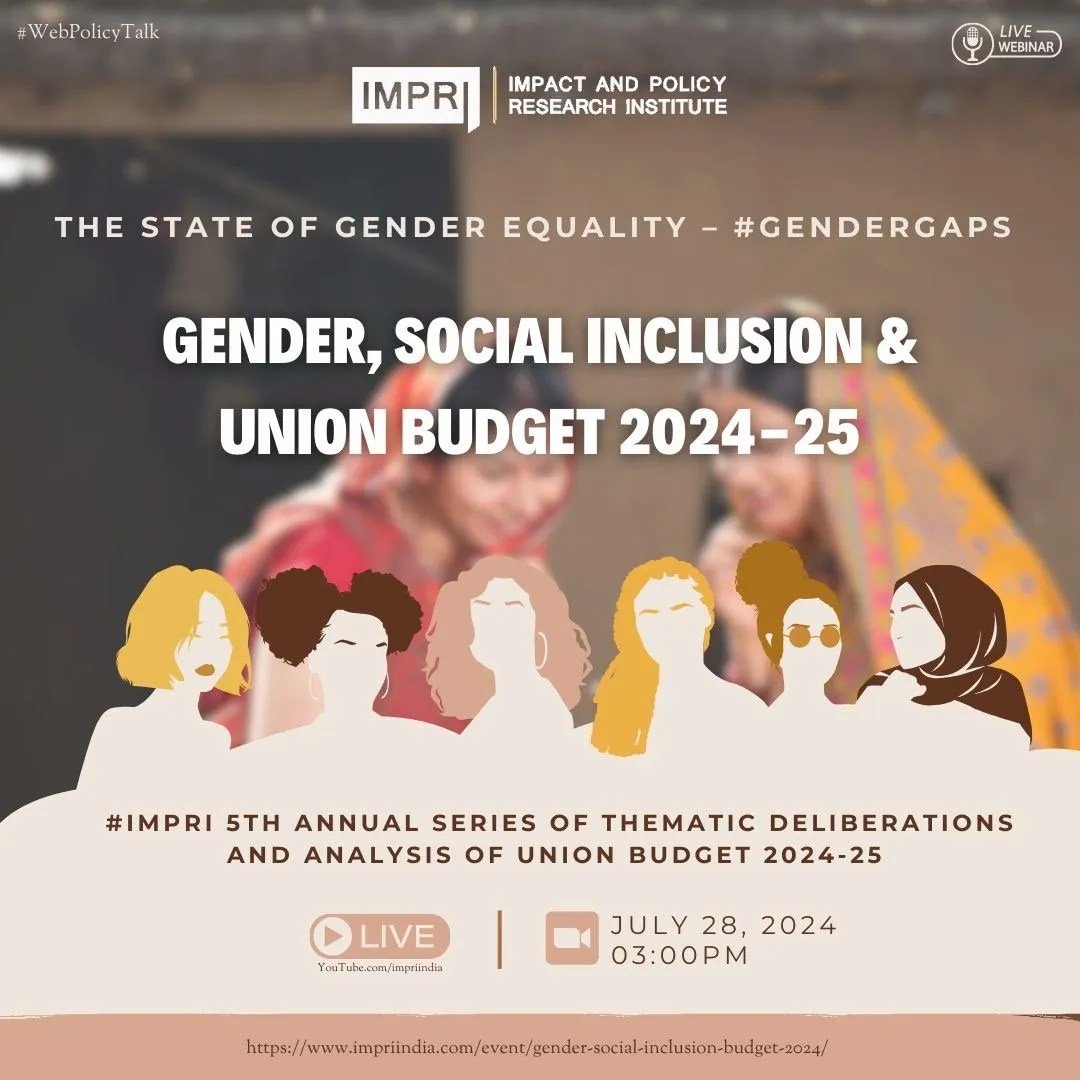
The 5th Annual Series of Thematic Deliberations and Analysis of the Union Budget 2024-25, organized by the Gender Impact Studies Center at IMPRI, included a discussion on “Gender, Social Inclusion, and the Union Budget 2024-25.” The session was introduced by Ms Reet Lath, a researcher at IMPRI, and chaired by Prof. Vibhuti Patel. The expert panel comprised Dr Sanghamitra Dhar, Prof. N. Manimekalai, Shri Shailesh Mishra, Ms Deepa Pawar, Dr Neha Shah, Prof. Paramita Saha, Dr Aditi Kapoor, and Dr Aditi Sawant.
Prof. Vibhuti Patel ji began the session by highlighting the budget’s promises in agriculture, employment, skilling, inclusive human resource development, social justice, MSMEs, urban development, energy security, infrastructure, and R&D. These areas are crucial for gender equity and social inclusion, especially for marginalized populations facing intersecting disadvantages of class, caste, ethnicity, religion, location, ability, and gender. Prof. Vibhuti ji stressed the need for intersectional, participatory, decentralised, and outcome-based gender-responsive budgeting. The budget is divided into three parts: Part A for schemes 100% targeted at women, Part B for schemes with 33-99% allocation for women, and Part C for schemes with less than 30% allocation. However, it has a binary approach to gender, neglecting the transgender community’s needs in education, employment, health, shelter, and decision-making. Additionally, allocations for women’s initiatives often lack clear timelines and strategies, and schemes like Beti Bachao Beti Padhao frequently divert funds to advertisements instead of directly empowering girls.
Prof. Paramita Saha ji discussed the budget’s focus on “Sabka Sath, Sabka Vikas, and Sabka Vishwas,” aiming for social inclusion across all societal strata and geographical regions. Despite robust GDP growth of around 8%, issues like food inflation, inequality, and a shrinking budget relative to GDP pose risks to those dependent on public expenditure and social security. Employment and skilling are key areas, with incentives for corporate first-time job seekers expected to benefit 210 lakh youth. Plans for women’s workforce participation through working women hostels and skilling initiatives lack specific implementation details. The budget allocation for SC and ST communities has seen a slight increase, but the Ministry of Tribal Affairs’ budget has decreased from 12,938.32 crores in 2023 to 12,386 crores in 2024. For the Northeast, the allocation stands at 10,893 crores, a 9.9% increase, but key projects have stagnant allocations.
Prof. N. Manimekalai ji highlighted trends in budget allocation across sectors, noting that economic liberalization since 1990 has exacerbated both economic and gender inequalities. She emphasized the importance of decent employment, pointing out that government internship schemes in corporates often lack proper training and permanent employment. The budget’s focus on capital expenditures is expected to generate income that should benefit marginalized populations, but this is not happening. Inflation and the rising cost of living disproportionately affect the poor, who need support in education, food, and security. Sustainable development and gender equality are crucial for achieving “Vishit Bharat” by 2047. The Gender Economic Forum’s report shows fluctuating progress in gender equality, emphasizing the need to address inequalities across all genders and recognize the diversity among women. The budget should prioritize employability, education, and skill development to improve gender equality and social inclusion in India.
Dr. Aditi Kapoor ji discussed the misconception that climate change is solely about increased pollution. She emphasized the rapid urbanization in India and the lack of attention to pollution in growing towns and cities. The budget’s focus on productivity and resilience should address air, water, and noise pollution, especially for vulnerable populations like street vendors, construction workers, slum dwellers, and traffic police. Despite the availability of LPG, indoor pollution from cooking remains a significant issue for women in slums. The budget’s allocation for the Central Pollution Control Board increased by 6.5%, but without clear plans for new equipment or mitigation efforts. Climate resilience is also underfunded, with minimal focus on disaster and climate change resilience for low-income and marginalized communities. The informal sector, including small producers and fisherfolk, significantly contributes to the GDP but is underrecognized. Investments in rooftop solar panels and the PM Awas Yojna promoting female house ownership are positive steps, but subsidies should target female-owned houses. The budget lacks specific targets for women’s participation in agriculture and overlooks skill-building and labor-saving devices crucial for women in rural areas.
Ms Aditi Sawant ji explained that the budget is a financial statement reflecting the government’s priorities across different sectors in the process of economic development. Although India is among the top five GDPs in the world, with over 17% of its GDP derived from agriculture, there is a significant mismatch between the agricultural sector’s GDP contribution and its share in budget allocation. Agriculture and rural development receive only 3% of the budget despite their critical roles in consumption and employment. Aditi Sawant ji highlighted three main areas of concern: women’s participation and empowerment in agriculture, social inclusion and technology penetration, and budget allocation for research and development.
The speaker emphasized that studies in Maharashtra reveal only 5% of women participate in significant household financial decisions. The Ministry of Agriculture and Farmers Welfare reported that the number of female cultivators and workers is significantly lower than their male counterparts, reflecting poor land ownership among women. Despite initiatives like PM AWAS YOJNA, which promotes women’s property rights, many states still lag in implementation. Moreover, official records often do not accurately reflect the number of female agricultural workers, exacerbating the issue of gender disparity in this sector.
Self-help groups, often involved in activities like stitching, pickle making, and candle making, do not provide long-term professional growth for women. The COVID-19 pandemic has underscored the importance of digital devices in agriculture, yet many farmers with smartphones do not use them for agricultural purposes. Sawant stressed the need for government investment in professional and vocational training for farmers, as outlined in the new education policy, which proposes agriculture as a vocational course from the 9th grade. However, the implementation of this course has been insufficient. Sawant criticized the budget as a temporary fix rather than a fundamental solution to the agricultural sector’s issues.
Shri.Shailesh Mishra ji began by quoting that aging is not the loss of youth but a new stage of opportunity and strength. He questioned whether this belief is genuinely held, noting that the 2024-25 budget omits mention of senior citizens. According to a recent government economic survey, there is an urgent need for a structured elder care policy in India. Despite the NITI Aayog’s 2023 report on age care welfare highlighting issues like social engagement, financial stability, security, and digital well-being, the budget does not adequately address the needs of senior citizens. Mishra pointed out that the Department of Social Justice and Empowerment’s budget is around Rs 13,500 crore, but only Rs 279 crore is allocated for aging, which is just 2% of the department’s budget. This allocation is insufficient for a population that constitutes 10% of the country.
Shailesh ji emphasised the need for healthcare, security, independence, and financial stability for seniors. He advocated for the restoration of senior citizen railway concessions, which were withdrawn during the pandemic, and the removal of the 18% GST on essentials for seniors, arguing that most seniors do not have a steady income or social security. He called for a pension system to support these individuals. Mishra stressed that senior citizens require security, mental health provisions, safety, and elder care services.
Dr. Neha Shah ji discussed income inequality, referencing the Paris-based World Inequality Report 2024, which indicates that the top 1% of income and wealth shares in India are at their highest historical levels. The report reveals that India’s top 1% holds a significant portion of income and wealth, among the highest in the world. The Pradhan Mantri Garib Kalyan Anna Yojana (PMGKAY) aims to cover 81 crore people over the next five years, highlighting the widespread poverty in the country. Neha ji emphasised the importance of discussing the budget because fiscal policy plays a crucial role in achieving distributive justice through income redistribution.
Neha ji pointed out that 48.5% of tax revenue comes from indirect taxes, which are regressive in nature. In contrast, direct taxes, which are supposed to be progressive, account for only 17% from corporate taxes and 19% from personal taxes. This fiscal structure is not supportive of the sections of society that need assistance. Shah noted that the budget’s acknowledgment of unemployment is a positive step, but the support for social welfare sectors remains inadequate.
Neha ji also discussed gender budgeting, noting that women’s participation in the economy is low due to poor skills and the constraints of the care economy. She stressed the need for investment in both STEM and the care economy to increase women’s participation. Investment in the care economy is crucial in rural areas where women face constraints that prevent them from participating in the workforce.
Ms. Deepa Pawar ji raised concerns about the lack of provisions for nomadic and denotified tribes in the budget. With only Rs 5 crore allocated for these communities, She criticised the budget for favouring capitalists and lacking social justice. She questioned the government’s political stance and for whom the budgetary provisions are intended. Deepa ji called for the government to promote intersectional, inclusive, and empowering ideas. She highlighted the need for clarity and focus on grassroots communities, rather than a capitalist-driven budget.
Deepa ji pointed out that schemes like Support for Marginalised Individual Livelihood Enterprises are supposed to rehabilitate marginalised communities, but the budget’s approach seems more geared towards profit-driven enterprises rather than social justice. She strongly criticised the government for not addressing the needs of marginalized communities and urged a rethinking of their budgetary priorities.
Way forward
In conclusion, the budget reflects the government’s priorities and should emphasize agriculture and employment while addressing gaps in the informal and unorganized sectors. The education system needs reform with more vocational and professional training. The government should act as a welfare state, generating jobs and facilities, and providing empathy and constructive action plans for senior citizens. A focus on sustainable development and gender inclusion is essential for a more equitable budget. This decade is crucial for India; failing to look beyond youth could turn potential assets into liabilities, as seen in Japan and China, which are struggling to support their aging populations.
Acknowledgement: Sana Ansari a researcher at Impri pursuing masters in public policy at St Xavier’s College Mumbai.