



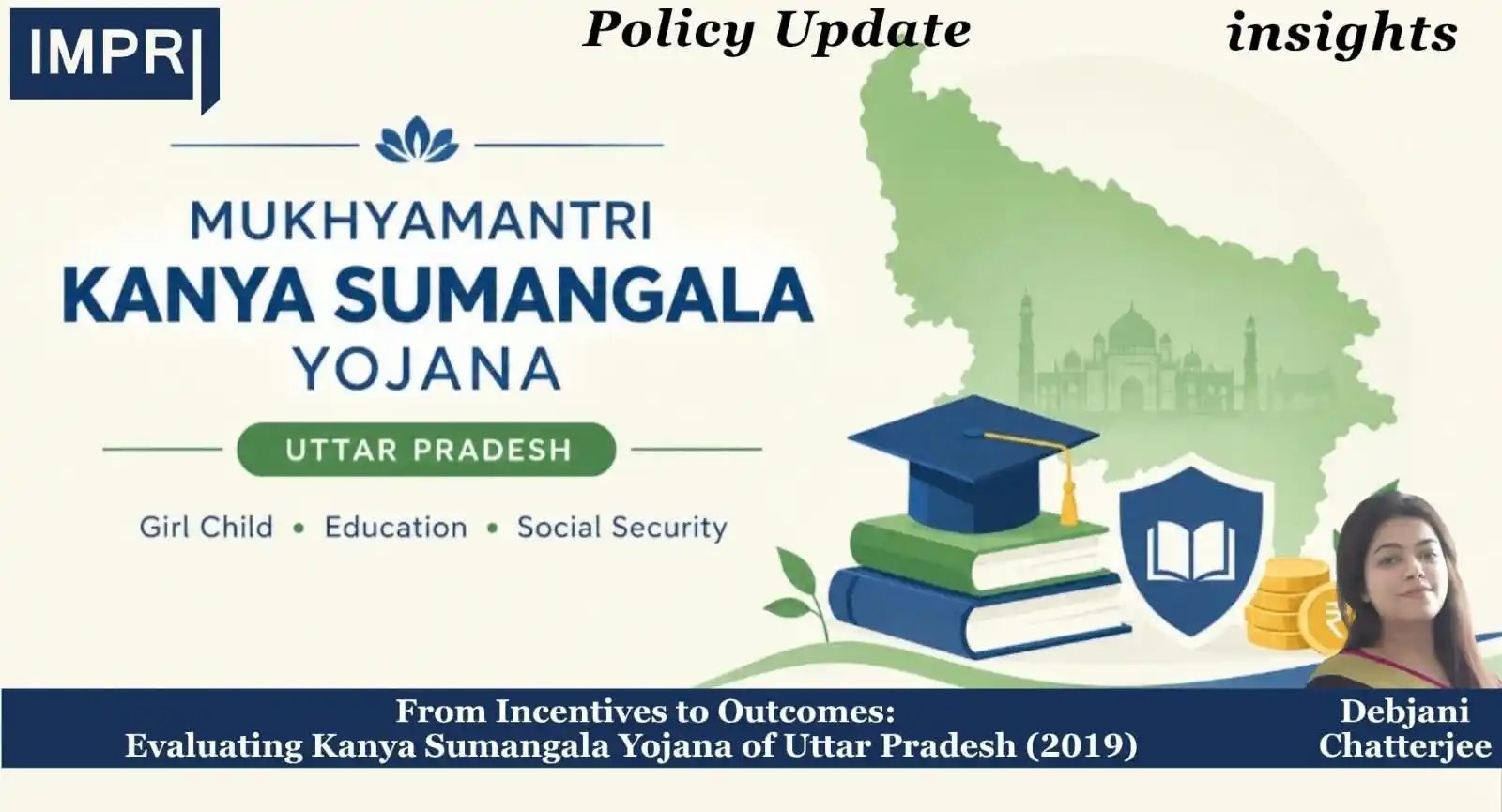
Policy Update
Debjani Chatterjee
Background
Historically, Uttar Pradesh has faced persistent gender disparities, including low female literacy, child marriage and gender discrimination affecting girls. Census 2011 recorded a child sex ratio of only 902 girls per 1,000 boys. NFHS 4 (National Family Health Survey, 2014-15) also reported that 21.1 percent of women aged 20 to 24 were married before the age of 18, while only 32.9 percent had completed ten or more years of schooling.
These challenges highlighted the need for financial support to encourage families to invest in girls’ health and education. In response, the Uttar Pradesh government introduced Mukhyamantri Kanya Sumangala Yojana on 25 October 2019. The scheme provides conditional financial assistance across key life stages, aiming to improve child sex ratio, reduce child marriage, promote immunisation and school enrolment, and reduce girls dropout rates.
Function
Mukhyamantri Kanya Sumangala Yojana is administered by the Department of Women and Child Development, Government of Uttar Pradesh, with implementation supported by district and block level officials. Under the revised structure, an eligible girl can receive a total of ₹25,000 through six stages. The family receives ₹5,000 after the girl’s birth, ₹2,000 after completion of required vaccinations, ₹3,000 on admission to Class I, ₹3,000 on entering Class VI, ₹5,000 on entering Class IX and ₹7,000 after admission to a recognised graduation or diploma course.
The family must meet the prescribed annual income limit and other eligibility conditions. Applications are submitted through the MKSY portal and verified using documents such as birth registration, Aadhaar and school records. After verification and approval, the assistance is transferred through the Direct Benefit Transfer system. District authorities supervise verification, while the state department manages funds, guidelines, monitoring and the online MIS.
Performance
• Beneficiary Coverage: The scheme has expanded substantially since its launch in 2019. Uttar Pradesh government reported 22.11 lakh girls benefited under the scheme by 2025, while the 2026–27 Budget document reported that 26.81 lakh girls had benefited up to January 2026. This indicates a substantial expansion in cumulative coverage over the implementation period.
| Year / Period | Beneficiaries |
| 2021 | 7.81 lakh |
| 2022–23 | 12.68 lakh |
| Feb 2024 | 17.82 lakh |
| 2025 | 22.11 lakh |
| Jan 2026 | 26.81 lakh |
(Figures represent cumulative beneficiaries reported at different points of implementation and are not uniform financial year end figures.)
• Financial Assistance: The financial support under the scheme increased from ₹15,000 to ₹25,000 from April 2024. The revised six stage structure provides ₹5,000 at birth, ₹2,000 after complete vaccination, ₹3,000 on admission to Class I, ₹3,000 on admission to Class VI, ₹5,000 on admission to Class IX and ₹7,000 after Class 10 or 12 for enrolment in a recognised graduation or diploma course.
| Stage | Original | Revised |
| Birth | ₹2,000 | ₹5,000 |
| Complete vaccination | ₹1,000 | ₹2,000 |
| Class I | ₹2,000 | ₹3,000 |
| Class VI | ₹2,000 | ₹3,000 |
| Class IX | ₹3,000 | ₹5,000 |
| Higher education | ₹5,000 | ₹7,000 |
| Total | ₹15,000 | ₹25,000 |
(Official MKSY Portal)
• Budget Allocation: The Uttar Pradesh government provided ₹400 crore for Mukhyamantri Kanya Sumangala Yojana in the 2026–27 Budget. The increase in individual assistance from ₹15,000 to ₹25,000 also increased the financial requirement per beneficiary.
• Disbursement and Financial Utilisation: Government reporting confirms direct transfers to beneficiaries under the scheme, including the transfer of assistance to 1.55 lakh eligible girls during the 2021 launch of Mission Shakti Phase III. However, figures such as ₹647.21 crore total expenditure and ₹130.03 crore for 3.28 lakh beneficiaries are not directly traceable to a primary UP Government source in the material reviewed. Therefore, these figures should not be presented as verified government data without citing the underlying official expenditure record.
| Financial Year | Sanctioned Amount | Actual Utilisation | Utilisation Rate |
| 2021–22 | ₹200 crore | ₹80.93 crore | 40.5% |
| 2022–23 | ₹400 crore | ₹75.17 crore | 18.8% |
| 2023–24 | ₹175 crore | ₹74.67 crore | 42.7% |
| 2024–25 | ₹167.17 crore | ₹164.50 crore | 98.4% |
• District and Regional Coverage: District level reporting demonstrates substantial geographical reach. An eight year government achievement exhibition in Varanasi reported 57,777 girls benefited under Mukhyamantri Kanya Sumangala Yojana in the district. This can be used as a district level implementation benchmark, although it should not be described as evidence that Varanasi is the highest performing district in Uttar Pradesh unless a statewide district ranking is available.
• Governance and Digital Monitoring: Implementation has progressively shifted towards digital and integrated monitoring. MIS 2.0 became operational in October 2021, Parivaar ID integration was introduced in August 2022, birth registration through CRS integration became mandatory in September 2022, Aadhaar integration for applicants, parents and beneficiaries became mandatory in October 2022, and application verification was shifted to BDOs and SDMs from November 2022. The government also introduced Basic Education Student ID requirements for Classes I and VI in government schools in 2023 and further portal based rejection reasons in 2025.
Impact
• Reduction in child marriage:
The proportion of women aged 20 to 24 married before 18 in Uttar Pradesh declined from 21.1 percent in NFHS 4 (2015–16) to 15.8 percent in NFHS 5 (2019–21), a reduction of 5.3 percentage points. This indicates improvement in the age at marriage among young women. Delaying child marriage is a stated objective of Mukhyamantri Kanya Sumangala Yojana (MKSY). However, as NFHS 5 overlapped with the initial phase of MKSY, launched in October 2019, the decline should be viewed as a broader state level trend consistent with the scheme’s objective, rather than evidence directly attributable to MKSY.
• Improvement in educational attainment:
The proportion of women aged 15 to 49 who completed more than ten years of schooling increased from 32.9 percent in NFHS 4 to 39.3 percent in NFHS 5. While this indicates broader improvement in educational attainment, a 2025 rapid process evaluation found that less than 20 percent of potential beneficiaries were accessing MKSY. Thus, although the scheme provides education-linked financial support, its limited reach constrains the extent to which wider educational gains can be linked to MKSY.
• Reduction in school dropout:
Recent UDISE+ data show improved educational continuity among girls in Uttar Pradesh. The secondary-level dropout rate declined from 4.8 percent in 2023–24 to 1.5 percent in 2024–25, while the middle-level rate fell from 4.8 percent to 3.1 percent. These trends indicate improved retention, although they reflect the wider education system and cannot be attributed exclusively to MKSY.
• Continued challenge in high-risk areas:
NFHS data show a decline in child marriage, but the issue remains concentrated in vulnerable communities and districts. UNICEF’s 2026 case study identifies MKSY as a conditional cash transfer programme addressing education, health and skill development. However, the 2025 evaluation identified low awareness, limited uptake and application rejections as key barriers, highlighting the need for targeted outreach.
• Progress with implementation gaps:
Overall, the evidence indicates improvements in girls’ educational continuity and a decline in early marriage, alongside limitations in MKSY’s reach. UDISE+ shows declining dropout rates, while the 2025 evaluation found that less than one-fifth of potential beneficiaries accessed MKSY and over 90 percent received only one stage of the benefit. These trends cannot be attributed to MKSY alone.
• Contribution to longer term empowerment:
The observed changes in education and age at marriage are consistent with the broader outcomes targeted by MKSY. UNICEF’s assessment of the Uttar Pradesh model identifies the scheme as contributing to delayed marriage, continuity of education and greater family and community support for girls. The evidence therefore suggests that the scheme has potential value beyond short term financial assistance.
• Limits of attribution:
These outcomes cannot be attributed to MKSY alone. Changes in child marriage and education are influenced by multiple factors, including other government programmes, improved school access, awareness campaigns, household income, legal enforcement and wider social change. Therefore, the available evidence supports MKSY as a contributing intervention, rather than establishing a direct causal relationship between the scheme and the observed improvements.
Emerging Issues
• Coverage does not ensure sustained participation:
The expansion of beneficiaries does not necessarily mean that girls remain in education until higher secondary or college. The scheme supports important transition points, but there is limited publicly available evidence tracking the same beneficiary from birth to higher education. This makes it difficult to assess whether financial assistance is translating into sustained educational progression.
• Exclusion and eligibility barriers:
The scheme depends on documents such as birth certificates, Aadhaar and other eligibility records. Families facing documentation gaps, limited digital access or difficulties in completing applications may remain outside the formal system. This creates a risk that the most vulnerable households may not receive benefits despite being eligible.
• Financial adequacy:
Although total assistance increased from ₹15,000 to ₹25,000 from April 2024, its real value needs to be assessed against rising service costs. In January 2025, education, health and transport inflation stood at 3.95 percent, 3.97 percent and 2.76 percent respectively. This suggests that a fixed transfer may provide different levels of support across households, particularly where education and healthcare costs are higher.
• Uneven district performance:
State level coverage can conceal implementation gaps across districts. A 2025 rapid process evaluation found that fewer than 20 percent of potential beneficiaries were accessing MKSY, while around four in ten applications were rejected, often due to inaccurate information and technical issues. The findings highlight differences in awareness and administrative access and support the need for district wise monitoring of applications, rejection rates and stage-wise payments.
• Payment and verification delays:
Multiple eligibility conditions and verification stages can slow down the movement from application to payment. Delays can reduce the usefulness of an incentive when the associated educational or health milestone has already occurred.
• Limited outcome measurement:
Existing monitoring systems are stronger at recording applications, approvals and payments than at measuring long term outcomes. Public data provide limited evidence on whether beneficiaries actually remain in school, complete higher education, delay marriage or experience improved employment opportunities.
• Risk of treating cash support as a complete solution:
Financial incentives alone cannot address all social barriers affecting girls. Child marriage, school dropout, safety concerns, poor transport and household attitudes require complementary interventions. The future effectiveness of MKSY therefore depends on stronger convergence between financial support, education, health and social protection programmes.
Way Forward
• Introduce a stage completion dashboard: The MKSY portal should track each girl across all six payment stages instead of showing only applications and payments. For every beneficiary, the system should record whether she completed vaccination, entered Class I, reached Class VI and Class IX, and progressed to higher education. This would help identify where girls are dropping out between two benefit stages.
• Create district performance scorecards: The Women and Child Development Department should publish a quarterly district scorecard covering applications received, approval rate, pending cases, rejection rate, payment delays, school progression and completion of each MKSY stage. Districts performing below the state average for two consecutive quarters should receive targeted administrative review and additional support.
• Set fixed timelines for verification and payment: Once an application is submitted with complete documents, BDOs and SDMs should have a defined time limit for verification, followed by a fixed timeline for approval and DBT payment. Applications pending beyond the prescribed period should automatically appear on a district level escalation dashboard so that delays can be traced to the responsible administrative level.
• Use schools as verification and support points: Government schools should play a greater role in helping eligible families complete later stages of the scheme. Class I, VI and IX admission records can be digitally matched with MKSY beneficiary records, reducing repeated document submission and helping identify girls who have received an earlier instalment but have not progressed to the next stage.
• Target districts with persistent child marriage: MKSY implementation should be prioritised in districts where child marriage remains significantly above the state average. District administrations can combine MKSY beneficiary lists with child protection, school attendance and adolescent health data to identify vulnerable areas and organise focused counselling and outreach rather than relying only on general awareness campaigns.
• Strengthen the higher education stage: The final ₹7,000 instalment should be linked more effectively with verified admission and continued enrolment in recognised degree or diploma programmes. The government could also track how many beneficiaries receiving the final instalment actually continue beyond the first year, providing a clearer measure of whether the scheme is supporting transition into higher education.
• Introduce an annual outcome review: Every year, the government should compare MKSY districts on child marriage, school completion, dropout and higher education transition. A small independent evaluation every two to three years could examine whether beneficiaries show better outcomes than comparable eligible girls who did not receive the benefit. This would provide stronger evidence of the scheme’s actual impact.
• Review the ₹25,000 assistance periodically: The revised amount should be reviewed against current education and household costs rather than remaining fixed for several years. Any future increase should be directed towards stages where financial constraints are most likely to affect school continuation or higher education, particularly for economically vulnerable families.
References and Links
- Government of Uttar Pradesh, Department of Women Welfare and Child Development. (2025). Mukhyamantri Kanya Sumangala Yojana: Citizen portal and scheme details DEPARTMENT OF WOMEN & CHILD DEVELOPMENT
- International Institute for Population Sciences. (2021). National Family Health Survey (NFHS-5), 2019–21: Bahraich, Uttar Pradesh: Key indicators. Ministry of Health and Family Welfare, Government of India.f8095b22-bb15-470f-a0a8-6d21b982aa8a.pdf
- International Institute for Population Sciences. (2021). National Family Health Survey (NFHS-5), 2019–21: Uttar Pradesh. Ministry of Health and Family Welfare, Government of India.
- Department of Women Welfare, Government of Uttar Pradesh. (n.d.). Mukhyamantri Kanya Sumangala Yojana: Introduction, implementation stages and eligibility criteria. DEPARTMENT OF WOMEN & CHILD DEVELOPMENT
- Department of Women Welfare, Government of Uttar Pradesh. (2025). Mukhyamantri Kanya Sumangala Yojana: Citizen portal and benefit structure.DEPARTMENT OF WOMEN & CHILD DEVELOPMENT
- Government of Uttar Pradesh. (2025). Budget speech 2025–26. Finance Department, Government of Uttar Pradesh. budgetbhashan_2025_2026.pdf
- UNICEF India. (2026). Strategic investment in girlhood: Uttar Pradesh’s MKSY model for empowerment. UNICEF. Strategic investment in girlhood: Uttar Pradesh’s MKSY Model for Empowerment | UNICEF India
About the Contributor
Debjani Chatterjee is a policy researcher with a background in Finance and Political science. Her work focuses on leveraging data analytics to support evidence based policy research.
Acknowledgement
My sincere thanks to the Impact and Policy Research Institute (IMPRI) for the opportunity to prepare this policy update article. IMPRI’s dedication to connecting research with actionable policy practice provides an invaluable platform for learning.
Reviewed by:
Ninchen Tamang and Dolly Kaushik
Disclaimer
The opinions expressed in this article are strictly those of the author and do not reflect the official position or views of the organization.
Read more at IMPRI:
Governing AI Responsibly : The Safe & Trusted AI Pillar (2024)
ITEC Executive Courses (2024): Strategic Capacity Building for Global Governance