








Policy Update
Devanandhana C
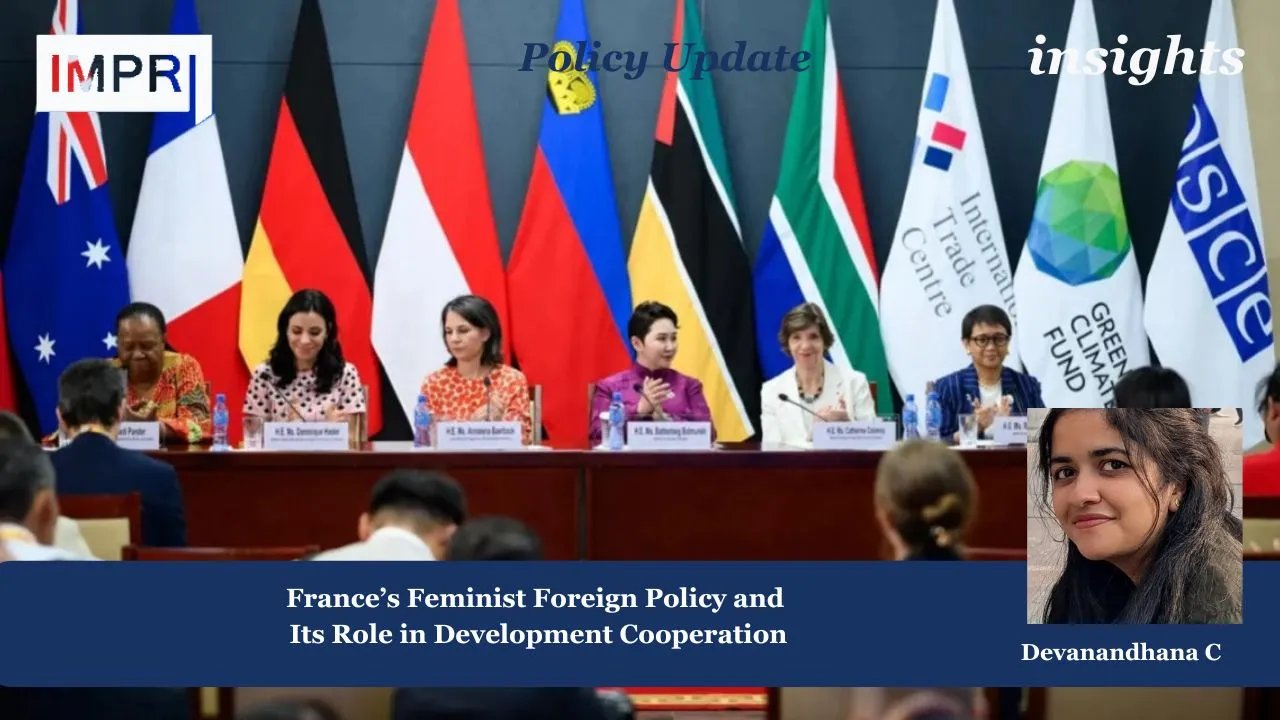
France’s Feminist Foreign Policy is an example of how a state can connect diplomacy, development and gender equality. This is a diplomatic approach that puts women’s and girls’ rights at the centre of action. In development cooperation it moves gender from secondary concern to a core objective by advancing women’s rights and wider social development. limited to strategy; it is actively implemented through strong advocacy in international forums such as the UN Commission on the Status of Women and European institutions.
Background
France adopted its Feminist Foreign Policy (FFP) in 2019, becoming the fourth country in the world to officially adopt a feminist foreign policy. In March 2025 France adopted its first International Feminist Foreign Policy Strategy (2025-2030) taking the state’s FFP one step forward. This strategic approach asserts the key priority of gender in France’s international action. The new strategy outlines shared goals for France’s international and European efforts and provides a roadmap for the Ministry for Europe and Foreign Affairs from 2025 to 2030.
The Agence Française de Développement (French Development Agency) Group operates in over 160 countries to strengthen women’s empowerment through three types of autonomy: Physical autonomy- ensuring women’s control over their bodies and to live without the fear of violence.
Financial autonomy- providing women greater capacity to earn, manage and control their own income.
Political autonomy- supporting women’s equal participation in decision making and public policy.
France’s feminist foreign policy reflects a wider understanding of international affairs. It goes beyond social issues by connecting gender equality with peace, security, climate action, digital governance, and democracy.
Performance
Recent reporting shows that the policy has developed from just an announcement to a concrete commitment (Agence Française de Développement, 2025). AFD claims that in 2025, 68.5% of their investment around the world contributes to reducing gender inequality and empowering women and girls. This suggests gender equality has advanced to the mainstream of French development cooperation rather than just being a marginal concern. Whether focused on healthcare, food security, education and training, entrepreneurship, or climate change adaptation, AFD’s projects promote inclusive and equitable development for all citizens.
Another key tool used by France to implement its Feminist Foreign Policy is the Feminist Support Fund for Feminist Organisations (FSOF), which is run jointly by the Ministry for Europe and Foreign Affairs. Since its launch in 2020, the Support Fund for Feminist Organizations has strengthened more than 1,400 organizations in 75 countries (Ministry for Europe and Foreign Affairs, 2025). The first FSOF-funded program has improved the capacity of 200 organisations operating in 30 different countries to protect the rights of women. It includes their sexual and reproductive rights, freedom from violence and economic empowerment. The final evaluation of this project highlighted its effectiveness in supporting small organisations which struggle to access financing.
Impact
The impact of France’s FFP is visible in both developmental and diplomatic aspects. In development cooperation, the policy has redirected attention and resources toward women’s rights, girls’ education, sexual and reproductive health, economic empowerment, and protection from gender-based violence. This action pushed gender equality to the centre of aid policy. This matters especially because gender inequality goes beyond just social concern it also shapes poverty, health, security, and political participation.
Moreover, it should be highlighted that there is a diplomatic effect of this policy. In many instances, France has positioned itself as the supporter of the feminist diplomacy. As a result, the country gains some soft power to influence future development norms and to shape new norms in such fields as peace-building and digital governance. It also makes it possible for France to tie gender equality to climate change and conflict resolution policies.
At the same time the policy is still evolving and is uneven. Even though FFP is capable of strengthening visibility, funding, and political commitment it cannot directly alter the deeper social structures. The political backlashes and limited administrative capacity faced by women’s organisations in many partner countries are examples for this. Ultimately, the impact of the policy will be determined by France’s capacity to sustain its commitment through long-term institutional reforms rather than symbolic diplomacy alone.
Emerging Issues
- The broad policy has ambitious feminist commitments but it makes implementation uneven across the development, humanitarian, diplomatic, defence, security, trade, and arms export sectors as well as across institutions such as the Ministry for Europe and Foreign Affairs (MEAE), the Agence Française de Développement (AFD), and the Ministry of the Armed Forces.
- Although France’s Feminist Foreign Policy has made significant progress, its implementation varies by region. There is stronger engagement in Sub-Saharan Africa and the Indo-Pacific through development cooperation. However, implementation is more limited in the Middle East and North Africa because of geopolitical and security priorities.
- Although France has stepped up its investments for gender inequality initiatives, many feminist organisations especially the grassroots groups still faces issues with limited financing.
- The questions about the consistency of France’s commitment towards FFP raises when it continues to maintain diplomatic, security and economic partnerships with countries having poor women’s rights records.
- The absence of clear accountability frameworks and limited monitoring mechanisms makes measuring the impact of FFP difficult.
- Policy should have betterment in addressing the overlapping forms of discrimination faced by women based on sexual orientation, race, ethnicity, socioeconomic position and migration status.
- Digital gender equality should receive greater attention because gender-based violence in online spaces remains a significant challenge.
- For the FFP strategy to succeed, it is necessary to promote the incorporation of feminism into all spheres of foreign policy, rather than making separate initiatives.
Way Forward
France’s Feminist Foreign Policy shows how development cooperation can be redesigned around gender equality. It also exhibits how a major donor country links gender equality and development cooperation. An important lesson for development cooperation emphasised by France’s FFP is that: aid is most effective when it addresses inequality at its roots. This model advances from narrow project delivery to major structural change.
France should further reinforce its assistance to grassroot feminist organisations, embrace an intersectional agenda, strive for digital gender equality, and make sure there is consistency between its feminist commitments and its overall foreign policy agenda.
By strengthening implementation, ensuring adequate funding, improving accountability, advancing monitoring systems and integrating gender equality across all aspects of its foreign policy, France’s FFP can achieve greater impacts. This will ensure that France’s feminist foreign policy moves beyond commitments to achieve meaningful and lasting change.
References
About the Contributor:
Devanandana is an International Relations student at Loyola College, Chennai, who has completed a Bachelor’s degree in French Literature.Interested in researching gender trends and impacts in international relations.
Acknowledgement:
The author extends sincere thanks to the IMPRI team for their guidance. I also extend my sincere thanks to CB Kavin Adithya and Ameya Sushilchandra Satam for their constructive reviews and editorial support.
Disclaimer:
All views expressed in the article belong solely to the author and not necessarily to the organisation.
Read more at IMPRI
Kishtwar’s Hydropower Revolution: Development, Energy Security and Local Challenges
From Deterrence to Preparedness: Analysing India’s ₹52,000 Crore Defence Modernisation Drive