








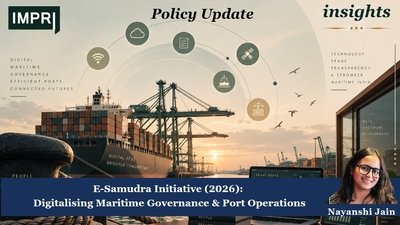
Policy Update
Nayanshi Jain
Introduction
India’s Maritime Economy and the Imperative of Digital Governance
India’s maritime sector is central to its trade and economic security, with around 95% of trade by volume and 68% by value moving by sea. Its extensive coastline and strategic location provide a natural advantage, but physical port capacity alone cannot determine maritime competitiveness.
Modern ports function as interconnected logistics and information hubs, where vessel clearances, cargo movement, customs and regulatory compliance depend increasingly on seamless information flows. India’s maritime policy is consequently shifting from port-centric infrastructure creation towards integrated, technology-enabled maritime governance.
From Paper-Based Administration to Digital-First Maritime Governance
Maritime administration traditionally involves multiple agencies, approvals, certificates and documentation, creating delays and raising compliance costs. These administrative frictions, though less visible than physical bottlenecks, can affect the efficiency and predictability of the entire logistics chain.
Digitalisation can address these constraints through single-window, paperless and trackable processes. However, its value lies not merely in replacing paper with screens, but in redesigning processes, eliminating duplication and enabling secure data-sharing across agencies.
E-Samudra (2026): A New Architecture of Maritime Governance
Launched on 8 August 2026, E-Samudra is the flagship digital platform of the Directorate General of Maritime Administration (DGMA). It aims to provide a unified, paperless interface for maritime stakeholders, including seafarers, shipping companies and maritime training institutions, with online services, real-time tracking and greater administrative transparency.
E-Samudra forms part of India’s wider maritime digitalisation agenda alongside initiatives such as Sagarsetu, Sagarmanthan and the Maritime Digital Centre of Excellence, supporting the objectives of Maritime India Vision 2030 and Maritime Amrit Kaal Vision 2047.
From Digital Service Delivery to Maritime Competitiveness
E-Samudra marks a shift from fragmented maritime administration towards integrated digital governance. Yet, digitisation alone does not guarantee efficiency. Its transformative potential will depend on interoperability with existing maritime platforms, robust data governance, cybersecurity, institutional coordination and measurable reductions in regulatory and operational frictions.
The key policy question is therefore not how many maritime services have been digitised, but whether E-Samudra can make India’s maritime governance faster, more transparent, predictable, secure and stakeholder-centric.
Background
Institutional Architecture of Indian Maritime Governance
India’s maritime governance operates through a multi-layered institutional structure. The Ministry of Ports, Shipping and Waterways (MoPSW) provides policy direction, while the maritime administration/regulatory machinery oversees shipping safety, security, training, certification and seafarer-related matters. Alongside these are Major and non-Major port authorities, shipping companies, terminals, maritime training institutions, recruitment and placement agencies, customs and other logistics stakeholders.
This distributed architecture reflects the complexity of maritime activity but also creates a coordination problem: the same transaction may require information to move across multiple institutions, each operating with distinct systems, databases and compliance requirements. Digital integration is therefore not simply an efficiency measure; it is a mechanism for institutional coordination and regulatory coherence. The MoPSW’s IT Division now explicitly coordinates digital transformation, cybersecurity and data-governance initiatives across the Ministry and affiliated organisations.
Evolution of Maritime Digitalisation in India
India’s maritime digitalisation has evolved progressively- from paper-based administration to e-governance, single-window systems and increasingly integrated digital platforms. The transition began with the digitisation of individual services and port processes before moving towards platforms designed to connect multiple stakeholders.
A significant step was the Port Community System (PCS), subsequently integrated into National Logistics Portal–Marine/SagarSetu, conceived as a common digital interface connecting ports, terminals, shipping lines, agents, customs brokers, CFSs and importers/exporters.
The ecosystem has since expanded beyond transactions towards data-driven governance. The Sagarmanthan dashboard currently comprises 42 live modules covering project monitoring, KPIs, governance and strategic planning, while the Sagar Aankalan framework introduces the Logistics Port Performance Index (LPPI) to benchmark port performance.
The establishment of the Maritime Digital Centre of Excellence (MDCoE) with C-DAC in 2025 further signals a shift towards institutionalising digital capabilities rather than treating technology as standalone projects.
Policy Linkages: Maritime India Vision 2030 and Amrit Kaal Vision 2047
E-Samudra fits within India’s broader objective of building a globally competitive, technology-enabled maritime sector. Maritime India Vision 2030 seeks to improve port efficiency, logistics competitiveness and ease of doing business, while Maritime Amrit Kaal Vision 2047 provides a longer-term framework for transforming India’s maritime infrastructure, services and governance.
The Ministry’s current digital initiatives- including MDCoE, SagarSetu and Sagarmanthan, are explicitly aligned with these two visions. The linkage is important because digital governance addresses the “soft infrastructure” of competitiveness: predictable regulation, faster clearances, accessible services and better information flows.
For seafarers, this also extends the concept of Ease of Doing Business to Ease of Living by making regulatory and welfare services accessible without dependence on physical interfaces.
Why Maritime Governance Requires Digital Integration
The policy problem is not the absence of digital tools but their fragmentation. Multiple databases and institutional interfaces can produce repetitive documentation, information asymmetry and delays even when individual processes are online.
The need is therefore for interoperability rather than mere digitisation. A vessel, cargo or seafarer should not have to repeatedly submit information that the government already possesses elsewhere. Integrated systems can enable “once-only” data submission, real-time status visibility and automated information exchange, reducing compliance costs while improving regulatory oversight.
This is particularly important in maritime operations, where delays can have cascading effects across vessels, ports, cargo owners and logistics providers. India’s move towards integrated systems such as SagarSetu and E-Samudra reflects an attempt to address this coordination failure at the ecosystem level.
The Seafarer as a Critical but Often Overlooked Stakeholder
Digital maritime governance ultimately has a human dimension. Seafarers operate at the intersection of safety regulation, employment, certification and welfare, often while physically distant from administrative centres. Consequently, fragmented documentation or inaccessible services can impose disproportionate costs on them.
The 2026 E-Samudra launch was deliberately paired with a government-stakeholder programme on seafarer security, safety, welfare and social protection, signalling a broader conception of maritime governance beyond commercial efficiency.
A digitally integrated system can improve the portability and accessibility of certification, employment and welfare records, strengthen grievance redressal and create better regulatory visibility. Yet inclusion must remain central: digital-first governance should reduce barriers for seafarers rather than create new ones through poor accessibility, data gaps or digital exclusion.
Functioning
E-Samudra as a Single-Window Digital Architecture
E-Samudra is designed as a single-window, paperless platform integrating maritime services through a common digital interface. The official portal describes 72+ services, online applications, digital documentation, payments, approvals, real-time tracking and notifications. Its significance lies in consolidating previously dispersed administrative interactions into a more coherent service-delivery system.
However, a single window is meaningful only when it reduces the number of interfaces a user must navigate. If applications remain dependent on disconnected back-end systems or manual verification, the platform risks becoming a digital front end for unchanged administrative processes. Its effectiveness must therefore be assessed by reductions in processing time, repeat submissions and compliance costs- not merely by the number of services listed online.
Stakeholder Integration
E-Samudra brings together seafarers, ship owners, charterers, maritime training institutions, recruitment and placement agencies and regulators within a common digital ecosystem. Its underlying logic is to connect information generated at different stages of the maritime employment and regulatory lifecycle: training records, medical fitness, sea service, certification and compliance.
This can reduce information asymmetry and coordination costs. For example, training certificates are updated by maritime training institutions, sea service by recruitment and placement companies, and medical fitness by approved doctors, while the seafarer accesses and verifies the resulting record. The policy gain, however, depends on data accuracy, timely updating and clear institutional responsibility. Integration without reliable data can simply transmit errors faster.
Digitisation of Regulatory and Compliance Processes
The platform supports services across the seafarer lifecycle, including Certificate of Competency applications, eligibility assessment, revalidation, INDoS updates and examination-related services. It also provides digital interfaces for regulatory submissions and service-record management.
The central policy question is whether E-Samudra merely converts paper forms into online forms or redesigns the regulatory process itself. Genuine reform would involve once-only data submission, automated validation, risk-based scrutiny and interoperable records. Otherwise, digitisation may improve convenience without substantially reducing administrative burden.
Real-Time Tracking and Data-Driven Governance
Real-time application tracking and digital records can shift maritime administration from reactive processing to proactive monitoring. By making application status, pending actions and service timelines visible, E-Samudra can improve accountability and reduce uncertainty for users. The wider MoPSW ecosystem already includes Sagarmanthan, a dashboard with 42 live modules covering project monitoring, KPIs, governance and strategic planning.
The next step is to use such data for predictive governance- identifying recurring delays, detecting anomalies and directing regulatory attention towards higher-risk cases. This requires consistent data standards and analytical capacity; otherwise, dashboards may remain reporting tools rather than instruments of decision-making.
Digitalisation of Seafarer Welfare
E-Samudra’s significance extends beyond commercial efficiency to seafarer welfare and social protection. The DGMA’s stated responsibilities include digital management of seafarer identity and service documents, grievance handling and regulatory oversight of recruitment and placement agencies.
Its potential lies in making certification, employment documentation and welfare-related services more accessible, particularly to seafarers working far from administrative centres. The platform’s launch was accompanied by a government programme on seafarer security, safety, welfare and social protection, reinforcing this human-centred dimension. Yet, digital welfare delivery must be supported by accessible grievance mechanisms, data protection and alternatives for users facing connectivity or digital-literacy constraints.
Interoperability with the Wider Maritime Digital Ecosystem
E-Samudra’s long-term value will depend on its ability to function as part of one maritime data ecosystem, rather than as another isolated portal. MoPSW’s Maritime Single Window–SagarSetu already enables ship-related data exchange and has onboarded all 12 Major Ports and 56 non-Major Ports.
The policy objective should therefore be interoperability across E-Samudra, port community systems, customs, shipping databases, port authorities and other logistics platforms. Common data standards, secure APIs and clearly defined data-sharing protocols are essential. Without them, India risks replacing paper silos with digital silos.
Data, AI and Emerging Technologies
E-Samudra creates a foundation for more advanced applications of data and technology, including AI-assisted regulatory processing, anomaly detection, risk-based inspections and automated compliance monitoring. These applications could help regulators move from uniform administrative scrutiny towards more targeted and evidence-based oversight.
The wider maritime sector is already experimenting with advanced technologies. For instance, V.O. Chidambaranar Port has implemented a digital-twin platform incorporating IoT, GPS, LiDAR, drones and real-time analytics, illustrating how digital systems can support operational visibility and planning.
For E-Samudra, however, technological sophistication must remain subordinate to governance objectives. AI should support, not replace human judgment in safety-critical and welfare-related decisions.
Performance
Administrative Efficiency and Reduction in Transaction Costs
E-Samudra’s principal efficiency gain lies in consolidating maritime services through a paperless, online and trackable interface. By reducing physical visits, repetitive submissions and dependence on manual correspondence, it can lower the time and administrative costs associated with certification, approvals and regulatory compliance. The official platform lists 72+ services, indicating the breadth of functions brought within its digital architecture.
However, digitising a transaction does not necessarily eliminate the transaction cost. The relevant test is whether processing times, repeat submissions and approval delays decline after implementation. Without such evidence, the platform’s current significance should be understood as an institutional efficiency opportunity rather than a conclusively demonstrated outcome.
Transparency and Accountability
Real-time application tracking, digital records and standardised workflows can improve procedural transparency by making the status of an application visible to both users and administrators. Digital audit trails can also strengthen accountability by recording submissions, decisions and pending actions, thereby reducing the opacity associated with purely manual processes.
Yet, transparency is not automatic. If decisions remain dependent on opaque manual scrutiny, or if users cannot access reasons for delays and rejections, a digital interface may merely relocate discretion rather than reduce it. The policy objective should therefore be auditable decision-making, time-bound service standards and accessible grievance escalation.
Ease of Doing Business for Maritime Stakeholders
For ship owners, shipping companies, charterers, training institutions and recruitment agencies, E-Samudra can reduce the friction involved in regulatory compliance and stakeholder coordination. A common platform can make documentation, approvals and service interactions more predictable, particularly for organisations managing multiple applications or operating across jurisdictions.
This aligns with India’s broader maritime competitiveness agenda. However, the business value of the platform will depend on whether it produces lower compliance costs and greater regulatory predictability, rather than simply adding another mandatory interface. Its success should therefore be assessed through user-level outcomes, not portal activity alone.
Ease of Living and Welfare of Seafarers
The platform’s significance extends beyond commercial efficiency to the accessibility of maritime services for seafarers. Digital certification, employment-related documentation and grievance mechanisms can reduce dependence on physical administrative offices and improve access for workers operating far from shore.
This is particularly relevant because the 2026 launch explicitly placed seafarer security, safety, welfare and social protection alongside digital service delivery. Nevertheless, welfare outcomes cannot be inferred from digitisation alone. They require measurable improvements in grievance resolution, accessibility, service reliability and protection of personal data.
Port and Logistics Performance: The Larger Ecosystem
E-Samudra should not be treated as a direct substitute for port-operational systems. Its contribution to port efficiency will depend on how effectively it connects with the wider maritime digital ecosystem, including SagarSetu, port community systems, customs and logistics platforms.
The appropriate evaluation framework is therefore Sagar Aankalan’s Logistics Port Performance Index (LPPI), which provides a basis for assessing port efficiency and service standards. Rather than assuming that digitalisation automatically reduces congestion or vessel turnaround time, policymakers should examine whether integrated information flows contribute to faster clearances, improved berth utilisation, lower cargo dwell time and greater supply-chain predictability.
The distinction is important: E-Samudra’s direct outcomes are administrative; its wider economic impact depends on ecosystem-level integration.
Measuring What Matters: From Digitisation to Outcomes
A credible performance assessment should move beyond the number of services placed online and measure whether the platform improves governance in practice.
| Dimension | Suggested Indicator |
| Administrative efficiency | Average application-processing time |
| Transaction costs | Cost per regulatory transaction |
| Accessibility | Share of services completed fully online |
| Transparency | Time taken to resolve grievances |
| Regulatory quality | Share of applications processed within prescribed timelines |
| Port efficiency | Vessel turnaround time |
| Logistics | Cargo dwell time |
| Compliance | Rate of digitally completed compliance submissions |
| Seafarer welfare | Grievance-resolution rate and service accessibility |
| Reliability | Platform uptime and system recovery time |
| Integration | Number of interoperable government systems |
The central evaluation principle should be simple: measure the reduction in time, cost and uncertainty- not merely the expansion of digital infrastructure.
Structural and Implementation Challenges
The platform’s benefits will depend on the quality of its implementation. Cybersecurity, data privacy, interoperability failures, legacy systems and uneven technological capacity can limit the effectiveness of an otherwise well-designed platform. Smaller maritime firms, training institutions and users with limited digital literacy may also face higher transition costs.
These concerns are not peripheral. The International Maritime Organization identifies digitisation, integration and automation as creating new cyber vulnerabilities across shipping’s administrative and operational systems. Its 2026 digitalisation strategy emphasises interoperability, standardisation, data-sharing and effective data governance, while also highlighting the need for human-centred and resilient systems.
For India, the policy challenge is therefore to ensure that digital transformation does not create new exclusion, security or accountability risks.
The Risk of “Digitalising Silos”
The most important limitation is the possibility that E-Samudra becomes another standalone digital platform rather than a genuinely integrated governance system. If maritime agencies retain disconnected databases, incompatible standards and separate verification processes, users may still have to submit the same information repeatedly- only now through different portals.
E-Samudra’s long-term performance should therefore be judged by its ability to connect systems, not merely by the number of services it hosts. Its transformative potential lies in making maritime governance more integrated, predictable and data-driven; without interoperability, digitisation risks improving the interface while leaving the underlying institutional fragmentation intact.
The Way Forward
Build a National Maritime Digital Public Infrastructure
E-Samudra should evolve into a foundational layer of Maritime Digital Public Infrastructure (MDPI) rather than remain an isolated service portal. This requires interoperable databases, common APIs, open technical standards, digital identity and secure data exchange across maritime institutions. The objective should be to make information portable across services and institutions, reducing repeated verification while preserving regulatory control.
Adopt “Interoperability by Design”
Interoperability should be treated as a design requirement, not a future add-on. E-Samudra should be capable of securely exchanging relevant information with customs, ports, shipping databases, logistics platforms, inland waterways, immigration, maritime training and labour-welfare systems.
India’s existing Maritime Single Window–SagarSetu provides a practical foundation for this approach. The next step is to establish common data standards, API-based integration and clear institutional responsibility for data exchange, ensuring that users do not encounter multiple digital interfaces for the same transaction. (shipmin.gov.in)
Establish a Strong Maritime Data-Governance Framework
As maritime administration becomes increasingly data-dependent, India needs a clear framework governing data ownership, access rights, consent, retention, sharing and accountability. The platform should adopt purpose limitation, role-based access and auditable data-sharing protocols, consistent with the principles of the Digital Personal Data Protection Act, 2023.
The policy objective should be to enable data-sharing without compromising privacy, commercial confidentiality or regulatory integrity. Data localisation should be applied where legally or strategically necessary, rather than treated as a substitute for robust security and governance.
Strengthen Cybersecurity and Maritime Resilience
Maritime digital systems are increasingly part of critical infrastructure, making cybersecurity a governance and national-security priority. E-Samudra should incorporate zero-trust architecture, continuous vulnerability assessment, regular independent audits, incident-response protocols and tested disaster-recovery arrangements.
Cybersecurity obligations should also extend to connected stakeholders, including ports, shipping companies, training institutions and service providers. The IMO’s digitalisation strategy similarly emphasises resilience, interoperability, standardisation and secure data exchange as essential to maritime digital transformation.
Move from E-Governance to AI-Enabled Governance
Once reliable and interoperable data systems are established, E-Samudra can support AI-assisted regulatory processing, anomaly detection, risk-based inspections and predictive analytics. These tools could help regulators allocate attention more efficiently and identify emerging compliance risks.
However, automation must remain human-centred and proportionate to risk. Safety-critical, employment-related and welfare decisions should retain meaningful human oversight, with explainability and avenues for review. AI should strengthen regulatory judgment- not replace accountability.
Create Outcome-Based Performance Measurement
The platform’s success should be measured through publicly reported outcomes, not merely the number of services digitised. An annual maritime digital-governance dashboard should track:
- average processing time and approval delays;
- compliance costs and repeat submissions;
- grievance-resolution rates;
- vessel turnaround and cargo dwell time;
- user satisfaction;
- platform uptime and recovery time;
- number of interoperable systems.
This would shift evaluation from “How much has been digitised?” to “How much time, cost and uncertainty has been removed?”
Bridge the Digital Divide
Digital-first governance must not become digital-only governance. Smaller shipping firms, maritime training institutions, coastal communities and users with limited digital literacy may face disproportionate transition costs.
The government should provide assisted digital access, multilingual interfaces, user-support mechanisms and alternative channels where necessary. This is particularly important for ensuring that seafarer welfare and regulatory access are not determined by technological capacity.
Institutionalise Stakeholder-Centred Governance
E-Samudra should be governed through continuous feedback from seafarers, ship owners, ports, training institutions, recruitment agencies, maritime associations and technology providers. Periodic user consultations, grievance analytics and independent service evaluations can help identify bottlenecks that administrative dashboards may overlook.
A platform designed around user experience is more likely to deliver substantive ease of doing business and ease of living, rather than merely administrative convenience.
Develop a Unified Maritime Digital Governance Roadmap to 2047
India should establish a time-bound maritime digital-governance roadmap aligned with Maritime India Vision 2030 and Maritime Amrit Kaal Vision 2047. The roadmap should define interoperability milestones, cybersecurity standards, data-governance responsibilities, AI-readiness and measurable service outcomes.
The strategic progression should be:
E-Samudra → interoperable maritime platforms → smart ports → data-driven logistics → resilient maritime infrastructure → globally competitive maritime sector.
This would position digitalisation as a long-term institutional capability, rather than a series of disconnected technology projects.
E-Samudra’s significance ultimately lies beyond its digital interface. Its success will depend on whether it can transform fragmented administrative processes into a coherent, interoperable and accountable maritime governance system.
References
Directorate General of Maritime Administration. (2026, August 8). Hon’ble Union Minister Shri Sarbananda Sonowal launches E-Samudra on 08 August 2026. Government of India.https://www.dgma.gov.in/gallery/it-e-governance/honble-union-minister-shri-sarbananda-sonowal-launches-e-samudra-on-08-august-2026
Directorate General of Maritime Administration. (2026). Nautical examinations: Examination, assessment and certification. Government of India.https://www.dgma.gov.in/nautical-wing/nautical-examinations
Directorate General of Maritime Administration. (2026). Crew Division: About us. Government of India.https://dgma.gov.in/crew-division/crew-about-us
Directorate General of Maritime Administration. (2026). E-Samudra portal. Government of India.https://esamudra.dgshipping.gov.in
Ministry of Ports, Shipping and Waterways. (2026). Information technology. Government of India.https://www.shipmin.gov.in/en/content/information-technology
Ministry of Ports, Shipping and Waterways. (2025). Annual report 2024–25. Government of India.https://shipmin.gov.in/sites/default/files/Annual%20Report%202024-25.pdf
Ministry of Ports, Shipping and Waterways. (2025). Maritime India Vision 2030. Government of India.https://www.shipmin.gov.in/sites/default/files/Maritime_India_Vision_2030.pdf
Ministry of Ports, Shipping and Waterways. (2024). Sagar Aankalan: Logistics Performance Index for Ports. Government of India.https://www.shipmin.gov.in/sites/default/files/Sagar%20Aankalan%20Guidelines.pdf
International Maritime Organization. (2026, March 31). The Facilitation Committee approves digitalization strategy and cybersecurity measures.https://www.imo.org/en/MediaCentre/PressBriefings/pages/Facilitation-Committee-approves-digitalization-strategy-and-cyber-security-measures.aspx
International Maritime Organization. (n.d.). Maritime cyber risk.https://www.imo.org/en/OurWork/Security/Pages/Cyber-security.aspx
About the Contributor
Nayanshi is a Research and Editorial Intern at IMPRI and a student of Economics and Political Science at St. Stephen’s College, Delhi. Her research interests lie in international political economy, monetary and financial systems, public policy, developmental economics, welfare economics, behavioural economics and sustainable development.
Reviewers
Angela Rajeev and Shruti Chandra
Disclaimer:
All views expressed in the article belong solely to the author and not necessarily to the organisation.
Acknowledgement
The author extends her sincerest gratitude to the IMPRI team for their expert guidance and constructive feedback throughout the process.