








Policy Update
Asmatwali
Background
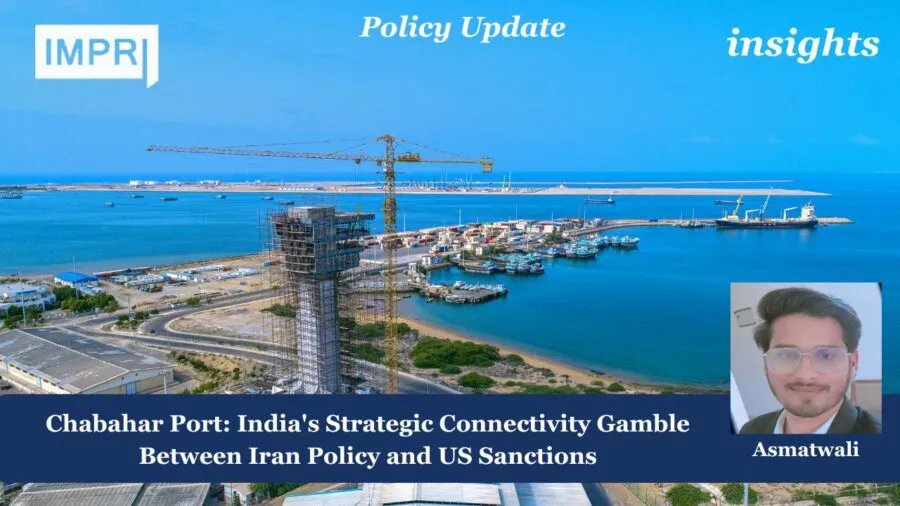
The Chabahar Port project has, for over a decade, occupied a singular place in India’s foreign policy imagination: a deep-water gateway on Iran’s Gulf of Oman coast offering New Delhi direct maritime access to Afghanistan and Central Asia without transiting Pakistani territory. India’s involvement dates back to an intergovernmental Memorandum of Understanding (MoU) signed on 6 May 2015, a year before Prime Minister Narendra Modi’s first visit to Iran. Under the framework agreement, Indian entities were to lease and operationalise two berths at the Shahid Beheshti terminal as container and multi-purpose cargo facilities.
On 13 May 2024, India Ports Global Limited (IPGL) signed a ten-year contract with Iran’s Ports and Maritime Organisation to equip and operate the Shahid Beheshti terminal, committing approximately USD 120 million for port machinery and cranes, alongside a separate credit line earmarked for ancillary infrastructure. The port was conceived with three strategic objectives: an Afghanistan and Central Asia corridor bypassing Pakistan; the maritime anchor of the International North-South Transport Corridor (INSTC), a roughly 7,200-kilometre multimodal route linking India with Russia, Central Asia and Europe; and a strategic counter to the Chinese-financed Gwadar port, barely 170 kilometres to the east on the Pakistani coast.
India’s Chabahar operations have been insulated from US sanctions on Iran since November 2018, when Washington granted a project-specific exemption under the Iran Freedom and Counter-Proliferation Act of 2012, framed around Afghan reconstruction. That insulation has now come under sustained pressure following the second Trump administration’s reimposition of “maximum pressure” sanctions on Iran through 2025-26, turning a decade-long infrastructure story into an urgent exercise in diplomatic and legal risk-management.
Functioning
Operationally, Chabahar comprises two terminals, Shahid Kalantari and Shahid Beheshti, with India’s role confined to the latter, run by IPGL, a wholly owned subsidiary of Sagarmala Development Corporation Limited (since renamed Sagarmala Finance Corporation Limited, India’s first maritime non-banking financial corporation). IPGL’s mandate covers equipping, operating, and expanding container-handling capacity, with an eventual target of 250,000 TEUs annually, as well as installing gantry cranes, reach stackers, and mobile harbour cranes.
The mechanism through which India’s presence is now being renegotiated is a conditional US Treasury sanctions waiver. The 2018 exemption was formally revoked effective 29 September 2025; following Indian diplomatic representations, the US Treasury issued a letter on 28 October 2025 extending conditional protection until 26 April 2026. Within this window, IPGL reportedly transferred its full committed investment to Iran in advance, wound down its board presence, and took its public-facing website offline, taking administrative steps intended to minimise India’s exposure once the waiver lapsed.
As the deadline neared, officials began structuring a temporary transfer of IPGL’s holding in the India Ports Global Chabahar Free Zone (IPGCFZ) to a local Iranian entity, with an understanding, not yet a binding published instrument, that operational control would revert to India once sanctions ease. This stake-transfer route, rather than an outright sale or complete withdrawal, is the functional core of India’s current Chabahar policy.
Performance
Measured against budgetary and institutional indicators over the past two to three years, India’s commitment to Chabahar shows a clear pattern of contraction. For years, the government allocated a consistent Rs 100 crore annually for the port’s development; Union Budget 2026, presented on 1 February, carried no allocation whatsoever for Chabahar, the first such omission in nearly a decade. In Parliament, the Ministry of External Affairs confirmed in March 2026 that India’s approximately USD 120 million financial commitment under the 2024 contract had been fully discharged and that no further funding obligation remained, effectively closing out the investment phase of the project ahead of schedule.
On the operational side, the resignation of India-nominated IPGL directors and the removal of the company’s website in the period leading up to the September 2025 sanctions reimposition indicate a substantial retreat from day-to-day management, even though the underlying ten-year operating contract signed in 2024 formally remains in force. Cargo performance data specific to the India-run terminal has grown sparse in the public domain over this period, itself a proxy indicator of the project’s declining operational visibility. Where earlier reporting (2018-2023) tracked wheat and pulse shipments to Afghanistan, approximately 2.5 million tonnes of wheat and 2,000 tonnes of pulses moved as humanitarian assistance via the port; comparable throughput figures for 2025-26 are not readily available, reflecting the operational slowdown.
Impact
The most immediate impact has been on India’s connectivity architecture for Afghanistan and Central Asia. Chabahar had served as a practical instrument for reaching Afghan markets and advancing the INSTC vision without Pakistani transit; a reduced Indian footprint narrows these options at a time when India has also been activating alternative air cargo links to Kabul to compensate. The rail link under construction toward Zahedan, intended to convert port access into a genuine overland corridor to Iran and onward to the Central Asian rail network, now faces uncertainty regarding Indian participation in its financing and planning.
A second impact is geostrategic: several analysts, including Michael Kugelman of the Atlantic Council, have characterised Chabahar as having become “a damaged asset,” cautioning that a full Indian withdrawal creates a vacuum that China, backed by its 25-year comprehensive cooperation agreement with Tehran and a demonstrably higher tolerance for US sanctions exposure, is structurally well placed to fill. This risk is compounded by the fact that Chabahar sits barely 170 kilometres from Chinese-financed Gwadar, making the balance of regional port influence directly contestable.
A third impact concerns India’s strategic autonomy doctrine itself. The episode has unfolded alongside India’s deepening defence and technology partnership with Israel, elevated to a Special Strategic Partnership during Prime Minister Modi’s February 2026 visit, even as New Delhi has sought to preserve its relationship with Iran. During the active phase of the US-Israel-Iran conflict, this balancing posture drew domestic criticism, including from opposition leaders who characterised the Chabahar wind-down as capitulation to US pressure, and from commentators noting that India’s declined mediatory role, despite ties with all three parties, sat awkwardly against its aspirations for a larger global voice, including within its 2026 BRICS chairmanship.
Emerging Issues
i. Absence of a binding reversion mechanism: The proposed stake transfer to an Iranian entity currently rests on informal assurances rather than a published, legally enforceable instrument specifying the conditions and timeline for India’s return, creating risk that the “temporary” transfer could harden into a permanent loss of control.
ii. Sanctions spillover risk to unrelated assets: Because IPGL sits under Sagarmala Finance Corporation, which also operates Myanmar’s Sittwe Port and is part of the Bharat Global Ports consortium, unresolved Chabahar exposure could complicate India’s broader ambitions to become an international ports operator.
iii. Erosion of first-mover advantage on rail connectivity: Continued Indian disengagement risks ceding both the timing and the terms of the Chabahar-Zahedan rail linkage, the corridor’s most transformative unbuilt component, to Iranian or third-country partners.
iv. Diplomatic ambiguity during active conflict: India’s calibrated neutrality across the US-Israel-Iran conflict has been read by some regional observers as a substantive choice rather than genuine neutrality, weakening India’s claimed mediatory credibility in West Asia.
v. Domestic political contestation: Opposition criticism of the wind-down as a foreign-policy retreat under external pressure adds a domestic political cost to what the government frames as a purely tactical, sanctions-driven recalibration.
vi. Data and transparency gap: The removal of IPGL’s public website and the scarcity of recent operational data make independent verification of the port’s current throughput and status difficult, complicating both policy analysis and public accountability.
Way Forward
Chabahar’s trajectory since April 2026 illustrates the narrowing room within which India’s strategic autonomy doctrine currently operates. Four steps would help convert the present tactical pause into a genuinely reversible arrangement rather than a slow-motion exit. First, any stake-transfer understanding with an Iranian entity should be formalised in a clear, ideally written, bilateral instrument specifying conditions and timelines for reversion, closing the ambiguity that could otherwise be exploited in a future renegotiation. Second, India should continue to press Washington for a sector-specific, connectivity- and humanitarian-linked sanctions exemption, building on the precedent of the original 2018 Afghan reconstruction waiver, rather than treating the relationship as a binary choice between full engagement and full exit.
Third, India can sustain technical and advisory engagement on the Chabahar-Zahedan rail corridor even amid reduced equity exposure to preserve its first-mover advantage once sanctions conditions change, while simultaneously diversifying connectivity to Afghanistan and Central Asia through the air cargo corridor to Kabul and other complementary routes. Fourth, Sagarmala Finance Corporation’s wider port portfolio should be structurally insulated from Iran-linked sanctions risk, so that exposure at Chabahar does not migrate to unrelated strategic assets such as Sittwe.
Ultimately, whether the current arrangement proves a genuine tactical pause or the effective end of India’s Chabahar ambitions will depend less on New Delhi’s stated intentions than on the trajectory of the wider US-Iran confrontation and on how decisively India moves to lock in its return option. At the same time, diplomatic leverage is still a test case for how India’s strategic autonomy doctrine functions not in peacetime but under active geopolitical strain.
References
1. Al Jazeera. (2026, April 29). Is India’s Chabahar dream in Iran dead? https://www.aljazeera.com/features/2026/4/29/is-indias-chabahar-dream-in-iran-dead
2. Bloomberg. (2026, April 24). India mulls options on Iran port stake before sanctions kick in. https://www.bloomberg.com/news/articles/2026-04-24/india-mulls-options-on-iran-port-stake-before-sanctions-kick-in
3. Drishti IAS. (2026, April 28). The US waiver ends at the Chabahar Port. https://www.drishtiias.com/daily-updates/daily-news-analysis/us-waiver-ends-on-chabahar-port
4. India Shipping News. (2026, April 25). India moves to transfer its stake in Iran’s Chabahar Port amid looming US sanctions risk. https://indiashippingnews.com/india-moves-to-transfer-irans-chabahar-port-stake-amid-looming-us-sanctions-risk/
5. Maritime Gateway. (2026, April 25). India eyes temporary transfer of a stake in Chabahar to Iran. https://www.maritimegateway.com/india-eyes-temporary-chabahar-stake-transfer-to-iran/
6. Ministry of External Affairs, Government of India. (2026, March 24). Reply to the Rajya Sabha unstarred question on Chabahar Port sanctions waiver—Government of India.
7. Modern Diplomacy. (2026, May 29). India’s Chabahar Port crisis: How US sanctions and the Iran war are testing New Delhi’s strategic autonomy. https://moderndiplomacy.eu/2026/05/29/indias-chabahar-port-crisis-how-us-sanctions-and-the-iran-war-are-testing-new-delhis-strategic-autonomy/
8. Outlook Business. (2026, April 24). Why India may exit Chabahar — and why it’s not a complete U-turn. https://www.outlookbusiness.com/economy-and-policy/why-india-may-exit-chabaharand-why-its-not-a-complete-u-turn-walking-away
9. Swarajya. (2026, March 25). India says no further financial commitment to Chabahar as the US extends sanctions waiver until April 2026. https://swarajyamag.com/news-brief/india-says-no-further-financial-commitment-to-chabahar-as-us-extends-sanctions-waiver-until-april-2026
10. The Business Standard. (2026, April 26). India weighs future of Iran’s Chabahar port as US sanctions clock runs out. https://www.tbsnews.net/world/south-asia/india-weighs-future-irans-chabahar-port-us-sanctions-clock-runs-out-1421691
11. The Week. (2026, April 24). Will India give up its stake in Iran’s Chabahar Port before US sanctions kick in? What we know so far. https://www.theweek.in/news/maritime/2026/04/24/will-india-give-up-stake-in-iran-s-chabahar-port-before-us-sanctions-kick-in-what-we-know-so-far.html
12. TRT World. (2026, January 19). Did India withdraw from Iran’s Chabahar Port under US pressure? https://www.trtworld.com/article/e9605c09d611
13. Wikipedia. (2026). Chabahar Port. https://en.wikipedia.org/wiki/Chabahar_Port
14. WION. (2026, April 24). India is planning to exit from the Chabahar port as the US sanction waiver expires. https://www.wionews.com/india-news/india-chabahar-port-exit-us-sanctions-waiver-1777030983122
About the Contributor
Asmatwali is a research and editorial intern at IMPRI. He is a scholar in the Department of West Asian and North African Studies at Aligarh Muslim University. Earlier, he worked on two project reports based on semi-structured interviews for the think tank JINF, Japan.
Acknowledgement
The author expresses sincere gratitude to IMPRI (Impact and Policy Research Institute) for providing the opportunity to prepare this policy update article and for fostering a rigorous learning environment that connects research with public policy practice. He also extends sincere thanks to Sneha Sharma & Pallavi Lad for their valuable feedback, useful suggestions, and support in shaping this article in the required policy-update format.
Disclaimer: All views expressed in the article belong solely to the author and not necessarily to the organisation.
Read More at IMPRI:
Creditor-Led Resolution: How the IBC Amendment Bill (2025) Speeds Up Insolvency
France’s Feminist Foreign Policy and Its Role in Development Cooperation