




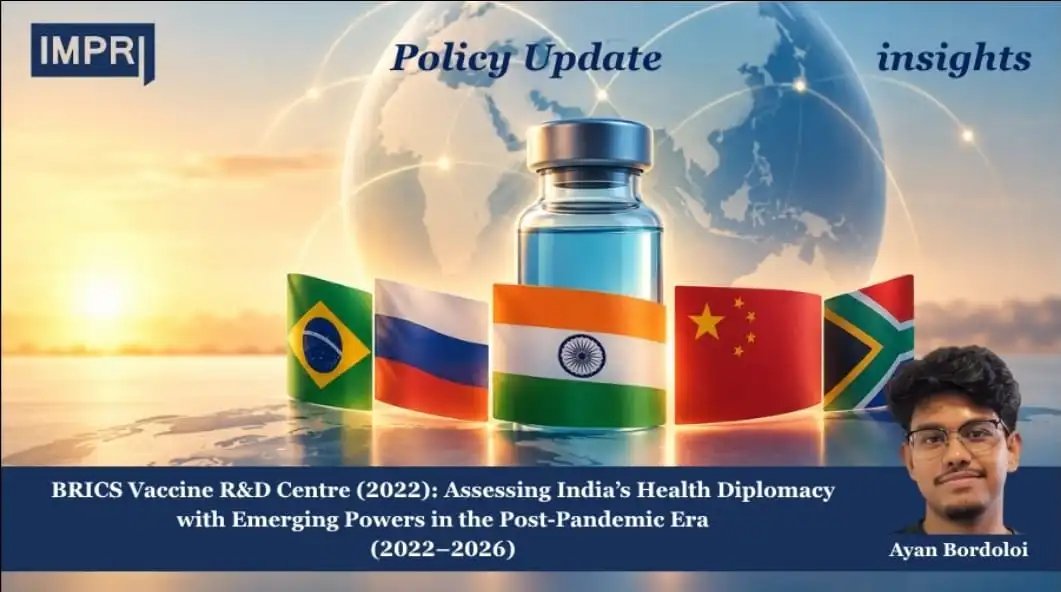
Policy Update
Ayan Bordoloi
Background
The BRICS Vaccine Research and Development (R&D) Centre is an almost imperceptible entity, as it took a long time to establish the institution. Its concept was first introduced during the 2018 Johannesburg Summit, where South Africa offered a proposal for a joint vaccine centre, which was reiterated in the 2020 Moscow Declaration. With COVID-19, the need for the proposal was pressing, but so was also the inability to meet in person at an institution. The health ministers of the BRICS countries agreed in July 2021 to start the Centre in a virtual format and the New Delhi Declaration of the 13th BRICS Summit, adopted during the Indian Presidency in September 2021, reinforced the desire to launch the Centre in a virtual format. Under China’s chairship, the Minister of Science and Technology of China Wang Zhigang presided over the formal launch ceremony of the Centre via video-conference on 22 March 2022, with the Ministers of Science and Technology of Brazil, Russia and South Africa also participating. The Union Health Minister, Dr Mansukh Mandaviya, inaugurated the Centre, along with a Workshop on Vaccine Cooperation.
That was a unique diplomatic legacy with which India has reached that launch. India, under the initiative of Vaccine Maitri (“Vaccine Friendship”), first supplied the neighbouring countries like Bhutan, Maldives, Bangladesh, Nepal, Myanmar and Seychelles with vaccines and then moved on to commercial and COVAX supply. During the launch, Mr Mandaviya said India exports vaccines to over 150 countries and fulfills 65-70 per cent of the vaccine requirement of the World Health Organization (WHO). He said India has already administered more than 1.81 billion doses of vaccines within its country and given emergency use listing to nine vaccines, five of which are indigenous, and offered its manufacturing capability to develop vaccines for the BRICS countries and the rest of the world. The Centre thus provided New Delhi with an opportunity to change its image from a supplier to a partner in a research collaboration with the other emerging powers.
Four years on, the strategic setting has changed. As of May 2025, the WHO Pandemic Agreement is yet to have its Pathogen Access and Benefit-Sharing (PABS) annex, and the COVID-19 global emergency has since concluded in May 2023. India is the chairman of BRICS, which has expanded from five to eleven members with ten more countries joining in 2025. India has the honour of hosting the 16th BRICS Health Ministers’ Meeting in Chandigarh, 23 July 2026 and the 18th BRICS Summit in New Delhi, 12–13 September 2026, under the theme of “Building for Resilience, Innovation, Cooperation and Sustainability”. This policy shift review looks at the actions taken by the Centre over the last four years (2022-2026) and the lessons it provides on India’s health diplomacy with the emerging powers.
Functioning
The Centre can be seen as a network, and not an institution. The national nodes were given by the Immunobiological Technology Institute (Bio-Manguinhos) of the Oswaldo Cruz Foundation (Fiocruz) in Brazil, the Smorodintsev Research Institute of Influenza in Russia, the Indian Council of Medical Research (ICMR) and Sinovac Life Sciences of China, and the South African Medical Research Council (Table 1). ICMR’s National Institute of Virology (NIV) has been appointed as the coordinating agency for India’s activities under the Centre by the Union Health Secretary, India. At the time of the launch, the Foreign Ministry of the People’s Republic of China explained that the Centre would be a network of internet-based virtual centres, with physical centres only taken into consideration after a detailed feasibility study is conducted.
It is supposed to combine the best vaccine R&D capacities of the member countries of the BRICS, conduct basic research and preclinical and clinical studies, develop its laboratory capacity and normalise laboratory assays for evaluation of vaccine candidates, enhance the prevention and control of infectious diseases, and deliver prompt assistance to other developing countries facing similar needs. During the launch, Mr Mandaviya suggested that the WHO R&D Blueprint and International Health Regulations should be the principles for their cooperation, called on BRICS countries to support ACT-A, COVAX and the Coalition for Epidemic Preparedness Innovations (CEPI), and appealed for collaboration on diseases that either have a high burden or no vaccine, including AIDS and tuberculosis.
The chairmanship has changed hands and the record since 2022 reflects the rotational irregularity. The science minister at the launch said that a priority of South Africa’s chairship in 2023 will be progress on the Centre. On 17 September 2024, the Russian national coordinator hosted an online meeting with the national coordinators to discuss the vaccine development capabilities of the new members (Iran, Egypt, Ethiopia) and proposed an electronic platform for the coordination of joint projects. This platform was identified as the Electronic R&D Stock and five priorities were outlined in the 2025 Issues Note of Brazil: building the Stock, providing consultation services to all stakeholders involved in the vaccine market via the Stock, encouraging bilateral partnerships as a first step, connecting the Centre with other BRICS centres and networks, and introducing the New Development Bank into the discussions on financing mechanisms. In June 2025, a working group was formed for the Stock and meets monthly; the Centre held its third meeting on 25th September 2025, which focused on governance, regulatory cooperation and a proposal for a vaccine against tuberculosis presented by Bio-Manguinhos.
Table 1: BRICS Vaccine R&D Centre – National Coordinating Institutions and Chairship Milestones
| Member | National Coordinating Institution | Chairship Contribution to the Centre |
| South Africa | South African Medical Research Council (SAMRC) | Proposed the Centre at the 2018 Johannesburg Summit; named its progress a priority for the 2023 chairship |
| Russia | Smorodintsev Research Institute of Influenza | Hosted an online meeting of national coordinators on 17 September 2024; proposed an electronic platform for joint projects |
| Brazil | Immunobiological Technology Institute (Bio-Manguinhos), Fiocruz | 2025 Issues Note; Electronic R&D Stock working group (June 2025); tuberculosis vaccine proposal; third Centre meeting on 25 September 2025 |
| India | Indian Council of Medical Research (ICMR); ICMR-NIV as coordinating agency | 2021: New Delhi Declaration and designation of national centres; 2026: 16th Health Ministers’ Meeting reaffirmed support (23 July 2026) |
| China | Sinovac Life Sciences Co. Ltd | 2022: hosted the online launch and workshop on 22 March 2022; ceremony chaired by the Minister of Science and Technology |
Source: Author’s compilation based on PIB (2022), Union Health Minister launches BRICS Vaccine R&D Centre; BRICS Brazil (2025), Vaccine R&D Center Issues Note; BRICS Russia 2024 (2024); Fiocruz (2025); PIB (2026); Research Professional News (2022).
The contribution of India’s own can be divided into two. On the research front, ICMR and NIV are the national interfaces and the Health Secretary of India has said that ICMR, NIV and its institutes were going into phase-3 clinical trials of a recombinant dengue vaccine. The Centre was now at the heart of a nine-priority health agenda, with the 2026 chairship of India, and the 16th BRICS Health Ministerial Declaration, signed in Chandigarh, reiterating support for the Centre to enhance collaborative research and equitable access to safe and effective vaccines.
Performance
In terms of institutional continuity, the Centre has performed well compared to many initiatives under the auspices of the BRICS. It has remained on the agenda for five successive chairmanships and the Electronic R&D Stock has been explicitly supported by the 2025 Rio de Janeiro Declaration. A Brazilian health ministerial report from June 2025, which was released by the health minister, features the Centre as “in operation”, with a digital archive of projects currently being developed, and mentions a joint development of a BRICS tuberculosis vaccine as an example of cooperation. But the account of the meeting from September 2025, which is written by Fiocruz itself, still calls the tuberculosis vaccine a proposal, suggesting that this is an example that has yet to be achieved. The scientific record is not extensive. None of the BRICS vaccine candidates have gone into clinical trials via the Centre according to the official documents searched for this update, nor are there any reports of a dedicated pooled fund or results published. The framework for the Centre, originally presented by China in 2022 was taken up again for discussion only in September 2025, 3.5 years after its launch, while the terms of reference of the Electronic R&D Stock were still being drafted during the same meeting. This is typical for an organisation that relies on voluntary cooperation among national institutes, whose core business is different.
The credibility of India’s performance as a partner can be measured against its performance in the past during the pandemic. India had donated or sold more than 66 million doses by the time it halted exports in April 2021 to prioritise its second wave; of these, about 10.7 million were grants, 35 million were commercial sales and 19 million went to COVAX. Gavi had announced that the 140 million doses of Covid-19 vaccines expected from the Serum Institute of India by the end of May will be available in India, while the United Nations Children’s Fund (UNICEF) had estimated the shortfall in Covid-19 vaccines to be around 190 million by the end of June. Exports started again in early October 2021 with approximately 4 million doses and a Lok Sabha reply indicated that India had provided 23.9 crore doses to 101 countries through COVAX and commercial exports and grants as of 15 July 2022. The record reflects true scale and a commitment to caring for the community first. 2026 is another benchmark year. The Chandigarh meeting resulted in new operational frameworks on social determinants of health-driven diseases and national public health institutes, a network of centres of excellence on mental wellness, being led by NIMHANS, India, and a sub-working group on a BRICS Integrated Early Warning System for mass infectious diseases. In the official record of that meeting only one line of reaffirmation is given to the vaccine Centre. The BRICS vaccine track was maintained, not promoted, for a Chair that was a loud voice for the Global South.
Impact
The Centre’s most publicized impact is in positioning the nation. India has been pursuing vaccine diplomacy on multiple fronts, ranging from Vaccine Maitri and COVAX vaccines supplies to the decision taken by Quadrilateral Security Dialogue leaders in 2021 to supply at least one billion doses to Asia and the Indo Pacific. In the same way the BRICS Centre brings to New Delhi a vaccine path which is not led by one camp or the other, and fits into a larger picture of multi-alignment. It is an interpretation and not an official Indian policy but is consistent with how Mr Mandaviya announced the Centre as a resource for other BRICS countries and the world, and not a closed project. Overall the scientific and industrial effect is still more prospective than realised. The Centre’s impact on vaccine cost and access was predicted in a 2023 integrative review of the Centre’s impact in Frontiers in Public Health, but it was not found. In addition, there is an asymmetry in the design of the network. The four national nodes are public research institutions, while China’s is a commercial manufacturer, and India’s node, ICMR, is a research council, with much of India’s manufacturing capacity in private firms, like the Serum Institute of India. With the manufacturing base that Mr Mandaviya gave in 2022, there are no direct institutional linkages to the Centre. The equity effect is related to who is in the network. As the 2024 meeting demonstrated, the Centre’s membership has been expanding with the arrival of Iran, Egypt and Ethiopia in the ranks of the BRICS. In September 2026, the WHO welcomed BRICS’ progress towards increasing production of health products locally and in the region, and in support of concluding the PABS negotiations, the two conditions on which a Global South research centre would be judged. The Centre’s initial commitment to providing timely assistance to other developing countries in need has yet to be matched in terms of tangible delivery. The reputational impact on India is two-fold. With the export ban in 2021, partners have had a new interpretation of India’s commitments as COVAX was deprived of an expected export of doses. Co-development is one way to help rebuild trust, as it gives partners a stake in research and capacity as opposed to dependence on a single exporter through the Centre. The extent to which it reaches that would depend on whether the Centre is developing shared products and not just communiqués.
Emerging Issues
- The first is the thinness of institutions and the second is the absence of a direct path to the market. The Centre does not have a physical campus, and there is no dedicated secretariat, no common fund or no official record identified during the review of the record for this update. Brazil’s 2025 Issues Note only seeks to provide the New Development Bank with “room to participate” in discussions regarding financing mechanisms, suggesting thus there are none at this time. A chairship-led network that rotates through the different national institutes will be biased towards the priorities of the chair during his chairmanship – platform building with Russia in 2024, governance and a tuberculosis vaccine with Brazil in 2025, and in 2026, a health agenda where the Centre will be competing for attention with other priority areas.
- Second, there is a lack of accountability because there is no public results frameworks. The framework, which was introduced in 2022, was resumed in 2025 and the Electronic R&D Stock, which was introduced in 2024, was at the terms of reference in September 2025. There are no targets, dates or budgets in the Leaders’ and Ministers’ documents of 2025 and 2026, which reaffirm and welcome the Centre’s work. The evidence base is also limited, with almost all evidence available about the Centre originating in official government and institutional sources and independent evaluation is scarce. If there’s no Milestones, there is no declaratory support.
- Thirdly, size and diversity make collaboration difficult. The Centre was conceived during the era of the 5-member, as Fiocruz itself emphasized in the framework discussion when reopening the Centre. The members now include countries with well-established vaccine industries and regulators, as well as those in the process of establishing them. To make the R&D project a success, there must be compatible clinical-trial standards, IP rules and technology-transfer terms, among other aspects, which were discussed in a session during the meeting held in September 2025 in Brazil, dedicated to the research and development aspects of the project. The 2026 New Delhi Declaration is said to be a call for further expansion of the cooperation mechanism of the regulators to all member countries, while the BRICS GxP White Paper was a baby step in Chandigarh. There is also strategic mistrust that plays a role. India’s ties with Chinese national node—a commercial vaccine manufacturer—are still relatively guarded, and that will influence the extent of data sharing or joint development Indian institutions are willing to do. It is an analytical judgement, not an Indian position.
- Fourthly, India’s credibility as a partner is limited due to the structure of India’s own vaccine industry. The 2021 export ban made it clear that the policy of first serving domestic needs can be implemented in a hurry and that over half of the doses delivered by September 2021 came from commercial sales instead of grants. The industrial capacity India provided back in 2022 is mostly provided by the private companies, and the Indian node is a public research council. There is no clear public statement yet from India on the terms and conditions on which its manufacturers will get involved in BRICS joint projects, the price they would receive and the licensing conditions applied to them, or the weightage of commitments to BRICS partners over domestic needs in a crisis situation.
- The fifth is the Centre’s location in a growing architectural jostling. It coexists with the BRICS TB Research Network, the Network of National Public Health Institutes, the Integrated Early Warning System, the Partnership for the Elimination of Socially Determined Diseases and the cooperation of the regulators in the framework of the BRICS format. It needs to carve out a niche for itself in the eyes of the world, as the WHO, CEPI, Gavi and the WHO Pandemic Agreement (PABS) with its under negotiated PABS annex of 2026. No visible division of labour has occurred in the process from the call made by Mr Mandaviya to align the Centre with ACT-A, COVAX and CEPI in 2022. Especially a BRICS tuberculosis vaccine initiative will be operating in a space that has many large pipelines and should communicate what it brings.
- Sixthly, the political urgency which has led to the establishment of the Centre has abated. It was born out of emergency and launched when the 70 per cent global vaccination target that Mr Mandaviya mentioned was still the “organising principle” of international vaccine diplomacy. The WHO has lifted the emergency flag and BRICS health focus shifted towards tuberculosis, digital health, healthy lifestyles, mental wellness and social determinants of disease in the outcomes of the 2026 meeting in Chandigarh. Research into vaccines is a high cost, high loss and slow process that requires long-term political and financial support, which tends to fade once the crisis is over. If the Centre does not have a longer-term preparedness programme attached to it then it will become a pandemic relic.
- Last but not least, there is a disconnect between representation and representation in inclusion. BRICS health diplomacy is presented as an act of solidarity from the South, but their activities are controlled by a few national institutes in big producer countries. Ten partner countries admitted in 2025 and the rest of the Global South have no defined status in the Centre. There’s also biosecurity and data governance, as the international community has yet to agree on how samples and sequences can be shared in joint research and development efforts on pathogens and vaccine candidates.
Way Forward
- Given the rest of the chairship of 2026, India must leave the Centre with a ‘rudimentary institutional backbone’ when China takes over in 2027. The problem of continuity would be solved by a small coordination group to be located in an existing member institute, under the leadership of a deputy to be chosen among the incoming chair, with funding provided via a technical-assistance window of the New Development Bank, which would not create an excessive bureaucracy. Brazil’s 2025 note already anticipates NDB participation in financing mechanisms, thus India can come up with a concrete plan of host and rotate formula, which will not be an additional priority but the one already in place. ICMR can readily help in the preparation of that proposal, being the national coordinator with its counterparts.
- The Centre should focus on 2-3 anchor projects, especially ones that have measurable stage-gates, not a menu. The obvious choice: Brazil and India are the two countries with the BRICS share of the global burden estimated to be about 50%, and Bio-Manguinhos has already presented a proposal. If the results of the phase-3 trial are favorable, India could provide multi-country partnerships for trial and manufacturing by other dengue-endemic countries. This is just a suggestion which should be taken up for discussion as it is an Indian programme and no BRICS scheme has been announced for the dengue trial. There is a simple record of protocol, funding, trial sites, data sharing agreement and regulatory pathway that each project should publish, and report progress at each chairship.
- The prerequisite for joint development is regulatory convergence and this must be viewed as the Centre’s key task. The BRICS GxP White Paper and the enhanced cooperation between the Medical Products Regulatory Authorities of the BRICS countries were welcomed at the Chandigarh meeting. India should seek them to deliver real-world results for the Centre – shared scientific input to the candidates in a shared pipeline, shared clinical trials inspections and data when standards permit, and standardised reporting formats. By referring to the WHO guidance as they anchor their protocols, the Centre’s products will be welcomed outside the bloc as well, following a suggestion made by Mr Mandaviya in 2022 when he introduced the R&D Blueprint and the International Health Regulations.
- The Electronic R&D Stock should not only be a directory of capabilities, but also contain the IP and technology-transfer and benefit-sharing templates. The directory provides information on who can do what, while the template provides information on who can work on what terms. India needs to get the BRICS common position on the PABS annex as well, as the WHO has welcomed the support of BRICS for the completion of the negotiations. Such a role would align the Centre’s research agenda with the rules governing it and would be rewarding for the sharing of pathogens and sequences with predictable access to resulting vaccines reflecting the interests of the members of the Global South.
- India needs to mend the credibility gap that she has created in 2021 with clear supply guidelines. An export-safeguard policy already in publication would make clear when domestic requirements outweigh exports and would reserve a portion of capacity for future emergencies, where there would be a need for multilateral commitments. Annual reporting of supply to other countries, disaggregated as it was done in parliamentary replies into grants, commercial sales and multilateral channels would allow partners to assess India’s reliability. The institutional pathway should also be provided for Indian manufacturers and ICMR, to enter into licensing and co-development arrangements under the Centre, so that the manufacturing base provided in 2022 has an institutional pathway to enter into the network.
- To extend the inclusion without burdening the decision making, partner countries and regional manufacturers can be included as associate-nodes. This would enable participation by institutions from partner countries and from Africa and Southeast Asia in a selected number of projects, allow for technology transfer and training of staff without a decision on full participation in all governance issues. This would be a good approach and would help to realize the founding promise of aid to developing countries in need, as well as the WHOs encouragement for increased local and regional manufacturing.
- Internally, India needs to base its BRICS vaccine involvement on a clear programme, rather than the tempo set by the chairmanship. This would involve having a separate desk at ICMR for coordination with NIV and the Ministry of External Affairs and the Department of Biotechnology, a brief annual report on the work of the Centre to Parliament’s health and external affairs committees as well as a permanent interface with industry and academia. These arrangements are not expensive but would create a noticeable footprint for India’s contribution, on par with that of its partners, and lasting beyond 2026. They would also give India a set of commitments, rather than a set of speeches, to pass on to the next chair.
- Last but not least the Centre must be complementary and evaluated from the ground up. A formal relationship with the WHO, CEPI and Gavi would help define its comparative advantage, especially in regards to diseases neglected or targeted to a region, and avoid duplication. There should be an independent mid-term evaluation for the Chair to be conducted with academic and think tank networks from member countries on progress against stage-gates and funding for the Chair for 2027/28. India’s health diplomacy will be assessed not by the number of pledges it has made, but by the number of times a vaccine project by BRICS gets to a trial site and a patient. Turning a gesture into a lasting institution would be achieved by its 2026 chairship setting that standard during a pandemic.
Selected References and Important Links
- Press Information Bureau (2022), Union Health Minister Dr. Mansukh Mandaviya Launches BRICS Vaccine R&D Centre, Ministry of Health and Family Welfare, Government of India. Available at: https://pib.gov.in/PressReleasePage.aspx?PRID=1808277
- Press Information Bureau (2026), 16th BRICS Health Ministers’ Meeting Concludes Successfully under India’s BRICS Chairship 2026, Ministry of Health and Family Welfare, Government of India. Available at: https://www.pib.gov.in/PressReleasePage.aspx?PRID=2288267®=48&lang=2
- BRICS Brazil (2025), BRICS Vaccine R&D Center: Issues Note, BRICS 2025. Available at: https://brics.br/pt-br/documentos/brics-vaccine-r-d-center-issue-note-brics-2025.pdf/@@download/file
- Fiocruz (2025), BRICS vaccine R&D Center discusses governance and regulatory cooperation. Available at: https://fiocruz.br/en/news/2025/10/brics-vaccine-r-d-center-discusses-governance-and-regulatory-cooperation
- BRICS Brazil (2025), BRICS Health Ministers Approve Partnership to Eliminate Socially Determined Diseases and Strengthen Vaccine Cooperation. Available at: https://brics.br/en/news/brics-health-ministers-approve-partnership-to-eliminate-socially-determined-diseases-and-strengthen-vaccine-cooperation
- BRICS Information Centre, University of Toronto (2025), BRICS Rio de Janeiro Declaration. Available at: http://www.brics.utoronto.ca/docs/250706-declaration.html
- BRICS Russia 2024 (2024), BRICS Vaccine R&D Centre Holds Online Meeting. Available at: https://brics-russia2024.ru/en/news/zasedanie-po-voprosu-funktsionirovaniya-tsentra-vaktsin-briks-proshlo-v-onlayn-rezhime/
- World Health Organization (2026), WHO welcomes strong health commitments at the 2026 BRICS Summit. Available at: https://www.who.int/news/item/21-09-2026-who-welcomes-strong-health-commitments-at-the-2026-brics-summit
- Research Professional News (2022), Brics bloc launches joint vaccine R&D centre. Available at: https://www.researchprofessionalnews.com/rr-news-africa-partnerships-2022-3-brics-bloc-launches-joint-vaccine-r-d-centre/
- Modern Diplomacy (2022), BRICS Launches Vaccine R&D Center. Available at: https://moderndiplomacy.eu/2022/03/27/brics-launches-vaccine-rd-center/
- Press Information Bureau (2021), Export of Covid-19 Vaccines, Ministry of Health and Family Welfare, Government of India. Available at: https://www.pib.gov.in/PressReleasePage.aspx?PRID=1778837
- Reuters via Inquirer (2021), India unlikely to resume sizable COVID-19 vaccine exports until October. Available at: https://newsinfo.inquirer.net/1433323/exclusive-india-unlikely-to-resume-sizable-covid-19-vaccine-exports-until-october-sources
- The Conversation (2021), India’s COVID vaccine exports resume – but others must step up to vaccinate the world. Available at: https://theconversation.com/indias-covid-vaccine-exports-resume-but-others-must-step-up-to-vaccinate-the-world-168334
- Zee News (2021), ‘Vaccine Maitri’ to resume, India to restart COVID-19 vaccine exports to COVAX, neighbours. Available at: https://zeenews.india.com/india/vaccine-maitri-to-resume-india-to-restart-covid-19-vaccine-exports-to-covax-neighbours-2395643.html
- Outlook India (2022), India Supplied 23.9 Crore Covid-19 Vaccine Doses To 101 Countries, UN Entities: Government. Available at: https://www.outlookindia.com/amp/story/national/india-supplied-23-9-crore-covid-19-vaccine-doses-to-101-countries-un-entities-government-news-211253
- TV BRICS (2026), BRICS leaders adopt New Delhi Declaration at 18th Summit. Available at: https://tvbrics.com/en/news/brics-leaders-adopt-new-delhi-declaration-at-18th-summit/
- Frontiers in Public Health (2023), On the momentum toward vaccine self-sufficiency in the BRICS: an integrative review of the role of pharmaceutical entrepreneurship and innovation. Available at: https://doaj.org/article/ae89d6f607354a40bb35050dcdfca487
About the Contributor
Ayan Bordoloi is an intern with IMPRI, currently pursuing his master’s in political science at the University of Delhi. His research interests lie in federalism, tribal governance, and Northeast India’s political landscape.
Acknowledgements
The author extends sincere gratitude to the IMPRI team for their guidance and support along with the reviewers Raushan Raj and Khushi for their valuable feedback and insights.
Disclaimer
All views expressed in the article belong solely to the author and not necessarily to the organization.
Read More at IMPRI :
e-Jagriti: The Digital Transformation of Consumer Dispute Resolution in India
Necessary Step Towards Agricultural Prosperity: The Significance of the Rabi MSP Revision