






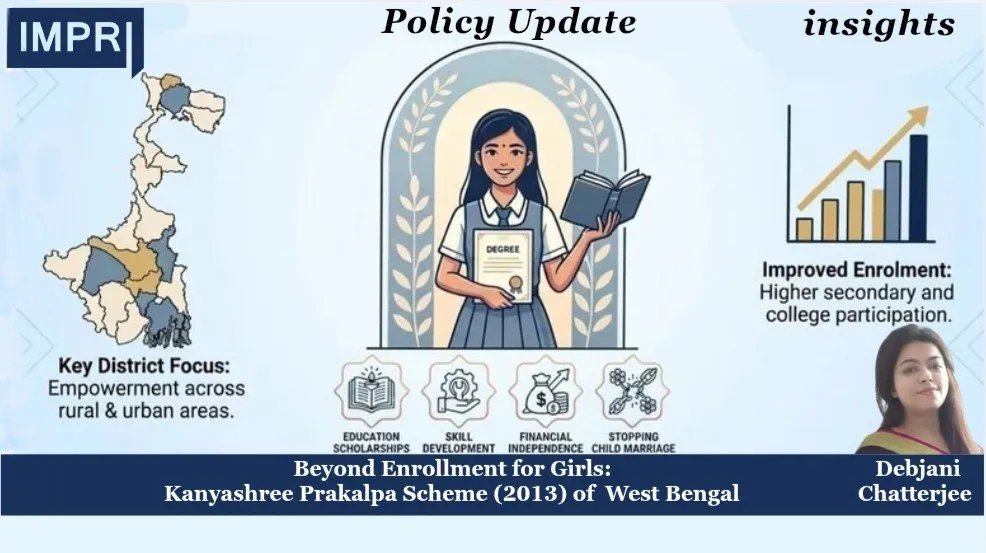
Policy Update
Debjani Chattarjee
Background
Kanyashree Prakalpa was introduced in 2013 in West Bengal to address two closely connected challenges faced by adolescent girls in West Bengal: child marriage and discontinuation of education. The scheme sought to provide families with financial incentives to keep girls in education while encouraging them to delay marriage until adulthood. faced a serious dual problem. Early marriage and girls leaving education, especially among poorer households. The State Government’s communication strategy reported that 54.7% of women aged 20–24 in West Bengal had been married before age 18, highlighting the scale of child marriage. The government also identified child marriage and trafficking as major social concerns that were harming girls’ education, health and development.
Government’s early assessment also found that child marriage was still prevalent. In 12 surveyed schools, 127 girls were married below the legal age during 2012–13 and 2013–14. At the same time, school attendance had improved only modestly, from 72% in 2011–12 to 75% in 2013–14, showing that keeping girls connected to education remained a challenge. Kanyashree was therefore designed to delay marriage, reduce dropout and encourage girls to continue secondary, higher secondary or vocational education.
Function
1. Institutional Architecture:
Kanyashree is managed mainly by the Department of Women and Child Development and Social Welfare. At the state level, the State Project Management Unit manages the scheme. At the district level, the District Project Management Unit works under the District Magistrate. At the block and sub division level, government officials support implementation. Schools and colleges are the main delivery points.
2. Funding Mechanism:
Kanyashree is a cash transfer scheme of the West Bengal Government. Eligible girls receive money directly in their bank accounts. K1 gives ₹1,000 every year to eligible unmarried girls aged 13 to 18 who continue their education. K2 gives a one time grant of ₹25,000 after the girl turns 18, if she is unmarried and continues education or another recognised activity.
3. Beneficiaries:
The scheme mainly targets girls from economically weaker families. Girls studying from Class VIII onwards can receive K1. The income limit is ₹1.2 lakh per year. The income condition is relaxed for orphans, girls with special needs and girls living in certain child care homes.
FeatureK1K2Age13 to 1818+Payment₹1,000 yearly₹25,000 one timeMain conditionContinue educationUnmarried + education/occupationPurposeKeep girls in educationDelay marriage and support transition |
4. Implementation Process:
Girls apply through their school or educational institution. The institution checks eligibility and enters the information in the online system. The application is then verified through the administrative system before payment is made to the beneficiary bank account. This reduces the need for cash based delivery.
5. Stakeholders:
The main stakeholders are girls, schools and colleges, the Women and Child Development Department, Education Departments, District Magistrates, block officials, banks, NIC and local community institutions.
Performance
1. Coverage:
Kanyashree has achieved very wide coverage in West Bengal. According to the latest State Government data, the scheme had covered 96.30 lakh beneficiaries by 2025-2026. During 2025 to 2026, 15.50 lakh girls received the K1 annual scholarship, while 2.24 lakh girls received the K2 one time grant. The official Kanyashree dashboard also recorded 98,91,361 unique beneficiaries as on 7 June 2026. (Government of West Bengal, 2026).
Kanyashree Coverage and K1–K2 Beneficiaries in West Bengal, 2025–26 (Source: Government of West Bengal, 2026; Kanyashree Prakalpa Dashboard)
2. Financial Performance:
Kanyashree continues to receive significant financial support from the West Bengal government. In 2023 to 2024, the scheme had an actual expenditure of ₹559.62 crore, against a budget estimate and revised estimate of ₹574 crore. In 2024 to 2025, the actual expenditure was ₹556.49 crore, while the budget estimate was ₹558.65 crore. But the revised estimate for that year was reduced to ₹280.19 crore. For 2025 to 2026, the budget estimate was ₹320 crore, which was later revised to ₹520 crore. For 2026 to 2027, the state government has allocated ₹530.24 crore for the scheme.
3. Physical Progress:
The scheme has expanded continuously since its launch in 2013. The latest official figures show that more than 96 lakh beneficiaries have been covered, showing strong progress in reaching adolescent girls across the state. However, the government does not publish a single annual target achievement percentage or a complete year wise completion rate for Kanyashree.
4. State and District Comparison:
Kanyashree is a West Bengal state scheme, so a state to state comparison of beneficiaries is not possible. However, district level variation can be seen in government survey data. Awareness among girls was highest in Nadia at 97.1 percent and Purba Medinipur at 96.6 percent. It was much lower in Darjeeling at 67.7 percent and Kolkata at 75.3 percent. The state average was 89.2 percent. (Kanyashree Baseline Survey)

5. Trend Analysis:
The number of beneficiaries has increased over time. Government data shows that Kanyashree covered 85.53 lakh beneficiaries in 2023–24, rising to 96.30 lakh by 2025–26. This represents an increase of around 12.6 percent.
6. Governance indicator :
Kanyashree uses direct bank transfers and an online system for application and monitoring. The official dashboard provides data on enrolled applications, sanctioned applications and unique beneficiaries. As on 7 June 2026, it showed 3.54 crore enrolled applications and 98.91 lakh sanctioned unique beneficiaries.
7. Comparative Benchmark:
Kanyashree has received several national and international awards, including the United Nations Public Service Award in 2017 and the National e Governance Award. These recognitions show that its digital delivery and conditional cash transfer model has been considered a good governance practice.
Impact
1. Reduction in Child Marriage
Government assessment found that girls, parents and communities became more willing to delay marriage. Many parents said the Kanyashree grant helped them delay their daughters’ marriage. In 12 schools, underage marriage cases fell from 73 to 54. However, the study could not prove Kanyashree directly reduced child marriage (Government of West Bengal, 2014).
2. Continued Education
Kanyashree has been associated with improvement in girls’ enrolment. A government supported assessment found that enrolment among girls aged 13 to 18 increased from 79.8 percent in 2014 to 89.8 percent in 2016, a rise of 10 percentage points. The improvement was stronger in rural areas. However, enrolment still fell sharply at higher classes, reaching 69.6 percent by Class XII, showing that keeping girls in education beyond school remains a challenge (Government of West Bengal, 2017).
3. Higher Education Participation
Kanyashree’s impact goes beyond keeping girls in school. The scheme encourages girls to continue into higher secondary, vocational and higher education. Under K2, girls aged 18 and above must remain in education or work. K3 also supports postgraduate studies. In 2021 to 22, 22,782 students received K3 scholarships, showing that the scheme can support girls beyond school.
4. Greater Decision Making Power
Kanyashree has supported greater awareness and participation of girls in decisions about marriage. A government assessment found that 45.6 percent of girls said they had a say in their marriage decisions, while 50.1 percent believed girls should ideally participate in such decisions. However, parents continued to play the main role, showing that family control remains strong (Government of West Bengal, 2017).
5. Change in Attitudes Towards Girls’ Education
The scheme has also influenced parents’ attitudes. Government assessment found that many parents were more willing to delay their daughters’ marriage and support continued education after receiving Kanyashree benefits (Government of West Bengal, 2014).
6. Better Awareness of Rights
Kanyashree has increased awareness among girls about the scheme and child marriage. A government survey found that 89 percent of girls had heard about Kanyashree, while 80 percent of parents had heard about it. The 2017 government assessment also found that 90.3 percent of girls knew the legal age of marriage, showing better awareness of child marriage laws (Government of West Bengal, 2017).
7. Economic and Social Confidence
Kanyashree has also supported financial inclusion among girls. The government pays the benefit directly into the girl’s own bank account and allows her to decide how to use the money. The scheme was designed to improve financial inclusion and empower girls (Government of West Bengal).
8. Long Term Human Capital
Kanyashree can support girls’ long term development by keeping them in education. A government assessment found that 81 percent of Kanyashree girls wanted vocational training, showing strong interest in skills and future work. The scheme also aims to improve skills and economic opportunities. However, public data on later training, jobs and income remain limited. So its long term impact needs further study (Government of West Bengal, 2017).
Emerging issues
1. Weak evidence on what happens after school
Kanyashree has strong data on enrolment and payments, but there is much less regular government data on whether girls complete college, gain skills, get jobs or earn higher incomes. This makes it difficult to judge the long term impact of the scheme. The government itself says that one objective is to support the transition to higher education.
2. Child marriage is still a problem
Child marriage remains a major challenge in West Bengal despite Kanyashree. According to NFHS 5 (2019 to 20), 41.6 percent of women aged 20 to 24 were married before 18, with little change from NFHS 4. The official Kanyashree District Action Plan also found higher child marriage rates in districts such as Purba Medinipur, Hugli, Kolkata, Bankura, Cooch Behar, Murshidabad and Dakshin Dinajpur. This suggests that financial support alone has not been enough to end child marriage in the state.
3. A large gap between enrolment and actual outcomes
The dashboard shows 3.54 crore enrolled applications but about less than a crore unique beneficiaries as on 7 June 2026. These are administrative figures and do not tell us how many girls actually completed education or remained unmarried until 18.
4. Payment related problems can reduce the benefit
Government assessments and Finance Department directives identified payment problems under Kanyashree, including wrong bank details, failed transactions and difficulty tracking payment failures. In 2023, the Finance Department noted that these issues caused some funds to lapse and introduced automatic cancellation of failed transactions.
5. Cash support may not be enough
Kanyashree gives financial support, but girls may still face costs for transport, books, coaching, digital access and college education. This means the cash transfer may not remove all barriers to continuing education.
6. Transition at age 18 needs more support
K2 gives a one time grant of ₹25,000, but the bigger question is what happens after that. There is a need for a stronger link with college, vocational training and employment so that the benefit does not stop at the payment stage.
7. District level differences need closer attention
Statewide coverage is very high, but girls in poorer and remote areas may face different barriers. More district wise outcome data is needed to see where the scheme is working better and where additional support is required.
8. Monitoring still focuses more on numbers than outcomes
The dashboard is useful for tracking applications and beneficiaries, but regular public indicators on marriage age, education completion, skills and employment are limited. This is the main gap between administrative success and outcome based evaluation.
9. Rising financial needs
The state spent ₹556.49 crore in 2024 to 2025 and has provided ₹530.24 crore for 2026 to 2027. As the scheme covers nearly one crore girls, future policy needs to ensure that rising spending is matched by measurable long term outcomes.
10. Data Gaps
Kanyashree has good data on enrolment, beneficiaries and payments, but there is limited public data on school completion, higher education, skill development, employment, income and long term changes after receiving benefits.
Kanyashree Performance Scorecard
| Performance Indicator | Evidence | Assessment |
| Beneficiary Coverage | 96.30 lakh beneficiaries by 2025–26 | Strong |
| K1 Reach | 15.50 lakh girls received K1 in 2025–26 | Strong |
| K2 Reach | 2.24 lakh girls received K2 in 2025–26 | Strong |
| Coverage Growth | Beneficiaries increased from 85.53 lakh in 2023–24 to 96.30 lakh in 2025–26 | Strong |
| Financial Support | ₹530.24 crore allocated for 2026–27 | Sustained |
| Education Retention | Enrolment among girls aged 13–18 increased from 79.8% in 2014 to 89.8% in 2016 | Positive |
| Higher Education | 22,782 students received K3 scholarship in 2021–22 | Emerging |
| Child Marriage | Underage marriage cases fell from 73 to 54 in 12 surveyed schools | Positive but limited evidence |
| District Awareness | Awareness ranged from 67.7% in Darjeeling to 97.1% in Nadia in the baseline survey | Uneven |
| Post-school Outcomes | Limited public data on college completion, skills, employment and income | Evidence Gap |
Overall Assessment
Kanyashree performs strongly on coverage and financial reach and shows positive evidence on education and child marriage. However, evidence on long-term outcomes after school remains limited.
Way Forward
Short Term
1. Track girls who stop attending school: Schools should prepare a simple monthly list of girls with repeated absence. The school should contact the family and understand whether the reason is marriage, money, transport or household work.
2. Fix payment problems quickly: Every block can maintain a list of failed K1 and K2 payments. Bank errors should be corrected through a fixed help desk so that girls do not have to make repeated visits.
3. Focus on high risk areas: Government should identify districts and blocks with high child marriage and dropout rates. These areas should receive more counselling, field visits and awareness programmes than areas where the problem is already low.
Medium Term
4. Create a Kanyashree career link
Before girls complete Class XII, schools should give information on college courses, ITI, polytechnic, nursing, apprenticeships and government scholarships. This can make the move from school to the next stage easier.
5. Start local career camps
Block offices can organise quarterly career camps where colleges, training centres, employers and banks explain real opportunities. Girls should be able to register for courses and jobs at the camp itself.
6. Give support for practical barriers
For girls from poor or remote families, education may stop because of transport, hostel or digital access. The government can connect Kanyashree beneficiaries with existing transport concessions, hostels, bicycles, digital learning facilities and scholarships.
7. Strengthen local counselling
Every school should have a trained teacher or counsellor who can talk privately with girls about early marriage, education, safety, health and career choices. Cases at risk can then be referred to the appropriate government service.
Long Term
8. Follow beneficiaries after 18
The government should track a sample of Kanyashree girls for several years. It should record whether they entered college, completed training, got a job, started a business or married before completing education.
9. Build an education to employment pathway
Kanyashree should connect girls directly with internships, apprenticeships, skill courses and local employers. A girl should not lose access to support simply because she has completed school.
10. Link funding with results
Future budgets should be assessed not only by the number of girls receiving money, but also by indicators such as higher education continuation, delayed marriage, skill completion and employment.
The main shift should be from giving support to creating opportunities. Kanyashree can become more effective when every beneficiary gets a clear path from school to higher education, skills and economic independence.
References and Links
- Government of West Bengal. (n.d.). Kanyashree 9.0 dashboard. Kanyashree Prakalpa. Kanyashree 9.0. dashboard
- Government of West Bengal. (n.d.). Kanyashree scheme and objectives. Kanyashree Prakalpa
- Government of West Bengal. (n.d.). Kanyashree 9.0: Cash benefits and eligibility. Kanyashree Prakalpa.
- Government of West Bengal. (n.d.). Baseline survey. Kanyashree Prakalpa.
- Government of West Bengal. (n.d.). Assessment of Kanyashree Prakalpa. Kanyashree Prakalpa. Pratichi Assessment
Assessment of Kanyashree Prakalpa
- Government of West Bengal. (n.d.). Kanyashree communication strategy. Kanyashree Prakalpa.
- Government of West Bengal. (2026). West Bengal budget 2026–27: Budget speech. Finance Department.
https://finance.wb.gov.in/writereaddata/Budget_Speech/2026-2027_English_I.pdf
- Government of West Bengal. (n.d.). Kanyashree Plus. Kanyashree Prakalpa
https://kanyashree.wb.gov.in/kanyashree_plus
- Government of West Bengal. (n.d.). Kanyashree K4 and other education links.
https://kanyashree.wb.gov.in/other_benefits
About the Contributor
Debjani Chatterjee is a policy researcher with a background in Finance and Political science. Her work focuses on leveraging data analytics to support evidence based policy research.
Acknowledgement
My sincere thanks to the Impact and Policy Research Institute (IMPRI) for the opportunity to prepare this policy update article. IMPRI’s dedication to connecting research with actionable policy practice provides an invaluable platform for learning.
Reviewed by Pragya and Gargi Bisht
Disclaimer
The opinions expressed in this article are strictly those of the author and do not reflect the official position or views of the organization.