






Policy Update
Yashkirti Pal
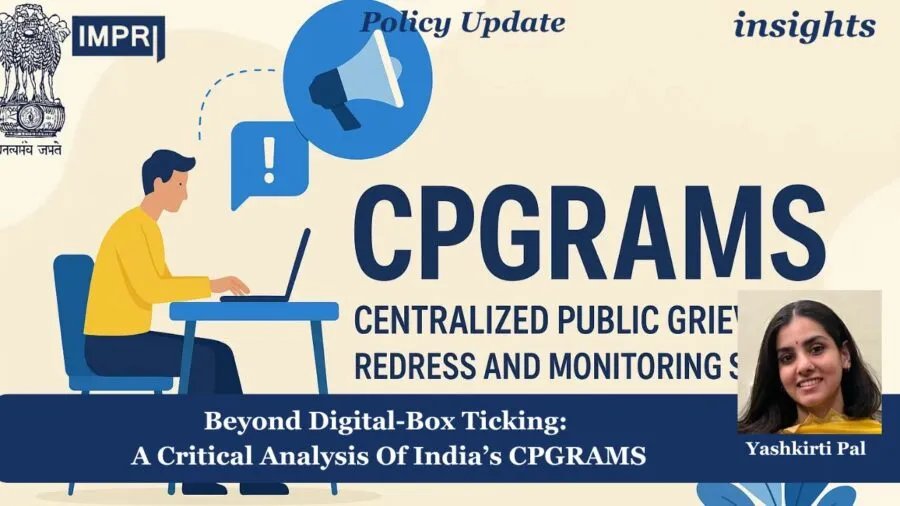
India’s Centralised Public Grievance Redress and Monitoring System (CPGRAMS), launched in 2007 by the Department of Administrative Reforms and Public Grievances, represents an ambitious attempt to modernise grievance redressal through digital infrastructure. In a country characterised by its vast geography and complex administrative layers, CPGRAMS was envisioned as a “single window” for the aggrieved. The scale of the platform is undeniably impressive: it connects 92 central ministries with 36 states/UTs, supported by over 73,000 active users.
Between 2022 and 2024, the system resolved 70,03,533 grievances. On paper, these figures suggest a triumph of digital governance. Yet beneath these impressive figures lies a more complex reality warranting critical examination.
POLICY FRAMEWORK AND PERFORMANCE
CPGRAMS operates as a 24/7 online platform accessible through web portals, mobile apps, and over 5 lakh Common Service Centres. The system reduced grievance redressal timelines to 21 days and introduced an appeal mechanism in 2021 for cases receiving poor feedback. Recent “10-step reforms” included AI-powered spam detection through the Intelligent Grievance Management System and revised categorisation across 31 ministries.
Quantitatively, performance appears substantial. From 2020 to 2024, 1,15,52,503 grievances were redressed, with an all-time high of 26,45,869 in 2024. However, pendency remains concerning–208,103 cases pending as of April 2025, with 23 states/UTs having over 1,000 pending grievances each. Critically, citizen satisfaction barely exceeds 50%, suggesting procedural disposal does not guarantee substantive resolution.
CRITICAL ANALYSIS : STRUCTURAL LIMITATIONS
The centralisation paradox
CPGRAMS centralised architecture creates a fundamental tension. While providing unified monitoring, it struggles with inherently local grievances. A municipal water complaint filed through CPGRAMS gets forwarded from central to state to local authorities–recreating the multi-layered bureaucracy the system aimed to eliminate. This centralised structure does not effectively address local-level issues despite the system’s overall success at higher administrative levels.
Digital divide and exclusion
While digitalisation offers efficiency, it simultaneously creates barriers. Low digital literacy excludes large sections of India’s population from accessing the platform. Rural communities, elderly citizens, and economically disadvantaged groups face systematic exclusion requiring internet access, smartphone literacy, and familiarity with bureaucratic processes. Even with the presence of Common Service Centres, the process of articulating a complaint in a way that is understandable to an urban, educated elite. Limited awareness hampers effectiveness, with rural communities particularly underutilizing the platform. The platform’s multilingual interface is a step toward inclusivity, yet it cannot overcome the fundamental challenge of navigating jurisdictional boundaries.
Excessive focus on disposal
The emphasis on the 21-day timeline and high disposal rates has inadvertently created a culture of “disposal-at-all-costs”. In the quest to maintain “clean” digital dashboards, departments are incentivised to prioritize the closure of the ticket over the resolutions of the problem. This leads to citizens receiving generic, templated responses–such as “matter forwarded to concerned department” or “noted for future action”–which are marked as “resolved” in the system (Brighter Kashmir). When quality is sacrificed for speed, grievance redressal becomes a form of “bureaucratic box-ticking”.
The administrative machinery begins to treat the grievance not as a citizen’s right to service, but as a data point that needs to be moved from the “pending” column to the “closed” column to satisfy departmental KPIs. this focus on quantity over quality erodes public trust, as the citizen perceives the system as a procedural labyrinth rather than a genuine avenue for justice.
Accountability deficits
Perhaps the most significant critique of CPGRAMS is its lack of “consequence architecture”.Despite formal mechanisms–nodal officers, appeal provisions, feedback systems–actual consequences for poor handling remain limited. DARPG’s monthly reports emphasize disposal numbers rather than qualitative resolution assessments (PIB,2024). The sheer volume–hundreds and thousands–annually strains institutional capacity, producing standardised responses without meaningful engagement. The system treats multiple complaints about the same systemic issue as separate cases, missing opportunities for proactive governance reform. Crucially, CPGRAMS operates within the executive branch rather than acting as an external check upon it. The officials monitoring the grievances are often from the same administrative cadre as those being complained against. This “internalised accountability” lacks the teeth of an independent ombudsman.
INTERNATIONAL COMPARISONS
International best practice features three-tiered systems: frontline service providers handling immediate issues, administrative complaint-handling at local government level, and independent authorities like Human Rights Commissions or Ombudsman as final resort (Pande & Hossain,2022). South Korea’s Foreign Investment Ombudsman demonstrates institutional independence–answering to parliament rather than being embedded within monitored administrative machinery (Ahn,2025). Vietnam’s Law on Complaints and Denunciations provides legislative grounding with clearer rights and remedies than CPGRAMS’s administrative framework (World Bank,2020).
CONCLUSION
CPGRAMS represents significant administrative innovation, demonstrating digital infrastructure potential for expanding access and improving tracking. However, the transition from a “monitoring system” to a “redressal system” remains incomplete. Technology, no matter how advanced, cannot resolve responsive governance challenges. It cannot be a substitute for political will or institutional accountability. Without independent oversight, genuine accountability mechanisms, and linkages to policy reform, grievance redressal remains an internal bureaucratic function rather than a rights-based citizen entitlement.
For CPGRAMS to fulfill its democratic promise, it must move beyond being a sophisticated software solution. It must be embedded within a broader accountability ecosystem–one that includes independent oversight, localised empowerment, and a shift in focus from “clearing the dashboard” to “serving the citizens”.This evolution–prioritizing resolution over disposal, substance over process, and accountability over efficiency–will determine whether CPGRAMS fulfills its democratic promise or remains a digital facade on unchanged bureaucratic reality.
REFERENCES:
PIB (2024). CPGRAMS: 3 Years, 70 Lakh Grievances Solved : A Citizen-Centric Path to a Better India
https://www.pib.gov.in/PressReleasePage.aspx?PRID=2088830®=3&lang=2
PIB (2025). Parliament Question: DISPOSAL RATE OF GRIEVANCE REDRESSAL MECHANISM
https://www.pib.gov.in/PressReleasePage.aspx?PRID=2117810®=3&lang=2
IJARSCT (2025) Citizen Complaint Management System: A GOIAligned Web-Based Digital Grievance Redressal Platform
https://www.ijarsct.co.in/Paper32687.pdf
Pande, S. & Hossain, N. (2022). Grievance redress mechanisms in the public sector: A literature review.
https://accountabilityresearch.org/wp-content/uploads/2022/05/Grievance-Redress-Mechanisms-in-the-Public-Sector-A-Literature-Review.pdf
Chandran, P. (2025). Grievance Redress Mechanisms for Commons: Evaluating the Design and Effectiveness of Public Land Protection Cells in Rajasthan, India
https://repository.nls.ac.in/jlpp/vol9/iss1/1/
PIB (2020). Dr Jitendra Singh launches CPGRAMS Reforms at a National Workshop on e-Office in Delhi
https://www.pib.gov.in/PressReleaseIframePage.aspx?PRID=1602980®=3&lang=2#:~:text=Launching%20the%20CPGRAMS%20Reforms%20at,adopt%20this%20significant%20reform%20step
TaxTMI (2021). CPGRAMS Grievance Redressal Portal of GOI-Its Efficacy.
https://www.taxtmi.com/article/detailed?id=9665
Brighter Kashmir (2025).Grievance Redress Mechanisms
https://brighterkashmir.com/grievance-redress-mechanisms
Constructionworld (2025). States Dispose 57,000 Grievances via CPGRAMS in April
https://www.constructionworld.in/amp/policy-updates-and-economic-news/states-dispose-57-000-grievances-via-cpgrams-in-april/73796
DARPG (2024). Public grievances. Department of Administrative Reforms and Public Grievances.
https://darpg.gov.in/en/public-grievances
About the Contributor
Yashkirti Pal is a Research and Editorial Intern at Impact and Policy Research Institute (IMPRI).
Acknowledgement
The author sincerely thanks Harshini S. for her valuable feedback, as well as the IMPRI faculty for providing this platform and opportunity to share my work.
Disclaimer: All views expressed in the article belong solely to the author and not necessarily to the organisation.
The author sincerely thanks Harshini S. for her valuable feedback, as well as the IMPRI faculty for providing this platform and opportunity to share my work.
Read More at IMPRI:
Border fencing and National security: India’s strategy along the Bangladesh border.