









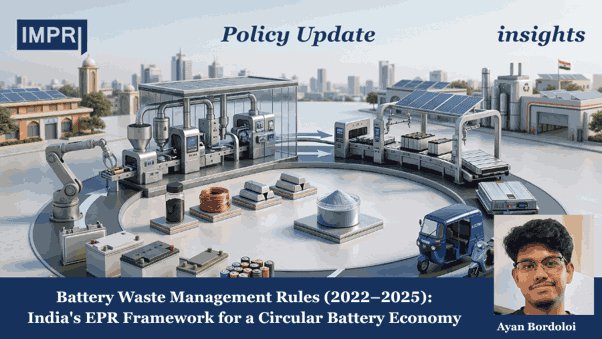
Policy Update
By Ayan Bordoloi
The country has a large amount of battery waste being produced every year which includes lead-acid batteries from automobiles and telecom towers, portable batteries from mobile phones and laptops, industrial batteries used to power UPS and solar applications, and the latest and fastest-growing segment – lithium-ion batteries that are at the heart of India’s EV transition. The Batteries (Management and Handling) Rules, 2001, were narrow rules that applied to lead-acid batteries only, and were largely unenforced, for more than 20 years this waste stream remained unregulated.
The Ministry of Environment, Forest and Climate Change (MoEFCC) notified the Battery Waste Management Rules, 2022 (BWMR 2022), replacing the Rules notified in 2001 with a comprehensive and chemistry-neutral framework based on Extended Producer Responsibility (EPR). With EPR, the producer, defined as manufacturers, brand owners and importers, has a perpetual liability for the environmentally sound collection, recycling or refurbishment of the batteries it puts on the market, beyond the point of sale. The Rules underwent a series of progressive changes between 2023 and 2025, progressively reducing recovery targets, and adding recycled content requirements for new batteries, improving the EPR certificate trading mechanism and implementing digital traceability via QR codes and barcodes.
This policy update contextualises the BWMR 2022-2025, looks at the design of the EPR mechanism, places it within the broader agenda of the circular economy and critical minerals in India, and explores the challenges of implementation and the future course.
Background
Historically, India’s waste battery stream was dominated by lead acid batteries but it has been broadened in a shot one. Industry estimates suggest that India produces more than 50,000 tonnes of battery waste every year, with only lead-acid and dry cell batteries, excluding the much smaller but rapidly growing lithium ion battery waste, which is related to EV adoption. India’s cumulative demand for lithium-ion batteries is forecast to grow from an estimated 16 GWh in 2023 to 248 GWh by 2035 at a compound annual rate of about 26 per cent, while the availability of the batteries is set to increase to 233 kilotonnes (kT) in 2035 from about 19 kT in 2023, NITI Aayog said in a report. The regulatory action follows India’s wider EPR framework, which was initially rolled out for e-waste and plastic packaging, and is now expanded to batteries, as a separate chemistry-neutral category. The BWMR 2022 was issued under the Environment (Protection) Act, 1986, and has been implemented immediately with the Central Pollution Control Board (CPCB) being directed to set up a centralised online registration and EPR-certificate portal within six months of the publication of the notification. The Rules have been updated five times since the notification, with the Second Amendment in June 2024, indicating a very iterative and learning by doing process in developing an EPR system in India.
Key Features of the Battery Waste Management Rules
The BWMR 2022 is a Rules change from any of the BWMR 2001 in scope, structure, and enforcement design. It has the following main characteristics: The Rules cover all battery chemistries, shapes, volumes, weights and uses, and categorize batteries into four types — Electric Vehicle (EV) batteries, portable batteries, automotive batteries and industrial batteries. Extended Producer Responsibility: The producer (manufacturers and importers) is legally liable for the collection and recycling or refurbishment of waste batteries, and for reusing recovered material in new batteries, either by himself or through the use of authorised Producer Responsibility Organisations. No landfilling and incineration: No waste batteries are to be disposed of on landfills or incinerated; all waste batteries will be sent to registered recyclers and/or refurbishers. Centralised digital portal: CPCB has introduced an online portal for the enrolment of producers, recyclers, refurbishers etc. and for EPR certificate generation, trading, and verification.
- Increasing minimum material-recovery percentages: Recovery rates step up for recyclers with the minimum rate rising over time, from 70 per cent for EV batteries and portable batteries to 90 per cent by 2026-27, and from 50 per cent for automotive batteries and industrial batteries to 60 per cent by the same period.
- Producers’ recycled-content mandates: The Second Amendment (June 2024) will progressively mandate that producers include minimum percentages of recycled material in the total dry weight of new batteries, starting in FY 2027-28 and increasing to FY 2030-31 and beyond.
- Environmental compensation: A producer or recycler whose amount to be collected under the EPR or recovery requirements is not met will be liable to pay environmental compensation, based on the cost of the EPR or recovery shortfall quantity for collection, transport and processing — operationalising the polluter pays principle.
- Chain of custody verification: Under the 2025 Amendment, QR codes or barcodes including the producer’s EPR registration number must be placed on the batteries, battery packs, equipment and packaging, further strengthening chain of custody verification.
Figure 1: Minimum recovery-rate targets for recyclers under BWMR 2022. Source: Battery Waste Management Rules, 2022, Schedule II; IEA Policy Database.
The BWMR is based on a certificate-trading mechanism that is broadly similar to that of the e-Waste and plastic packaging certificate trade. Producers have collection and recycling goals that are expressed as a percentage of their sales in that particular year, and the goal is based on historic sales — so if sales for that year are low, but the number of batteries sold over the last several years is high, then the goal can be high.
For meeting these requirements, producers can either establish their own collection and recycling system, or purchase an EPR certificate from the recyclers/ refurbishers who are registered with the CPCB and have recycled the same number of batteries. CPCB sets a lower and upper limit for EPR-certificate prices – 30 per cent and 100 per cent of the environmental compensation for the non-fulfilment, respectively – in order to provide a price range that would make it more appealing to buy certificates than pay the penalty straight. Surplus certificates are certificates that the recyclers can sell to producers if they recover more than their targets, thus providing an incentive for investment in more recycling capacity.
If the producer and/or recycler is unable to meet the target, the CPCB issues environmental compensation that is used to collect and recycle the quantity of the uncollected or unrecycled waste-batteries, thus completing the concept of polluter pays, instead of allowing the environmental compensation to be treated as general revenue. The Second Amendment (2024) imposed an additional requirement on the structure – from FY 2027-28, the minimum quantity of recycled content in batteries by dry weight for producers manufacturing or importing batteries in India. This now puts the onus on the producer to buy feedstock, which must be recovered, as opposed to the previous regime of setting targets for recyclers.

Figure 2: Illustrative recycled-content mandate trajectory under the BWM Second Amendment Rules, 2024. Source: MoEFCC, Battery Waste Management (Second Amendment) Rules, 2024; Lexology/Mondaq compliance analysis.
The CPCB portal has been at the heart of compliance since 2022, and the number of registrations by producers, recyclers and refurbishers has increased steadily with some industry experts claiming that there are still unresolved issues around the portal’s stability and EPR-certificate liquidity. Five rounds of amendments over less than three years of implementation indicate a complexity of regulating a chemistry-diverse waste stream, and the government’s receptivity to industry concerns in implementation, including recycled content verification and lithium-ion-specific licensing.
The task is huge. According to NITI Aayog projections, India’s battery capacity recyclability will be approximately 128 GWh by 2030 with around 46 per cent total contribution from EVs while remaining 54 per cent from consumer electronics and stationary/industrial storage. While the total number of registered battery recyclers in the country is limited to 32 with an authorised capacity of 3.84 lakh tonnes per year, Karnataka alone has 32 battery recyclers with an annual capacity of close to 4.19 lakh tonnes.
The formal recycling capability of the country is in the lithium-ion segment is far less than the wave of retirement looming large. So far, the organised-sector processing capacity is estimated at around 60,000 tonnes per year, and most of the processing is done by players like Attero Recycling, Lohum and Rubamin, where only about half of the throughput is converted into usable “black mass” from which lithium, cobalt and nickel can be extracted. India is presently dependent on imports for almost all lithium and cobalt, and the production of the recycling ecosystem is currently around 3,000 tonnes of lithium carbonate per year.

Figure 3: Projected growth in India’s end-of-life lithium-ion battery waste, 2023–2035. Source: NITI Aayog / IndexBox India Lithium-ion Battery Recycling Market Report (2026); figures for 2026 and 2030 are midpoint estimates.
There is some variation in the size of the market estimated depending on the method but the trend is the same. The India Battery Recycling Market is expected to grow at a healthy CAGR of around 9 per cent and reach approximately USD 152.7 million by 2025, while projected growth to USD 235.6 million by 2030 (Mordor Intelligence). Other more positive lithium-ion-specific forecasts suggest there will be 80,000–120,000 tonnes recycled formally by 2030, valued at USD 500–800m, and more than 250,000–350,000 tonnes annually after 2035 when the first large volumes of EV batteries will reach end-of-life in 2023-2026. On the other hand, NITI Aayog had said in a separate statement that India is recycling only around 10 per cent of its total e-waste with battery waste accounting for a larger share, which is far short of the global average of 22 per cent and significantly lower than the formal recycling rates in the European Union and the United States at more than 55 per cent, with the informal sector handling an estimated 62 per cent of India’s e-waste.

Figure 4: India’s formal lithium-ion battery recycling capacity gap — illustrative estimates. Source: IndexBox India Lithium-ion Battery Recycling Market Report (2026); BDO India capacity assessment, cited in DIYguru (2026).
The regulatory push has been complemented by policy support. The Ministry of Mines has offered incentive schemes (around ₹1,500 crore), to support the domestic critical mineral recovery process from battery recycling, apart from the BWMR recycled content mandates. NITI Aayog has also advised a separate, lighter-touch license category for lithium-ion battery recyclers, which is different from the standard e-waste license category to help reduce the hurdles to organised recyclers and push volumes away from the unsafe informal sector.
Data Snapshot: BWMR at a Glance
| Indicator | Figure | Source |
| Date BWMR 2022 notified | 24 August 2022 | MoEFCC |
| Number of amendments (2022–2025) | 5 (Oct 2023, Mar 2024, Jun 2024, Dec 2024, Feb 2025) | S J Exim Services; Vision IAS |
| Battery categories covered | 4 (EV, portable, automotive, industrial) | BWMR 2022, Schedule I |
| Recovery target, EV & portable batteries (2026-27) | 90% | BWMR 2022, Schedule II |
| Recovery target, automotive & industrial (2026-27) | 60% | BWMR 2022, Schedule II |
| Recycled-content mandate begins | FY 2027-28 | Second Amendment Rules, 2024 |
| EPR-certificate price band | 30%–100% of environmental compensation | BWM Amendment Rules, 2024 |
| India’s annual battery waste (lead-acid + dry cell) | >50,000 tonnes | Lawrbit; industry estimates |
| End-of-life Li-ion battery waste, 2023 → 2035 | 19 kT → 233 kT (~26% CAGR) | NITI Aayog |
| Recyclable battery capacity by 2030 | 128 GWh (46% from EVs) | NITI Aayog |
| India’s e-waste recycling rate | ~10% (vs. global average of 22%) | NITI Aayog, cited in The Print |
| India Battery Recycling Market, 2025 → 2030 | USD 152.7 mn → USD 235.6 mn (9.06% CAGR) | Mordor Intelligence |
Table 1: Key quantitative indicators for India’s Battery Waste Management Rules and battery recycling landscape.
Figure 5: Composition of India’s projected recyclable battery capacity by 2030 (128 GWh). Source: NITI Aayog, cited in IMARC Group, India Battery Recycling Market Report (2025).
- Introduce a separate and proportional licensing class for lithium-ion battery recyclers: Adopt the NITI Aayog proposal to introduce a separate, proportionate class of lithium-ion battery recyclers that will have lower entry barriers for organised growth.
- Facilitate scaling up hydrometallurgical and black-mass processing capacity: Targeted capital incentives should be given to the new recycling plant pipeline in emerging hubs like Gujarat and Odisha, as the current 60,000-tonne capacity is far less than the multi-hundred-kilotonne capacity expected by mid-2030s.
- Improve digital traceability and audit systems: Implement the QR/barcode requirement in the 2025 Amendment and ensure regular third-party audits for authenticity of EPR certificate and recycled content claims, and also ensure that the CPCB portal has the technical ability to manage the increased number of registrations and transactions.
- Enable MSME compliance: Simplify the registration process, offer sectoral guidance and, if feasible, set different deadlines for MSMEs to comply with the EPR, rather than exclude them altogether from the formal EPR routes.
- Connect with critical-minerals policy: Strengthen coordination between the BWMR policy of the MoEFCC and the critical-mineral incentives policy of the Ministry of Mines to ensure that the recycled-content requirement and recovery goal are aligned with India’s critical-mineral import-reduction policy.
- Enhance data transparency: Report regularly, by category, on the national level of collection, recycling and recycled content compliance, to allow independent verification of compliance with BWMR targets in reality and not just in theory.

Figure 6: Evolution of India’s Battery Waste Management Rules, 2022–2025. Source: Compiled from MOEFCC notifications and industry compliance trackers (Gravita India; S J Exim Services; Vision IAS).
Alephindia. (2024, June). Battery Waste Management (Second Amendment) Rules, 2024. https://alephindia.in/battery-waste-management-second-amendment-rules.php
Alephindia. (2025, February). Battery Waste Management (Amendment) Rules, 2025. https://alephindia.in/battery-waste-management-amendment-rules-2025.php
Certification India (MPR India Certification). Battery Waste Management and EPR. https://www.certification-india.com/en/battery-waste-management-and-epr/
Diligence Certification. EPR Certificate for Battery Waste Management Rules 2022. https://www.diligencecertification.com/battery-waste-management-rules-2022/
DIYguru. (2026, April). Battery Recycling India 2026: ₹17,000 Cr Market, EPR, Lohum & Attero. https://diyguru.org/battery-recycling-india/
Gravita India. (2025). Battery Waste Management Rules 2025 (BWMR): Compliance Guide for OEMs & Recyclers in India. https://www.gravitaindia.com/blogs/battery-waste-management-rules-2025-compliance-guide-india
IMARC Group. (2025). India Battery Recycling Market Size & Industry Report, 2034. https://www.imarcgroup.com/india-battery-recycling-market
Indexbox. (2026, May). Lithium Ion Battery Recycling Market in India — Prices, Size, Forecast, and Companies. https://www.indexbox.io/store/india-lithium-ion-battery-recycling-market-analysis-forecast-size-trends-and-insights/
Inkwood Research. (2025, December). India Battery Recycling: Emerging Technologies & Market Disruptions to 2030. https://www.inkwoodresearch.com/india-battery-recycling-market-analysis/
International Energy Agency (IEA). Battery Waste Management Rules 2022 – Policies. https://www.iea.org/policies/25166-battery-waste-management-rules-2022
Karparivartan. (2026, April). Key Updates in Battery Waste Management Rules and EPR Duties in India. https://www.karparivartan.com/battery-waste-management-rules-2022-epr-india/
Lawrbit. (2024, July). Batteries Waste Management Rules, 2022. https://www.lawrbit.com/article/batteries-waste-management-rules/
Legitquest. (2025). Battery Waste Management Amendment Rules, 2025. https://www.legitquest.com/act/battery-waste-management-amendment-rules-2025/10A08
Lexology. (2024, November). Navigating India’s Battery Waste Regulation. https://www.lexology.com/library/detail.aspx?g=ad5d7f68-d3ac-4c52-a771-284a9cf2ffc3
Mondaq. (2024, November). Navigating India’s Battery Waste Regulation. https://www.mondaq.com/india/waste-management/1547088/navigating-indias-battery-waste-regulation
Mordor Intelligence. (2025, May). India Battery Recycling Market Size & Growth to 2030. https://www.mordorintelligence.com/industry-reports/india-battery-recycling-market
Nav Prakriti. (2026, February). What is Battery Waste Management Rules 2022? https://navprakriti.com/indias-battery-waste-management-rules-2022/
Press Information Bureau. (2022, August). Government notifies Battery Waste Management Rules, 2022. Ministry of Environment, Forest and Climate Change. https://www.pib.gov.in/PressReleasePage.aspx?PRID=1854433
PV Magazine India. (2025, March). Challenges and opportunities for lithium-ion battery recycling in India. https://www.pv-magazine-india.com/2025/03/25/challenges-and-opportunities-for-lithium-ion-battery-recycling-in-india/
Shoonya. Battery Waste Management Rules, 2022 (policy brief). https://shoonya.info/wp-content/uploads/2024/11/battery-waste-management.pdf
S J Exim Services. (2025, March). Battery Waste Rules 2025 – India. https://sjexim.services/2025/03/17/battery-waste-rules-2025-india/
StriveEdge IAS. (2025, March). Battery Waste Management (Amendment) Rules, 2024. https://striveedgeias.in/battery-waste-management-amendment-rules-2024/
The Print. (2026, January). India’s looking at 14 million metric tonnes of e-waste by 2030, recycling can’t keep up — NITI Aayog. https://theprint.in/economy/indias-looking-at-14-million-metric-tonnes-of-e-waste-by-2030-recycling-cant-keep-up-niti-aayog/2838862/
Vision IAS. (2024, April). Battery Waste Management (Amendment) Rules, 2024. https://visionias.in/current-affairs/monthly-magazine/2024-04-15/environment/battery-waste-management-amendment-rules-2024
WRI India. Battery Circularity in India: Policy, Regulations, and Implementation Strategies. https://wri-india.org/sites/default/files/ConferenceProceeding-WRI-India-Battery-circularity-policy-regulations-implementation-strategies.pdf

Ayan Bordoloi is an intern with IMPRI, currently pursuing his master’s in political science at the University of Delhi. His research interests lie in federalism, tribal governance, and Northeast India’s political landscape.
The author extends sincere gratitude to the IMPRI team for their guidance and support along with the reviewers Ameya Satam and Shivali Yadav for their valuable feedback and insights.
Disclaimer: All views expressed in the article belong solely to the author and not necessarily to the organization