









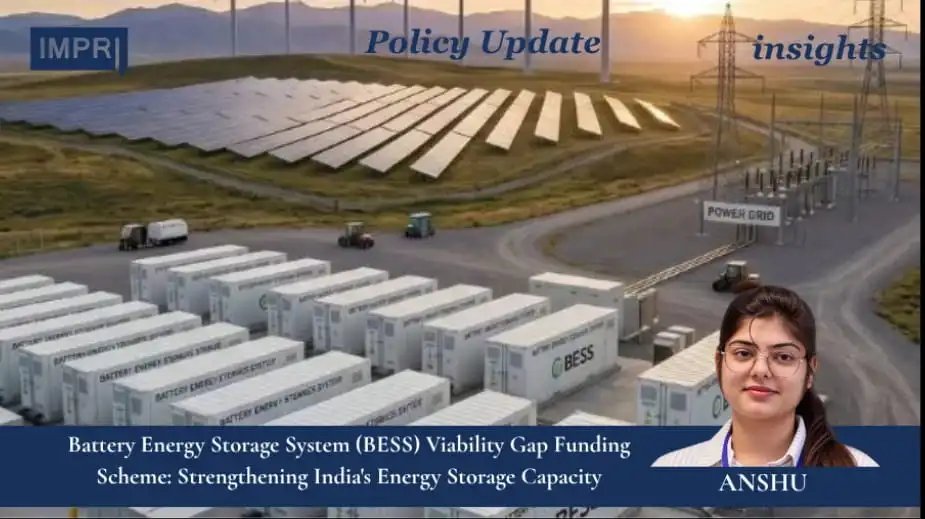
Policy Update
Anshu
Background
As India scales solar and wind capacity toward its 500 GW non-fossil target by 2030, a goal announced as part of India’s “Panchamrit” commitments at the COP26 climate summit in Glasgow in November 2021, the variability of renewable generation has become a central grid-management challenge; solar output disappears every evening precisely when electricity demand peaks.
Battery Energy Storage Systems (BESS) address this by storing surplus renewable power for dispatch during non-solar hours, but their high capital cost has made them commercially unviable without government support. The Ministry of Power’s National Framework for Promoting Energy Storage Systems, notified in 2022, first classified BESS as a distinct generation-cum-transmission asset class and exempted co-located storage from inter-state transmission charges.
This push toward domestic renewable generation, backed by adequate storage, also carries a strategic dimension beyond decarbonisation: India currently imports the large majority of its crude oil and a significant share of its natural gas, and reducing this fossil-fuel import dependence is increasingly framed as an energy security and self-sufficiency objective in its own right, not only a climate one. A power system built on domestic sun and wind, made dispatchable through storage, reduces exposure to volatile global fuel prices and supply disruptions in a way continued reliance on imported coal, oil, and gas cannot.
Building on this framework, the Union Cabinet approved the Viability Gap Funding (VGF) Scheme for Development of Battery Energy Storage Systems on 6 September 2023, with an initial outlay of ₹9,400 crore, including ₹3,760 crore in budgetary VGF support covering up to 40 per cent of project capital cost (Press Information Bureau [PIB], 2023). The scheme targeted a Levelized Cost of Storage (LCoS) of ₹5.50-6.60 per kWh, with a minimum of 85% of supported capacity reserved for distribution companies (DISCOMs). This update examines how the scheme has evolved and performed since.
Functioning
The scheme’s core mechanism and institutional design include:
- Financial structure: VGF of up to 40 per cent of capital cost is disbursed in five tranches, 10 per cent at financial closure, 45 per cent at commercial operation date (COD), and 15 per cent annually over the following three years, directly tying most of the subsidy to actual project delivery rather than upfront commitment.
- Institutional roles: the Ministry of Power oversees scheme implementation, the Central Electricity Authority (CEA) monitors progress, and bidding is conducted through central agencies including the Solar Energy Corporation of India (SECI) and NTPC, alongside state DISCOMs.
- Consumer protection: a minimum of 85 per cent of each project’s capacity must be made available to DISCOMs, intended to ensure VGF-subsidised storage benefits consumers rather than only merchant markets.
- Complementary incentives: BESS co-located with renewable plants is exempt from inter-state transmission charges if commissioned by 30 June 2028, and a parallel Production-Linked Incentive scheme for Advanced Chemistry Cells (₹18,100 crore, run by the Ministry of Heavy Industries) supports domestic battery manufacturing, though this operates as a separate scheme under a different ministry.
- Domestic content: a 20% domestic content requirement was subsequently added by the Ministry of Power, reportedly after several states sought exemptions from it.
As battery costs fell faster than anticipated, the scheme’s design proved flexible: within the same ₹3,760 crore Tranche I budget, supported capacity was expanded from the original 4,000 MWh to 13.2 GWh, since less VGF was needed per unit of storage than originally estimated.
Performance
The scheme’s rollout has occurred in two distinct phases, summarised below:
| Approval | Outlay | Capacity | VGF Rate | |
| Tranche I | 6 September 2023 (Cabinet) | ₹3,760 crore | Expanded from 4,000 MWh to 13.2 GWh within the same budget | Up to ₹46 lakh/MWh initially; components later discovered as low as ₹27 lakh/MWh as costs fell |
| Tranche II | Ministry allocation mid-2025; Cabinet outlay approved 14 May 2026 | ₹5,400 crore (PSDF) | 30 GWh (25 GWh to 15 states, 5 GWh to NTPC) | Revised down to ₹18 lakh/MWh |
Table 1: BESS VGF scheme tranches
Sources: PIB (2023); Saur Energy (2025); JMK Research (2025); Anantam IAS (2026)
Tranche I’s early implementation was slower than the scheme’s design implied. In a written Lok Sabha reply, Minister of State for Power Shripad Naik confirmed that no VGF expenditure was incurred in FY2024-25, since no project had achieved financial closure that year, despite ₹96 crore having been budgeted (Saur Energy, 2025). By 2026, however, projects under Tranche I were reported under construction across Gujarat, Maharashtra, Karnataka, and Chhattisgarh, suggesting the delay was one of timing rather than a structural failure of the scheme.
The gap between tendering activity and actual commissioning remains the scheme’s central performance story. Roughly 69 BESS-related tenders totalling approximately 102 GWh were floated in 2025 alone, yet cumulative commissioned BESS capacity stood at only 758.4 MWh by the end of that year, a large award pipeline still working through an 18-to-24-month construction cycle (Energy-Storage.News, 2026).
One SECI tender for firm and dispatchable renewable energy was also undersubscribed, awarding only about 0.2 GW against 2 GW on offer. Against this, tariff discovery has been a genuine success: BESS tariffs have fallen an estimated 86% since 2022, with VGF rates correspondingly revised down from roughly ₹46 lakh per MWh in early Tranche I awards to ₹18 lakh per MWh under Tranche II.
Impact
The scheme’s clearest impact has been in price discovery and market formation. BESS has moved from a handful of pilot projects to industrial-scale procurement within roughly three years, with combined VGF commitment across both tranches now around ₹9,100 crore supporting 43.2 GWh of capacity, and Tranche II alone projected to mobilise approximately ₹33,000 crore in investment. This directly supports grid integration of India’s expanding solar and wind fleet by making stored renewable power available during evening peak demand, reducing curtailment and the need for costly transmission upgrades.
Measured against national requirements, the impact remains partial. The CEA’s National Electricity Plan estimates India needs 37 GWh of BESS by 2027 and 236 GWh by 2031-32; the 43.2 GWh currently under VGF support broadly matches the nearer-term 2027 milestone but represents under a fifth of the 2032 requirement. The scheme has also had a state-level distributive impact, Tranche II allocated 25 GWh across 15 states, with Rajasthan, Gujarat, and Maharashtra receiving the largest shares (4,000 MWh each), giving several states genuine early experience integrating grid-scale storage into their own DISCOM planning.
Emerging Issues
Several structural issues will determine whether this early momentum translates into the scale India ultimately needs:
- Award-to-commissioning lag: the gap between 102 GWh tendered in 2025 and only 758 MWh commissioned by year-end reflects an inherent construction timeline, but consistent monitoring will be needed to confirm this pipeline converts rather than stalls.
- Immature revenue stacks: VGF exists specifically because India lacks developed ancillary markets, frequency regulation, capacity markets, and genuine time-of-day arbitrage that make storage bankable without subsidy elsewhere; until these mature, BESS economics remain dependent on continued government support.
- Cross-scheme coordination: BESS deployment (Ministry of Power), battery-cell manufacturing under the ACC PLI (Ministry of Heavy Industries), and battery recycling under the Battery Waste Management Rules (Ministry of Environment) currently sit across three separate ministries with no unified tracking, risking mismatches between storage demand and domestic manufacturing supply.
- Critical mineral and supply-chain dependence: India has limited domestic production of key battery minerals such as lithium, cobalt, and nickel, which may leave the BESS industry vulnerable to import dependence, price volatility, geopolitical disruptions, and the concentration of global mineral processing capacity in a small number of countries, a vulnerability the VGF scheme’s domestic content requirement does not, by itself, resolve.
- Domestic content tension: the 20% domestic content requirement, added after state pushback, signals unresolved friction between localisation goals and near-term project bankability.
- Undersubscription risk: the 0.2 GW-against-2 GW outcome on one SECI tender suggests VGF alone may not yet be sufficient for every storage configuration, particularly more complex firm-and-dispatchable renewable products.
Way Forward
Sustaining the scheme’s momentum will likely require attention on several fronts:
- Track conversion, not just awards: given the scale of the tendered-versus-commissioned gap, MoP and CEA should report commissioning progress against awarded capacity as a standard performance metric, rather than headline tender volumes alone.
- Develop ancillary markets: accelerating frequency regulation and capacity-market mechanisms would reduce long-term dependence on VGF by giving storage additional revenue streams beyond energy arbitrage.
- Align manufacturing and deployment timelines: closer coordination between the Ministry of Power’s BESS pipeline and the Ministry of Heavy Industries’ ACC PLI scheme could help ensure domestic cell capacity is available when the domestic content requirement takes full effect.
- Extend successful design features: the tranche structure’s flexibility, expanding supported capacity as costs fell without needing a new budget, is a model worth replicating in other capital-subsidy schemes facing similar cost uncertainty.
- Deepen state-level engagement: building on Tranche II’s 15-state allocation, targeted technical support for state DISCOMs on storage integration and dispatch planning would help convert allocated capacity into genuine operational experience, not just paper allocations.
References
1. Press Information Bureau (PIB). (2023, September 6). Cabinet approves the Scheme titled Viability Gap Funding for development of Battery Energy Storage Systems (BESS). https://www.pib.gov.in/PressReleasePage.aspx?PRID=1955112
2. Ministry of Power. (2024, March). VGF Guidelines for Development of BESS. https://www.energetica-india.net/news/ministry-of-power-releases-vgf-guidelines-for-development-of-bess
3. Saur Energy. (2025, April 4). No Viability Gap Funding released for BESS in FY25: Govt. https://www.saurenergy.com/solar-energy-news/no-viability-gap-funding-released-for-bess-in-fy25-govt
4. JMK Research & Analytics. (2025, June 16). BESS support grows: VGF scheme expanded for 30 GWh in India. https://jmkresearch.com/vgf-scheme-expands-to-support-30-gwh-of-new-standalone-bess-development-in-india/
5. Anantam IAS. (2026, May 15). Battery Energy Storage Systems VGF Scheme 2026. https://anantamias.com/current-affairs/battery-energy-storage-vgf-scheme-2026/
6. Energy-Storage.News. (2026, January 20). India’s energy storage market in 2025: From tenders to scaled deployment. https://www.energy-storage.news/indias-energy-storage-market-in-2025-from-tenders-to-scaled-deployment/
7. pv magazine India. (2025, March 20). VGF-supported battery storage target increased to 13.2 GWh. https://www.pv-magazine-india.com/2025/03/20/vgf-supported-battery-storage-target-increased-to-13-2-gwh/
8. Indian Institute of Solar Energy (IISE). (2026, June 28). India Battery Storage Policy 2026: BESS Subsidies & Incentives. https://indianinstituteofsolarenergy.com/industry-news/india-battery-storage-policy-2026-bess-subsidies-incentives/
9. MVApulse. (2026). BESS India: Tariffs, tenders & the 890 GWh opportunity. https://www.mvapulse.com/bess-india/
About the Contributor
Anshu Kumari is a Research Intern at IMPRI, and holds an MA in Public Policy and Sustainable Development from TERI School of Advanced Studies, New Delhi. Her research focuses on energy policy, renewable energy manufacturing, and workforce development in India’s clean energy transition.
Acknowledgement
The author sincerely thanks the reviewers and editorial team at IMPRI Insights for their valuable comments, constructive suggestions, and guidance throughout the preparation of this article, which significantly enhanced its clarity and analytical quality. The author also acknowledges the support received during the research and writing process that contributed to the completion of this work.
Disclaimer
The views and analysis presented in this article are those of the author alone and do not necessarily reflect the official position of IMPRI or any institution the author is affiliated with. Every effort has been made to ensure the accuracy of the data and figures cited, drawn from publicly available government, parliamentary, and other credible secondary sources referenced in the article; however, readers are encouraged to verify critical information independently, as official figures may be revised subsequent to writing.
Read more at IMPRI:
West Bengal Department Wise Schemes and Budget Updates 2026
Affirmative Action and Social Justice: Reading Dr. Ambedkar, Rawls and Amartya Sen Together