









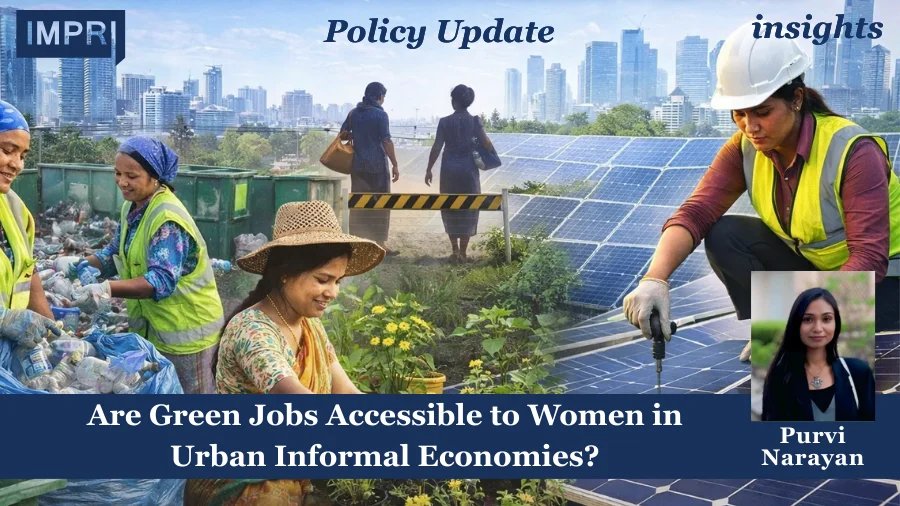
Gender Justice, Skills, and Local Governance in the Green Transition
Purvi Narayan
As cities pursue green transitions to address global environmental challenges, are women working in urban informal economies being included or quietly left behind?
Urban economies across the Global South are undergoing profound transformations driven by climate imperatives, sustainability goals, and green growth agendas. Yet these transitions intersect with labour markets that are already deeply unequal. Informal work constitutes the backbone of urban employment in countries like India, and women form a substantial share of this workforce. The question of who benefits from green transitions is therefore inseparable from concerns of gender justice, informality, and local governance.
Women, Informal Work, and Urban Economies
Urban informal work includes street vending, domestic work, waste picking, home-based production, and care services, sectors characterised by low wages, lack of contracts, and minimal social protection. The International Labour Organization (ILO) estimates that over 80% of women’s employment in South Asia is informal, with urban areas witnessing increasing feminisation of precarious work.
Women’s concentration in informal sectors is shaped by structural factors: unpaid care responsibilities, limited access to education and skills training, restricted mobility, and gendered norms within labour markets. Despite their central role in sustaining urban systems, particularly in recycling, waste management, and service provision, women informal workers remain largely invisible in urban policy frameworks.
In addition to labour precarity, women’s informal work in urban economies is shaped by spatial and regulatory exclusion embedded in urban policy and planning processes. Zoning laws, street vending regulations, housing policies, and urban redevelopment projects frequently criminalise or displace informal livelihoods, disproportionately affecting women who rely on proximity to home and neighbourhood-based work.
UN-Habitat and WIEGO document how evictions, street clearances, and infrastructure-led urban renewal disrupt women’s income sources while offering limited alternatives or compensation. These governance choices often ignore gendered mobility constraints and care responsibilities, reinforcing economic insecurity and exclusion from emerging green employment opportunities. Consequently, urban policy frameworks not only fail to support women informal workers but actively produce vulnerabilities by prioritising formalised, capital-intensive models of development that marginalise gendered informal labour (UN-Habitat; WIEGO; Environment and Urbanization).
Green Transitions and the Question of Access
Green transitions are expected to generate employment in renewable energy, sustainable transport, waste management, climate-resilient infrastructure, and circular economies. However, evidence from multilateral and academic studies suggests that green jobs often reproduce existing labour inequalities.
Women’s access to green employment in cities is constrained by:
- Skill mismatches, as green jobs are often framed as technical or capital-intensive
- Occupational segregation, where women remain confined to low-paid segments of the green economy
- Informality traps, where green work (such as recycling) is recognised as environmentally valuable but not formally remunerated or protected
UN Women notes that while women are frequently engaged in environmentally sustainable activities, these roles are rarely acknowledged as part of formal green economies, resulting in exclusion from policy support and financing. Similarly, the World Bank cautions that without deliberate gender-responsive interventions, green growth strategies risk becoming gender-blind, failing to address unpaid care burdens, mobility constraints, and institutional barriers that shape women’s labour market participation in cities.
The policy challenge, therefore, is not simply job creation, but access. A gender-just green transition requires cities to redefine what counts as green work, formalise and protect women’s existing environmental labour, and redesign skill and employment pathways around women’s lived realities. This includes recognising informal green workers as legitimate economic actors, integrating gender-responsive skilling and certification into urban climate programmes, expanding social protection for informal workers, and embedding women’s participation into local green governance structures. Without such measures, green transitions risk producing “green growth without gender justice”- a future where sustainability advances, but inequality deepens.
Skills, Time Poverty, and Social Protection Gaps
In India, the challenge of skills and social protection for women in green transitions is not a lack of programmes, but a lack of access and design alignment. Flagship skilling initiatives such as the Pradhan Mantri Kaushal Vikas Yojana (PMKVY), Skill India Mission, and emerging Green Skill Development Programme (GSDP) under the Ministry of Environment, Forest and Climate Change have expanded training in renewable energy, waste management, and climate-related sectors. However, these programmes largely follow standardised, full-time training models that rarely account for women’s irregular work schedules, unpaid care responsibilities, or mobility constraints, particularly for women in informal urban work. As a result, participation remains skewed, reinforcing existing gender divides in access to emerging green employment.
Similarly, while India has made significant strides in expanding social protection through schemes such as Ayushman Bharat (PM-JAY) for health insurance, Pradhan Mantri Matru Vandana Yojana (PMMVY) for maternity benefits, e-Shram for unorganised workers’ registration, and Atal Pension Yojana, women informal workers often face procedural and structural barriers to enrolment. Digital registration requirements, lack of awareness, documentation gaps, and weak last-mile delivery in urban informal settlements limit the effective coverage of these schemes. Multilateral evidence from the World Bank and ILO underscores that without portable, accessible, and gender-responsive social protection, informal women workers are unlikely to take the risks associated with transitioning into new or emerging green sectors.
To make green transitions genuinely inclusive, urban and national policy frameworks must move beyond scheme proliferation towards integrated delivery. This includes embedding skilling programmes within urban local governance structures, aligning training schedules with women’s care responsibilities, recognising prior learning in informal green work such as waste recycling, and linking skills certification directly to social protection enrolment. Strengthening convergence between skilling missions, social security schemes, and city-level climate action plans can transform existing welfare architecture into an enabling platform- one that allows women not only to participate in green transitions, but to do so with dignity, security, and long-term economic mobility.
The Role of Urban Local Governance
Local governments are central to shaping inclusive green transitions. Municipalities control urban planning, service delivery, labour regulation enforcement, and skill development partnerships. A gender-just transition requires cities to:
- Recognise informal workers in urban climate and economic plans
- Design gender-responsive skill programmes with flexible formats and care support
- Extend social protection mechanisms at the city level
- Institutionalise participation of women informal workers in local decision-making
Global networks such as C40 Cities and WIEGO demonstrate that when informal workers, especially women, are included in urban governance, cities achieve both environmental sustainability and social equity outcomes.
Conclusion: Towards Gender-Just Urban Transitions
Green transitions in urban economies offer a critical opportunity to reshape development pathways in ways that are environmentally sustainable and socially inclusive. Yet, as this analysis demonstrates, without intentional gender-responsive design, these transitions risk reinforcing the very inequalities they seek to address, particularly for women engaged in informal urban work. A gender-just transition requires moving beyond viewing women informal workers as marginal beneficiaries of climate action, and instead recognising them as essential economic actors whose labour sustains urban systems, from waste management to care services.
For policymakers and practitioners, the central challenge lies in bridging the gap between climate ambition and labour justice. This calls for urban governance frameworks that integrate gender-responsive skilling, recognise and formalise informal green work, and extend social protection in ways that are accessible, portable, and responsive to women’s lived realities. In India, this means strengthening convergence between climate action plans, skilling missions, and social security schemes, while empowering urban local bodies to deliver inclusive green employment pathways. Without such alignment, green transitions may produce environmental gains at the cost of deepened social exclusion. With it, cities can become sites where sustainability and gender justice advance together- laying the foundation for truly inclusive urban futures.
About the Author
Purvi Narayan, a Host and Visiting Researcher, IMPRI.
Acknowledgement: This article was posted by Vatsala Sinha, Research Intern at IMPRI.
Disclaimer: All views expressed in the article belong solely to the author and not necessarily to the organisation.