



Policy Update
Manisha Kumari
Background
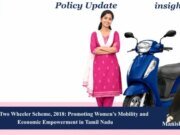
The Amma Two Wheeler Scheme was introduced to support working women who faced difficulties travelling to their workplaces or conducting livelihood-related activities. The original scheme guidelines envisaged assistance for one lakh working women annually, covering both rural and urban areas of Tamil Nadu (Government of Tamil Nadu, 2018). The initiative recognised that women’s economic participation depends not only on the availability of employment but also on their ability to reach workplaces safely, conveniently and affordably.
The scheme sought to improve women’s mobility by reducing the initial financial burden of purchasing a two-wheeler. It also aimed to support economic participation by helping women access employment, self-employment and livelihood opportunities. Personal transportation could potentially reduce dependence on family members, improve flexibility in managing work schedules and make it easier to undertake activities such as visiting markets, banks and customers. Furthermore, the scheme incorporated social inclusion by prioritising women from disadvantaged backgrounds, including women-headed households, widows, deserted women, Scheduled Caste and Scheduled Tribe women, and women with disabilities. Through these provisions, the initiative attempted to address both financial barriers and the unequal mobility constraints experienced by different groups of women.
Key Provisions
The central feature of the Amma Two Wheeler Scheme was its purchase subsidy. Eligible beneficiaries could receive financial assistance equivalent to 50 per cent of the vehicle’s cost or ₹25,000, whichever was lower. The subsidy was intended for eligible new gearless or auto-geared two-wheelers with an engine capacity not exceeding 125 cc. Special provisions were also made for eligible women with disabilities to purchase appropriately retrofitted three-wheeler scooters, subject to the applicable guidelines (Government of Tamil Nadu, 2018).
The scheme was intended for women aged between 18 and 40 years who were residents of Tamil Nadu and whose annual income did not exceed ₹2.5 lakh. The educational eligibility requirement specified that applicants should have appeared for the Class VIII examination, whether they had passed or failed. Applicants were also required to satisfy the applicable driving licence and documentation conditions. The scheme restricted benefits to one woman per family to broaden access across households. Priority provisions covered women living in remote and hilly areas, women-headed households, deserted women, destitute widows, unmarried women above 35 years, women with disabilities, Scheduled Caste and Scheduled Tribe women, and transgender applicants.
The original allocation framework also provided reservations for disadvantaged groups, including 21 per cent for Scheduled Caste women, one per cent for Scheduled Tribe women and four per cent for women with disabilities across categories. These provisions reflected an attempt to make mobility assistance more inclusive. Nevertheless, the subsidy did not cover the entire cost of purchasing and maintaining a vehicle. Beneficiaries had to arrange the remaining purchase amount and bear recurring expenses such as fuel, insurance and maintenance. Consequently, the scheme reduced the initial financial burden but did not remove all the costs associated with personal transportation.
Implementation and Functioning
The scheme was implemented through the administrative machinery of the Tamil Nadu Government, with applications processed through designated block offices and urban local bodies. The operational framework required applicants to submit documents establishing their eligibility, including proof of residence, age, income, educational qualifications, employment and driving credentials, along with the necessary vehicle-related information. Applications were subject to verification and beneficiary selection under the prescribed procedures (Government of Tamil Nadu, 2018).
The financial assistance was linked to the purchase of an eligible vehicle rather than being an unrestricted cash transfer. Eligible women could purchase vehicles using their own resources or seek financing from eligible financial institutions, subject to the scheme’s conditions. The subsidy could be claimed through the prescribed process, including reimbursement where applicable. This arrangement sought to preserve beneficiary choice while ensuring that public funds were used for the intended purpose.
However, effective implementation depended on more than the availability of subsidies. Awareness of eligibility conditions, access to application offices, timely verification and clear communication about the reimbursement process were also important. Women facing difficulties with documentation, digital access or financial services could encounter barriers even when they met the eligibility requirements. Strengthening local assistance and transparent application procedures is therefore essential for ensuring equitable access to the scheme.
Performance
The Tamil Nadu Government’s Budget Highlights 2020–2021 reported that approximately 1.88 lakh two-wheelers had been distributed to working women under the Amma Two Wheeler Scheme by the time of publication. The document also reported an allocation of ₹253.14 crore for implementation during the financial year 2020–2021 (Government of Tamil Nadu, 2020).
These figures indicate substantial early implementation and demonstrate that the scheme reached a considerable number of beneficiaries after its introduction.
However, the number of vehicles distributed should be understood as an output indicator rather than conclusive evidence of long-term economic empowerment. Beneficiary numbers alone cannot establish whether women secured better employment, increased their earnings, reduced commuting time or gained greater independence in household decision-making. A comprehensive evaluation would require updated district-wise beneficiary data, expenditure and utilisation figures, and information about the socioeconomic backgrounds of recipients. It would also need to examine employment retention, changes in income, travel costs and the actual use of vehicles for livelihood activities.
The absence of sufficiently detailed outcome evidence in the figures cited here makes it difficult to quantify the scheme’s overall economic impact. Its reported reach is an important indicator of implementation, but the extent to which it produced sustained improvements in women’s livelihoods requires further assessment through official monitoring data and independent evaluation.
Impact
The scheme offers several plausible pathways through which improved mobility can strengthen women’s economic participation. Personal transportation may expand the range of workplaces accessible to women, particularly in areas where employment opportunities are geographically dispersed or public transport services do not align with working hours. For women engaged in informal employment, self-employment or small businesses, easier travel may also support access to customers, suppliers, markets and financial institutions. Such flexibility can be important for women whose livelihoods require frequent local travel.
Improved mobility may also strengthen women’s autonomy by reducing dependence on relatives or other household members for everyday journeys. Greater control over commuting arrangements can help women manage work schedules and household responsibilities more flexibly. In this sense, the scheme connects transportation assistance with broader questions of gender equality and economic inclusion. Its potential benefits extend beyond the physical possession of a vehicle to the opportunities that access to transportation may create.
Nevertheless, these benefits are not automatic. The economic value of personal mobility depends on employment availability, household decision-making, road conditions, fuel prices, maintenance costs and the safety of the surrounding transport environment. A woman who receives a subsidised vehicle may not experience a substantial increase in income if suitable employment is unavailable or the recurring cost of operating the vehicle remains unaffordable. The scheme should therefore be understood as an enabling intervention that can improve access to opportunities but cannot independently eliminate the structural barriers that limit women’s economic participation.
Challenges and Limitations
One of the major challenges concerns affordability. Although the subsidy reduces the initial cost of purchasing a vehicle, beneficiaries must meet the remaining purchase price and recurring expenses. For women from low-income households, the costs of fuel, insurance, maintenance and repairs may limit regular use. The subsidy ceiling may also cover a smaller proportion of the price of more expensive eligible vehicles, making the final financial burden different across beneficiaries.
Eligibility restrictions present another consideration. The age limit of 40 years and educational requirements may exclude some women who experience mobility-related disadvantages but do not satisfy the prescribed conditions. Although eligibility criteria are necessary for targeting public expenditure, their design should be periodically reviewed to ensure that vulnerable groups are not unnecessarily excluded.
Women in remote areas may also experience greater transportation difficulties while simultaneously facing limited access to application offices, financial services and vehicle dealerships.
Road safety is equally important. Increased access to personal vehicles must be accompanied by appropriate licensing, helmet use, safe riding practices and awareness of traffic regulations. Finally, the limited outcome information discussed above restricts the ability to determine whether the scheme has generated sustained improvements in employment, income and independence. Stronger monitoring is needed to establish which beneficiaries benefit most, what barriers remain and whether public expenditure is producing the intended social and economic outcomes.
Way Forward
The long-term effectiveness of the Amma Two Wheeler Scheme could be strengthened through improved transparency, evaluation and coordination with other development programmes. The Tamil Nadu Government should publish updated information on beneficiary numbers, district-wise coverage, expenditure and fund utilisation so that the scheme’s implementation can be assessed more systematically. Periodic independent impact assessments should examine changes in commuting time, employment participation, income and livelihood stability, rather than relying exclusively on the number of vehicles purchased.
Beneficiary support should also include road-safety awareness, information on vehicle maintenance and guidance regarding financing obligations. Application procedures should remain accessible through local administrative offices and clear digital information, with assistance for women facing documentation or technological barriers. Furthermore, mobility assistance should complement improvements in public transport, women’s employment initiatives, skill development and livelihood programmes. Such coordination would help ensure that access to transportation is linked to actual economic opportunities rather than being treated as an isolated welfare benefit.
A stronger monitoring framework could also identify whether benefits differ across rural and urban areas or among different socioeconomic groups. This would allow the government to improve targeting and address barriers that may prevent beneficiaries from using their vehicles regularly. By combining financial assistance with safety, accessibility and evidence-based evaluation, the scheme could make a more measurable contribution to women’s economic participation.
Conclusion
The Amma Two Wheeler Scheme represents an important policy effort by the Government of Tamil Nadu to address transportation as a barrier to women’s economic participation. Its subsidy-based approach, coverage of rural and urban areas, and priority provisions for disadvantaged groups demonstrate recognition of the relationship between mobility, livelihood opportunities and personal autonomy. The government’s reported distribution of approximately 1.88 lakh vehicles by the time of its 2020-2021 budget highlights indicates substantial early reach.
However, the scheme’s wider success must be assessed through more than beneficiary numbers. Affordability, road safety, equitable access and evidence of sustained improvements in employment and income remain essential considerations. Improved monitoring, transparent reporting and coordination with broader livelihood and transport policies would help establish whether access to personal transportation is translating into lasting economic empowerment. Ultimately, the scheme’s value lies not simply in helping women purchase vehicles, but in enabling them to access opportunities, exercise greater independence and participate more fully in economic and public life.
References
Government of India. (n.d.). Amma Two Wheeler Scheme for Working Women. myScheme.
https://www.myscheme.gov.in/schemes/atwsfww
Government of Tamil Nadu. (2018). Citizen charter 2018. Rural Development and Panchayat Raj Department.
https://tnrd.tn.gov.in/policynotes/Citizen%20Chart%20-%202018%20-%20ENG.pdf
Government of Tamil Nadu. (2018). Policy note 2018–2019: Rural Development and Panchayat Raj Department.
https://www.tnrd.tn.gov.in/policynotes/rd_e_pn_2018_19.pdf
Government of Tamil Nadu. (2020). Budget highlights 2020–2021. Finance Department.
https://tnbudget.tn.gov.in/tnweb_files/budget%20highlights/2020-21/A5%20HIGHLIGHTS-2020-21_Eng.pdf
Krishnagiri District Administration. (n.d.). Amma Two Wheeler Scheme. Government of Tamil Nadu.
https://krishnagiri.nic.in/scheme/amma-two-wheeler-scheme
Tenkasi District Administration. (n.d.). District Supply and Marketing Society: Amma Two Wheeler Scheme. Government of Tamil Nadu.
https://tenkasi.nic.in/district-supply-and-marketing-society
About the Contributor
Manisha Kumari is a Research and Editorial Intern at the Impact and Policy Research Institute (IMPRI) and a B.A Liberal Studies (Major Public Policy) graduate from Jagran Lakecity University ,Bhopal . Her research interests lie in public policy , governance , sustainable development ,social justice , and evidence based policymaking with a particular focus on analysing government policies and programmes to assess their effectiveness and contribution to inclusive and sustainable development.
Acknowledgement- The author extends sincere gratitude to Karnavi Shende and Tanisha Hooda for their invaluable guidance and support.
Disclaimer
All views expressed in the article belong solely to the author and not necessarily to the organization.
Reviewed by Karnavi Shende and Tanisha Hooda
Read more at IMPRI:
Karma Sathi Prakalpa (2020): From Youth Loans to Sustainable Self Employment in West Bengal