

Policy Update
Shivani Khanna
Background and Significance
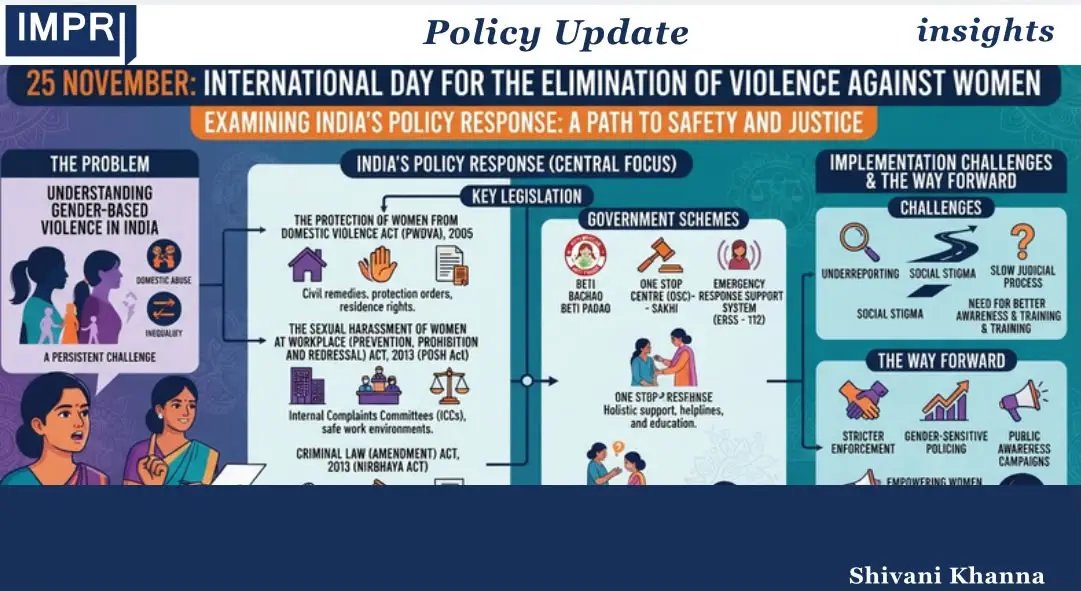
Every year, 25 November is observed as the International Day for the Elimination of Violence Against Women. It highlights the violence faced by women and girls and calls for their safety, dignity and equal rights. The day also marks the beginning of the 16 Days of Activism against Gender-Based Violence, which concludes on 10 December, Human Rights Day.
The 2026 campaign theme is “The future she deserves: Ensure justice, protect survivors, end impunity.” It emphasises the need for justice systems that respond effectively to violence, protect survivors and hold perpetrators accountable (World Health Organization WHO, 2026).
Violence against women remains a serious concern in India. The National Crime Records Bureau (NCRB, 2026) recorded 4,41,534 cases of crimes against women in 2024, at a rate of 64.6 cases per lakh women. These figures represent cases registered by the police and do not include every incident. Many women may not report abuse because of fear, social pressure, financial dependence or limited access to support.
The National Family Health Survey-5 found that 29.2% of ever-married women aged 18–49 had experienced spousal violence, compared with 30.9% in NFHS-4 (Ministry of Health and Family Welfare MoHFW, 2023).
Violence against women is not only a criminal justice issue. It can affect women’s health, education, employment and participation in society. The day provides an opportunity to examine whether India’s laws, programmes and institutions are helping women live free from violence.
Functioning: India’s Policy Response
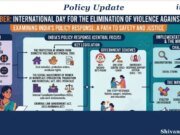
India’s response combines legal protections, government schemes and institutions that support women and help them seek justice.
1. Legislative Reforms
Several laws address different forms of violence. The Protection of Women from Domestic Violence Act, 2005 provides civil remedies for women experiencing domestic abuse, including protection, residence and monetary relief orders. It also provides for Protection Officers who help women access these remedies.
The Dowry Prohibition Act, 1961 prohibits giving and taking dowry. The Sexual Harassment of Women at Workplace Act, 2013 provides a system for addressing workplace harassment through Internal and Local Committees.
The Bharatiya Nyaya Sanhita, 2023 includes provisions dealing with offences such as rape, stalking, voyeurism and cruelty by a husband or his relatives. These laws cover violence in homes, workplaces and public spaces. Their effectiveness depends on awareness, investigation and proper implementation.
2. Flagship Schemes
Mission Shakti is the Government of India’s umbrella programme for women’s safety, security and empowerment. It has two components: Sambal, which focuses on safety, and Samarthya, which supports empowerment (Ministry of Women and Child Development MWCD, n.d.).
One Stop Centres (OSCs), under Sambal, provide medical assistance, legal support, temporary shelter, police assistance and counselling to women affected by violence. By 30 June 2026, 991 centres were operational, and more than 15.20 lakh women had received assistance since the scheme began in 2015 (Press Information Bureau PIB, 2026a).
Women Helpline 181 connects women with emergency and non-emergency support. Beti Bachao Beti Padhao focuses on the welfare, education and value of girls. Under Samarthya, initiatives such as Shakti Sadan provide support and rehabilitation to women in difficult circumstances, including survivors of trafficking and domestic violence.
3. Justice Infrastructure
Laws require institutions that can respond when a complaint is made. Police stations, Women Help Desks, Protection Officers, District Legal Services Authorities and courts play an important role in providing assistance and access to justice.
Fast Track Special Courts were established to speed up trials in rape cases and cases under the Protection of Children from Sexual Offences Act. In November 2026, the Union Cabinet approved continuation of the scheme for five years, with 850 courts planned. The government reported that 779 courts were functioning and had disposed of more than 4.02 lakh cases since their establishment (PIB, 2026b).
Performance: Linking India’s Response with the SDGs
India’s progress should be assessed against Sustainable Development Goal 5, which aims to achieve gender equality and end violence against women and girls, and SDG 16, which focuses on justice and effective institutions.
SDG 5.2 calls for ending violence in both public and private spaces. The NFHS-5 finding on spousal violence shows that abuse within intimate relationships remains widespread. NCRB’s registered cases also indicate the continuing demand on police and other institutions. However, police data reflects reported cases, while surveys can capture experiences that may never reach authorities.
SDG 16 highlights access to justice and institutional responsiveness. The number of functioning Fast Track Special Courts and cases disposed of indicates court activity. Yet disposal figures alone cannot show whether survivors received timely justice or felt safe during proceedings.
Similarly, the number of OSCs and helpline contacts indicates service reach, but not necessarily service quality or lasting change. Performance should also be assessed through timely referrals, follow-up, legal outcomes and survivors’ safety.
Impact: What Has Changed?
Government programmes have widened the formal support available to women. OSCs and the connection of Women Helpline 181 with emergency services provide routes to medical, legal and counselling assistance. For women who may not know where to seek help, these services can provide an important first point of contact.
Women Helpline 181 reported more than 99.09 lakh women assisted between April 2015 and February 2026 (MWCD, 2026). This is a cumulative administrative figure. The parliamentary response does not clarify whether it counts unique women or includes repeated assistance to the same person. It should therefore not be presented as a confirmed number of individual beneficiaries.
Mission Shakti has helped create a wider support structure, but the number of centres or assistance records cannot by itself prove that violence has declined. Meaningful impact would include survivors receiving timely help, accessing legal remedies, remaining safe after reporting and avoiding repeated abuse. These outcomes require stronger follow-up and evaluation.
There have also been positive changes in indicators related to girls’ welfare. The sex ratio at birth rose from 918 in 2014–15 to 929 in 2024–25, while girls’ secondary school gross enrolment increased from 75.51% to 80.2% (PIB, 2026c). These changes align with the goals of Beti Bachao Beti Padhao, but do not alone prove that the programme caused them or directly reduced violence.
Emerging Issues and Challenges
Women in rural and remote areas may face practical difficulties reaching OSCs, police stations and legal services. Travel can take time and money, while seeking assistance may require missing work or arranging childcare. Dependence on family members for transport can also make reporting abuse more difficult.
A UNFPA assessment of 56 One Stop Centres across 16 states and two Union Territories examined accessibility, infrastructure, survivor-centred care and coordination between service providers (United Nations Population Fund UNFPA, 2026). This highlights that establishing centres is not enough; services must also be reachable and responsive to women’s circumstances.
Violence also takes place online. The GSMA Mobile Gender Gap Report 2024 found that among female mobile internet users surveyed in India, 12% had received offensive or unwanted content and 11% had experienced personal information or photos being used, taken or shared without consent (GSMA, 2024). These are separate reported experiences and should not be combined into one overall prevalence figure.
Online harassment, threats, stalking and non-consensual sharing of images can affect women’s participation in education, employment and public discussion. Effective reporting systems and timely action by digital platforms are therefore important parts of the response.
Way Forward
India’s response should focus not only on expanding programmes but also on improving implementation and measuring results.
Support services should become easier to reach through local awareness, outreach and better coordination between OSCs, police, hospitals and legal aid. Frontline workers should receive regular training to handle complaints sensitively and avoid blaming or stigmatising survivors.
Data systems should distinguish unique beneficiaries from repeat contacts and track referrals, follow-up and outcomes wherever possible. This would help determine whether assistance leads to sustained support rather than simply recording service delivery.
Prevention must also remain central. Gender-sensitive education, community engagement, economic opportunities and public awareness can challenge attitudes that normalise violence. Digital platforms should strengthen complaint mechanisms, act promptly against abusive content and cooperate with lawful investigations.
The International Day for the Elimination of Violence Against Women reminds us that laws and schemes are essential, but their success depends on how they work in practice. Justice, survivor protection and accountability require institutions that are accessible, responsive and able to support women beyond the moment they first seek help.
References
GSMA. (2024). The mobile gender gap report 2024. https://www.gsma.com/wp-content/uploads/2025/12/The-Mobile-Gender-Gap-Report-2024.pdf
Ministry of Health and Family Welfare. (2023). Health and family welfare statistics in India 2023. Government of India. https://www.mohfw.gov.in/sites/default/files/Publication%20Health%20and%20Family%20Welfare%20Statistics%20in%20India%202023.pdf
Ministry of Women and Child Development. (2026). Status of Women Helpline No. 181 (Rajya Sabha Unstarred Question No. 4318, answered April 1, 2026). Government of India. https://sansad.in/getFile/annex/270/AU4318_RJynhA.pdf?source=pqars
Ministry of Women and Child Development. (n.d.). Mission Shakti. Government of India. https://wcd.gov.in/women/mission-shakti
National Crime Records Bureau. (2026). Crime against women (IPC+SLL), 2022–2024: Table 3A.1. Ministry of Home Affairs, Government of India. https://www.ncrb.gov.in/uploads/files/TABLE3A12.pdf
Press Information Bureau. (2026a, August 5). One Stop Centre provides integrated and immediate support and assistance under one roof to women affected by violence and those in distress. Government of India. https://www.pib.gov.in/PressReleasePage.aspx?PRID=2294887
Press Information Bureau. (2026b, November 4). Cabinet approves continuation of Fast Track Special Courts scheme for five years. Government of India. https://www.pib.gov.in/PressReleasePage.aspx?PRID=2332483
Press Information Bureau. (2026c, February 6). Beti Bachao Beti Padhao: Progress in sex ratio at birth and girls’ secondary education. Government of India. https://www.pib.gov.in/PressReleasePage.aspx?PRID=2224413
United Nations Population Fund. (2026, July 9). Assessment of the functioning of One Stop Centres in India (2023–2024). https://india.unfpa.org/en/publications/assessment-functioning-one-stop-centres-india-2entity23%E2%80%932entity24
World Health Organization. (2026). 16 Days of Activism against Gender-Based Violence 2026. https://www.who.int/campaigns/16-days-of-activism-against-gender-based-violence/2026
Contributor
Contributor: Shivani Khanna is an undergraduate student pursuing a BSc (Hons) Economics from the London School of Economics. Her interests include public policy, governance and research.
Reviewer: Lahari and Tanisha
Acknowledgements: The author thanks the reviewers for their feedback and suggestions that helped improve the article.
Disclaimer: The views expressed in this article are those of the author and do not necessarily reflect the views of the institution or organisation with which the author is associated.
Read More at IMPRI
Participants’ List & Details: Public Health Policy and Action