







Policy Update
Hemant Raj
Background
“Political democracy cannot last unless there lies at the base of it social democracy.”
These words, spoken by Dr. B. R. Ambedkar on the eve of the adoption of the Indian Constitution, captured one of the fundamental challenges of India’s democracy: ensuring that political equality is accompanied by social and economic justice (Constituent Assembly of India, 1949).
On 26 November 1949, the Constituent Assembly adopted the Constitution, marking a decisive step in India’s transition from colonial rule to a sovereign democratic republic. The task of framing it had begun against the backdrop of independence in 1947, when a newly independent nation faced the challenge of building a political system that could accommodate its immense diversity while addressing deep-rooted inequalities. Under the presidency of Dr. Rajendra Prasad, the Assembly deliberated for nearly three years. The Drafting Committee, chaired by Dr. Ambedkar, played a central role in shaping the final document, alongside the valuable contributions and deliberations of its other members.
The Constitution reflected both the political aspirations of the freedom struggle and the foresight of its framers. Its Preamble placed Justice, Liberty, Equality and Fraternity at the heart of the republic. The Constituent Assembly also drew upon constitutional experiences from across the world, incorporating relevant features from different democratic systems while adapting them to India’s historical circumstances and social needs. This approach reflected the pragmatism and open-mindedness of the framers, who were willing to learn from diverse constitutional traditions while keeping India’s unique challenges and aspirations at the forefront.
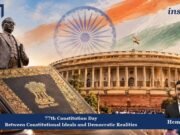
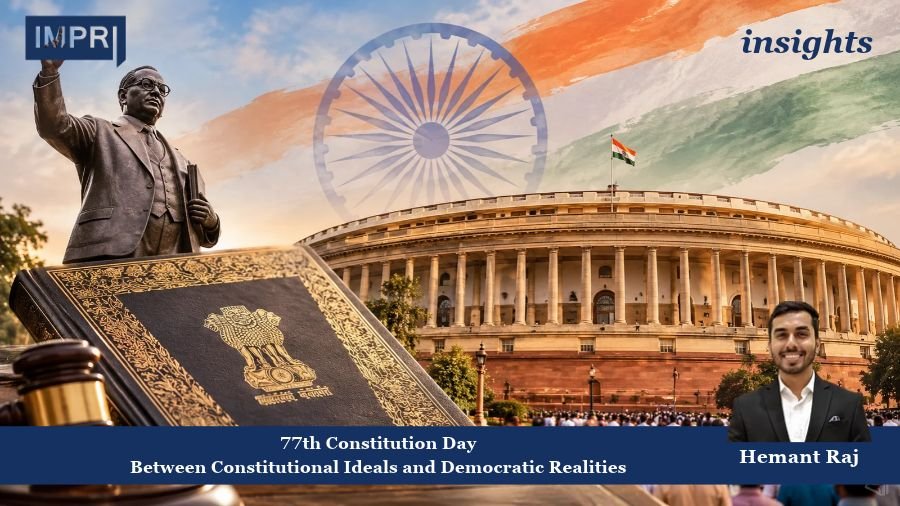
For a country that had made its “Tryst with Destiny” on 15 August 1947, the Constitution gave institutional shape to the promise of freedom. It came into force on 26 January 1950. Subsequently, in 2015, the Government of India designated 26 November as Constitution Day (Samvidhan Divas) to promote awareness of constitutional values among citizens, marking the 125th birth anniversary year of Dr. Ambedkar (Press Information Bureau, 2015). As India marks the 77th anniversary of the Constitution’s adoption in 2026, the occasion offers an opportunity not only to reflect on this historic achievement but also to critically examine the evolving relationship between constitutional ideals and democratic realities.
Functioning
The Indian Constitution establishes a comprehensive framework for democratic governance, extending beyond the institutional relationship between the Legislature, Executive and Judiciary. It defines the distribution of governmental authority, regulates territorial administration and provides mechanisms for democratic participation, accountability and social justice.
At the Union level, the Legislature, comprising the President and the two Houses of Parliament, performs the functions of representation, lawmaking and executive oversight. The Executive, headed by the President and functioning through the Prime Minister and Council of Ministers, administers the country and implements public policies.
The Judiciary, with the Supreme Court at its apex, safeguards constitutional supremacy through judicial review, interprets constitutional provisions and protects fundamental rights against arbitrary state action (Lok Sabha Secretariat, n.d.). Its role in preserving constitutional supremacy is further reflected in the Basic Structure Doctrine, established in the landmark Kesavananda Bharati v. State of Kerala (1973) judgment, which limits Parliament’s power to amend the Constitution by prohibiting changes that alter its basic structure, including democracy, secularism, federalism and judicial review.
The Constitution also accommodates India’s territorial and administrative diversity. Part VIII (Articles 239–241) provides for the administration of Union Territories, with special arrangements for Delhi under Article 239AA. The reorganisation of Jammu and Kashmir in 2019 into two Union Territories further illustrates the constitutional framework governing territorial administration. Similarly, the Fifth and Sixth Schedules provide special arrangements for Scheduled and tribal areas, recognising the importance of protecting tribal interests, customary practices and local self-governance.
Several constitutional institutions extend accountability beyond the three organs of government. The Election Commission of India (Article 324) oversees electoral processes, while the Comptroller and Auditor General (Article 148) audits public expenditure. The Union Public Service Commission (Article 315) provides a constitutional framework for public service recruitment, and the Finance Commission (Article 280) recommends the distribution of financial resources between the Union and States. The National Commissions for Scheduled Castes and Scheduled Tribes (Articles 338 and 338A) further safeguard the interests of historically disadvantaged communities.
The Constitution also institutionalises grassroots democracy through the 73rd and 74th Constitutional Amendments, which introduced Part IX and Part IXA for Panchayati Raj Institutions and Urban Local Bodies. The Eleventh and Twelfth Schedules identify subjects relating to rural and urban governance. Today, digital platforms such as eGramSwaraj support local planning and financial transparency, although the devolution of administrative and financial powers remains uneven across states.
Beyond governance, Fundamental Rights (Part III) protect individual freedoms, Directive Principles of State Policy (Part IV) guide the pursuit of social and economic welfare, and Fundamental Duties (Part IVA) emphasise citizens’ responsibilities. Together, these provisions demonstrate that the Constitution is not merely a framework for governmental institutions but a broader foundation for managing diversity, protecting rights and sustaining democratic accountability. Its effectiveness ultimately depends on how consistently these constitutional ideals translate into practice.
Performance
The Constitution placed its trust in the people by extending universal adult franchise to every citizen aged 18 and above, irrespective of caste, religion, gender or economic status. At a time when several newly independent nations were still cautious about universal voting rights, India chose to make democracy inclusive from the outset. This commitment was reflected in the 2024 Lok Sabha elections, which recorded 96.88 crore registered electors and a voter turnout of 66.10%. Women’s turnout (65.78%) also marginally exceeded that of men (65.55%) (Election Commission of India, 2025). Further, the 106th Constitutional Amendment, 2023, provides for one-third reservation for women in the Lok Sabha and State Legislative Assemblies, marking an important step towards more inclusive political representation.
However, political equality was only one part of the constitutional vision; addressing social and economic inequalities was equally important. Articles 14, 15 and 16 guarantee equality and enable affirmative action, while Article 17 abolishes untouchability. Article 21A, supported by the Right of Children to Free and Compulsory Education Act, 2009, made elementary education a legal entitlement for children aged six to fourteen (Government of India, 2009). These safeguards, along with welfare measures, have helped widen opportunities for disadvantaged communities.
NITI Aayog estimates that multidimensional poverty declined from 29.17% in 2013–14 to 11.28% in 2022–23, with an estimated 24.82 crore people moving out of multidimensional poverty (NITI Aayog, 2024). Yet, persistent caste-based discrimination shows that constitutional equality has not fully translated into social equality.
Alongside participation and social justice, the Constitution also protects individual freedom and dignity. Fundamental Rights under Articles 14–32 give citizens the means to challenge violations by the state and seek judicial protection. Over the years, the Supreme Court has expanded the scope of these rights through its interpretation of constitutional provisions. In Maneka Gandhi v. Union of India (1978), it gave a broader meaning to personal liberty under Article 21, while in Justice K.S. Puttaswamy v. Union of India (2017), it recognised privacy as a fundamental right.
Public Interest Litigation has further helped disadvantaged groups approach the courts. However, restrictions on free expression and delays in the delivery of justice continue to raise concerns about how effectively these freedoms are protected in practice.
The Constitution’s vision of democracy also extends beyond individual citizens to the relationship between the Union and the states. By distributing legislative and financial powers between the two levels of government, it seeks to accommodate India’s regional diversity while maintaining national unity. Institutions such as the Finance Commission and GST Council provide mechanisms for consultation and resource-sharing. Under the sixteenth Finance Commission’s recommendations, states receive 41% of the divisible pool of central taxes, with actual tax devolution reaching approximately ₹12.87 lakh crore in 2024–25 (PRS Legislative Research, 2026). Taken together, these achievements and shortcomings show how the Constitution has shaped India’s democratic journey while leaving important questions of equality, liberty and power-sharing to be addressed.
Impact
For an ordinary Indian citizen, the Constitution is not simply a document referred to in courts or remembered on 26 November; its influence is visible in everyday interactions with the State. It shapes a child’s access to education, an individual’s freedom to express an opinion, and a citizen’s ability to seek fair treatment from public authorities. Article 21A, implemented through the Right of Children to Free and Compulsory Education Act, 2009, guarantees free and compulsory elementary education for children aged six to fourteen. Similarly, Articles 14, 15 and 16 protect equality before the law, prohibit discrimination and promote equal opportunities in public employment. These provisions are particularly important for communities that have historically faced social and economic exclusion.
Beyond individual rights, the Constitution also gives citizens a role in shaping decisions that affect their communities. Articles 19 and 21 protect freedoms of expression and personal liberty, while Articles 32 and 226 allow individuals to approach the Supreme Court and High Courts when their constitutional rights are violated. This makes the judiciary an important avenue for challenging arbitrary state action and seeking justice. At the grassroots level, the 73rd and 74th Constitutional Amendments gave constitutional recognition to Panchayati Raj Institutions and Urban Local Bodies, bringing governance closer to citizens. Through elected local representatives, people can participate in decisions concerning drinking water, sanitation, local roads and community development.
These constitutional provisions also find expression in public policies and welfare programmes that shape access to essential services. The public distribution system, rural employment programmes and social protection measures provide institutional channels through which the State addresses economic vulnerability. While these programmes are not all direct outcomes of individual Fundamental Rights, they reflect the Constitution’s broader commitment to social and economic justice under the Directive Principles of State Policy. The Constitution’s real significance, therefore, lies not only in the rights it promises but also in the ability of ordinary citizens to exercise them in their everyday lives.
Emerging Issues
The Constitution provides a framework for democratic governance, but its effectiveness depends on how institutions function and how constitutional values are practised. Several contemporary challenges highlight the gap between constitutional promises and their implementation.
- Institutional accountability and separation of powers: A functioning democracy requires regular scrutiny of government decisions and independent institutions. However, parliamentary oversight needs strengthening. During the 17th Lok Sabha, only 16% of Bills were referred to parliamentary committees, while 35% were passed with less than an hour of discussion in the Lok Sabha (PRS Legislative Research, 2024). This raises questions about the time and scrutiny available for examining complex legislation.
- Federalism and Centre-State relations: India’s federal structure must balance national priorities with the administrative and financial responsibilities of States. Although the Sixteenth Finance Commission recommended that States receive 41% of the divisible pool of central taxes, PRS analysis indicates that their actual share in the Centre’s gross tax revenue was around 34% in 2024–25, partly reflecting the impact of cesses and surcharges (PRS Legislative Research, 2026). This makes predictable and transparent fiscal transfers important for States to deliver public services effectively.
- Fundamental Rights and civil liberties: Digital governance has made privacy and data protection increasingly important. The Digital Personal Data Protection Rules, 2025, were notified to operationalise the 2023 Act, but effective safeguards will depend on their implementation and citizens’ ability to exercise their rights. Similarly, India recorded 65 internet shutdowns in 2025 (Access Now, 2026). Such restrictions raise questions about proportionality and their impact on access to information, education and livelihoods.
- Social and economic inequalities: Constitutional equality does not automatically ensure equal access to opportunities. ASER 2024 found that only 23.4% of rural Class III children could read a Class II-level text (ASER Centre, 2025). Uneven learning outcomes underline the continuing gap between the right to education and the quality of education received. Access to affordable healthcare and timely justice also remains uneven.
- Constitutional morality and democratic conduct: Beyond laws and institutions, constitutional democracy depends on respect for dissent, tolerance of differences and responsible public conduct. Its strength rests not merely on constitutional safeguards but also on the willingness of political representatives, public institutions and citizens to uphold constitutional values in practice. However, inflammatory rhetoric, irresponsible public statements and divisive political discourse, often driven by short-term electoral gains, undermine constitutional morality and weaken the democratic spirit.
Taken together, these challenges suggest that India’s central task is not simply to preserve constitutional provisions, but to ensure that institutions apply them consistently and that citizens can meaningfully exercise the rights they guarantee.
Way Forward
Strengthening India’s constitutional democracy requires more than addressing individual institutional shortcomings. It calls for sustained reforms that improve accountability, protect institutional autonomy and encourage greater public participation. Some key priorities include:
- Legislative accountability must be strengthened through greater scrutiny of bills by parliamentary committees, adequate time for debate and more meaningful deliberations in legislatures. This would improve the quality of lawmaking and strengthen executive accountability. (PRS Legislative Research, 2024).
- Institutional independence must be protected by ensuring that constitutional bodies can function without undue political interference. Transparent appointments, institutional autonomy and effective oversight are essential to maintaining public confidence. The Supreme Court’s judgment in Anoop Baranwal v. Union of India (2023) highlights the importance of safeguarding the independence of the Election Commission.
- Cooperative federalism needs greater emphasis on regular Centre – State consultations, timely fiscal transfers, and constructive dialogue through institutions such as the Inter-State Council. Differences between governments should be addressed through constitutional mechanisms rather than political confrontation.
- Access to constitutional justice must improve through faster disposal of cases, stronger legal aid services and greater access to courts for economically disadvantaged sections. The effective implementation of Article 39A is particularly important in this regard.
- Finally, constitutional literacy should extend beyond ceremonial observances and Preamble readings. Schools, universities and public institutions should encourage informed discussions on fundamental rights, duties, democratic participation and constitutional values. Civil society, the media and local governments can also play an important role in building this awareness.
Ultimately, constitutional democracy cannot be sustained by institutions alone. It requires accountable political leadership, independent institutions and citizens who understand their constitutional rights and responsibilities.
Conclusion
The Constitution is not merely a historical achievement but an ongoing democratic commitment that demands constant reflection, participation and responsibility. Its success ultimately depends on how effectively its institutions protect individual rights, ensure accountability and uphold the dignity of citizens.
Constitution Day, therefore, should be an occasion not just to celebrate its adoption but also to reflect on India’s progress towards the ideals of justice, liberty, equality and fraternity enshrined in the Preamble.
As Dr. B. R. Ambedkar aptly cautioned, “If things go wrong under the new Constitution, the reason will not be that we had a bad Constitution. What we will have to say is that man was vile.” His words remind us that the true strength of the Constitution lies in the conduct of those entrusted with upholding it.
References
Access Now. (2026). Rising repression meets global resistance: Internet shutdowns in 2025. https://www.accessnow.org/?utm
ASER Centre. (2025). Annual Status of Education Report (Rural) 2024. https://asercentre.org/aser-2024/?utm
Constituent Assembly of India. (1949, November 25). Constituent Assembly debates, Volume XI: Closing speech by Dr. B. R. Ambedkar. https://api.sci.gov.in/AMB/pdf/Closing%20speech%2025%20Nov%201949.pdf
Election Commission of India. (2025). Atlas 2024: General Elections to Lok Sabha. Election Commission of India. https://www.eci.gov.in/EBooks/atlas-2024/files/basic-html/page90.html
Government of India. (2009). The Right of Children to Free and Compulsory Education Act, 2009. https://www.indiacode.nic.in/indiacode/handle/123456789/2086?view_type=browse&utm
Lok Sabha Secretariat. (n.d.). About Parliament. Digital Sansad, Government of India. https://sansad.in/poi/about?utm
NITI Aayog. (2024). Multidimensional Poverty in India since 2005–06: A discussion paper. https://www.niti.gov.in/sites/default/files/2024-01/MPI-22_NITI-Aayog20254.pdf
Press Information Bureau. (2015, November 23). 26th November to be observed as Constitution Day. Ministry of Social Justice and Empowerment, Government of India. https://www.pib.gov.in/newsite/PrintRelease.aspx?lang=2®=48&relid=131806&utm
PRS Legislative Research. (2024). Functioning of the 17th Lok Sabha. https://prsindia.org/files/parliament/session_track/2024/vital_stats/Functioning-17th_Lok_Sabha.pdf?utm
PRS Legislative Research. (2026). State of State Finances 2026–27. https://prsindia.org/files/budget/SOSF_2026-27.pdf
Supreme Court of India. (1978). Maneka Gandhi v. Union of India, (1978) 1 SCC 248. Supreme Court of India. https://api.sci.gov.in/jonew/judis/5154.pdf?utm
Supreme Court of India. (2017). Justice K.S. Puttaswamy (Retd.) v. Union of India, (2017) 10 SCC 1. Supreme Court of India. https://www.sci.gov.in/landmark-judgment-summaries/?judgment_year=2017&utm
Supreme Court of India. (2023). Supreme Court of India. (2023). Anoop Baranwal v. Union of India, Writ Petition (Civil) No. 104 of 2015. https://patnahighcourt.gov.in/ILR/viewpdf.aspx?ID=NjYx-dRYRy6tBACQ=&T=EN&utm
About the Author
Hemant Raj is a Research and Editorial Intern at the Impact and Policy Research Institute (IMPRI), an engineer-turned-Political Science postgraduate, and UGC-NET qualified in Political Science. His research interests include geopolitics, foreign policy, strategic affairs, and Indo-Pacific dynamics. He seeks to contribute to evidence-based research and strategic analysis that inform India’s foreign policy priorities and global engagement.
Acknowledgement
I sincerely thank the Impact and Policy Research Institute (IMPRI) for providing me with the opportunity to research and write this Policy Update. I am particularly grateful to Madhuritha D for her valuable feedback and constructive suggestions, which helped improve the quality and analytical depth of this article. I also extend my appreciation to the IMPRI team for their guidance, encouragement, and support throughout the process.
Disclaimer: The views of the article belong solely to the author and may not necessarily belong to the IMPRI Organisation.
Read More at IMPRI
European Union’s Carbon Border Adjustment Mechanism (CABM) and its impact on India’s Agricultural Exports
Skillerate 2026 – PROPEL, MEGASKILL, SHIELD and EQUIP: Meghalaya’s State-Led Model for Youth Skilling and Employment