







Policy Update
Mahenoor Imam
Introduction
“We must not for a moment forget, it is the birth right of every individual to receive at least the basic education without which he cannot fully discharge his duties as a citizen.” — Maulana Abul Kalam Azad (Speeches of Maulana Azad, 1947–1955, Publications Division)
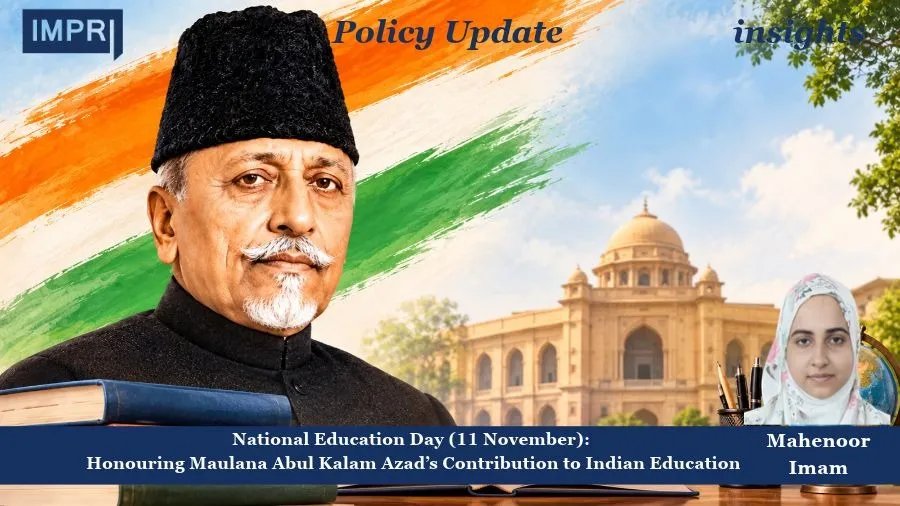
On 11 November every year, India observes National Education Day to mark the birth anniversary of Maulana Abul Kalam Azad (1888–1958). He was a scholar, journalist, freedom fighter and independent India’s first Union Minister of Education.
The day is a reminder that free India’s education system did not grow by chance. Much of it was planned by one man in the first eleven years after independence. With about 65% of Indians now under 35 years of age (Press Information Bureau [PIB], 2026), his central idea, that education is a birthright and the base of citizenship, is still the test for every education policy, including NEP 2020.
This article looks at Azad’s life, his vision as Education Minister, the institutions he built, why his birthday became National Education Day, and how far India has come in fulfilling his vision.
Maulana Azad- Azad was born Abul Kalam Ghulam Muhiyuddin on 11 November 1888 in Mecca. He never went to a formal school; he was taught at home and was largely self-taught. He took the pen name “Azad”, meaning “free”, to show his commitment to freedom(Encyclopaedia Britannica).
Life at a Glance:
| Year | Event |
| 1888 | Born in Mecca on 11 November |
| 1912 | Launches the Urdu weekly Al-Hilal from Calcutta, which opposes British rule |
| 1920 | Joins the Khilafat and Non-Cooperation movements; jailed several times between 1920 and 1945 |
| 1923 | Becomes the youngest Congress president, at 35 years |
| 1930 | Arrested during the Salt Satyagraha |
| 1940-46 | Congress president again; jailed with the entire Congress leadership during Quit India (1942) |
| 1947 | Becomes independent India’s first Education Minister |
| 1958 | Dies in office on 22 February |
| 1959 | His memoir India Wins Freedom is published posthumously |
| 1992 | Awarded the Bharat Ratna posthumously |
Source- Compiled by author from Encyclopaedia Britannica and Drishti IAS(National Education Day 2025).
- Scholar and writer: Tarjuman-ul-Quran, Ghubar-e-Khatir, Tazkirah and India Wins Freedom.
- Journalist: Al-Hilal and later Al-Balagh spread nationalism and Hindu–Muslim unity.
- Nationalist: a firm believer in composite nationalism, he opposed Partition.
Azad as Education Minister (1947–1958)
Azad was Education Minister for over ten years, from 1947 until his death, the longest tenure anyone has held. He saw education as a tool for social change and for national unity(President of India, National Education Day address, 2008). His visions covered:
- Universal schooling: free and compulsory education for all children up to age 14 .
- Adult literacy: education was not only for children, and he made adult literacy a priority.
- Girls and the rural poor: he gave special weight to educating girls and the rural poor.
- Science and technical education: the new nation needed engineers, scientists and planners.
- Culture and the arts: education should also cover India’s music, literature and art.
- Balanced minds: at the first meeting of the Central Advisory Board of Education (CABE), he said that education’s main aim is to create “balanced minds which cannot be misled”(Speeches of Maulana Azad, 1947–1955, Publications Division).
Commissions that shaped the system
| Year | Body | Focus |
| 1948 | University Education Commission (Radhakrishnan) | Higher Education Reform |
| 1948 | Kher Committee | Elementary Education Reform |
| 1952-53 | Secondary Education Commission (Mudaliar) | Restructuring Secondary Schools |
Source: Ministry of Education, Government of India.
As Chairman of Central Advisory Board of Education (CABE), he also pushed for diversifying secondary education . He wanted a much bigger share of the budget for education. Resources were scarce, but he argued that education came before other issues.
Institutions
Many of the bodies that run Indian education and culture today were set up or shaped under Azad.
| Year | Institution | Matters today |
| 1950 | Indian Council for Cultural Relations (ICCR) | India’s cultural diplomacy |
| 1951 | IIT Kharagpur, the first IIT | Seed of today’s 23 IITs |
| 1953 | University Grants Commission (UGC); statutory body from 1956 | Funds and regulates universities; now rolling out NEP’s four-year UG programme |
| 1953 | Sangeet Natak Akademi | Music, dance and drama |
| 1954 | Sahitya Akademi | Literature in Indian languages |
| 1954 | Lalit Kala Akademi | Fine arts |
Sources- complied by the Author from Anantam IAS: Contributions of Maulana Azad
He also strengthened the All India Council for Technical Education (AICTE), set up in 1945 as an advisory body, and used it to plan the expansion of technical education. This is why he is often called the architect of modern Indian education.
National Education Day: Why and How
On 11 September 2008, the Ministry of Human Resource Development (now the Ministry of Education) decided to mark Azad’s birthday as National Education Day. The notification gives the reason in plain terms: Azad, “a great freedom fighter, an eminent educationist and the first Union Minister of Education”, had immensely contributed to the cause of Education. Two features of the day, first, it is a working day. The day is observed every year without declaring it a holiday. The idea is to mark it through learning, not leave. Second, it is observed across the country. Schools, colleges and universities hold seminars, essay and debate contests, quiz competitions, rallies and talks on Azad’s life and on the value of education. It should not be confused with the International Day of Education, which the UN observes on 24 January.
The President of India has described Azad as convinced that education is a tool of social transformation, and as the founder of commissions, boards and institutions such as UGC and the IITs (President Pratibha Devisingh Patil, National Education Day address, 2008; President Pranab Mukherjee, National Education Day address, 2012).
Azad’s Vision Today: From RTE to NEP 2020
Many of Azad’s ideas, which looked ambitious in the 1950s, are now law or national policy.
- Free and compulsory education up to 14: Article 21A and the RTE Act, 2009 make it a fundamental right for ages 6–14 (Constitution (86th Amendment) Act, 2002; RTE Act, 2009).
- Universal schooling up to the secondary level: NEP 2020 targets 100% GER from pre-school to secondary by 2030 (NEP 2020, Ministry of Education).
- Removal of illiteracy, starting from basics: NEP’s foundational literacy and numeracy goal is being carried out through NIPUN Bharat (2021) (NIPUN Bharat Guidelines, Ministry of Education, 2021).
- Adult education: NEP pushes for lifelong learning and adult literacy (NEP 2020, Chapter 21).
- Girls’ and rural education: gender and social inclusion are central to NEP 2020 (NEP 2020, Chapter 6).
- Science and technical education: NEP calls for multidisciplinary higher education, research funding through ANRF and a 50% GER target by 2035 (NEP 2020; ANRF Act, 2023).
- A bigger budget for education: NEP sets a target of 6% of GDP for public spending on education (NEP 2020, Chapter 26)
- Culture and Indian languages: NEP stresses mother-tongue instruction and Indian knowledge systems. (NEP 2020)
NEP 2020, approved on 29 July 2020, is in many ways the latest attempt to finish the work Azad began.
How Far Have We Come?
Measured against Azad’s vision, the record is mixed. Access and teachers have improved a lot. Learning and retention in higher classes lag.
- Every child in school (Improving): 24.72 crore students and 1.03 crore teachers; secondary GER rose from 68.5% to 71.7% in 2025-26.(UDISE+ 2025-26, Ministry of Education)
- Children who stay and finish (Weak): secondary dropout is down to 7.0%, but secondary retention is only 51.9% and secondary NER is 52.2%.(UDISE+ 2025-26, Ministry of Education)
- Basic literacy and numeracy (Clear gains): Grade 3 scores are 64% in Language and 60% in Maths (PARAKH 2024). ASER 2024 found Class 3 reading in government schools at its highest since 2005.
- Learning in higher classes (Serious gap): the Grade 9 Maths average is only 37%.
- Higher and technical education (Slow progress): higher-education GER is 30% (2023-24); female GER, at 31.2%, is above male GER.
- Adequate funding (Short): public spending is about 4.12% of GDP (2021-22), against the 6% target (Parliamentary Standing Committee on Education, 2025).
Issues
- Dropout after Class 8 and Class 10- NITI Aayog’s 2026 review describes the school system as a “pyramid”, with many primary schools but few that go up to Class 12.
- Weak learning in higher grades, especially in Maths and Science.
- Falling trust in government schools and a heavy reliance on private coaching (27% of students).
- Only 54.9% of the Samagra Shiksha budget had been used by February 2026.
- Centre–state friction- Samagra Shiksha funds were withheld from Tamil Nadu, Kerala and West Bengal over PM SHRI and the three-language formula.
- Teachers and access- Over 1 lakh single-teacher schools remain, and one school in three has no internet.
Way Forward
- India’s school system narrows sharply after Class 8, because many villages have a primary school but no secondary school within reach. Composite schools that run from pre-school to Class 12 on one campus would let children continue without changing schools or travelling far, which matters most for girls and rural students. For adolescents who have already dropped out, especially those aged 14–18, open and distance schooling through NIOS and state open schools can offer a flexible route back (Ministry of Finance, 2026; NITI Aayog, 2026).
- Take NIPUN beyond Grade 3- NIPUN Bharat has helped lift foundational learning, but PARAKH 2024 shows that scores fall steadily by Grade 9, with Maths at only 37%. The same approach that worked in the early grades should be carried into Classes 4–9: clear grade-level learning targets, regular classroom assessment, remedial support for children who fall behind, and simple teaching materials (NCERT, 2025; NITI Aayog, 2026).
- Put teachers first- No reform succeeds without enough well-trained teachers. States should fill teacher vacancies through regular recruitment, use UDISE+ data to redeploy teachers where pupil–teacher ratios are high, and phase out the more than one lakh single-teacher schools. SCERTs and DIETs, the bodies that train teachers, also need staff, funds and autonomy so that they can provide the continuous professional development NEP 2020 envisages (MHRD, 2020, Chapter 5; Ministry of Education, 2026a).
- Fund education as Azad asked- Public spending on education is about 4.12% of GDP, well short of the 6% target that NEP 2020 reaffirmed. The Centre and the states should set out a clear, year-by-year path towards that target. Higher allocations must also be matched by better use of funds: money should be released on time, and spending should be tracked against outcomes, so that budgets are not cut at the revised-estimate stage or left unspent (MHRD, 2020, Chapter 26; Parliamentary Standing Committee on Education, 2025b, 2026).
- Work with the states- Education is on the Concurrent List, and states run most schools, so co-operative federalism is essential. Core funds under Samagra Shiksha, which support RTE entitlements such as teachers’ salaries and free textbooks, should not be held back because a state has not joined an optional scheme like PM SHRI. The Standing Committee has recommended keeping the two separate, while leaving room for regular dialogue on contested issues such as language policy (Parliamentary Standing Committee on Education, 2025a).
- Revive adult education- Azad treated adult literacy as part of nation-building, not an afterthought. Today, digital platforms such as DIKSHA and SWAYAM, together with the government’s adult literacy programme ULLAS (New India Literacy Programme), can bring literacy, digital skills and vocational learning to adults who missed school. Using schools, libraries and community centres as learning spaces outside school hours would extend that reach (MHRD, 2020, Chapter 21).
- Teach for “balanced minds”- Azad wanted education to create “balanced minds which cannot be misled” (Azad, 1956). In an age of misinformation, that aim is more relevant than ever. NEP 2020’s emphasis on critical thinking, ethical reasoning and constitutional values should shape classroom practice, not just curriculum documents. Students should be taught to question sources, weigh evidence and respect diversity (MHRD, 2020, Chapter 4).
Conclusion
Maulana Abul Kalam Azad was a freedom fighter who turned nation-builder. In just eleven years he gave free India its commissions, councils, IITs, UGC and Akademis, the foundation of everything that followed. National Education Day honours not just the man but the idea he stood for: that education is every citizen’s birthright and the basis of a free, united and thinking nation.
Six decades on, India has kept much of his promise at the primary level. The harder part, keeping every child in school until Class 12 and making sure they truly learn, is still unfinished. NEP 2020 offers the roadmap. The real tribute to Azad on 11 November is not a ceremony, but delivering his vision in every classroom, for every child.
References
- Anantam IAS. (n.d.). Contributions of Maulana Azad. https://anantamias.com/
- Drishti IAS. (2025, November 11). National Education Day 2025. https://www.drishtiias.com/state-pcs-current-affairs/national-education-day-2025
- Encyclopaedia Britannica. (n.d.). Abul Kalam Azad. In Encyclopaedia Britannica. https://www.britannica.com/biography/Abul-Kalam-Azad
- Ministry of Education. (n.d.). Ministry of Education, Government of India. Government of India. https://www.education.gov.in/
- Ministry of Education. (2021). NIPUN Bharat: National initiative for proficiency in reading with understanding and numeracy – Guidelines for implementation. Department of School Education & Literacy, Government of India. https://dsel.education.gov.in/sites/default/files/NIPUN_BHARAT_GUIDELINES_EN.pdf
- Ministry of Education. (2026a). Unified District Information System for Education Plus (UDISE+) 2025-26. Department of School Education & Literacy, Government of India. https://udiseplus.gov.in/#/en/page/publications
- Ministry of Education. (2026b). All India Survey on Higher Education (AISHE) 2023-24. Department of Higher Education, Government of India. https://aishe.gov.in/
- Ministry of Human Resource Development. (2008). Observance of 11th November as National Education Day [Notification reproduced in CBSE Circular No. 46/2008]. Central Board of Secondary Education. https://www.cbse.gov.in/circulars/cir46-2008.doc
- Ministry of Human Resource Development. (2020). National Education Policy 2020. Government of India. https://www.education.gov.in/sites/upload_files/mhrd/files/NEP_Final_English_0.pdf
- National Council of Educational Research and Training. (2025). PARAKH Rashtriya Sarvekshan 2024: National report. PARAKH, NCERT. https://parakh.ncert.gov.in/prs-reports-2024
- Patil, P. D. (2008, November 11). Speech by the President of India on the occasion of National Education Day. President’s Secretariat. https://presidentofindia.nic.in/smt-pratibha-devisingh-patil/speeches/speech-president-india-smt-pratibha-devisingh-patil-3
- Press Information Bureau. (2020, July 29). Cabinet approves National Education Policy 2020 [Press release]. Government of India. https://pib.gov.in/PressReleasePage.aspx?PRID=1642049
- Press Information Bureau. (2026a, July 7). The Union Ministry of Education releases the report on Unified District Information System for Education Plus (UDISE+) 2025-26 [Press release]. Government of India. https://www.pib.gov.in/PressReleasePage.aspx?PRID=2282141
- Press Information Bureau. (2026b, August 13). Empowering youth, transforming India: Amrit Peedhi for Viksit Bharat @2047 [Backgrounder]. Government of India. https://static.pib.gov.in/WriteReadData/specificdocs/documents/2026/aug/doc2026813953701.pdf
About the Contributor
Mahenoor is a postgraduate in Political Science from University of Calcutta, Kolkata. She is a former UPSC Civil Services Aspirant. Her interests lie in governance, social equity and welfare policy, with a focus on the gap between policy design and on-ground implementation.
Acknowledgement
The author extends sincere gratitude to Aditya Chavan and Shiva Karthik for their invaluable guidance and support.
Disclaimer
All views expressed in the article belong solely to the author and not necessarily to the organization.
Read More at IMPRI :
9 November – Legal Services Day 2026 : Bridging the Gap Between Legal Rights and Access to Justice
India’s Climate Finance Taxonomy (2025): Building a Framework for Climate-Aligned Finance