



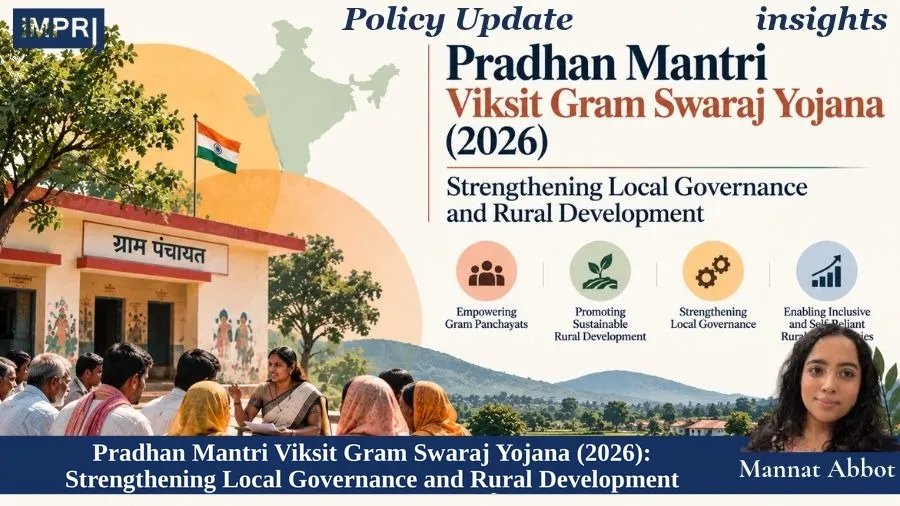
Policy Update
Mannat Abbot
1. Background
The constitutional framework for decentralised rural governance was strengthened by the 73rd Constitutional Amendment Act, 1992, which introduced Part IX of the Constitution and provided constitutional recognition to Panchayati Raj Institutions. Gram Sabhas, regular elections, reservations and the devolution of responsibilities were intended to bring governance closer to citizens and enable local communities to participate in development decisions.
However, constitutional recognition does not automatically ensure effective decentralisation. Panchayats differ in their administrative capacity, technical expertise, financial resources and ability to coordinate with government departments. In some areas, development planning remains fragmented across departmental schemes, limiting the ability of local institutions to address interconnected challenges such as sanitation, livelihoods, infrastructure, education and access to public services.
Existing initiatives provide an institutional foundation for addressing these constraints. The Rashtriya Gram Swaraj Abhiyan supports capacity-building for Panchayati Raj Institutions, while eGramSwaraj facilitates digital planning, accounting and monitoring of Panchayat activities. AuditOnline supports the online auditing of Panchayat accounts. These initiatives have established important administrative and technological systems, but their effectiveness also depends on how consistently local institutions can use them.
The Union Cabinet approved the Pradhan Mantri Viksit Gram Swaraj Yojana (PM VGSY) on 28 October 2026 as a Centrally Sponsored Scheme, described in the official release as a next-generation governance transformation initiative. It is approved for 2026-27 to 2030-31, co-terminus with the Sixteenth Finance Commission period, with an outlay of ₹7,395.55 crore (Centre ₹4,869.48 crore; States ₹2,526.07 crore). The Finance Commission has separately recommended around ₹4.35 lakh crore in grants for Rural Local Bodies over the same period. PM VGSY is intended to help Panchayats bring these resources together with national priorities, Government schemes and local needs through holistic planning, capacity-building and Gram Sabha deliberation.
These are the scheme’s announced provisions and targets. Implementation will be through States and Union Territories, whose Annual Action Plans are to be appraised and approved by a Central Empowered Committee in line with the scheme’s guidelines. At the time of writing, outcomes against these targets are not yet available.
The scheme has a total outlay of ₹7,395.55 crore, comprising a central share of ₹4,869.48 crore and a state share of ₹2,526.07 crore. It covers all States and Union Territories, including eligible traditional rural local government institutions in areas where Panchayats do not exist.
2. Functioning
PM VGSY seeks to place Gram Panchayats at the centre of integrated local development planning. Its operational approach combines digital systems, capacity-building, citizen engagement and financial accountability.
2.1 Integrated Gram Panchayat Development Planning
The scheme will support the preparation of holistic Gram Panchayat Development Plans (GPDPs) on the eGramSwaraj portal. These plans are intended to bring together village-level priorities, interventions undertaken by Central and State government departments, and the financial resources available to local institutions.
An integrated approach can help identify gaps in public services, reduce duplication across development programmes and improve the allocation of resources. Instead of treating individual schemes as isolated interventions, Panchayats can use the planning process to assess how different programmes contribute to broader village development objectives.
The scheme aims to support the preparation of more than 2.55 lakh GPDPs annually.
2.2 Digital Governance and Information Integration
PM VGSY will build on existing e-Panchayat systems to consolidate information relating to government schemes, beneficiaries, benefits, community assets and available resources on a common digital platform.
Access to consolidated information can improve planning and monitoring by helping Panchayats identify underserved areas and assess whether available resources correspond to local requirements. Digital integration may also facilitate coordination between departments and improve the accessibility of information required for administrative decision-making.
2.3 Capacity-Building and Citizen Participation
The scheme provides for capacity-building and digital handholding of approximately 32 lakh elected representatives, Panchayat functionaries and other stakeholders every year. These activities are intended to strengthen local planning, resource management and communication with citizens, and to advance locally relevant Sustainable Development Goals. Implementation will largely draw on existing institutional, training and digital systems.
Citizen awareness is a complementary component. The scheme will use Gram Sabhas, Panchayat forums and existing outreach platforms to explain government programmes and encourage informed community discussion. These platforms include PANCHAM (Panchayat Assistance and Messaging Chatbot), an AI-enabled, multilingual, two-way communication platform operating in 17 Indian languages. PANCHAM is not a new creation under the scheme: the Ministry of Panchayati Raj launched it in January 2026 with UNICEF’s support, as a WhatsApp-based channel for Panchayat representatives and functionaries. PM VGSY will build on it to help connect national development priorities with local needs and encourage informed participation in village-level decision-making.
2.4 Financial Accountability and Resource Mobilisation
The scheme will strengthen online accounting, auditing, public disclosure and the mobilisation of Own Source Revenue (OSR). It aims to support at least 2.55 lakh online audit plans annually, with corresponding audits to be completed in a timely manner through AuditOnline.
The initiative is intended to improve the transparency of public expenditure, strengthen financial management and encourage Panchayats to mobilise locally available revenue in addition to relying on intergovernmental transfers.
Implementation will take place through State Governments and Union Territory Administrations, which will submit Annual Action Plans for appraisal and approval by the designated Central Empowered Committee.
3. Performance
As PM VGSY was approved only on 28 October 2026, it is too early to assess its actual performance. Its announced targets nevertheless provide a framework against which implementation can subsequently be evaluated.
The scheme proposes the following annual outputs:
- Development planning: Support for more than 2.55 lakh holistic GPDPs annually.
- Institutional capacity: Capacity-building and digital handholding for approximately 32 lakh governance stakeholders annually.
- Citizen awareness: At least one crore citizens reached during each coordinated awareness-generation exercise.
- Financial accountability: Support for at least 2.55 lakh online audit plans annually, alongside timely completion of the corresponding audits.
These targets indicate the scale of the proposed intervention. However, administrative outputs should not be confused with development outcomes. The preparation of a development plan does not necessarily mean that its priorities have been funded or implemented. Similarly, conducting training sessions does not establish that elected representatives have acquired the skills required to improve governance.
A meaningful assessment will therefore require regular information on implementation progress, expenditure, audit completion, citizen participation and the extent to which identified development gaps are addressed. Evaluation should also examine whether the scheme improves the quality of local decision-making rather than merely increasing the number of plans and administrative activities recorded on digital platforms.
4. Impact
4.1 Improved Coordination and Resource Allocation
One of the scheme’s principal potential contributions is its emphasis on integrated planning. Rural development challenges frequently overlap, requiring coordination between infrastructure, sanitation, livelihoods, health, education and social welfare interventions. A consolidated planning framework could help Panchayats identify these interconnections and use available resources more effectively.
Better coordination may also improve the utilisation of Finance Commission grants and reduce the risk of overlapping interventions. However, the extent of these benefits will depend on whether departments share timely information and respond to priorities identified through local planning.
4.2 Greater Transparency and Accountability
Online accounting, auditing and public disclosure can make it easier for citizens and oversight institutions to scrutinise the use of public funds. Stronger financial management may help identify irregularities, improve compliance and strengthen confidence in local institutions.
Nevertheless, transparency requires more than the digital publication of information. Financial disclosures must be understandable and accessible, while audit findings must lead to corrective action. Effective accountability also requires accessible grievance-redressal mechanisms and meaningful opportunities for citizens to question expenditure decisions.
4.3 Stronger Local Institutions and Participatory Governance
Capacity-building may improve the ability of elected representatives to prepare development plans, manage resources and communicate with citizens. The proposed multilingual outreach approach could also help rural residents understand government programmes and participate more effectively in Gram Sabha discussions.
For women representatives, members of disadvantaged communities and residents of remote settlements, accessible information and inclusive consultation may be particularly important. The extent of participation, however, will depend on whether these groups can influence decisions and whether their priorities are reflected in approved plans and actual expenditure.
4.4 Progress towards Sustainable Rural Development
By connecting local planning with relevant Sustainable Development Goals, PM VGSY could encourage Panchayats to assess development through broader indicators of welfare rather than infrastructure creation alone. Locally relevant indicators could include access to sanitation, drinking water, education, healthcare, livelihood opportunities and essential public services.
The scheme’s contribution to rural development will ultimately depend on whether stronger governance translates into improvements in these indicators across different regions and social groups.
5. Emerging Issues
5.1 Uneven Institutional Capacity
Panchayats operate in diverse administrative and socioeconomic environments. Some possess greater technical expertise and digital infrastructure than others. A common digital planning framework may therefore produce uneven results if less-resourced Panchayats cannot access adequate technical support.
Capacity-building must be continuous and adapted to local requirements rather than limited to standardised training sessions.
5.2 Digital Access and Usability
Digital integration can improve administrative efficiency, but connectivity constraints, limited digital literacy and language barriers may restrict its effectiveness in remote rural areas. Information systems must be accessible to officials and citizens with different levels of technological familiarity.
The use of multilingual platforms is a relevant step, but its impact will depend on the quality, reliability and practical usability of the services provided.
5.3 Financial and Administrative Constraints
The scheme’s central and state funding arrangements require effective coordination between different levels of government. Delays in releasing funds, shortages of trained personnel or weak administrative follow-up could affect implementation.
Furthermore, improving a Panchayat’s ability to prepare plans does not automatically give it control over the funds or departmental decisions required to implement them. The relationship between planning responsibilities, expenditure authority and actual devolution must therefore receive attention.
5.4 Ensuring Genuine Citizen Participation
Awareness campaigns can inform citizens about government programmes, but information dissemination is not equivalent to participation. Gram Sabha meetings must provide meaningful opportunities for residents to influence priorities and scrutinise decisions.
Women, disadvantaged groups and residents of geographically isolated settlements may face barriers to participation. Local institutions will need to ensure that consultation processes are inclusive and that community feedback produces identifiable changes in development plans.
5.5 Measuring Outcomes Rather than Outputs
The scheme’s numerical targets provide measurable administrative benchmarks, but they cannot independently establish whether rural living conditions improve. A large number of completed plans or audit exercises may coexist with persistent gaps in service delivery.
The absence of clearly reported outcome data at the scheme’s initial stage also means that its effectiveness will need to be assessed over time. Independent evaluation and transparent reporting will be important for distinguishing implementation progress from actual development gains.
6. Way Forward
First, implementation should be supported by a clear monitoring framework that distinguishes administrative outputs from measurable development outcomes. Indicators could cover the implementation of GPDP priorities, timely completion of audits, public disclosure, citizen participation and improvements in selected local service-delivery measures. Baseline data should be established before outcomes are attributed to the scheme.
Second, capacity-building should be tailored to the administrative and technological conditions of individual Panchayats. Practical training, local-language materials, accessible technical assistance and periodic follow-up can help elected representatives apply their knowledge to actual planning and financial-management decisions.
Third, digital integration should be accompanied by safeguards for data quality, privacy, accessibility and system reliability. Digital platforms should simplify administrative processes rather than impose additional reporting burdens on already understaffed local institutions. Offline assistance and alternative access channels should remain available where connectivity is limited.
Fourth, Gram Sabhas should be strengthened as forums for participatory decision-making. Development plans, budget priorities, expenditure details and audit findings should be communicated in accessible formats. Participation by women and disadvantaged groups should be monitored, with mechanisms to record and address their concerns.
Fifth, the scheme should strengthen coordination between Panchayats, State departments and other relevant institutions. Clear responsibilities, timely fund flows and systematic follow-up on locally identified priorities will be necessary to ensure that integrated planning results in implementation.
Finally, periodic independent evaluations should assess differences across States, regions and categories of local bodies. Publishing implementation data and documenting successful as well as unsuccessful approaches would help policymakers refine the scheme during its five-year period.
Conclusion
The Pradhan Mantri Viksit Gram Swaraj Yojana represents an institutional approach to rural development that places local governance, integrated planning and financial accountability at the centre of village-level transformation. Its proposed combination of digital systems, capacity-building and citizen engagement seeks to strengthen the ability of Gram Panchayats to connect public resources with local development priorities.
However, the approval of a scheme and the announcement of ambitious targets are only the beginning of the implementation process. Its effectiveness will depend on administrative capacity, coordination across government departments, meaningful citizen participation and the transparent utilisation of funds. By prioritising measurable outcomes alongside institutional reforms, PM VGSY has the potential to strengthen grassroots governance and contribute to more inclusive rural development. Its long-term significance will ultimately be determined by whether empowered local institutions can convert development plans into tangible improvements in the everyday lives of rural communities.
References
- Government of India. (1992). The Constitution (Seventy-third Amendment) Act, 1992. Legislative Department, Ministry of Law and Justice. https://legislative.gov.in/
- Ministry of Panchayati Raj. (n.d.). eGramSwaraj. Government of India. https://egramswaraj.gov.in/
- Ministry of Panchayati Raj. (n.d.). AuditOnline. Government of India. https://auditonline.gov.in/
- Ministry of Panchayati Raj. (n.d.). Rashtriya Gram Swaraj Abhiyan. Government of India. https://panchayat.gov.in/
- Press Information Bureau. (2026, October 28). Cabinet approves Pradhan Mantri Viksit Gram Swaraj Yojana as a Centrally Sponsored Scheme for 2026–27 to 2030–31. Government of India. https://www.pib.gov.in/PressReleseDetailm.aspx?PRID=2329491&lang=1®=3
- Press Information Bureau. (2026, October 28). Pradhan Mantri Viksit Gram Swaraj Yojana: Strengthening governance at the grassroots. Government of India. https://www.pib.gov.in/PressNoteDetails.aspx?ModuleId=3&NoteId=160608&id=160608&lang=1®=3
About the Contributor
Mannat Abbot, is an Economics Honours student at the College of Vocational Studies, University of Delhi, with an interest in public policy, economic development and governance.
Acknowledgements
The author sincerely acknowledges the guidance and constructive feedback provided by Anamika P K and Ninchen throughout the preparation of this article. Their valuable suggestions and thoughtful observations contributed to strengthening the analysis, improving the organisation of ideas, and enhancing the overall quality of the manuscript.
The article was posted by Mahenoor Imam, a Research and Editorial Intern at IMPRI.
Disclaimer
The views and interpretations expressed in this article are those of the author. Any remaining errors or omissions are solely the responsibility of the author and do not necessarily reflect the views of the reviewers or IMPRI.
Read more at IMPRI:
Joint Humanitarian Assistance and Disaster Relief (HADR) Exercises (2016):
National e-Governance Service Delivery Assessment (NeSDA): 2019