



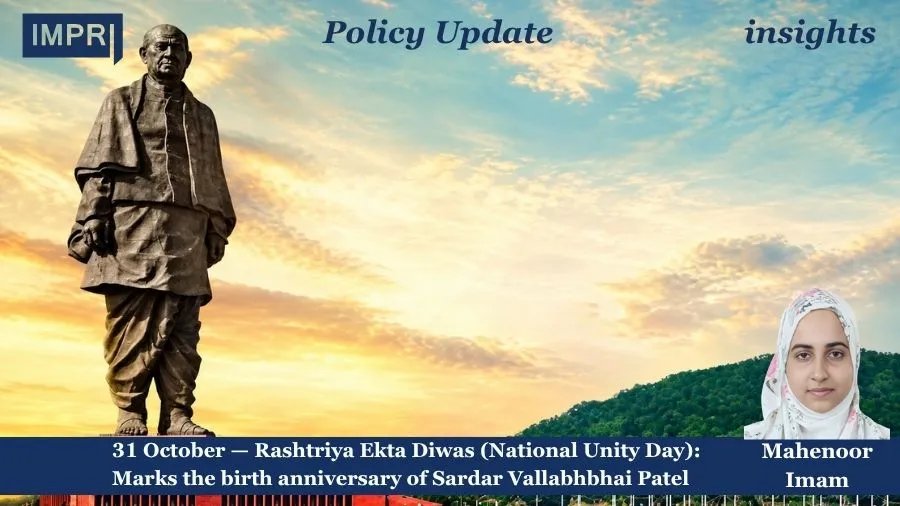
Policy Update
Mahenoor Imam
Background
“Manpower without Unity is not a strength unless it is harmonized and united properly, then it becomes a spiritual power” -Sardar Vallabhbhai Patel
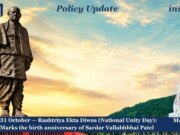
Rashtriya Ekta Diwas, also known as National Unity Day, is observed annually on October 31 to commemorate the birth anniversary of Sardar Vallahabhai Patel, a pivotal figure in India’s struggle for independence, the Iron Man of India, and the architect of a united India, and to honour his pivotal role in fostering national and political integration and unity in India. The day underscores in maintaining the sovereignty, peace and integrity of the nation, encouraging citizens to pledge in unity in diversity.
As India’s first home minister and deputy prime minister, Patel is credited with the merger of over 500 princely states with the Union of India. Rashtriya Ekta Diwas has been observed every year on 31 October since 2014. On 23 October 2024, the Government of India would mark the 150th birth anniversary of Sardar Vallabhbhai Patel, which fell on 31 October 2025, with a two-year nationwide celebration running from 2024 to 2026 (All India Radio News, 2024; Deccan Herald, 2024). Under this commemoration, programmes across the country recall Patel’s role in unifying India. Some events belong to the anniversary programme, such as the Sardar@150 Unity March of 2025. Others belong to the annual Rashtriya Ekta Diwas observance.
The Rashtriya Ekta Diwas Parade 2026 will be a magnificent celebration of India’s unity and national spirit. It will be held at Ekta Nagar, Gujarat, on the evening of 31 October 2026. At a press conference on 21 October 2026, Union Home Secretary Govind Mohan said the celebrations would focus on the end of armed Naxalism and on 150 years of Vande Mataram (DD India, 2026). It key highlights include:
- Contingents of State Police forces and Central Armed Police Forces involved in operations against armed Naxalism will march in the parade. The number of contingents was not announced.
- There will be 15 tableaux, designed through public competitions on MyGov and in Gujarat’s districts.
- The National School of Drama will stage a performance based on Anandamath, featuring about 2,000 artists from 126 districts once affected by armed Naxalism.
- About 5,000 people from these districts have been invited.
- About 25,000 people are expected to attend (ANI, 2026a).
A national motorcycle rally, with 45 riders from each State, Union Territory and CAPF, has also been reported as part of the observance (ANI, 2026b).
- The parade has an estimated 10,000 participants, including personnel from the Police and Paramilitary Forces as well as artists from across the country.
- Rock Band performances and a spectacular flypast by the Indian Air Force.
- After Rashtriya Ekta Diwas, the Ministry of Tourism lists Bharat Parv at the Statue of Unity from 1 to 15 November 2026, under the theme “Ek Bharat Shreshtha Bharat” (Ministry of Tourism, 2026b). The festival is not new to either venue: the Ministry holds Bharat Parv at the Red Fort every Republic Day, most recently from 26 to 31 January 2026 (Ministry of Tourism, 2026a), and Ekta Nagar hosted an edition from 1 to 15 November 2025.
Conceived to celebrate India’s cultural diversity, the festival showcases traditional crafts, art forms, performances and regional cuisines. The Studio Kitchen complements this celebration by offering tourists a unique culinary experience that highlights the nation’s rich and diverse food culture.
History
Sardar Vallabhbhai Patel was born on 31 October 1875 in Nadiad, Gujarat. He was a successful lawyer, but his life took a major turn in 1918 when Mahatma Gandhi chose him to lead the Kheda Satyagraha. The movement was organised to support farmers facing difficulties due to crop failure and the burden of taxes. This experience inspired Patel to dedicate his life to public service and the freedom struggle.
In 1924, Patel became the President of the Ahmedabad Municipal Board. During his tenure, he improved the city’s drainage, sanitation, cleanliness and water distribution systems. He also personally participated in cleaning the Harijan quarter of the city, demonstrating his commitment to public service. His efforts earned him great respect among the people of Ahmedabad.
Patel’s role in the freedom movement grew further through the Bardoli Satyagraha of 1928. He led farmers in their protest against increased land revenue. His strong leadership, organisational skills and dedication made the movement a major success. It was during this movement that he earned the title ‘Sardar’, meaning leader. He subsequently became one of the most important leaders of India’s struggle for independence.
At Independence, India comprised the British provinces and about 565 princely states (estimates range from 562 to 565). With the end of British paramountcy, each ruler could accede to India or Pakistan, or remain independent. In mid-1947, a States Department was set up under Sardar Vallabhbhai Patel, with V. P. Menon as Secretary (PIB, 2021). Menon devised the Instrument of Accession, under which rulers ceded only defence, external affairs and communications to India (Menon, 1956). Patel’s political authority and persuasion won the rulers’ agreement. By 15 August 1947 almost all states had acceded. Junagadh, Hyderabad and Jammu and Kashmir joined later, through a plebiscite, a police action and the Maharaja’s accession respectively (PIB, 2021). Patel played a crucial role in bringing these princely states into the Indian Union, helping to establish a united India.
On 15 August 1947, Patel became the first Deputy Prime Minister and Home Minister of independent India. He also took charge of the Ministry of Information and Broadcasting. His contribution to the integration of princely states earned him lasting recognition as one of the key architects of modern India.

Dr Rajendra Prasad administers the Oath of Office At a Press Conference on the Integration of States to Sardar Patel , Source: Sardar Vallabhbhai Patel: The Man Who United The Nation.
National Unity Day 2026
Theme: The theme of National Unity Day 2026 is “Ek Bharat Shreshtha Bharat,” emphasising national integration and unity in diversity. The celebrations at Ekta Nagar, Gujarat, will also focus on commemorating 150 years of Vande Mataram, promoting a drug-free India, highlighting national security and showcasing India’s cultural diversity through Bharat Parv.
Key Events and Celebrations: The celebrations will include a Unity Parade featuring state police forces and Central Armed Police Forces (CAPFs), 15 tableaux, an Indian Air Force flypast, cultural performances by around 2,000 artists from 126 districts affected by Left-Wing Extremism, a Run for Unity and a national motorcycle rally. Approximately 25,000 people are expected to attend.
Objectives: The celebrations aim to highlight the contributions of police and security forces in maintaining national security and combating armed Naxalism. They also seek to encourage public participation, promote cultural exchange and strengthen national integration through activities at the Statue of Unity complex.
Significance: National Unity Day commemorates Sardar Vallabhbhai Patel’s contribution to India’s political integration. It promotes unity in diversity, national security, civic responsibility and respect for different cultural identities. Through public events and youth participation, the observance seeks to strengthen social harmony and encourage citizens to contribute to nation-building.
Statue of Unity: History, Construction and Tourism
The Statue of Unity is a monument dedicated to Sardar Vallabhbhai Patel, the project was announced in 2013 by Narendra Modi, then Chief Minister of Gujarat, to honour Patel’s contribution to national unity. The statue was inaugurated on 31 October 2018, Patel’s 143rd birth anniversary, at Ekta Nagar (formerly Kevadia), in Gujarat.
Key features:
- World’s tallest statue: The statue stands 182 metres tall, with a 58-metre base. Its height was selected to correspond with the 182 seats in the Gujarat Legislative Assembly at the time of the project’s conception.
- Engineering and materials: The structure uses reinforced concrete, structural steel and bronze cladding. Its design incorporates engineering measures to withstand strong winds and earthquakes.
- Visitor facilities: The complex includes a museum, exhibition hall and a viewing gallery at approximately 153 metres, offering views of the Narmada River and Sardar Sarovar Dam.

Source: Wikipedia- Skyline of Statue of Unity
Construction and Funding: The project was developed by the Government of Gujarat through the Sardar Vallabhbhai Patel Rashtriya Ekta Trust (SVPRET). Larsen & Toubro (L&T) received the contract for design, construction and maintenance in October 2014, and construction began on 31 October 2014. The monument was completed in 2018.
The funding structure included state government resources, a Union Budget allocation and contributions from public sector undertakings under Corporate Social Responsibility (CSR).
| Funding detail | Amount / source |
| Gujarat government allocation (2012–15) | ₹500 crore |
| Union Budget allocation (2014–15) | ₹200 crore |
| L & T contract value, awarded October 2014 | ₹2,989 crore |
| Reported construction cost incurred up to 31 December 2019 | ₹2,361.29 crore |
Sources: Government of India, PIB, 30 November 2016; Ministry of Tourism, Rajya Sabha reply, 17 March 2020.
Tourism and Regional Development: The Statue of Unity has become a major tourism destination, attracting visitors to the Narmada Valley and supporting the development of tourism infrastructure in Ekta Nagar. Its associated attractions include the viewing gallery, museum, exhibition spaces and Sardar Patel Zoological Park, popularly known as Jungle Safari. The tourism complex is intended to generate economic opportunities through hospitality, transport, local businesses and employment. It also provides a platform for cultural programmes and national events, including Rashtriya Ekta Diwas celebrations on 31 October.
Impact
Rashtriya Ekta Diwas has gained national recognition through annual events and public participation. However, there is limited evidence to show whether these activities have improved public attitudes or strengthened national integration. Most available data measure participation rather than long-term outcomes.
Civic Participation: The Run for Unity and unity pledge are organised across schools, universities, government departments and police forces. Under the Sardar@150 initiative, more than 10 lakh people participated in 842 district-level padyatras. However, the increase in participation cannot be attributed solely to National Unity Day programmes. The district marches led to a 150 km national padyatra from Karamsad to Ekta Nagar, held from 26 November to 6 December 2025 (Ministry of Youth Affairs and Sports, 2025). Registrations on the MY Bharat platform also rose from about 0.5 crore in 2023 to over 2.5 crore by August 2026 (IMPRI, 2026). These figures are reported by the organisers and have not been independently audited.
Institutional Reach: The Ek Bharat Shreshtha Bharat programme promotes cultural and educational exchanges between States and Union Territories. Schools also organise activities under this initiative. However, independent evidence on its impact on inter-state understanding remains limited. Announced on Patel’s birth anniversary in 2015, the programme pairs States and Union Territories with one another for language, cultural and tourism exchanges. Its school guidelines were revised in 2020 to align with the National Education Policy, and include EBSB clubs and learning simple phrases in the partner state’s language (Department of School Education & Literacy, 2020). No independent evaluation of the programme has been published so far.
Tourism and Local Economy: The Statue of Unity has become a major tourist attraction, drawing around 58.25 lakh visitors in 2024. Tourism has created opportunities in transport, hospitality and local services. However, more evidence is needed to assess its long-term benefits for local communities. More than 2 crore people have visited the statue since it opened in 2018 (Aaj Tak, 2025), and the Government reported a construction cost of ₹2,361.29 crore up to December 2019 (Ministry of Tourism, 2020). In its first months, footfall was well below official projections, but numbers have grown steadily since. Local communities have gained jobs in e-transport and hospitality, but tribal groups in the area have also raised concerns about land and rehabilitation (The Wire, 2019).
Recognition of Contributions: The Sardar Patel National Unity Award was introduced in 2019 to recognise contributions towards national unity and integrity. Its impact depends on regular implementation and wider public awareness. The Ministry of Home Affairs notified the award on 20 September 2019 as the highest civilian honour in this field. It consists of a medal and a citation with no cash prize, and no more than three awards can be given in a year (Ministry of Home Affairs, 2019). Nominations are invited each year through the National Awards Portal, but there is little public information on recipients so far.
Spending compared with major national needs
The Statue of Unity cost ₹2,361.29 crore in construction spending up to December 2019 (Ministry of Tourism, 2020), against an L&T contract value of ₹2,989 crore awarded in 2014. This one-time spending equals about a fifth of the Union Government’s 2026-27 allocation for PM POSHAN and about half of the entire Youth Affairs and Sports budget.

Source: Ministry of Health’s 2026-27 allocation and the Ministry of Education cited by the author.
Emerging Issues
Despite the wide reach of Rashtriya Ekta Diwas, several concerns remain regarding its effectiveness, funding, local impact and public participation.
1. Lack of Outcome Measurement: Most activities focus on events such as runs, pledges and parades. There are no clear indicators to measure whether these activities improve social harmony or understanding between states. Participation figures are generally reported by organisers, with limited independent verification.
2. Funding Transparency: The costs of annual celebrations and related activities need clearer public disclosure.In its Report No. 18 of 2018, the CAG observed that ₹146.83 crore contributed by five oil public sector companies (ONGC, IOCL, BPCL, HPCL and OIL) to the Statue of Unity did not qualify as CSR activity under Schedule VII of the Companies Act, 2013, since the statue was not a heritage asset (CAG, 2018, para. 4.5.4.4). The companies argued that MCA Circular No. 21/2014 allowed a liberal interpretation, which the CAG did not accept. This remains an audit observation: no subsequent official determination of non-compliance has been published.
3. Opportunity Cost: The Statue of Unity involved a major public investment of around ₹2,989 crore. This raises questions about how public resources are balanced between tourism projects and essential services such as nutrition, healthcare and education, particularly in areas facing development challenges.
4. Tribal Rights and Rehabilitation:Tourism development around Ekta Nagar has raised concerns among Adivasi residents. In 2019, a petition alleged that about 5,000 residents of six Kevadia Colony villages faced eviction from land acquired in 1961–62 for the Sardar Sarovar dam and later earmarked for tourism. The Gujarat High Court ordered a status quo but later dismissed the petition, while the state said compensation had already been paid (The Wire, 2019; Land Conflict Watch, 2025). Residents also argue that the Statue of Unity Tourism Act, 2019 bypasses Gram Sabhas in this Fifth Schedule area; a challenge to the Act is pending. Under the Panchayats (Extension to Scheduled Areas) Act, 1996 and Section 41 of the Right to Fair Compensation Act, 2013, Gram Sabhas must be consulted on, or consent to, land acquisition and resettlement in Scheduled Areas. These concerns highlight the need to protect tribal rights and ensure meaningful consultation with affected communities.
5. Political Differences and Public Participation: Political parties have different interpretations of Sardar Vallabhbhai Patel’s legacy. Moreover, official instructions encouraging participation in unity programmes may raise questions about whether participation is entirely voluntary. If such events are perceived as politically driven or compulsory, they may weaken their broader message of unity and inclusion.
Way Forward
To improve the effectiveness of Rashtriya Ekta Diwas, the Government should move from counting participation to measuring outcomes. A baseline survey could first record current levels of inter-state awareness, language familiarity and attitudes towards other regions among students and youth.
Progress could then be tracked through annual data from the MY Bharat and Ek Bharat Shreshtha Bharat portals, including repeat engagement, such as how many participants go on to join exchanges, clubs or volunteering after a one-day event. Language-learning outcomes could be assessed through simple tests in schools paired under Ek Bharat Shreshtha Bharat.
Every few years, an independent evaluation, for example by the Development Monitoring and Evaluation Office (DMEO) or a university, could compare participants with non-participants to assess changes in inter-state cultural understanding. Publishing these findings in a periodic public report would help distinguish short-term participation from lasting social impact.
Financial transparency should also be strengthened by publishing detailed expenditure on National Unity Day celebrations, the Unity Parade and related programmes. Public funds and CSR contributions should follow clear rules and remain open to public scrutiny.
Tourism revenue from the Statue of Unity could be used to support healthcare, nutrition, education and employment in Narmada district. This would help ensure that local communities benefit from tourism-led development. At the same time, tribal rights must be protected through proper consultation with affected communities, respect for Gram Sabha powers under the Panchayats (Extension to Scheduled Areas) Act (PESA), and compliance with legal safeguards on land acquisition and rehabilitation.
Finally, national integration activities should continue throughout the year through school programmes, cultural exchanges and youth volunteering. Participation should remain voluntary and inclusive, encouraging people from different states and communities to contribute to nation-building.
References
- Aaj Tak. (2025, January 7). Statue of Unity created new record in terms of tourists. Aaj Tak.
- All India Radio News. (2025, October 6). Union Minister Dr. Mansukh Mandaviya launches Sardar@150 Unity March. Prasar Bharati.
- All India Radio News. (2025, November 2). Chief Minister Bhupendra Patel inaugurates Bharat Parv at Ekta Nagar in Gujarat. Prasar Bharati.
- All India Radio News. (2025, November 19). National padyatra announced to mark 150th birth anniversary of Sardar Patel. Prasar Bharati.
- Deccan Herald. (2024, October). Government to commemorate 150th birth anniversary of Sardar Patel with two-year-long programme. Deccan Herald.
- DeshGujarat. (2025, October 27). Ekta Diwas celebrations at Statue of Unity; 16 contingents, 9 marching bands, 10 tableaux to be part of parade. DeshGujarat.
- Government of Gujarat. (2019). Statue of Unity Area Development and Tourism Governance Act, 2019. Gujarat Legislative Assembly.
- Ministry of Finance. (2026). Union Budget 2026-27: Demands for grants. Government of India.
- Ministry of Youth Affairs and Sports. (2025). Sardar@150 Unity March. MY Bharat, Government of India.
- Press Information Bureau. (2018, December 31). HRD Ministry has taken several initiatives to promote national integration under Ek Bharat Shreshtha Bharat. Ministry of Human Resource Development, Government of India.
- Press Information Bureau. (2021, October 31). Ek Bharat Shreshtha Bharat: Backgrounder. Government of India.
- Press Information Bureau. (2022, July 25). Ek Bharat Shreshtha Bharat. Ministry of Education, Government of India.
- Press Information Bureau. (2025, October 30). Rashtriya Ekta Diwas: A pillar of national cohesion [Backgrounder]. Government of India.
About the Contributor
Mahenoor is a postgraduate in Political Science from University of Calcutta, Kolkata. She is a former UPSC Civil Services Aspirant. Her interests lie in governance, social equity and welfare policy, with a focus on the gap between policy design and on-ground implementation.
Acknowledgement
The author extends sincere gratitude to Aditya Chavan and Khushi for their invaluable guidance and support.
Disclaimer
All views expressed in the article belong solely to the author and not necessarily to the organization.