





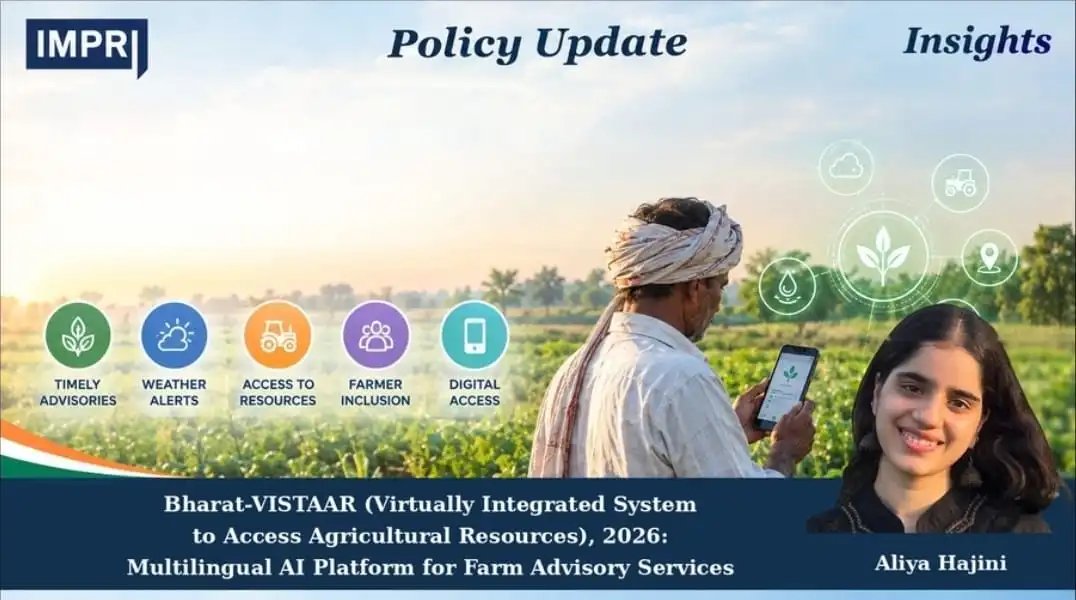
Policy Update
Aliya Hajini
Background
Bharat-VISTAAR (Virtually Integrated System to Access Agricultural Resources) is a multilingual, AI-powered Digital Public Infrastructure (DPI) platform for agriculture, announced in the Union Budget 2026-27 with an allocation of ₹150 crore (Press Information Bureau [PIB], 2026c). The Government describes it as a nationwide, voice-first system designed to provide farmers with reliable, real-time and location-specific advisories on crops, weather, markets, pests and diseases, soil health, and access to allied services and government schemes (PIB, 2026c).
The platform responds to long-standing fragmentation in agricultural information (PIB, 2026a). Farmers traditionally had to navigate separate offices, websites and apps for weather forecasts, mandi prices, crop practices and scheme benefits, which made it hard to check eligibility, track benefits or get complaints resolved on time (PIB, 2026a). Bharat-VISTAAR seeks to bring these sources into a single interface to support more informed decision-making and easier access to government services (PIB, 2026a).
Phase I was launched on 17 February 2026 in Jaipur, Rajasthan, by Union Agriculture Minister Shivraj Singh Chouhan, alongside an AI Hackathon and the Agri Kosh AI Strategy Roadmap to promote agri-tech innovation (PIB, 2026b). At launch, the platform integrated information from ten major central schemes—including PM-KISAN, PMFBY, Soil Health Card and Kisan Credit Card (PIB, 2026c)—and was made available in Hindi and English through a dedicated helpline (155261), a voice-based AI assistant (“Bharati”), a web portal and a mobile application (PIB, 2026a; PIB, 2026c). The Government announced that four additional languages would be added within three months and that the platform would reach 11 languages within six months (PIB, 2026a).
Functioning
Bharat-VISTAAR combines government digital systems with scientific agricultural knowledge to generate personalised, location-specific advisories. In Phase I, it draws on weather data from the India Meteorological Department (IMD), market prices from AgMarkNet, pest and disease alerts from the National Pest Surveillance System (NPSS), ICAR’s Package of Practices, AgriStack data, and information on ten central schemes (PIB, 2026a).
Using these inputs, the platform is designed to provide advisories on crop management practices, weather forecasts, mandi prices, pest and disease warnings, and soil health recommendations (PIB, 2026a).
The Ministry describes Bharat-VISTAAR as a “plug-and-play” central digital public infrastructure designed to interface seamlessly with central, state, and cooperative systems (PIB, 2026a). A critical architectural distinction must be maintained between the central platform and state-level platforms: while Bharat-VISTAAR serves as the nationwide foundational network and central scheme aggregator, state-specific platforms—such as Maharashtra’s MahaVistaar and Vasudha, Gujarat’s AmulAI, and the Bihar Krishi App—act as localized execution nodes that deliver regional-language voice tools and state-tailored extension networks (PIB, 2026a; PIB, 2026c).
Farmers can access Bharat-VISTAAR through a toll-free helpline (155261) with Interactive Voice Response System (IVRS) and voice-based AI, a web interface on the Ministry of Agriculture & Farmers Welfare website, mobile applications, and links with related government platforms. Voice and IVRS access are specifically intended to support small and marginal farmers, including those without smartphones or with limited digital literacy. At launch, the chatbot and voice assistant were available in Hindi and English, with plans to expand to regional languages and integrate state-specific schemes and extension networks (PIB, 2026a; PIB, 2026c).
Beyond crop advisories, the platform allows farmers to register and track PM-KISAN complaints directly, streamlining service delivery and reducing the need for repeated visits to government offices or navigating multiple portals (PIB, 2026a).
Performance
Bharat-VISTAAR was launched in February 2026, meaning long-term socio-economic outcomes cannot yet be robustly evaluated. However, an analysis of early operational indicators and implementation milestones reveals notable gaps between initial targets and current status.
Budget and Launch: The Union Budget 2026-27 allocated ₹150 crore to the platform, and Phase I was successfully launched on schedule on 17 February 2026 (PIB, 2026c).
Scheme Integration: Phase I successfully integrates ten major central schemes. However, the Ministry’s target to integrate all remaining central schemes for eligibility, benefit status, and grievance redressal by May 2026 (PIB, 2026a) has passed without any public verification or official status update.
Language Expansion: While initial announcements promised four additional languages within three months and 11 languages within six months (PIB, 2026a), the central portal as of October 2026 continues to list support for only two primary languages across three states (Ministry of Agriculture & Farmers Welfare, n.d.). Broader regional access remains dependent on state partner networks like MahaVistaar and AmulAI (PIB, 2026a).
Usage and Adoption Data: A critical institutional limitation is the complete absence of disaggregated national usage statistics. Official releases and media reports lack verified data on registered farmer counts, call volumes handled through the helpline (155261), query resolution turnaround times, or geographic distribution (PIB, 2026a, 2026b, 2026c.. For comparative scale, Maharashtra’s state-level MahaVistaar crossed three million downloads within its first few months (Gandikota, 2026), though app downloads reflect initial reach rather than true agricultural impact.
Table 1: Implementation Targets and Early Performance Status of Bharat-VISTAAR
| Indicator | Government announcement / target | Early status (as of October 2026) |
| Budget allocation | ₹150 crore (Union Budget 2026-27) | Allocated (PIB, 2026c) |
| Launch | Phase I on 17 February 2026 | Launched in Jaipur (PIB, 2026b) |
| Languages | Four more within 3 months; 11 within 6 months | Website shows 2 (Ministry of Agriculture & Farmers Welfare, n.d.) |
| Central schemes integrated | Ten at launch; all central schemes by May 2026 | Ten at launch; no public update on the May 2026 target found |
| Access channels | 155261, web, mobile, voice/IVRS | Available (PIB, 2026c) |
| Usage data | Public reporting needed to assess adoption | No consolidated national figures found |
Source: Author’s compilation from PIB (2026a, 2026b, 2026c) and Ministry of Agriculture & Farmers Welfare (n.d.), retrieved October 8, 2026.
Impact
The Government’s stated objective is to make agricultural information more accessible, technology-driven and integrated, thereby helping farmers make better-informed decisions. The platform addresses a real problem: the fragmentation of information on schemes, weather, markets, insurance and soil health, which farmers previously obtained from multiple sources (PIB, 2026a).
In practice, Bharat-VISTAAR has built three things: a common window for ten central schemes, voice and IVRS access for non-smartphone users, and a backend that pulls data from IMD, AgMarkNet, NPSS, ICAR and AgriStack (PIB, 2026a; PIB, 2026c). On paper, this is what a digital public infrastructure for agriculture should look like.
However, infrastructure creation alone does not demonstrate impact. The platform is still at an early stage, and no independent evaluation or consolidated public usage figures were found. It is therefore too early to conclude that Bharat-VISTAAR has improved farm incomes, reduced costs, or systematically changed agricultural decision-making. The Government’s expectation of reaching “lakhs of farmers” should be treated as intended reach rather than measured outcome (PIB, 2026a). For a smallholder in, say, Vidarbha or Purvanchal, the real test will be whether the advice she gets is timely, affordable to act on, and trustworthy enough to shape her next sowing decision.
Emerging Issues
1. Ground realities and digital literacy. A report in The Secretariat points out that it is unclear whether advisories will reflect on-ground constraints such as water scarcity, power shortages and labour availability, and that farmers with limited digital literacy may not benefit fully. A Bharatiya Kisan Sangh representative quoted in the report said farmers first need timely access to inputs, water, electricity and markets, and that many grow several crops together to manage weather and income risks, which crop advisory should not disturb .
2. Over-production and market risk. If large numbers of farmers in the same region receive similar crop recommendations, local supply could rise sharply, contributing to price declines, a risk that experts quoted in The Secretariat have also raised . This creates a design challenge: advisories must account not only for agronomic suitability but also for local planting patterns, acreage and market demand, to avoid unintended market distortions.
3. Technology dependence and data protection. The use of AI and AgriStack raises questions about data governance, transparency and accountability. The Government states that Bharat-VISTAAR complies with the Digital Personal Data Protection Act, 2023 and cybersecurity guidelines (PIB, 2026c), yet it remains important to clarify what farmer data is collected, how it is processed, who can access it, and which authority audits compliance. The Secretariat report also notes concern about growing dependence on large technology companies for AI and data infrastructure . Transparency here is critical for maintaining farmer trust.
4. Forecast failure and accountability. Agricultural decisions involve significant financial risk. Weather forecasts and AI recommendations may be less reliable during extreme events such as heavy rainfall, heatwaves or disasters, and it remains unclear who is accountable if a farmer suffers losses after following incorrect or unsuitable AI-generated advice . Clear disclaimers alone may be insufficient where recommendations influence high-cost decisions.
5. Language coverage and awareness. Language accessibility remains a concern. In May 2026, a Gujarat Agriculture Department official told The Secretariat that the platform was available only in English and Hindi, with Gujarati to follow, and a Bharatiya Kisan Sangh leader from Gujarat said it had not yet been widely promoted in the state . The Government, however, highlights state-linked systems (MahaVistaar/Vasudha, AmulAI’s Gujarati assistant and the Bihar Krishi App) as part of its language and integration strategy (PIB, 2026a). This creates a need to distinguish between language availability through the central Bharat-VISTAAR interface and through the wider ecosystem of state platforms.
6. Limited public data. As noted under Performance, no consolidated figures on registrations, calls handled or queries resolved were found. Without them, it is hard to judge adoption, reach among small and marginal farmers, or the use of the ₹150 crore allocation.
Way Forward
1. Address over-production risk
Implementation: The Ministry of Agriculture & Farmers Welfare, in collaboration with State Agricultural Departments, should incorporate real-time district-level seed distribution and acreage tracking into the platform’s recommendation engine. Algorithms must automatically cap recommendations for specific crops once regional acreage thresholds are met, promoting crop diversification across agro-climatic zones.
2. Balance technology with expert oversight
Implementation: Establish a mandatory human validation protocol for high-stakes AI recommendations—such as chemical pesticide dosage, disease control, or extreme weather alerts. Before reaching farmers via voice or SMS, automated outputs should be reviewed and verified by district-level Krishi Vigyan Kendra (KVK) agronomists.
3. Create clear accountability mechanisms
Implementation: Form state-level Digital Advisory Grievance Cells under the existing Agricultural Extension machinery to record, investigate, and resolve claims of crop loss resulting from erroneous AI advisories. Additionally, the Ministry should work with insurance authorities to evaluate integrating technology-linked advisory failures under the PMFBY insurance coverage framework.
4. Expand languages and last-mile access
Implementation: Publish a strict, phased roadmap for adding all 22 official languages to the central platform. To ensure contextual accuracy, the Ministry should partner with State Agricultural Universities (SAUs) and local extension networks to build localized dialect and crop terminology datasets, combining digital voice tools with frontline KVK workers to build trust and digital literacy.
5. Publish regular performance data
Implementation: Establish an open-access public dashboard on the official website publishing monthly operational metrics: total farmers registered, call volumes on the helpline (155261), query resolution turnaround times, language usage ratios, and geographic distribution. Ensuring complete transparency through such regular reporting would allow researchers and citizens to assess platform adoption, effectiveness, and the use of the ₹150 crore allocation more independently.
References
Gandikota, S. (2026, October 1). MahaVISTAAR: Scaling agricultural AI. Gateway House. https://www.gatewayhouse.in/mahavistaar-scaling-agricultural-ai/
Ministry of Agriculture & Farmers Welfare. (n.d.). BharatVistaar [Web portal]. Government of India. Retrieved October 8, 2026, from https://vistaar.da.gov.in/
Press Information Bureau. (2026a, February 16). AI farmer revolution to begin from Jaipur: Union Minister Shri Shivraj Singh Chouhan to launch ‘Bharat-VISTAAR’ (Release ID: 2228842). Ministry of Agriculture & Farmers Welfare, Government of India. https://www.pib.gov.in/PressReleaseDetail.aspx?PRID=2228842
Press Information Bureau. (2026b, February 17). Amid the AI Summit in Delhi, Union Minister Shri Shivraj Singh Chouhan launched the artificial intelligence-based scheme ‘Bharat VISTAAR’ Phase 1 in Rajasthan (Release ID: 2229256). Ministry of Agriculture & Farmers Welfare, Government of India. https://www.pib.gov.in/PressReleaseDetail.aspx?PRID=2229256
Press Information Bureau. (2026c, March 13). Rollout of BHARAT-VISTAAR platform (Release ID: 2239788). Ministry of Agriculture & Farmers Welfare, Government of India. https://pib.gov.in/PressReleasePage.aspx?PRID=2239788
Purohit, G. (2026, May 13). AI in agriculture: Bharat VISTAAR faces triple test. The Secretariat. https://thesecretariat.in/article/ai-in-agriculture-bharat-vistaar-faces-triple-test-of-credibility-market-risk-accountability
About the Contributor
Aaliya Hajini has recently completed her Bachelor’s degree in Economics and Political Science from the University of Delhi. Her main areas of research interest include gender equality, women’s empowerment, and public policy, with a focus on how policy design and implementation affect marginalized groups in India.
Acknowledgement
My sincere thanks to the Impact and Policy Research Institute (IMPRI) for the opportunity to prepare this policy update article. IMPRI’s dedication to connecting research with actionable policy practice provides an invaluable platform for learning.
Reviewers
Amrutha and Himanshi Singh
Disclaimer
The opinions expressed in this article are strictly those of the author and do not reflect the official position or views of the organization.
Read More at IMPRI:
India–UN Development Partnership Fund (2024): Advancing South–South Development Cooperation