








Policy Update
Gowri Kodali
Introduction
India’s biotechnology sector has expanded significantly over the past decade, with the bioeconomy growing from $10 billion in 2014 to $165.7 billion in 2024, accounting for approximately 4.25% of GDP. And the target? $300 billion by 2030 (PIB, 2025)[2]. Recent global supply-chain disruptions, particularly during the COVID-19 pandemic, exposed India’s dependence on imported biological inputs and reinforced the need for domestic biomanufacturing capacity. But strong science alone won’t make India an industry leader.
Biotech ideas face tough hurdles once they leave the lab – validation, scaling up, navigating regulations, manufacturing, and getting to market. The Biotechnology Research Innovation and Entrepreneurship Development (Bio-RIDE) scheme steps in to tackle that crucial gap. Approved by the Union Cabinet on 18 September 2024, Bio-RIDE operates under the Department of Biotechnology (DBT), with an approved outlay of ₹9,197 crore for the 15th Finance Commission period (2021–22 to 2025–26), including the continuation of existing biotechnology programmes(PIB, 2024). The core challenge isn’t just pumping money into research – it’s making sure good research actually turns into usable products:
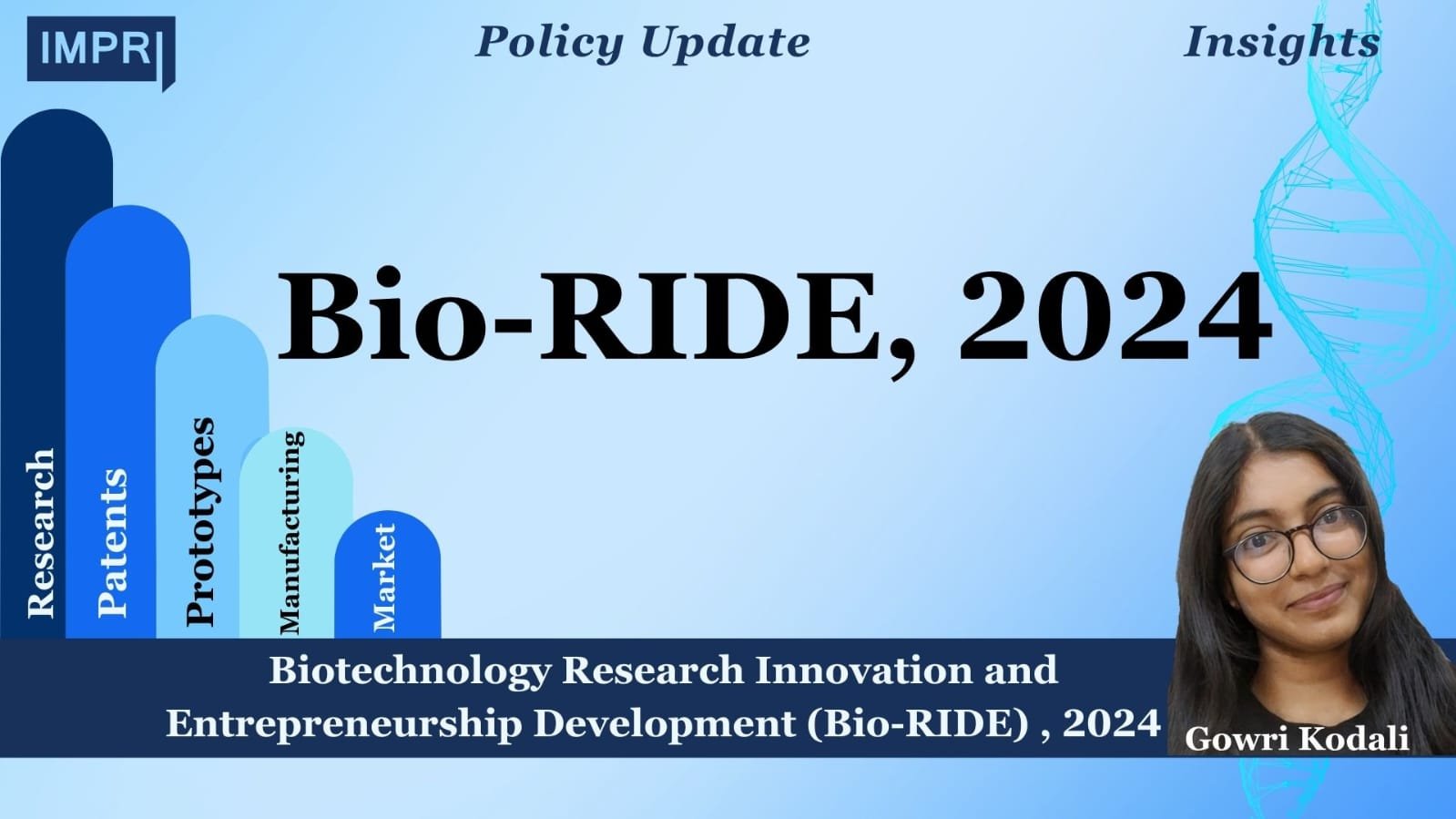
Research → Innovation → Scale-Up → Manufacturing → Market.
Background
Bio-RIDE consolidates DBT’s existing research and industrial development programmes while introducing Biomanufacturing and Biofoundry as a new component. Building on BIRAC’s existing support for early-stage innovation, Bio-RIDE places greater emphasis on shared biomanufacturing infrastructure, complementing individual project grants with facilities for validation and scale-up. The scheme comprises three components:
1. R&D: Funding both basic and applied research in biotech.
2. Industrial & Entrepreneurship Development: Backing startups, innovation, incubation, and working with industry and academia.
3. Biomanufacturing & Biofoundry: Setting up shared infrastructure to move promising biotech from lab benches to pilot and pre-commercial production.
The biomanufacturing part is key for bridging that tricky jump from lab prototype to real-world product. Startups often get stuck in the infamous “valley of death” between proof of concept and scaling up. They just don’t have the cash for pilot facilities, fermentation systems, validation, and regulatory compliance. Bio-RIDE teams up with the BioE3 Policy, which aims to boost biomanufacturing in fields like bio-based chemicals, food innovations, climate-resilient agriculture, and even marine and space research.
While BioE3 provides the broader policy direction for high-performance biomanufacturing, Bio-RIDE combines research funding, entrepreneurship development and biomanufacturing support. Their overlapping objectives require careful distinction between scheme-specific achievements and outcomes of the wider biotechnology ecosystem.
Functioning
Bio-RIDE covers every stage of biotech innovation – from discovery to commercialisation. The R&D component funds early scientific breakthroughs, while entrepreneurship programmes offer incubation, mentorship, and startup cash. Within DBT’s broader entrepreneurship-support ecosystem, BIRAC’s Biotechnology Ignition Grant (BIG) provides funding of up to ₹50 lakh over 18 months to support early-stage biotechnology innovations and proof-of-concept development (BIRAC, n.d.). DBT’s Annual Report 2024–25 documents the wider biotechnology incubation ecosystem, including 95 BioNEST and E-YUVA centres and over 9 lakh square feet of incubation infrastructure (DBT, 2025).
The broader DBT-supported biotechnology ecosystem has reported support for more than 2,500 incubatees and students, over 800 products and technologies progressing towards commercialisation, 1,300 intellectual property filings, and more than 25,000 skilled jobs (DBT, 2025). Biofoundry and Biomanufacturing modules tackle the hard stage: scaling up. These hubs focus on automation, bioengineering, and test-learn cycles.
Their shared models let startups, SMEs, universities, and researchers tap cutting-edge infrastructure without early-stage capital. A hub-and-spoke approach linking central biofoundries with regional BioNEST incubators could further reduce pilot-production costs by enabling startups to access specialised facilities without establishing their own. This makes the innovation pipeline way smoother:
Lab → Incubator → Biofoundry → Pilot Production → Commercialisation.
Performance
Approved in September 2024, Bio-RIDE remains at an early stage for assessing long-term commercialisation outcomes. Developments in the closely related BioE3 framework provide useful implementation context. The first call for Biofoundries and Biomanufacturing Hubs received 253 proposals, followed by 213 proposals in the second call, of which 24 were advanced by the Apex Committee. By August 2025, the National Biofoundry Network had been launched, alongside 15 Biomanufacturing Platforms covering areas such as chemicals, enzymes, biotherapeutics and agricultural biotechnology.
DBT also introduced a User Access Policy to facilitate access to Biofoundry infrastructure by researchers, startups and industry (DBT, n.d.). Separately, its 2025 year-end review reported support for over 3,000 startups, more than 1,300 intellectual property filings, and over 800 products at various stages of commercialisation, alongside 75 BioNEST and 19 E-YUVA centres (PIB, 2025)[5]. These figures reflect developments across the broader biotechnology ecosystem and should not be interpreted as outcomes attributable solely to Bio-RIDE.
The available figures demonstrate expansion of biotechnology infrastructure and entrepreneurial support, but do not yet establish Bio-RIDE’s independent contribution to commercialisation. A stronger assessment would require facility-level utilisation, pilot-scale completion, regulatory approvals and market-entry outcomes, including the proportion of Apex Committee-advanced proposals that eventually reach commercialisation. Another important evaluation requirement is component-wise expenditure tracking. The approved ₹9,197 crore outlay establishes the scheme’s financial framework, but assessing implementation requires information on actual fund releases, expenditure and utilisation across its three components. Where disaggregated data is unavailable, this limits the assessment of financial progress and programme effectiveness.
Impact
Opening Up Infrastructure
- Shared Biofoundry facilities can reduce the capital requirements faced by startups and SMEs by providing access to specialised equipment and technical infrastructure.
Supporting Sustainability
- Biomanufacturing isn’t just about healthcare – it stretches to materials, agriculture, industrial enzymes, carbon use, and eco-friendly manufacturing. Bio-RIDE can sync biotech policy with India’s environmental and industrial goals.
Building Strategic Tech Strength
- Homegrown capacity in vaccines, therapeutics, advanced manufacturing – these build resilience in health, agriculture, food security, and new technology sectors. Such capabilities could strengthen technological self-reliance and supply-chain resilience across critical sectors. Domestic production of high-value biologics, fermentation-derived industrial enzymes and selected active pharmaceutical ingredients could also reduce import dependence in strategically important sectors.
Key Challenges
- Research grants don’t automatically lead to commercial products. Without solid routes for validation, scaling, and market entry, discoveries stall.
- Infrastructure expansion alone is an insufficient measure of success without evidence of facility utilisation and successful technology translation.
- Biotech often takes longer and carries more risk than digital startups. There’s still a big gap between early-stage funding and commercial investment. Most advanced infrastructure and money cluster in established hubs. Bio-RIDE needs to make sure researchers outside big cities get fair access – through clear allocation policies, outreach to underrepresented areas, transparent selection, and regular access reporting to spot and fix blocks.
- Academia rewards papers; industry wants reproducibility, manufacturability, regulatory readiness, and commercial viability. A shortage of specialised bioprocess engineers and regulatory professionals could further constrain the operation and scaling of advanced biofoundries. Bio-RIDE should encourage researchers to go beyond publishing or patenting.
- Gene editing, synthetic biology, and new biological products face strict, sometimes shifting, regulation. Uncertainty brings costs and scares off investors. Just setting up a Biofoundry doesn’t promise fair access. Pricing, wait times, IP protection, and transparent scheduling all matter. The expansion of synthetic biology and biomanufacturing also requires robust biosafety, biosecurity and ethical oversight, alongside predictable regulatory pathways.
Way Forward
- First, DBT should create a Bio-RIDE Translation Scorecard to track each tech from research to proof-of-concept, prototype, pilot scale, regulatory check, manufacturing, and market. It’ll show exactly where ideas fall through.
- Second, every Biofoundry should post a Facility Utilisation Dashboard – who’s using it, capacity used, startup/SME access, turnaround time, and commercial outcomes.
- Third, Bio-RIDE should ramp up milestone-based funding. If a project hits certain technical milestones, it gets bigger support for validation, pilot manufacturing, scale-up. That bridges the gap between grants and big investment.
- Fourth, DBT should roll out a Lab-to-Market Conversion Rate: the ratio of commercially deployed tech to all projects that got translational support. It’s a direct measure of success.
- Fifth, targeted first-buyer mechanisms could support market entry for domestically developed biotechnology products that meet applicable safety, quality and cost-effectiveness standards.
- Sixth, the National Biofoundry Network should be connected nationwide – not siloed labs. Researchers should easily find and use infrastructure anywhere in India.
- Seventh, Bio-RIDE should build regional biotech nodes – not just in hot-spot cities, but around strong universities and research institutes in smaller or overlooked zones. Regional access mechanisms could reduce geographical disparities in biotechnology infrastructure and entrepreneurial support.
- Eighth, DBT should coordinate with CDSCO and other relevant regulatory agencies to establish an inter-ministerial single-window facilitation mechanism for early regulatory consultations and coordinated reviews, reducing avoidable delays while maintaining biosafety and clinical evaluation standards.
Bio-RIDE shouldn’t be judged only by money spent, facilities built, or patent numbers. The real test is: How many Indian scientific discoveries actually became scalable technologies because Bio-RIDE existed?
Conclusion
Bio-RIDE represents an effort to strengthen India’s biotechnology innovation ecosystem by integrating research, entrepreneurship and biomanufacturing within a ₹9,197 crore framework. While the sector has expanded significantly, the transition from scientific discovery to commercially viable products remains a critical challenge.
The scheme’s effectiveness will depend on access to shared infrastructure, sustained support for scale-up, regulatory preparedness and stronger linkages between research institutions and industry. Its long-term performance should therefore be assessed through measurable commercialisation outcomes rather than expenditure, infrastructure expansion or patent generation alone.
Ultimately, Bio-RIDE’s success will depend on whether publicly supported research produces scalable, internationally competitive and IP-protected biological technologies that strengthen domestic manufacturing and India’s position in the global bioeconomy.
Selected References
[1] Press Information Bureau, Cabinet Secretariat (18 September 2024).
Cabinet approves Bio-RIDE scheme.
Scheme approval, ₹9,197 crore outlay, three components and objectives.
https://www.pib.gov.in/PressReleasePage.aspx?PRID=2056004
[2] Press Information Bureau, Research Unit (March 2025).
India’s Bioeconomy: From $10 Billion to $165.7 Billion.
Bioeconomy size, GDP contribution, growth and 2030 target.
https://static.pib.gov.in/WriteReadData/specificdocs/documents/2025/mar/doc2025327528401.pdf
[3] Department of Biotechnology, Ministry of Science & Technology.
BioE3: Biofoundries and Biomanufacturing Hubs.
Official data on 253 first-call proposals, 213 second-call proposals, National Biofoundry Network, 15 platforms and User Access Policy.
https://bmi.dbt.gov.in/bio-hubs.php
[4] Department of Biotechnology, Ministry of Science & Technology (2025).
Annual Report 2024–25.
BioNEST/E-YUVA network, 9 lakh+ sq. ft. incubation space, products, IP filings, jobs and BIG funding.
https://dbtindia.gov.in/sites/default/files/DBT%20Annual%20Report%202024-25.pdf
[5] Press Information Bureau, Ministry of Science & Technology (16 December 2025).
Achievements of Department of Biotechnology – Year Ender 2025.
75 BioNEST Centres, 19 E-YUVA Centres, 3,000+ startups, 1,300+ IP filings and 800+ products progressing towards commercialisation.
https://www.pib.gov.in/PressReleasePage.aspx?PRID=2204756®=48&lang=2
About the Author
Gowri Kodali is pursuing a Master’s in Economics and currently works as a Research and Editorial Intern at the Impact and Policy Research Institute (IMPRI). She is also actively preparing for the UPSC Civil Services Examination, with a keen interest in public policy, governance and socio-economic development.
Acknowledgement:
I sincerely thank the IMPRI team for providing the opportunity to research and write this Policy Update. I am grateful for the guidance and feedback that helped strengthen the analysis and presentation of this article.
Read more at IMPRI:
AyushSuraksha: Digital Surveillance and Data-Driven Regulation in the Ayush Sector