






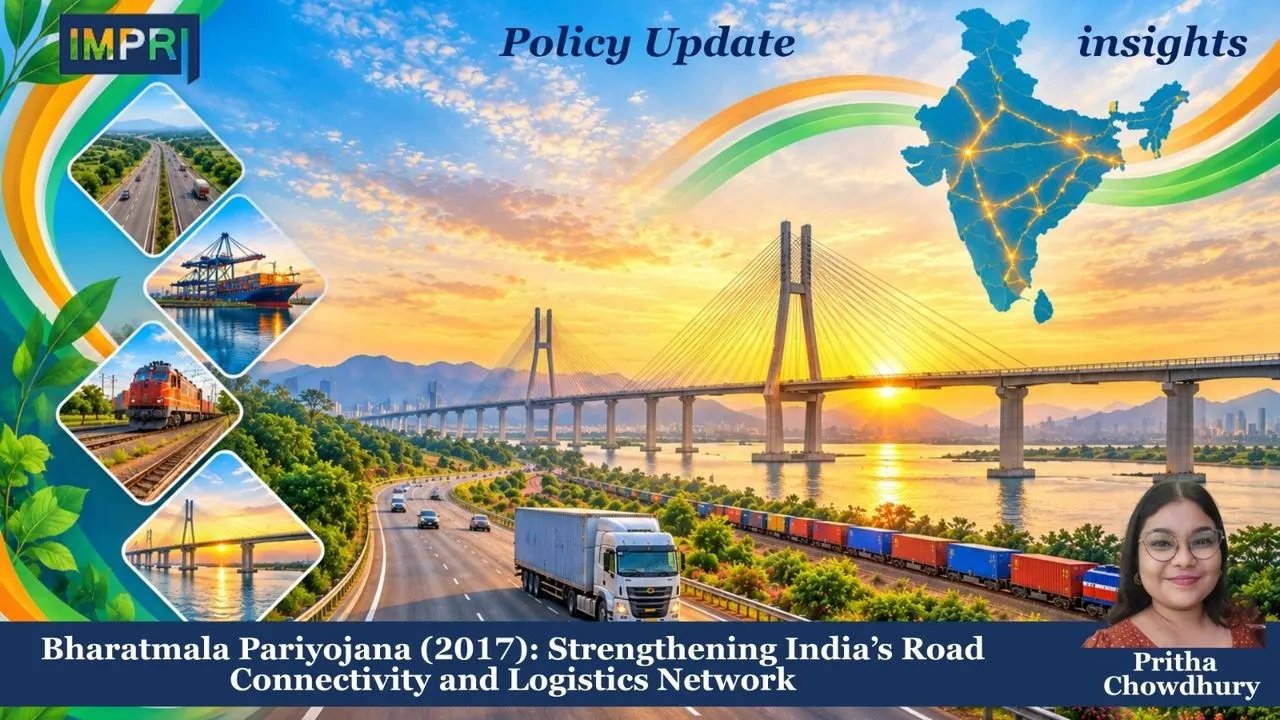
Policy Update
Pritha Chowdhury
Background
Bharatmala Pariyojana is a flagship highway development programme of the Government of India, launched in 2017 under the Ministry of Road Transport and Highways (MoRTH). The programme was introduced in response to several structural gaps in India’s highway network. These included the inadequate optimisation of the National Highway network due to resource constraints and the absence of a comprehensive national plan, limited integrated planning for connecting major economic corridors and ports with their hinterlands, persistent congestion points even along developed corridors, and inadequate accident-response infrastructure (MoRTH, 2017).
Bharatmala therefore adopted a corridor-based approach to improve the efficiency and integration of the road network rather than focusing only on constructing additional roads. It aimed to connect economic centres, production areas, ports, border regions and remote areas while reducing travel time, logistics costs and congestion (PIB, 2017).
Phase-I was approved by the Cabinet Committee on Economic Affairs (CCEA) on 24 October 2017, with an approved outlay of ₹5.35 lakh crore for the development and upgradation of 34,800 km of National Highways, including residual works under the National Highways Development Project (NHDP) ([MoRTH], 2018). The programme also sought to complement existing networks such as the Golden Quadrilateral and North-South and East-West corridors, thereby creating a more integrated and efficient national highway system.
Functioning
Bharatmala Pariyojana operates as an umbrella highway-development programme involving multiple categories of road infrastructure. There are six key features of the programme:
- Economic Corridors: Integrating the economic corridors facilitates larger connectedness between economically important production and consumption centers.
- Inter-corridor and Feeder routes:This would ensure first mile and last mile connectivity.
- National Corridor Efficiency Improvement: Through this, the greater actionable goal is to undertake lane expansion and decongestion of existing National Corridors.
- Border and International connectivity roads: Better border road infrastructure would ensure greater maneuverability, while also boosting trade with neighbouring countries.
- Coastal and Port connectivity roads: Port-led economic development is further boosted through connectivity to coastal areas, encouraging both tourism and industrial development.
- Green-field Expressways: Expressways have higher traffic configuration and choke points would benefit from green-field expressways.
As per the CCEA approval, Phase-I of Bharatmala shall be implemented over a period of five years i.e. 2017-18 to 2021-22.
Table1: Summary of Phase I components and approved outlay
| Sl. No | Components | Length (in km) | Outlay (in Crore) |
| 1 | Economic corridors development | 9,000 | 1,20,000 |
| 1 | Inter-corridor & feeder roads | 6,000 | 80,000 |
| 3 | National Corridors Efficiency improvements: | 5,000 | 100,000 |
| 4 | Border & International connectivity roads | 2,000 | 25,000 |
| 5 | Coastal & port connectivity roads | 2,000 | 20,000 |
| 6 | Expressways | 800 | 40,000 |
| Total | 24,800 | 385,000 | |
| Balance road works under NHDP | 10,000 | 1,50,000 | |
| Total | 5,35,000 |
Source: Bharatmala Pariyojna Phase-1
Bharatmala Pariyojana focusses on improving the capacity, connectivity and efficiency of the existing road network. Instead of developing highways in isolation, the programme identifies major economic corridors and connects them with feeder routes, ports, border areas and important economic centres. Under Phase-I, the programme aimed to develop 50 major corridors, increase the share of freight carried on National Highways, and improve four-lane connectivity to a larger number of districts (MoRTH, 2017). The transformation envisaged under the programme is illustrated below:
Source: Bharatmala Pariyojna, 2017
The project will build highways from Maharashtra, Gujarat, Rajasthan, Punjab, Haryana and then cover the entire string of Himalayan territories – Jammu and Kashmir, Himachal Pradesh, Uttarakhand – and then portions of borders of Uttar Pradesh and Bihar alongside Terai, and move to West Bengal, Sikkim, Assam, Arunachal Pradesh, and right up to the Indo-Myanmar border in Manipur and Mizoram. Special emphasis will be given on providing connectivity to far-flung border and rural areas including the tribal and backward areas
Performance
As of February 2025, 6,669 km length of high speed greenfield corridors has been awarded with construction completed for 4,610 km. As far as National Highways (NHs) are concerned, works are carried out as per standards, guidelines, manual, code of practice of Indian Roads Congress as well as Specification for Road and Bridge Works. Necessary road safety measures are taken during design, construction, operation and maintenance stages.
Further, guidelines have been issued for regular safety audit of all NHs at design, construction, pre-opening stage of NH projects as well as on existing NHs for ensuring road safety. Many Smart Technologies such as Automated & intelligent Machine-aided construction (AI-MC), LIDAR and drone based analytics etc are being adopted in Highway Construction (PIB, 2025).
Some of the major ongoing projects under the Bharatmala Pariyojana include:
- Delhi-Mumbai Expressway– a major greenfield expressway aimed at improving connectivity between Delhi and Mumbai.
- Zojila Tunnel– a strategic tunnel project improving all-weather connectivity to the Ladakh region.
- Kosi Bridge, Bihar– aimed at improving connectivity across the Kosi River.
- Mahatma Gandhi Setu (MG Setu), Bihar– strengthening road connectivity across the Ganga and improving access to North Bihar.
- Vikramshila Bridge on NH-131B, Bihar– improving connectivity across the Ganga and strengthening the road network in eastern Bihar.
- Nechipu–Hoj Road, Arunachal Pradesh– improving connectivity in the strategically important northeastern region.
Till 30 November 2025, projects covering 26,425 km had been awarded, of which 19,826 km had been completed, representing approximately 82% of the awarded length (PIB, 2025).
Table 2 : State Wise details of Awarded and Constructed length under Bharatmala Pariyojana Phase – I
| State | Length of Awarded Projects (km) | Length Constructed (km) |
| Andhra Pradesh | 1,936 | 1,070 |
| Assam | 431 | 381 |
| Bihar | 1,159 | 672 |
| Chhattisgarh | 471 | 291 |
| Delhi | 203 | 183 |
| Goa | 26 | 26 |
| Gujarat | 1,194 | 977 |
| Haryana | 1,058 | 940 |
| Himachal Pradesh | 167 | 115 |
| Jammu & Kashmir | 251 | 131 |
| Jharkhand | 801 | 481 |
| Karnataka | 1,603 | 1,109 |
| Madhya Pradesh | 2,017 | 1,586 |
| Maharashtra | 2,174 | 1,878 |
| Manipur | 635 | 417 |
| Meghalaya | 170 | 112 |
| Mizoram | 593 | 461 |
| Nagaland | 208 | 157 |
| Odisha | 967 | 909 |
| Punjab | 1,553 | 692 |
| Rajasthan | 2,360 | 2,251 |
| Telangana | 1,026 | 793 |
| Tamil Nadu | 1,476 | 1,230 |
| Tripura | 94 | 68 |
| Uttar Pradesh | 2,496 | 1,964 |
| Uttarakhand | 264 | 163 |
| West Bengal | 385 | 324 |
| Total | 26,425 | 19,826 |
Source: Implementation of Bharatmala Pariyojna
As of March 2023, CAG noted that while 76% of the CCEA-approved project length had been awarded, 58% of the approved funds had been sanctioned, and the estimated cost per kilometre had increased from approximately ₹14 crore to ₹24 crore (CAG, 2023). These findings highlight the difference between physical progress and financial efficiency.
Table 3: The status of various components of Bharatmala Pariyojana as on 30th November, 2025 is as under
| Component | Length (in km) | Total Length Completed (in km) |
| Up to 30.11.2025 | ||
| Economic Corridors | 8,737 | 6,896 |
| Inter Corridors Roads | 2,889 | 2,397 |
| Feeder Roads | 973 | 702 |
| National Corridors | 1,777 | 1,516 |
| National Corridor Efficiency Improvement | 824 | 767 |
| Expressways | 2,422 | 1,994 |
| Border Roads & International Connectivity Roads | 1,619 | 1,466 |
| Coastal Roads | 77 | 72 |
| Port Connectivity Roads | 348 | 154 |
| Balance Road Works under NHDP | 6,758 | 5,633 |
| Total – Bharatmala | 26,425 | 21,597 |
Source: PIB- Year End Review of 2025
Impact
Bharatmala also has a strategic and regional-development dimension. Border and international connectivity roads strengthen connectivity in strategically important areas, while coastal and port-connectivity projects improve access between highways and maritime gateways. The programme therefore supports not only passenger and freight mobility but also regional integration, trade facilitation and strategic connectivity. In addition, the construction of highways generates demand for construction, engineering, logistics and related services, creating indirect economic activity. Major completed projects under Bharatmala include the Eastern Peripheral Expressway, Delhi–Meerut Expressway, the Atal Tunnel, the Chenani–Nashri Tunnel, the Dhola–Sadiya Bridge, the Bogibeel Bridge, the Sudarshan Setu, and the Z-Morh Tunnel.
One of the important impacts of Bharatmala Pariyojana is the development of multimodal logistics infrastructure to improve the movement of goods between production and consumption centres. The programme promotes the development of Multimodal Logistics Parks (MMLPs) at strategically important locations along major national corridors. Twenty-four logistics parks were identified along national corridors, covering key production and consumption centres that account for a significant share of India’s road freight (MoRTH, 2017). Their development is expected to reduce transportation inefficiencies, improve freight handling and contribute to lower logistics costs.
.

Source: Bharatmala Pariyojna, 2017
Another important impact of Bharatmala Pariyojana is its focus on reducing congestion and improving the efficiency of major highway corridors. The programme identified critical congestion or “choke points” across the National Highway network and proposed targeted interventions such as ring roads, bypasses, lane expansions and other capacity-enhancement measures. A total of 185 choke points were identified, with interventions planned at several locations to improve traffic flow and reduce delays (MoRTH, 2017).
Source: Bharatmala Pariyojna, 2017
Development of projects/sub projects under the umbrella program would generate substantive employment opportunities across the country. It has been estimated that more than 10 crore mandays shall be generated from Phase I of the program. Road safety audits were conducted for 32,971 km till FY20 and an additional length of 40,000 km was targeted till FY24. 5785 blackspots were identified for removal and rectification as a permanent measure to reduce road accidents (PIB, 2020).
Emerging Issues
One of the major challenges facing Bharatmala is land acquisition. Delays in obtaining the required right of way can postpone construction, increase project costs and extend project completion periods. According to PRS, the Estimates Committee noted delays in 189 projects due to land-acquisition issues and 64 projects due to environmental-clearance issues (PRS Legislative Research, 2026). Rising land-acquisition costs have further increased the financial burden on highway projects. Another concern is the escalation of project costs. CAG’s performance audit highlighted significant increases in sanctioned costs and differences between approved and actual financial requirements.
There is also a need to address the environmental and social costs associated with large highway projects. Highway construction can involve land-use changes, tree cutting, habitat fragmentation and displacement. Therefore, faster implementation needs to be balanced with environmental safeguards, rehabilitation and transparent land-acquisition processes.
Several sampled projects reportedly proceeded to tendering without the prescribed appraisal by the Project Appraisal and Technical Scrutiny Committee. The Comptroller and Auditor General (CAG) of India identified instances involving non-compliant bidders and inadequate/inaccurate Detailed Project Reports (DPRs).
Way Forward
The future implementation of Bharatmala should focus on completion, efficiency and integration rather than simply expanding the number of projects. First, projects should be prioritised using transparent criteria based on traffic demand, economic importance, logistics potential, strategic relevance and expected social returns. CAG’s recommendation for systematic prioritisation should be incorporated more strongly into project selection (CAG, 2023).
Second, land acquisition and environmental clearances should be substantially completed before major contracts are awarded. This can reduce delays, claims and cost overruns. Better coordination between central ministries, state governments and local authorities would be important in resolving right-of-way and rehabilitation issues.
Third, the financial sustainability of highway development needs greater attention. Greater use of appropriate PPP models, asset monetisation and carefully structured user charges can reduce excessive dependence on government borrowing, while project-level financial monitoring can improve accountability. The government should also maintain clear accounting of expenditure across different highway schemes, an issue highlighted by CAG (2023).
Finally, Bharatmala should increasingly be integrated with multimodal logistics infrastructure, including railways, ports, inland waterways, freight corridors and Multimodal Logistics Parks.
References
- Bharatiya Janata Party. (n.d.). Bharatmala Pariyojana. https://www.bjp.org/files/inline-images/BharatMala_Pariyojna_Ebook.pdf
- Ministry of Road Transport and Highways. (2017, October 25). Bharatmala Pariyojana: Phase-I. Press Information Bureau. https://archive.pib.gov.in/documents/rlink/2017/oct/p2017102504.pdf
- Press Information Bureau. (2021, November 9). Bharatmala. Government of India. https://www.pib.gov.in/FactsheetDetails.aspx?Id=148574®=3&lang=2
- Press Information Bureau. (2025, March 13). Implementation of Bharatmala Pariyojana. Ministry of Road Transport and Highways, Government of India. https://www.pib.gov.in/PressReleasePage.aspx?PRID=2111286&lang=2®=48
- Press Information Bureau. (2025, December 30). Year end review 2025: Ministry of Road Transport & Highways. Government of India. https://www.pib.gov.in/PressReleasePage.aspx?PRID=2209837&lang=1®=3
- PRS Legislative Research. (2023, August 10). Implementation of Phase 1 of Bharatmala Pariyojana. https://prsindia.org/policy/report-summaries/implementation-of-phase-1-of-bharatmala-pariyojana
- PRS Legislative Research. (2026). Demand for Grants 2026-27 analysis: Road Transport and Highways. https://prsindia.org/budgets/parliament/demand-for-grants-2026-27-analysis-road-transport-and-highways
- Vajiram & Ravi. (2026, August 29). Bharatmala Pariyojana, objective, current status, challenges. https://vajiramandravi.com/upsc-exam/bharatmala-pariyojana/
About the Contributor
Pritha Chowdhury is a postgraduate in Economics from Jadavpur University. Her academic interests include public policy, economic development, innovation policy, and data-driven policy analysis.
Reviewers:
Sandra Menon, Karnavi Shende
Acknowledgment
The author extends sincere thanks to the IMPRI team for their guidance and support in developing this Policy Update.
Disclaimer
The views and opinions expressed in this policy update are those of the author and do not necessarily reflect the official position of IMPRI or any affiliated institution. While every effort has been made to ensure the accuracy of the information and data presented, readers are encouraged to verify facts independently before relying on them for any decision-making purpose.
Read more at IMPRI:
Participants’ List & Details: Urban Policy & City Planning – Cohort 4.0