





Policy Update
Viksha Adhinarayanan
Abstract
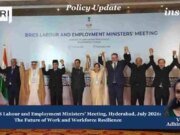
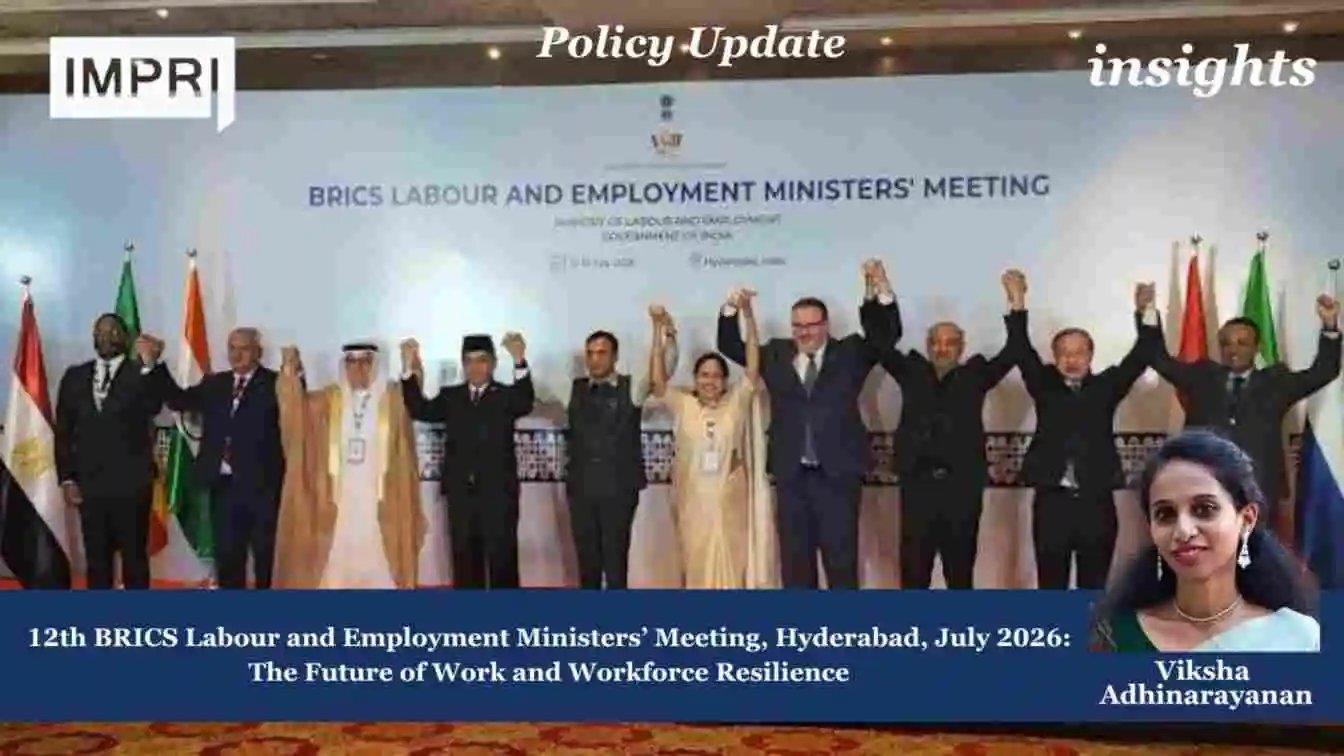
The 12th BRICS Labour and Employment Ministers’ Meeting (LEMM) was held in Hyderabad, India, on 15–16 July 2026 under India’s BRICS Chairship. Convened under the theme “Building for Resilience, Innovation, Cooperation and Sustainability,” the meeting focused on major transformations taking place in labour markets due to technological change, informality, changing forms of employment and evolving skill requirements. Ministers, officials, and social partners discussed how technological change, informality, and evolving skills are reshaping labour markets. The meeting produced a Declaration outlining four priorities: expanding social security and formalising labour markets, enhancing women’s workforce participation, strengthening employability and skills mapping, and leveraging digital technologies for all workers, including gig and platform workers.
India also launched BRICS CONNECT, a platform for technical cooperation and knowledge exchange. By showcasing initiatives like e‑Shram (which has registered over 290 million informal workers) and the National Career Service (which connects 1.5 million job seekers annually), India positioned itself as a model for the Global South. Yet, differences in labour structures, informality, and digital access across BRICS may challenge implementation.
Keywords: BRICS, Labour and Employment, Social Protection, Future of Work, Gig Economy, Digital Public Infrastructure, Women’s Workforce Participation, Skills Development, South-South Cooperation, India.
1. Introduction
In the emerging global world, work has been constantly changing according to the situation and time period. Where new technologies like Artificial intelligence, digital platforms, gig work, and widespread informality are reshaping labour markets across the globe, creating both opportunities and vulnerabilities. For BRICS nations, home to nearly half of the world’s workforce, these disruptions pose a shared challenge: how to secure millions of informal and gig workers who lack stable contracts, social protection, and access to future‑ready skills. The 12th BRICS Labour and Employment Ministers’ Meeting in Hyderabad directly addressed this challenge by emphasising the need for an inclusive, technology‑driven skilling and social‑protection framework. Such a framework would jointly equip BRICS workers with digital and green skills while extending portable benefits and protections to informal and platform‑based employment, ensuring that economic growth and innovation do not leave vulnerable groups behind.
2. Background
The 12th LEMM was one of the key ministerial engagements of India’s 2026 BRICS Chairship. It followed the Third BRICS Employment Working Group Meeting held in Hyderabad on 13–14 July 2026, where member countries exchanged national experiences and developed discussions around the four priority areas that were subsequently considered by the ministers.
Venue & Dates: Hyderabad, Telangana, India on the 15th & 16th of July 2026
The Union Minister for Labour and Employment Dr. Mansukh Mandaviya chaired the meeting and brought together ministers, heads of delegation, senior officials, workers’ and employers’ organisations and knowledge partners. The ILO, International Social Security Association (ISSA) and United Nations Resident Coordinators Office were among the organisations contributing to the deliberations.
Where the four major policy priorities that exchanged experiences among the member countries are mentioned as follow:
- Social security and formalisation of labour markets
- Women’s participation and inclusion in the workforce
- Employability, skills mapping and development
- Digital technologies for all workers
3. Analysis
3.1 Geopolitical and Strategic Shifts
The Hyderabad meeting signals that labour and employment are now central to BRICS diplomacy. The adoption of the common Declaration reflects a joint platform to address labour market challenges while respecting national models. For instance, China’s digital labour systems cover over 200 million platform workers, Brazil’s Bolsa Família programme reaches 21 million households, and India’s e‑Shram has mapped millions of informal workers. Such comparative data underscores the diversity of BRICS experiences and the value of South‑South cooperation through BRICS CONNECT.
If we analyze the topic in more depth, the adoption of the common Labour and Employment Ministers’ Declaration shows how BRICS receives a joint platform to deal with labour market problems using different models without imposing any of them. Moreover, such an approach takes into account national specificity and encourages mutual exchange within the framework of South-South cooperation. This is crucial for BRICS countries which share the same problems but with diverse experience: digital labour systems in China and the UAE, employment programs in Brazil, informal labour force and skills in Indonesia, and social protection platforms in India. The meeting provided an opportunity to learn about such experiences and create BRICS CONNECT in order to turn BRICS into a policy cooperation tool.
3.2 Economic Implications and Opportunities
Transformations in the labour market affect economic growth directly. If there is a need for workers skilled in using new technologies in the economy, then these workers have to be protected during their job transitions. Hence, the emphasis of BRICS on skills mapping in areas such as digital, care, and green becomes crucial in predicting future demands. Additionally, the cooperation on the International Reference Classification of Occupations is particularly significant because it can enhance skills recognition, labour‑market data collection, and mobility. As noted in the Hyderabad meeting, India, Brazil, and the ILO are already conducting feasibility studies, which demonstrates that this initiative is grounded in ongoing institutional work rather than abstract proposals. However, digitalization, through platforms connecting workers to jobs, social security and services, as demonstrated by India’s e-Shram and National Career Services, has potential only when there are robust worker protections.
3.3 Challenges and Structural Impediments
The main challenges that were discussed at the BRICS Labour and Employment Ministers’ Meeting in Hyderabad are mentioned as follow:
- The first challenge is the labour market informality because many workers do not have a contract, insurance, and other forms of protection. Where the formalization needs affordable social security and the motivation for both employers and employees. For instance, over 80% of India’s workforce and nearly 60% of South Africa’s remain informal, highlighting the scale of the problem across BRICS.
- Secondly, the problem of instability, weak protection, and algorithmic management of gig and platform workers which means their inclusion into labour policy. China alone has more than 200 million platform workers, while India’s gig economy is projected to employ 23.5 million people by 2030, showing both the opportunities and vulnerabilities of this sector.
- The third challenge is related to technology changes and artificial intelligence which could lead to skills mismatch and need for constant re-skilling. The studies suggest that automation and AI could displace up to 30% of routine jobs in BRICS economies, making lifelong learning and reskilling essential.
- Fourth, gender inequality in participation and leadership roles which need workplace changes and shared responsibilities beyond training. Women’s labour force participation remains uneven across BRICS, ranging from 32% in India to nearly 59% in China, underscoring the need for structural reforms to close the gender gap.
4. Policy Recommendations
The Hyderabad meeting provides a strong framework, but its long-term significance will depend on implementation. Where the following measures could strengthen BRICS labour cooperation:
- Monitoring Framework : Establish a BRICS‑wide monitoring system covering employment, informality, social‑security coverage, women’s workforce participation, gig work, skills gaps, and digital employment. Regular reporting would help identify progress and implementation gaps across member states.
- Promote Human-Centred Digitalisation and AI : It should establish a cooperation on the responsible use of artificial intelligence in labour administration.
- Develop Social Protection Mechanisms for Gig and Platform Workers : Develop minimum social‑protection standards tailored to BRICS contexts, including accident insurance, health protection, retirement savings, and portable benefits for platform workers.
- Build a BRICS Skills and Occupational Mobility Framework : The occupational-classification initiative should be expanded into a broader skills-recognition mechanism. Therefore, the common occupational terminology and skills mapping could improve employability, recognition of qualifications and responsible international labour mobility.
5. Conclusion
The 12th BRICS Labour and Employment Ministers’ Meeting represents an important shift in BRICS cooperation from broad political dialogue towards practical coordination on the future of work. The adoption of the Labour and Employment Ministers’ Declaration (BRICS, 2026) establishes four central areas of cooperation: social protection and labour formalisation, women’s workforce participation, skills development and digital technologies. The launch of BRICS CONNECT further strengthens this direction by creating a potential institutional mechanism for knowledge exchange, technical cooperation and capacity building.
For India, the meeting provides an opportunity to project its digital public infrastructure and social-protection experience as part of South-South cooperation. However, significant challenges remain, particularly informality, the protection of gig workers, gender inequality, technological disruption and differences among national labour systems. The real test for BRICS will be whether these commitments translate into measurable implementation: expanding social‑security coverage, reducing informality rates, protecting platform workers, and closing gender gaps. Without concrete indicators and accountability, declarations risk remaining aspirational. If BRICS can successfully connect digital innovation with decent work and universal social protection, the outcomes could result in a more inclusive and resilient model of labour governance across the Global South.
References (APA 7th)
- Press Information Bureau. (2026, July 14). India to host 12th BRICS Labour and Employment Ministers’ Meeting in Hyderabad. Government of India. https://www.pib.gov.in/PressReleaseDetail.aspx?PRID=2284592®=48&lang=1
- DD India. (2026, July 14). India to host 12th BRICS Labour and Employment Ministers’ Meeting in Hyderabad. Prasar Bharati. https://ddindia.co.in/2026/07/india-to-host-12th-brics-labour-and-employment-ministers-meeting-in-hyderabad/
- Press Information Bureau. (2026, July 16). 12th BRICS Labour and Employment Ministers’ Meeting concludes in Hyderabad. Government of India. https://www.pib.gov.in/PressReleaseDetail.aspx?PRID=2285145®=1&lang=1
- Press Information Bureau. (2026, July 15). 12th BRICS Labour and Employment Ministers’ Meeting begins in Hyderabad. Government of India. https://www.pib.gov.in/PressReleasePage.aspx?PRID=2284962®=3&lang=1
- BRICS. (2026, July 15). Labour and Employment Ministers’ Declaration, Hyderabad. BRICS Official Documents. https://www.brics2026.gov.in/document/brics-labour-and-employment-ministers-declaration/
Acknowledgement
The author extends sincere thanks to the IMPRI team for their guidance.
Disclaimer: All views expressed in the article belong solely to the author and not necessarily to the organization.
About the Author:
Viksha A is currently pursuing a Master’s in International Relations at Loyola College, Chennai, and serves as a Research & Editorial Intern at IMPRI. She is passionate about public policy research and writing, with interests in governance, social impact, and contributing to evidence-based policy discussions through research and informed analysis.
Name of the Reviewers: Ashi Verma and Pragya Raghav