


Policy Update
Nivedya Murali
Background
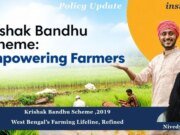
The Krishak Bandhu Scheme is a flagship agricultural welfare programme of the Government of West Bengal, introduced by the Department of Agriculture with effect from 1 January 2019. The scheme was subsequently revamped as Krishak Bandhu (Natun)in June 2021, with a substantial enhancement in the financial assistance provided to farmers. Compared with the original scheme, the revised programme significantly increased the annual financial support available to different categories of landholding farmers.
The scheme primarily seeks to reduce agricultural distress, provide timely pre-production liquidity, and reduce farmers’ dependence on informal sources of credit. The financial assistance is intended to help farmers meet essential cultivation expenses such as seeds, fertilisers, pesticides and agricultural labour. In addition to income support, Krishak Bandhu incorporates a social-security component through a death benefit of ₹2 lakh, payable to the nominee or eligible family member of a registered farmer in the event of the farmer’s death, irrespective of the cause of death. This provision acts as a basic financial safety net for farming households and helps reduce the economic vulnerability of families following the loss of an earning member (Department of Agriculture, Government of West Bengal, n.d.).
Eligibility is primarily linked to recognised cultivable land records, including Record of Rights (RoR), Patta, Forest Patta and registered Bhagchasi (sharecropper) status. Through this mechanism, the government seeks to ensure that agricultural households receive financial assistance during the pre-production stage, thereby supporting continuity in cultivation and improving the economic viability of farming (Department of Agriculture, Government of West Bengal, n.d.).
Overall, Krishak Bandhu has emerged as an important agricultural social-protection intervention in West Bengal, particularly through its combination of direct financial assistance and death benefits. Its major contribution lies in providing farmers with timely liquidity to meet immediate cultivation expenses while offering a basic social-security mechanism to farming households. However, while the scheme can reduce short-term financial vulnerability, its ability to address deeper structural challenges in agriculture,such as indebtedness, fragmented landholdings, rising input costs, market uncertainty and low farm profitability,depends on its integration with broader agricultural and rural-development interventions.
Functioning
The Krishak Bandhu (Natun) scheme functions primarily through a Direct Benefit Transfer (DBT) mechanism. Eligible farmers receive financial assistance of up to ₹10,000 per year, paid in two equal instalments during the Kharif and Rabi seasons. Farmers possessing one acre or more of cultivable land receive ₹10,000 annually, while those with less than one acre receive a proportionate amount subject to a minimum of ₹4,000. This design attempts to provide farmers with liquidity at crucial points of the agricultural cycle, particularly for purchasing seeds, fertilisers, pesticides and meeting labour costs (Department of Agriculture, Government of West Bengal, n.d.)
The scheme also incorporates a Krishak Bandhu Death Benefit, under which the family of a registered farmer aged between 18 and 60 years receives a one-time payment of ₹2 lakh in the event of the farmer’s death. Thus, the programme combines income support with a basic form of social security for agricultural households (Department of Agriculture, Government of West Bengal)
Registration is linked to farmers’ land records and verification through the state agricultural administration. Furthermore, registration under Krishak Bandhu provides access to certain associated agricultural benefits, including preference in the state’s paddy procurement system. This makes the scheme more than a simple cash-transfer programme and connects it with the broader agricultural support system of West Bengal (Department of Agriculture, Government of West Bengal, n.d.)
Performance
The performance of Krishak Bandhu can be assessed in terms of its coverage, utilisation of financial assistance and ability to address farmers’ immediate liquidity constraints. Earlier research on the scheme found that approximately 58% of farmers in the study area had received at least one instalment, while beneficiary farmers used the assistance largely for agricultural activities such as purchasing seeds, fertilisers and pesticides and paying agricultural labour. The assistance was estimated to cover around 9–16% of input costs for different crops among smallholder farmers (Saha et al., 2021).
More recent evidence provides a clearer picture of the scheme’s performance. A 2026 study based on 120 beneficiaries in Bankura found that 74.17% of respondents used the financial assistance for agricultural inputs, while 58.33% reported improvements in agricultural productivity and 50.83% reported changes in cropping patterns (Mandal et al., 2026).
However, the evidence also indicates that the scheme performs better as a short-term liquidity-support mechanism than as a tool for long-term agricultural transformation. Only 2.5% of respondents reported purchasing additional agricultural land, suggesting that the transfer is generally used to meet immediate production requirements rather than generate substantial capital accumulation (Mandal et al., 2026)
Impact
The most significant impact of Krishak Bandhu has been its contribution to reducing seasonal financial constraints among small and marginal farmers. Agriculture involves considerable expenditure before the harvest generates any income. By providing money during the Kharif and Rabi seasons, the scheme enables farmers to purchase essential inputs without completely depending on informal lenders or delaying agricultural operations. Earlier evidence showed that around two-thirds of beneficiaries primarily used the assistance for agricultural purposes.The scheme has also contributed to maintaining agricultural activity during periods of economic stress. During the COVID-19 pandemic, for example, cash assistance helped beneficiaries continue agricultural operations by reducing the burden of input expenditure .
Another important impact is its social-security function. The ₹2 lakh death benefit can provide immediate financial support to farming households following the death of an earning member. This is particularly important for smallholder households that may have limited savings and few alternative sources of income (Department of Agriculture, Government of West Bengal, n.d.).Nevertheless, the impact should not be overstated. The 2026 study found that the benefits were strongly associated with short-term farm expenditure and reported productivity improvements, but there was considerably less evidence of long-term asset creation and diversification. Therefore, Krishak Bandhu appears to function more effectively as a farm-income stabilisation and social-protection measure than as a standalone solution to structural agrarian distress (Mandal et al., 2026).
Emerging Issues
Despite its achievements, several issues affect the effectiveness and inclusiveness of Krishak Bandhu. The first is the landholding-linked nature of the benefit. Since assistance is calculated according to cultivable land, farmers with extremely small holdings receive relatively smaller payments. In the 2026 Bankura study, receiving lower benefits because of holdings below one acre emerged as the most severe perceived impediment, particularly among marginal farmers (Mandal et al., 2026).
A second concern is land-record dependency. Eligibility and benefit calculation depend heavily on land documentation. Farmers facing outdated, incomplete or disputed land records may experience difficulties in accessing the scheme or increasing their benefit when their landholding changes. In the Bankura study, difficulty in updating land records was ranked among the major barriers to accessing benefits.Third, digital and administrative literacy remains a concern. The increasing digitisation of agricultural welfare delivery can create difficulties for farmers who have limited literacy, digital skills or access to assistance. In the 2026 study, illiteracy was identified as the second-most severe impediment reported by beneficiaries.
Another issue is the limited size of the transfer in relation to rising agricultural costs. Although the increase to ₹10,000 annually represented a substantial improvement over the original scheme, the amount may still be insufficient to meet the rapidly increasing costs of seeds, fertilisers, pesticides, labour and machinery. Earlier research had already identified the need for increased assistance and more timely disbursement of funds to benefit farmers.
Finally, cash transfers alone cannot resolve structural problems in agriculture, such as fragmented landholdings, inadequate irrigation, market uncertainty, indebtedness, limited access to institutional credit and low farm profitability. The latest evidence suggests that while Krishak Bandhu improves immediate operational capacity, it has a much weaker effect on long-term capital formation and livelihood diversification (Mandal et al., 2026).
Way Forward
The future of Krishak Bandhu should focus on moving from simple income support towards comprehensive agricultural livelihood security. First, the government could consider revising the assistance periodically in accordance with input-price inflation and regional variations in cultivation costs. Additional support could also be targeted towards the most vulnerable marginal farmers rather than relying exclusively on land size as the basis for assistance.
Second, the government should strengthen land-record updating and grievance-redress mechanisms. Special camps at the block and panchayat levels could help farmers correct land records, complete verification and resolve registration problems without depending heavily on digital intermediaries.
Third, Krishak Bandhu should be integrated more closely with crop insurance, institutional credit, agricultural extension, irrigation and market-support programmes. The cash transfer can provide immediate liquidity, while these complementary interventions can address the structural causes of agricultural vulnerability. The 2026 evidence particularly supports combining cash assistance with credit, insurance and extension services to promote longer-term livelihood resilience (Mandal et al., 2026)
Fourth, greater emphasis should be placed on women farmers, tenant cultivators and other vulnerable agricultural workers who may not always have formal land ownership in their names. Improving their effective access to agricultural welfare programmes would make the scheme more inclusive.
Finally, the government should undertake regular independent impact evaluations across different districts of West Bengal. The latest study itself notes that its findings are based on 120 beneficiaries from selected areas of Bankura and therefore cannot automatically be generalised to the entire state.Such evaluations should measure not only the number of beneficiaries and money transferred but also changes in farm income, indebtedness, productivity, asset creation, consumption, women’s economic security and agricultural diversification.
References
1)Department of Agriculture, Government of West Bengal. (n.d.). Krishak Bandhu (Natun). https://share.google/4GctgjYXKMOsU0hEu
2)Economic Review 2021–22. Department of Finance, Government of West Bengal
https://nitiforstates.gov.in/policy-viewer?id=RSS1154M000572
3)UMANG,The spirit of new India
https://web.umang.gov.in/landing/scheme/detail/krishak-bandhu-scheme_kbs.html
About The Contributor
The author is a postgraduate student of Political Science at Madras Christian College, Chennai.Her academic interests spanning International Relations, Diplomacy, International Political Economy, South Asian politics, Public Policy, Gender Studies, Climate Politics, Human Rights, Global Governance, and History.She is currently a research intern at IMPRI, New Delhi.
Acknowledgments
The author extends her sincere gratitude to the IMPRI team and Anamika P.K for her valuable guidance throughout the process.
Disclaimer
All views expressed in the article belong solely to the author and do not necessarily represent the views or policies of the organisation
Read More at IMPRI
PAIMANA (2025): Project Assessment, Infrastructure Monitoring and Analytics for Nation-building.