


Policy Update
Manisha Kumari
Background
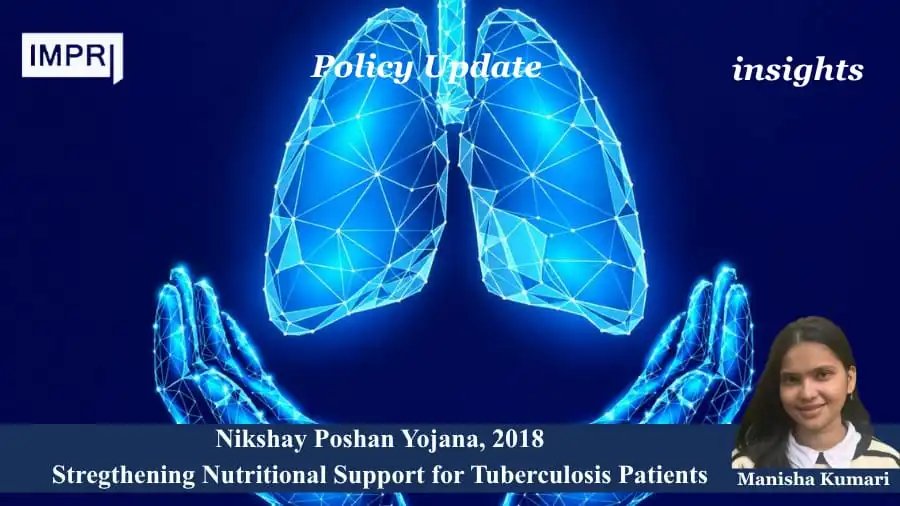
Tuberculosis (TB) remains a major public health challenge in India, with its impact extending beyond infection and treatment to nutrition, household expenditure and overall well-being. Malnutrition is closely associated with TB and can adversely affect treatment and recovery. Recognising the importance of nutritional support during TB treatment, the Government of India introduced the Nikshay Poshan Yojana (NPY) on 1 April 2018 under the National Tuberculosis Elimination Programme (NTEP).
The scheme was designed to provide nutritional support to notified TB patients through financial assistance. Under the original framework, eligible TB patients registered and notified on the Nikshay portal were provided ₹500 per month for the duration of anti-TB treatment through Direct Benefit Transfer (DBT). Against this backdrop, the scheme seeks to reduce the financial burden associated with meeting the nutritional requirements of TB patients during treatment, support nutritional recovery, and contribute to better treatment adherence and outcomes. By providing direct nutritional assistance, the scheme also seeks to address the economic and nutritional vulnerabilities that can accompany TB treatment.
The Central TB Division’s guidelines provide that all notified TB patients are beneficiaries, subject to registration or notification on the Nikshay portal. The scheme was subsequently strengthened in October 2024, when the Government announced an increase in nutritional support from ₹500 to ₹1,000 per month per TB patient for the entire duration of treatment. The enhanced assistance became effective from 1 November 2024. The Government stated that the revised support would provide between ₹3,000 and ₹6,000 to patients depending on the duration of treatment. Alongside the enhanced financial assistance, the Government introduced Energy Dense Nutritional Supplementation (EDNS) for TB patients with a BMI below 18.5 kg/m².
Eligible underweight patients are provided EDNS during the first two months of treatment, adding a targeted nutritional intervention for patients identified as nutritionally vulnerable. The Government also expanded the scope of the Nikshay Mitra initiative under the Pradhan Mantri TB Mukt Bharat Abhiyaan to include household contacts of TB patients, enabling community members and organisations to provide food baskets and other forms of social support. The delivery of nutritional assistance is supported by the Nikshay digital platform, which facilitates the registration and notification of TB patients and enables DBT payments through integration with the Public Financial Management System (PFMS). This digital mechanism is intended to streamline the delivery and monitoring of financial assistance under NPY
Functioning
The Nikshay Poshan Yojana functions through the Nikshay digital platform, which facilitates the registration and notification of TB patients under the National Tuberculosis Elimination Programme (NTEP). Once a patient is diagnosed with TB and notified on the Nikshay portal, the necessary beneficiary and bank account details are recorded to facilitate the transfer of nutritional support.
The financial assistance is provided through the Direct Benefit Transfer (DBT) mechanism, under which the prescribed amount is transferred directly to the beneficiary’s bank account. The assistance is linked to the patient’s treatment duration and is provided throughout the prescribed period of anti-TB treatment.The Nikshay platform also supports the monitoring of beneficiary registration, treatment status and payment-related information, enabling better tracking of the delivery of nutritional assistance.
Following the 2024 enhancement, eligible TB patients receive ₹1,000 per month for the duration of treatment. In addition, Energy Dense Nutritional Supplementation (EDNS) is provided to eligible TB patients with a BMI below 18.5 kg/m² during the initial phase of treatment. The scheme is further supported by the Nikshay Mitra initiative, through which individuals and organisations provide nutritional and social support to TB patients and their household contacts. Together, these mechanisms integrate financial assistance, digital monitoring, targeted nutritional support and community participation within the TB treatment framework.
Implementation and Digital Delivery
Nikshay Poshan Yojana is implemented under the Ministry of Health and Family Welfare through the National Tuberculosis Elimination Programme. The Nikshay digital platform enables the programme to maintain records of notified TB patients and facilitate monitoring of treatment and associated social-support interventions.
DBT forms an important component of the scheme. According to the Government, ₹4,322 crore had been disbursed to 1.35 crore TB patients under Nikshay Poshan Yojana since April 2018 as of December 2025.
The Government’s strengthened nutrition strategy therefore combines direct financial assistance with targeted nutritional supplementation and community participation.
Impact
The scheme has expanded the social protection dimension of TB care by recognising that successful treatment requires more than medicines alone. Financial nutritional support can help patients meet dietary requirements during treatment and potentially reduce the additional economic pressure faced by households.
The scale of implementation is significant. Since its launch in 2018, more than 1.35 crore TB patients had benefited from the scheme by December 2025. In addition, under the Nikshay Mitra initiative, 45.66 lakh food baskets had been distributed to 20.3 lakh TB patients since 2022.
The introduction of targeted energy-dense nutritional supplementation for underweight patients also represents a shift towards a more differentiated approach to nutritional care.
Performance
Since its launch in 2018, the Nikshay Poshan Yojana (NPY) has achieved extensive coverage across India as an important nutritional-support component of the National Tuberculosis Elimination Programme (NTEP). As of December 2025, the Government reported that ₹4,322 crore had been disbursed to 1.35 crore TB patients under the scheme. The scale of implementation demonstrates the expansion of direct nutritional assistance to a large number of notified TB patients across the country.
In addition, the Nikshay Mitra initiative has expanded nutritional support beyond direct financial assistance. Since 2022, 45.66 lakh food baskets have been distributed to 20.3 lakh TB patients. The Government also enhanced the monthly financial support under NPY from ₹500 to ₹1,000 per patient from November 2024, increasing the assistance available during the treatment period. These developments reflect the progressive strengthening of nutritional support through financial assistance and community participation.
Impact
NPY addresses an important nutritional and economic dimension of TB treatment by providing financial assistance to patients throughout their treatment period. Nutritional support can help patients meet additional food requirements during illness and reduce the financial burden associated with maintaining adequate nutrition. The Government has stated that enhanced support under the scheme is intended to facilitate nutritional recovery, improve treatment response and outcomes, and reduce TB-related mortality.
The scheme also represents a shift towards a more patient-centred approach to TB care by recognising that successful treatment requires support beyond the provision of medicines. However, the impact of NPY should be understood within the broader NTEP framework, as TB outcomes are influenced by several factors, including timely diagnosis, treatment adherence, access to medicines, follow-up and social support. Therefore, NPY complements medical treatment by addressing the nutritional and socioeconomic vulnerabilities that can affect patients during the course of TB treatment.
Emerging Issues
Despite the expansion of nutritional support, several issues require continued policy attention:
Nutritional adequacy: A fixed monthly transfer may not fully reflect differences in food prices, household size and nutritional requirements across regions.
- Timely DBT: Delays in beneficiary verification or payment processing can reduce the usefulness of support during treatment.
- Awareness: Patients need clear information regarding eligibility, payment schedules and the purpose of nutritional support.
- Nutritional diversity: Financial assistance alone does not guarantee access to a balanced
diet, particularly among economically vulnerable households.
4) Monitoring: Targeted interventions such as EDNS require effective identification of
underweight patients and appropriate follow-up.
5) Household vulnerability: TB can affect household income and nutrition beyond the
individual patient, making convergence with broader social-protection programmes
important.
Way Forward
First, payment systems should continue to be strengthened to ensure timely and predictable DBT throughout the treatment period.
Second, nutrition counselling should be integrated more systematically with TB treatment services so that patients receive practical guidance on affordable, locally available and nutritionally adequate diets.
Third, convergence with programmes related to food security, livelihoods and social protection can provide additional support to households facing economic hardship because of TB.
Fourth, monitoring mechanisms should assess not only the number of beneficiaries receiving payments but also the timeliness of payments and nutritional outcomes among vulnerable patients.
Finally, community participation through Nikshay Mitras can be strengthened while ensuring that support reaches both patients and eligible household contacts in accordance with programme guidelines.
Conclusion
The Nikshay Poshan Yojana, launched in 2018, has evolved into an important nutritional-support component of India’s TB elimination strategy. The increase in assistance from ₹500 to ₹1,000 per month from November 2024, together with targeted nutritional supplementation for underweight patients, has strengthened the scheme’s coverage and design.
As India continues to strengthen its TB response in 2026, sustained attention to timely financial transfers, nutritional adequacy, treatment adherence, community support and convergence with social-protection programmes can further improve the effectiveness of nutritional support for people affected by TB.
References
- Central Tuberculosis Division, Ministry of Health and Family Welfare, Government of India – Ni-kshay Poshan Yojana
- Press Information Bureau, Government of India -Nutrition Support to TB Patients, 2024
https://www.pib.gov.in/PressReleasePage.aspx?PRID=2062928
- Press Information Bureau, Government of India – Steps taken to strengthen TB-Mukt Bharat Abhiyan, 2025
https://www.pib.gov.in/PressReleasePage.aspx?PRID=2200795
- Central Tuberculosis Division – Guidance Document on TB-Mukt Bharat Abhiyan
- Central Tuberculosis Division -Guidance Document: Nutritional Care & Support for TB Patients in India
About the Contributor
Manisha Kumari is a Research and Editorial Intern at the Impact and Policy Research Institute (IMPRI) and a B.A Liberal Studies (Major Public Policy) graduate from Jagran Lakecity University,Bhopal. Her research interests lie in public policy,governance, sustainable development,social justice, and evidence based policymaking with a particular focus on analysing government policies and programmes to assess their effectiveness and contribution to inclusive and sustainable development.
Acknowledgement:
The author extends sincere gratitude to Rashi Kothari and Sneha Kohli for their invaluable guidance and support.
Disclaimer
All views expressed in the article belong solely to the author and not necessarily to the organization.
Reviewed by Rashi Kothari and Sneha Kohli
Read more at IMPRI:
BRICS Ocean and Polar Science Cooperation: India’s 2026 Presidency and Strategic Policy Priorities