







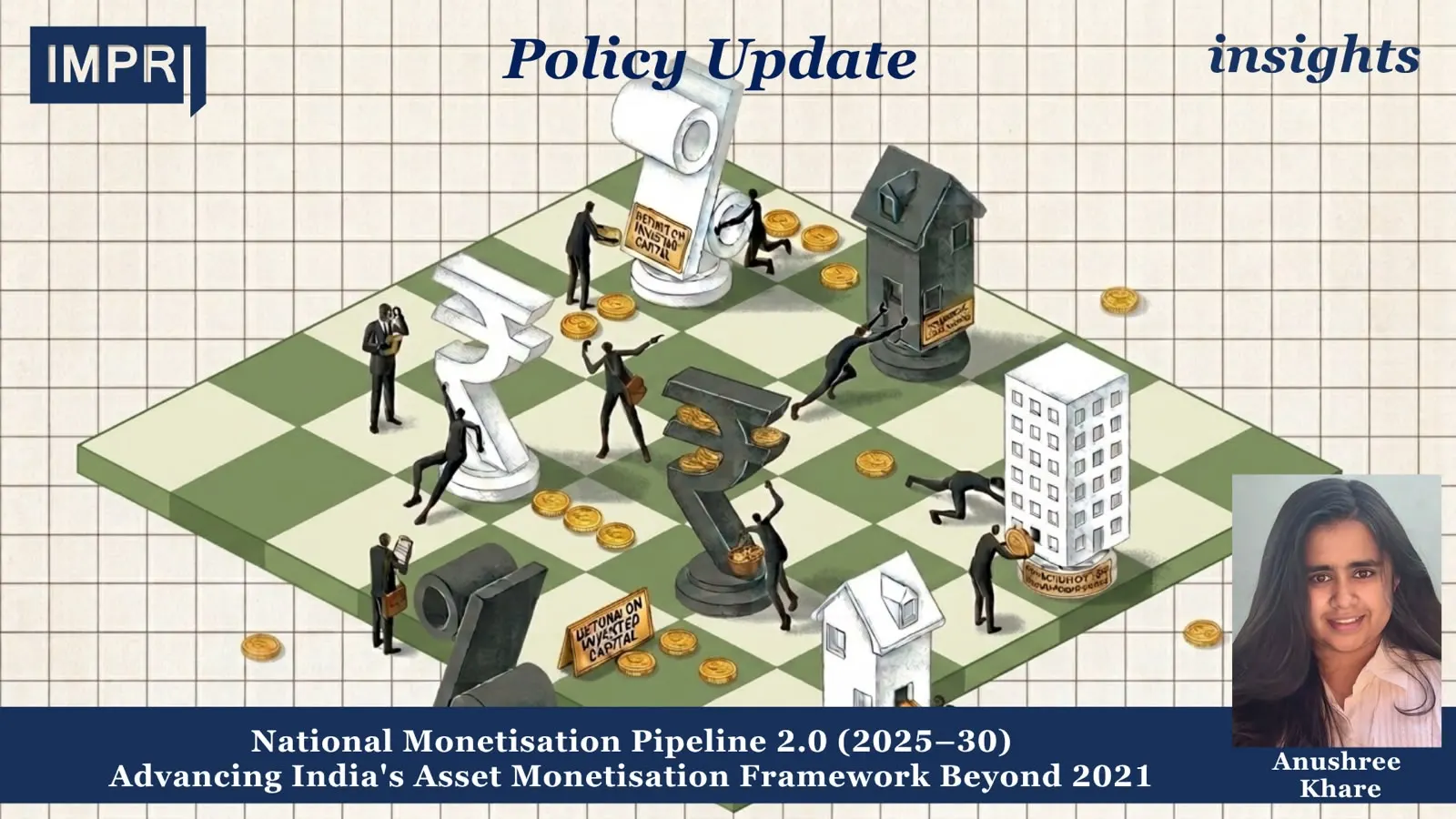
Policy Update
Anushree Khare
Background
The idea of asset recycling was created globally to help solve the traditional issue for governments known as “the sovereign dilemma” or how to provide new and better public services while keeping their public debt from increasing. The first state (in this case, Australia’s New South Wales) to implement asset recycling in its post-recession economic recovery in the 2010s demonstrated that with a few key steps a government can create the cash flow needed to develop new public assets.
The concept is simple: build a public asset, de-risk that public asset until it produces steady cash flowing into your budget, then lease those cash-flowing rights to private investors. Thereby immediately creating an influx of funds to start developing the next generation of public assets.
The development of physical infrastructure has become the key driver of India’s long-term economic growth strategy. To achieve this while also increasing government spending on public capital within a fiscally sustainable environment will require new forms of innovative funding. India’s Asset Monetization Plan (AMP 2025-2030) implemented via the National Monetization Pipeline 2.0 (NMP 2.0) represents a paradigmatic shift in the way that Indian infrastructure is financed.
Historically, India has relied on debt-funding to finance its growing demand for infrastructure. Asset Monetization Plan (AMP 2025-2030) and National Monetization Pipeline 2.0 (NMP 2.0) represents an alternative form of capital recycling where the process begins with public capital being used to create, de-risk and deliver large-scale infrastructure projects. After these assets have been successfully delivered and are producing consistent cash-flow streams (typically referred to as the “brownfield” phase of project life cycle), the rights to operate and maintain them are transferred to either private or institutional investors for a defined number of years. The upfront payments received from transferring these rights or subsequent annual concession revenue can be immediately invested in new infrastructure projects with high multipliers.
While many view monetizing state-owned assets as a variant of privatizing these same assets, they are distinct concepts:
- Ownership: Public ownership of the asset(s) is permanent with respect to the sovereign. However, only the right to operate and maintain the asset(s) and generate associated cash-flows are leased and transferred to private and institutional parties for a limited time period.
- Fiscal Multiplier Effect: While capital expenditures in core sectors carry a high estimated fiscal multiplier effect (approximately 2.5x – 3.2x by Reserve Bank of India & NIPFP over the short and medium-term), investing the proceeds from monetized “brown-field” capital back into “green-field” transportation, energy and logistics-related investment increases gross fixed capital formation without expanding the fiscal deficit.
Historical Development: Disinvestment to Asset Recycling
Asset management doctrine has been developed through three phases in India:
- Phase I – The Disinvestment Model (1991-2014): In the early years after the reform, government resource mobilization was centered around the dilution of Central Public Sector Enterprise (CPSE) equity or strategic straight out sales. Receipts from these actions were largely used to meet current revenue expenditures as opposed to a specific allocation for asset replacement/creation.
- Phase II – Structured Monetization of Assets (2014-2021): The Cabinet’s approval of the toll operate transfer (TOT) model for national highway concessions in June 2016, represented the first step towards monetizing cash flows for Indian highways. Simultaneously with the introduction of formal guidelines under the Securities Exchange Board of India (SEBI) regarding the use of Infrastructure Investment Trusts (InvITs) and Real Estate Investment Trusts (REITs). public entities began to leverage institutional capital for operational, income generating assets.
- Phase III – The institutionalized pipelines (2021–present): In August 2021, the first National Monetization Pipeline (NMP 1.0) was launched with a four year explicit roadmap for FY 2022–FY 2025 across thirteen different infrastructure sectors to target 6 lakh crore rupees. The Asset Monetization Plan 2025–2030 (NMP 2.0) was subsequently integrated through the union budget 2025–2026, scaling up the five year vision by 260% to ₹16.72 lakh crore. (Ministry of Finance, 2025; NITI Aayog, 2026).
The AMP 2025–30 also included a framework that would help to determine how revenue from this process will be deployed in each of the sectors mentioned above. The model has established four types of funds into which all of the money collected through the concession will go. These include:
1) The consolidated fund of India (CFI): This is where monies raised via upfront concession fees or premium on central ministry assets will be placed.
2) The balance sheets of CPSE/Major Port Authorities: In this case, the money made from the monetisation of assets owned by the public sector enterprises (PSE) will be used to make capital expenditures at the level of the individual PSE entities.
3) The state’s consolidated fund: The revenue sharing mechanism and auction profits generated from mining/mineral concessions etc., will be deposited here.
4) Direct Private Capital Outlays: The amount of private capital committed to expand, upgrade or develop facilities inside the boundary of each concession project.
Table 1: Sectoral Breakdown and Monetisation Modes under AMP (2025–30)
| Sector Focus | Indicative Value (₹ Lakh Crore) | Share of Total | Primary Monetisation Modes |
| Highways, MMLPs & Ropeways | ₹4.42 | 26% | Toll-Operate-Transfer (TOT), InvIT concessions |
| Power (Generation & Transmission) | ₹2.76 | 17% | Tariff-based transmission concessions, PGCIL InvIT |
| Ports, Shipping & Waterways | ₹2.64 | 16% | Berth/terminal concessions, Major Port PPPs |
| Railways | ₹2.62 | 16% | Station redevelopment, freight corridors, O&M |
| Coal Assets | ₹2.16 | 13% | Mine Developer-cum-Operator (MDO), commercial auctions |
| Mines & Mineral Blocks | ₹1.00 | 6% | Exploration & production concession auctions |
| Urban Infrastructure | ₹0.52 | 3% | Commercial real estate concessions, municipal utilities |
| Civil Aviation | ₹0.28 | 2% | Long-term airport O&M concessions (AAI lease model) |
| Petroleum, Gas & Telecom | ₹0.21 | ~1.3% | Pipeline tariff securitisation, optical fibre assets |
| Total Pipeline Potential | ₹16.72 | 100% | Comprehensive multi-instrument deployment |
Source: Compiled by author from NITI Aayog (2026), National Monetisation Pipeline 2.0 (NMP 2.0): Asset Monetisation Plan 2025–30; Ministry of Finance, Union Budget 2025–26 documents.
Performance
AMP 2025-2030 builds directly upon operational track record and empirical learnings of PHASE I (NMP 1.0)
- Success Factors & Target Achievement: NMP 1.0 realized approximately 90 percent of the headlined target, mobilising approximately Rs. 3.85 Lakh Crore through monetization of various sectors including mining and highways. (NITI Aayog / PIB, 2024).
- Key Drivers: Institutional maturation of (NHAI) in deployment of public (InvIT) along with sequential TOT Road Bundles helped build a level of institutional comfort among pension funds such as (CPPIB, CDPQ), sovereign wealth funds such as (ADIA, GIC) etc. Commercial coal block auctions were also completed at a faster pace than anticipated.
- Implementation Challenges: Sectors with bundled operational and commercial risks (such as Indian Railways’ passenger trains/station redevelopments and BharatNet telecom assets) saw muted bidder interest due to restrictive concessionary covenants as well as misallocation of risk/demand and ambiguous tariffs.
Impact
Asset monetization provides an alternate balance sheet based means of increasing the speed at which the public investment process occurs with less increase in government liabilities.
- Reduction of Sovereign Debt Burden: Funding for India’s NIP will require sustained annual outlays of approximately 7-8 % of Gross Domestic Product (GDP). Given existing statutory fiscal deficit targets (and assuming a sub 4.5 % fiscal deficit consolidation path) the generation of non-debt capital receipts through direct capital recycling will protect productive CAPEX from fiscal compression.
- Deepening Capital Markets: There exists an interest in generating a steady flow of income among yield-seeking institutional investors including domestic pension funds, insurance companies and international sovereign wealth funds. The creation of securitized structures such as InvITS create a conduit between the institutional savings pool and the ongoing operation of utility assets.
- Operational Efficiency: Transferring O&M responsibilities to private operators will introduce technical automation, predictive maintenance, and increased user service standards while reducing logistical and supply chain friction throughout the economy.
Emerging Issues
Resolution of these structural barriers will be required to scale from ₹6 lakh crore to ₹16.72 lakh crore:
- Asset Valuation and Revenue Risk Mismatch: Misaligned initial traffic surveys or artificially low reserve prices have historically derailed auction processes or caused significant stress on concessionaires. Adopting independent, multi-scenario discounted cash flow (DCF) valuation methods will be essential.
- Contractual Inflexibility: Twenty-to thirty year concession agreements often fail to account changes in the macroeconomy, technological obsolescence, or unforeseen demand shocks. The lack of flexible contractual models coupled with the failure to provide guidelines for renegotiating concession agreements has resulted in frequent litigations.
- Interagency Jurisdictional Issues: Central line ministries retain control over underlying assets, but authority to grant local statute approvals, property rights, environmental compliance, and clearance of right of way (ROW) lies with state or municipal authorities resulting in inter agency frictions.
- Capital Market Capacity Constraint: Transaction execution will also be dependent upon sufficient absorption within domestic debt markets to absorb ₹16.72 lakh crore in transaction over a five year horizon. As there is currently a limited secondary market for corporate infrastructure bonds and limited institutional participation into transactions, execution of large transactions could potentially experience liquidity constraints.
Way Forward
In order to ensure successful execution of a Rs 16.72 lakh crore pipeline, the policy interventions in the form of four institutional levers are as follows:
1. Standardizing Dynamic Model Concession Agreements (MCAs):
Line ministries need to move from traditional bespoke rigid contracts towards standardized (MCAs) with dynamic risk sharing mechanisms. The agreements also require embedding of pre- defined renegotiation trigger points, transparent inflation linked tariff indexation formulae and fast track dispute resolution mechanism so as to avoid legal disputes during unforeseen demand shocks.
2. Enhancing Inter-Ministerial Governance:
Statutory mediation and fast tracking powers should be conferred upon to the Core Group of Secretaries on Asset Monetization (CGAM) under the Chairmanship of Cabinet Secretary. This will enable (CGAM) to resolve inter departmental conflicts, facilitate right of way clearances and coordinate with the state governments for clearing their respective approvals which would lead to eliminating the administrative hurdles that delay large value transactions.
3. Deepening the Demand from Domestic Institutions:
The financial regulators such as (SEBI), (RBI), (PFRDA) & (IRDAI) need to relax the portfolio ceilings for scaling up the allocation of high grade (InvIT) debt and equity tranches by domestic pension, provident and insurance funds. It is essential to increase the absorptive capacity of the domestic institutions to reduce dependence on foreign capital and protect the pipeline from fluctuations in the global liquidity cycle.
4. Encouraging State Level Asset Recycling:
Centre can leverage its 50 years interest free capital loan scheme for providing special assistance to states for capital investments by linking it to verifiable state level assets recycling milestones. It can also provide targeted fiscal incentives to states and (ULBs) for structuring bankable concessions for municipal utilities, bus terminals and state highways.
Conclusion
The Asset Monetization Plan (AMP 2025 – 2030) represents a fundamental shift in how India governs its finances. Rather than depending solely upon borrowing to fund spending, India has chosen a long term, risk-averse and sustainable approach to recycle capital. By leasing de-risked brownfields via operational rights. Using this model, India can generate critical new equity to support high multiplier green field investments in infrastructure, while also meeting statutory fiscal constraints.
Although the size of the pipeline (₹16.72 lakh crore) indicates that there is a significant macro-economic commitment over time, implementation will be dependent on standardizing contracts, reducing or eliminating the inherent risks associated with revenue sharing and developing deeper local capital markets.
If successfully institutionalized (AMP 2025 – 2030) will create a direct linkage between government policy intentions and private sector delivery capacity and therefore provide a solid basis for India to achieve long term economic growth and realize the vision of Viksit Bharat.
References
Bose, S., & Purohit, M. (2021). Fiscal multipliers for the Indian economy: An empirical investigation (NIPFP Working Paper No. 342). National Institute of Public Finance and Policy.
Ministry of Finance. (2021). Report of the task force: National infrastructure pipeline (2019–2025) (Vols. 1–2). Department of Economic Affairs, Government of India. https://dea.gov.in/
Ministry of Finance. (2025). Union budget 2025–26: Key features and expenditure profile. Department of Economic Affairs, Government of India. https://www.indiabudget.gov.in/
NITI Aayog & Press Information Bureau. (2024). Review of the National Monetisation Pipeline (FY 2022–FY 2024) and Target Realisation Report. Government of India.
NITI Aayog. (2021a). National monetisation pipeline: Vol. 1. Monetisation guidebook. Government of India. https://www.niti.gov.in/node/348
NITI Aayog. (2021b). National monetisation pipeline: Vol. 2. Asset pipeline. Government of India. https://www.niti.gov.in/node/343
NITI Aayog. (2026). National monetisation pipeline 2.0 (NMP 2.0): Asset monetisation plan 2025–30. Government of India. https://niti.gov.in/
Press Information Bureau. (2021, August 23). Union Minister for Finance and Corporate Affairs Smt. Nirmala Sitharaman launches the National Monetisation Pipeline (Release ID: 1748297). Ministry of Finance, Government of India. https://pib.gov.in/PressReleasePage.aspx?PRID=1748297
Press Information Bureau. (2026, February 23). Union Finance Minister launches National Monetisation Pipeline 2.0 (NMP 2.0) (Release ID: 2231900). Ministry of Finance, Government of India. https://pib.gov.in/PressReleasePage.aspx?PRID=2231900
Reserve Bank of India. (2020). Measuring fiscal multipliers in India: A structural vector autoregression (SVAR) approach. RBI Bulletin, 74(6), 45–62.
Securities and Exchange Board of India. (2014). Securities and Exchange Board of India (Infrastructure Investment Trusts) Regulations, 2014 (Notification No. LAD-NRO/GN/2014-15/10/1577). The Gazette of India: Extraordinary. https://www.sebi.gov.in/
World Bank. (2021). Recycling infrastructure assets: A practical guide for governments on asset recycling mechanisms and PPP structuring. World Bank Group. https://openknowledge.worldbank.org/
About The Contributor
Anushree Khare is a Research & Editorial Intern at the Impact and Policy Research Institute (IMPRI). She holds a B.A (Hons) degree in Economics with Research. Her academic and professional interests lie in the domains of finance, quantitative research, data-driven policy analysis, and business strategy.
Acknowledgement
The author extends sincere gratitude to the IMPRI team for their guidance and support along with the reviewers Ms. Anamika P K and Ms. Tanisha for their valuable feedback and insights.
Disclaimer
All views expressed in the article belong solely to the author and not necessarily to the organization.
Read more at IMPRI:
Kerala’s K-AI Initiative: AI for Governance under Kerala Artificial Intelligence Mission (K-AIM)