






Policy Update
Karnavi Shende
BACKGROUND
Punjab’s female demographic profile presents a mixed picture of progress and persistent challenges. The state’s sex ratio stands at 895 females per 1,000 males, below the national average of 940, while female literacy has improved to approximately 75% (Census 2011; recent NFHS-5 estimates). More critically, female labour force participation remains low at around 22–24%, reflecting limited economic opportunities and strong social norms restricting women’s work outside the home (Periodic Labour Force Survey, 2024–25).
Against this backdrop, Punjab has introduced several women-focused schemes in recent years, such as the ‘Kanya Jagriti Jyoti Yojana’ and ‘Mai Bhago Vidya Scheme’ for educational support for girl children, ‘Janani Suraksha Yojana’ for maternity benefits under existing national programmes, and state-specific pension schemes such as the ‘Old Age Pension Scheme’ etc. However, these interventions have largely been categorical targeting specific age groups, life stages, or socio-economic categories leaving a significant gap in universal income support for adult women across households.
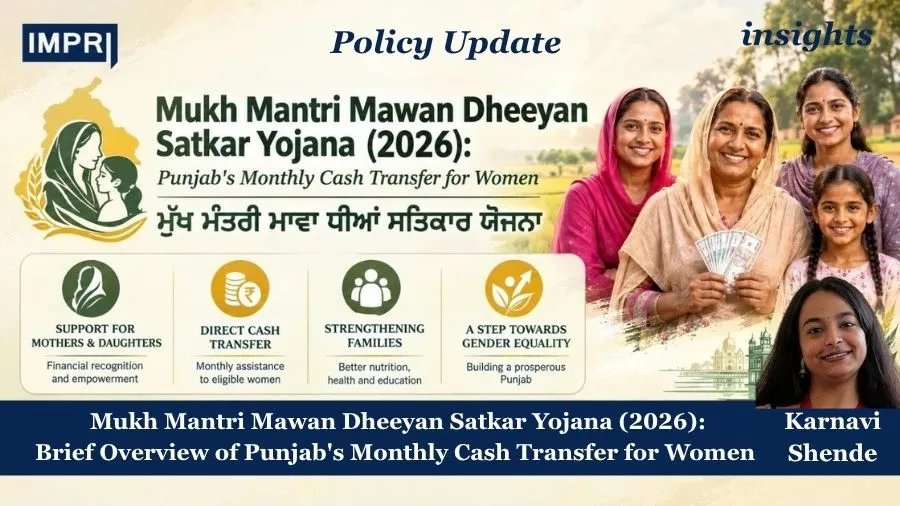
The Mukh Mantri Mawan Dheeyan Satkar Yojana (MMMDY), literally “Chief Minister’s Respect for Mothers and Daughters Scheme,” was designed to address this gap by providing near-universal monthly cash transfers to adult women. Announced in the 2026–27 budget on International Women’s Day (March 8, 2026), the scheme provides ₹1,000 per month to general-category women and ₹1,500 per month to Scheduled Caste beneficiaries (PRS Legislative Research, 2026).
The scheme was formally launched on July 1, 2026, at a public event in Dhuri, where Chief Minister Bhagwant Mann oversaw the first disbursement covering three months’ arrears (April–June 2026). General-category women received ₹3,000 and SC women received ₹4,500 in their initial transaction (Times of India, 2026).
FUNCTIONING
Policy Design and Eligibility
The scheme’s architecture is straightforward but deliberately inclusive. Every woman aged 18 or above who is a permanent resident of Punjab residency receives monthly financial assistance through direct bank transfer, with a higher rate for SC women to account for historical disadvantage.
Unlike some state schemes that cap the number of beneficiaries per household, MMMDY explicitly states: “There shall be no restriction on the number of eligible women in a family.” Women already receiving social security pensions can also avail this benefit in addition to their existing entitlements (Government of Punjab, Department of Social Security, Women and Child Development, 2026).
Who Is Excluded?
The exclusions are narrow but politically significant. The following categories cannot receive the benefit:
- Regular (permanent) or retired government employees (Punjab, central, or other state governments)
- Employees of PSUs, boards, corporations, commissions, cooperative institutions or tribunals who are eligible for or drawing pension
- Any woman who paid income tax of ₹1 or more in the last financial year
- Serving or former ministers, MPs, and MLAs (including their spouses)
The government estimates that only about 3% of adult women fall into these categories, leaving 97% eligible (Government of Punjab, Department of Social Security, Women and Child Development, 2026).
Registration and Delivery Mechanism
Registration is conducted offline at Anganwadi centres and Sewa Kendras, Nagar Nigam, and Municipal offices with deputy commissioners responsible for district-level implementation and grievance redressal. Required documents include:
- Aadhaar card reflecting Punjab residency
- Punjab voter ID card
- Bank account passbook (Aadhaar-linked)
- Caste certificate (for SC beneficiaries)
The scheme operates through a Direct Benefit Transfer (DBT) system via a dedicated web portal launched on July 1, 2026. The social security, women and child development department serves as the nodal implementing agency, with technical support from the department of good governance and IT (Government of Punjab, Department of Social Security, Women and Child Development, 2026).
PERFORMANCE
Registration and Disbursement Data
The first payment, made on July 1, 2026, covered three months’ arrears (April–June 2026), meaning general-category women received ₹3,000 and SC women received ₹4,500 in their initial transaction. Within 28 days of launch, the government had disbursed ₹1,149 crore to 33 lakh women (Times of India, 2026).
By August 27, 2026, Chief Minister Bhagwant Mann announced that 76.11 lakh women had registered under the scheme, with ₹2,381 crore already transferred to 68.06 lakh beneficiaries. At a separate event in Pathankot on August 31, another tranche was released, pushing the beneficiary tally past 68.5 lakh (ANI News, 2026; Hindustan Times, 2026).
Figure 2: MMMDY Beneficiary Growth: July to August 2026
Source: Compiled by the author using Government of Punjab budgetary documents 2026-27
Budgetary Allocation
The scheme was announced as part of Punjab’s ₹2.60 lakh crore budget for 2026–27, presented by Finance Minister Harpal Singh Cheema on March 8, 2026. The scheme was allocated ₹9,300 crore for 2026–27, forming part of a broader ₹18,304 crore women empowerment package, an exact 96% increase over the previous year. According to PRS Legislative Research, this allocation reflects the state’s commitment to fund the scheme for the full fiscal year, assuming phased rollout and not all beneficiaries enrolled from day one (PRS Legislative Research, 2026).
Figure 2: MMMDY Fund Disbursement Progress (2026)

Source: Compiled by the author using Government of Punjab budgetary documents 2026-27
IMPACT
Given that the scheme was launched only in July 2026, systematic impact assessments are not yet available. However, for many women, particularly in low-income and SC households, the monthly ₹1,000–₹1,500 is expected to provide a predictable income stream that may be used for children’s education, healthcare, nutrition, or small household investments. The higher rate for SC women acknowledges the compounded disadvantage faced by Dalit households and provides additional fiscal space for addressing caste-based deprivation. The direct credit into women’s own bank accounts rather than through male family members may strengthen their control over household spending decisions.
EMERGING ISSUES
Despite its ambitious rollout, the implementation of the Mukh Mantri Mawan Dheeyan Satkar Yojana has encountered several localized execution bottlenecks, technical errors, and administrative backlogs. Regional media coverage and official statements have documented the following challenges:
System Slowdowns and Server Outages:
The rush to register after the first batch of funds was released triggered massive technical complications. Frontline employees at Sewa Kendras and Anganwadi centres faced intense public pressure due to repeated server outages that routinely disrupted online application uploads and froze biometric processing (The Tribune, 2026).
Documentation and Caste Certificate Backlogs:
A massive surge in applicants seeking to update their documents to secure the scheme’s benefits caused heavy gridlock. Reports indicate that the e-Sewa portal slump created massive operational backlogs at service windows, forcing applicants to wait for multiple days just to clear routine tasks, extract caste documentation, or link their mobile numbers (The Times of India, 2026; The Tribune, 2026).
Database Reconciliation Failures:
In official administrative reviews, state officials openly acknowledged data friction points. The government noted that document mismatches had halted the payouts, forcing authorities to conduct door-to-door physical verifications to resolve database anomalies before subsequent payment cycles could clear safely (The Tribune, 2026).
Targeted Cyber Fraud Risks:
As the scheme gained massive popularity, bad actors began circulating malicious, unofficial links to exploit applicants. The Punjab Police Cyber Crime Division issued formal public advisories warning citizens against deceptive third-party links designed to compromise banking credentials under the guise of fake enrollment applications (The Tribune, 2026).
Fiscal Sustainability Concerns:
The scheme’s launch came against a backdrop of Punjab’s strained public finances. The state’s total public debt exceeds ₹4.13 lakh crore (likely to reach ₹4.47 lakh crore by March 2027), and opposition leaders have repeatedly questioned whether the government can sustain annual outlays of this magnitude without crowding out capital expenditure (The Tribune 2026; PRS Legislative Research, 2026).
WAY FORWARD
- Server Infrastructure and Load Management: Given the repeated server outages and biometric processing freezes reported at Sewa Kendras during peak registration periods, the Good Governance and IT Department should conduct a technical audit of the MMMDY portal’s capacity. Load-balancing measures such as staggered registration windows by district, offline bulk upload options for Anganwadi workers, and dedicated servers for biometric authentication could prevent future system crashes during high-traffic periods.
- Mobile Document Verification Camps: To address caste certificate backlogs and documentation gridlock, deputy commissioners should organise weekly mobile verification camps in rural and semi-urban clusters. These camps could offer on-the-spot issuance of caste certificates, Aadhaar updation, and bank account seeding, reducing the need for women to make multiple trips to Sewa Kendras. Priority should be given to blocks with the highest pending verification rates.
- Automated Database Reconciliation Protocol: Instead of relying on door-to-door physical verifications for every document mismatch, the state should develop an automated reconciliation protocol that cross-checks voter ID, Aadhaar, and ration card databases in real time. Where minor name or address discrepancies are detected, the system could flag these for applicant self-correction via SMS or IVRS, rather than halting the entire application. This would reduce the administrative burden on frontline staff and speed up payout cycles.
- Cyber Fraud Awareness and Official App: Following the Punjab Police Cyber Crime Division’s advisories on fake enrollment links, the government should launch an official MMMDY mobile app with two-factor authentication and in-app payment status tracking. Simultaneously, a statewide awareness campaign using radio, community loudspeakers, and Anganwadi networks should educate women on recognising official versus fraudulent links. A dedicated cyber fraud helpline for MMMDY beneficiaries could provide a rapid response to suspected phishing attempts.
- District-Wise Performance Scorecards: Rather than a single state-level dashboard, the Social Security Department should publish monthly district-wise scorecards showing: (a) registration completion rates, (b) average processing time per application, (c) percentage of applications rejected due to document mismatch, and (d) grievance redressal turnaround time. Districts with persistently high rejection rates or long processing times could be flagged for targeted administrative support or additional staffing (The Tribune, 2026d).
- Independent Impact Evaluation: An independent study should examine how MMMDY affects household spending, women’s control over money, debt, savings, work participation and access to services. Annual data on expenditure and beneficiaries showing allocated versus actually transferred amounts should be published in machine-readable formats for researchers and civil society.
REFERENCES
ANI News. (2026, August 1). Punjab CM to release funds under Mukh Mantri Mawan-Dhiyan Satkar Yojana; beneficiary tally to cross 68.5 lakh. ANI News. https://www.aninews.in/news/national/politics/punjab-cm-to-release-funds-under-mukh-mantri-mawan-dhiyan-satkar-yojana-beneficiary-tally-to-cross-685-lakh20260801085803/
Census of India. (2011). Census tables. Office of the Registrar General & Census Commissioner, Ministry of Home Affairs, Government of India. https://censusindia.gov.in/census.website/data/census-tables
Government of Punjab, Department of Social Security, Women and Child Development. (2026, April 2). Notification No. SSWCD-3/2/2026-6SS/E1074391/120: Mukh Mantri Mawan Dheeyan Satkar Yojana [Statutory scheme notification]. https://www.govtschemes.in/sites/default/files/2026-04/Punjab%20Mukh%20Mantri%20Mawan%20Dheeyan%20Satkar%20Yojana.pdf?v=1
Hindustan Times. (2026, August 27). Punjab: 76L women registered under Mawan Dheeyan Satkar Yojana, says Mann. Hindustan Times. https://www.hindustantimes.com/cities/chandigarh-news/punjab-76l-women-registered-under-mawan-dheeyan-satkar-yojana-says-mann-101787767970675.html
International Institute for Population Sciences. (2021). National Family Health Survey (NFHS-5), 2019–21: India (Vol. I). Ministry of Health and Family Welfare, Government of India. https://dhsprogram.com/pubs/pdf/FR375/FR375.pdf
Live Mint. (2026, July 28). Punjab credits Rs 1,149 crore to women under Mukh Mantri Mawan Dheeyan Satkar Yojana; beneficiaries praise DBT model. Live Mint. https://www.livemint.com/focus/punjab-credits-rs-1-149-crore-to-women-under-mukh-mantri-mawan-dheeyan-satkar-yojana-beneficiaries-praise-dbt-model-11784956271842.html
Ministry of Statistics and Programme Implementation, Government of India. (2026). Periodic Labour Force Survey (PLFS) 2024–25. https://www.mospi.gov.in/uploads/publications_reports/publications_reports1780040415321_0624fb13-fb47-40bc-b470-7c7e9635c3ef_PLFS_2025_F_REV_29052026.pdf
PRS Legislative Research. (2026). Punjab Budget Analysis 2026–27. https://prsindia.org/budgets/states/punjab-budget-analysis-2026-27
The Times of India. (2026, July 1). Punjab women receive 3-month stipend as CM Mann launches monetary scheme. The Times of India. https://timesofindia.indiatimes.com/city/chandigarh/punjab-women-receive-3-month-stipend-as-cm-mann-launches-monetary-scheme/articleshow/132122887.cms
The Times of India. (2026, July 10). Queues swell at Sewa Kendras as server slump disrupts services. The Times of India. https://timesofindia.indiatimes.com/city/ludhiana/queues-swell-at-sewa-kendras-as-server-slump-disrupts-services/articleshow/132001717.cms
The Tribune. (2026, March 15). Why Punjab’s debt trap is deepening. The Tribune. https://www.tribuneindia.com/news/comment/why-punjabs-debt-trap-is-deepening/
The Tribune. (2026, July 5). Women queue up at Sewa Kendras after first welfare scheme payment. The Tribune. https://www.tribuneindia.com/news/amritsar/women-queue-up-at-seva-kendras-after-first-welfare-scheme-payment/
The Tribune. (2026, July 20). Eligible women beneficiaries overshoot by 19 lakh in Punjab. The Tribune. https://www.tribuneindia.com/news/punjab/eligible-women-beneficiaries-overshoot-by-19-lakh-in-punjab/
The Tribune. (2026, July 28). Punjab credits Rs 1,149 crore to 33 lakh women under Mawan Dheeyan Satkar Yojana; women praise DBT model. The Tribune. https://www.tribuneindia.com/news/punjab/punjab-credits-rs-1149-crore-to-33-lakh-women-under-mawan-dheeyan-satkar-yojana-women-praise-dbt-model/
The Tribune. (2026, August 5). Fake links exploiting Punjab’s Mukh Mantri Mavan Dhiyan Satkar Yojna target women in cyber frauds. The Tribune. https://www.tribuneindia.com/news/punjab/fake-links-exploiting-punjabs-mukh-mantri-mavan-dhiyan-satkar-yojna-target-women-in-cyber-frauds/
The Tribune. (2026, September 10). Punjab’s Rs 4.47 lakh crore debt becomes key economic challenge ahead of 2027 polls: Manish Tiwari, member, Parliamentary Panel on Finance. The Tribune.
ABOUT THE CONTRIBUTOR
Karnavi Shende is a Research and Editorial Intern at IMPRI. She holds a Master’s in Politics, specializing in International Relations, from Jawaharlal Nehru University, New Delhi. Her interests include International Relations, Strategic Studies, Public Policy, Gender, and Human Rights, with a focus on policy research and contemporary governance challenges.
ACKNOWLEDGEMENTS
The author extends sincere gratitude to the reviewers (Shruti Chandra and Khushi) and the IMPRI team for their expert guidance and constructive feedback throughout the process.
REVIEWED BY
Shruti Chandra and Khushi
DISCLAIMER
All views expressed in the article belong to the author and not necessarily to the organization.
Read more at IMPRI:
Funding India’s AI Startups – Assessing IndiaAI Startup Financing Pillar (2024)