







Policy Update
Karnavi Shende
BACKGROUND
Women in many Indian households perform a substantial amount of unpaid domestic work, while their control over household finances may remain limited . To address this, several state governments have started schemes that send cash directly into women’s bank accounts and Odisha’s Subhadra Yojana is one such example.
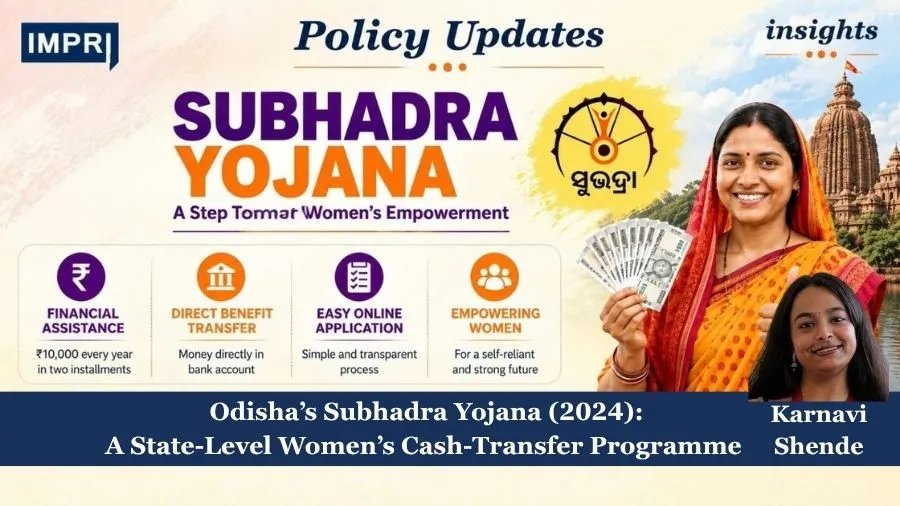
The scheme was announced in the 2024–25 state budget and officially launched on 17 September 2024. Under Subhadra, each eligible woman receives ₹50,000 over five years, paid as ₹10,000 annually in two instalments of ₹5,000 each on Rakhi Purnima and International Women’s Day. (Subhadra Yojana, Government of Odisha).
Under a specific sub-clause for incentives, the government explicitly states that the top 100 beneficiaries who complete the highest number of digital transactions in a particular financial year within each Gram Panchayat (GP) or Urban Local Body (ULB) will be rewarded an additional benefit of ₹500 credited directly into their bank accounts This clause included in the framework to actively promote digital financial literacy and encourage beneficiaries to utilize the Subhadra ATM-cum-debit card for cashless transactions (“SUBHADRA GUIDELINES”, Department of Women and Child Development, Government of Odisha).
The government says the scheme aims to improve women’s economic independence, support household spending on food, health and education, and encourage financial inclusion. Official budget documents describe it as a step towards “women empowerment, financial independence and entrepreneurship development” (Finance Department, Government of Odisha, 2025). The scheme targets women aged 21–60 years from poorer households and excludes relatively better-off families through clear income and asset rules.
Subhadra quickly became one of Odisha’s most prominent social-protection programmes. Within two years of launch, more than one crore women were receiving benefits, with each instalment disbursal involving transfers of over ₹5,000 crore (Times Of India, 2026; The Print 2026). Its design reflects a broader policy shift from narrowly targeted pensions towards large-scale, women-centric income support
FUNCTIONING
Institutional design and Eligibility
Subhadra Yojana is aimed at women aged 21 to 60 years who are permanent residents of Odisha and belong to economically weaker sections. For the first year of implementation (2024–25), the qualifying age window corresponded to women born between 2 July 1964 and 1 July 2003, with Aadhaar date of birth treated as final. However, women who turn 60 during the scheme period (2024–2028) do not remain eligible; they are explicitly excluded from the beneficiary list and will not receive installments for the subsequent years of the scheme once they cross the upper limit (“SUBHADRA GUIDELINES”, Department of Women and Child Development, Government of Odisha).
Eligibility is primarily determined through a combination of residency, income, and asset-based conditions. Women covered under the National Food Security Act (NFSA) or State Food Security Scheme (SFSS) ration cards are automatically considered, though women without these cards can apply if their total family annual income does not exceed ₹2.5 lakh. The scheme explicitly excludes:
- Age Out of Bounds: Women below 21 years or 60 years and above as of the qualifying date.
- Income Tax Payers: Households where any family member is an active income-tax payer.
- Government Employees & Pensioners: Regular or contractual employees of the Central Government, State Government, Public Sector Undertakings (PSUs), Boards, or Local Bodies, as well as individuals receiving a retirement pension from these entities.
- High-Level Political Representatives: Current or former MPs, MLAs, and Ministers, as well as elected public representatives in Urban Local Bodies or Panchayati Raj Institutions (excluding Ward Members and Councillors, who remain eligible).
- Large Landowners: Families owning more than 5 acres of irrigated land or 10 acres of non-irrigated land.
- Four-Wheeler Owners: Owners of four-wheeled motor vehicles, with explicit exemptions made for tractors, mini-trucks, and small commercial vehicles used for livelihoods.
- Double Dipping in Welfare Pensions: Women already receiving a monthly pension or financial assistance of ₹1,500 or more per month (or ₹18,000 or more per year) from any other state or central government scheme.
These exclusion criteria are intended to focus support on vulnerable households while avoiding overlap with other substantial welfare benefits. The scheme is implemented through the Department of Women and Child Development, with technical support from Odisha’s digital governance infrastructure, including Aadhaar authentication, DBT platforms, and the state’s beneficiary management systems. Standard Operating Procedures have been developed to guide district administrations, block-level officers, and front-line workers in registration, verification, and grievance redressal.
Application and Payment
Subhadra Yojana uses a dual-channel hybrid system, allowing applications to be submitted both online and offline. The entire application process is completely free of cost, meaning no fees are charged for collecting forms or submitting applications.
Eligible women can apply online directly through the official Subhadra Yojana Portal using an OTP-based login linked to their registered mobile number and Aadhaar card. For women with limited digital access or literacy, the government provides pre-printed physical application forms free of charge. These can be collected from local Anganwadi Centres, Block Offices, Urban Local Body Offices, Mo Seba Kendras, and Common Service Centres (CSCs). Once filled out, offline forms must be submitted along with a copy of the applicant’s Aadhaar card to the nearest Mo Seba Kendra or CSC (“SUBHADRA GUIDELINES”, Department of Women and Child Development, Government of Odisha).
To ensure secure delivery and reduce errors, every application undergoes strict digital identity verification (e-KYC). Applicants can use Aadhaar OTP or biometric authentication, but the scheme prioritises face recognition through the official SUBHADRA mobile app. This emphasis on app-based verification aims to minimise fraud and human discretion. If discrepancies arise between application and government records, Aadhaar details are treated as final, streamlining disputes but requiring women to ensure their Aadhaar is fully updated before applying.
Approved financial assistance is credited directly to the beneficiary’s single-holder, Aadhaar-seeded, and Direct Benefit Transfer (DBT) enabled bank account. Because the funds cannot be routed through a multi-holder household or male family member’s account, total consistency across the bank records, Aadhaar details, and the Subhadra Yojana Central Database is an absolute requirement. Major documentation gaps such as name mismatches, dormant bank accounts, or unseeded Aadhaar lines can instantly trigger payment delays or system rejections.
Applicants can monitor progress, view final beneficiary tracking, and trace scheduled tranches online. For immediate query support or to lodge structural complaints, the state runs dedicated grievance cells alongside official toll-free helper hotlines at 14678 and 1800-345-678 (“SUBHADRA GUIDELINES”, Department of Women and Child Development, Government of Odisha).
PERFORMANCE
Coverage and Payment Scale
The scheme was rolled out in phases. The first instalment was officially launched on 17 September 2024, when over ₹1,250 crore was released to about 25 lakh women during the main launch event in Bhubaneswar, later expanded through sub-phases to cover remaining applicants (PM India, 2024; The Hindu, 2024). A second batch of around 39 lakh women received payments on 9 October 2024 as part of a rapid expansion drive centred in Baripada (New Indian Express, 2024). The third tranche of the first instalment was credited on 24 November 2024 to over 20 lakh women, especially from northern and western districts such as Sundargarh, to clear pending applications (Economic Times, 2024).
In August 2026, the fifth instalment (second tranche of Year 2) was disbursed on 28 August, coinciding with Rakhi Purnima. Chief Minister Mohan Charan Majhi released over ₹5,163 crore to about 1.03 crore beneficiaries, including 2.21 lakh first-time recipients (Times of India, 2026; Chief Minister’s Office, Government of Odisha, 2026).
Each biannual disbursement functions as a major fiscal and administrative event, with synchronized, state-wide payment pushes on fixed dates creating predictability for beneficiaries and high visibility for the scheme.
Figure 2: Growth in Beneficiaries and Disbursement Amount under Subhadra Yojana (2024–2026)
Sources: Compiled by the author from documents of Government of Odisha.
Fiscal Performance
Subhadra Yojana represents a major commitment in Odisha’s social-sector budget. The state initially earmarked around ₹10,000 crore for the scheme in 2024–25 (PRS Legislative Research, 2024). In the 2025–26 budget, the allocation was revised to ₹10,145 crore (Highlights of Annual Budget Estimates for FY 2025–26, Finance Department, Government of Odisha, 2025). PRS’s 2026–27 budget analysis notes a continued allocation of ₹10,145 crore towards Subhadra, indicating that the scheme has become a recurring and substantial component of expenditure (PRS Legislative Research, 2026).
At the current benefit level of ₹10,000 per woman per year, a beneficiary base of around 1.03 crore implies an annual cash liability of roughly ₹10,300 crore, before accounting for administrative costs and payment failures. This is broadly consistent with the budgeted allocations, although, as with any large DBT programme, budget estimates and actual expenditure may diverge due to changes in beneficiary numbers, transaction success rates and timing of disbursements (The Print, 2026).
However, cash transfers give immediate relief and can improve women’s bargaining power at home but the relevant comparison is not between welfare and no welfare, rather between different ways of improving women’s long-term economic security and human development outcomes
Figure 1: Budget Allocation to Subhadra Yojana, 2024–25 to 2026–27 (₹ crore)

Sources: Compiled by the author from Finance Department, Government of
Odisha (2024-26); PRS Legislative Research (2024- 2026)
IMPACT
Income Security: The immediate effect of Subhadra Yojana is to provide a predictable source of cash to women who may have limited independent income. For many women, especially those dependent on irregular wage labour or informal work, this reduces dependence on family members or moneylenders for routine expenditure.
Bargaining Power: The gender dimension of the scheme is significant. Money is deposited in women’s accounts rather than being transferred to the household without a designated female recipient. This can improve women’s visibility in the formal financial system and strengthen their role in household decisions. However, account ownership does not automatically mean control. In some households, male relatives may retain the ATM card, passbook or phone used for banking, limiting the woman’s actual access to the funds.
Financial Inclusion: The scheme also supports financial inclusion. Women who previously had limited interaction with banks may begin using accounts, checking balances and resolving DBT-related problems. Yet this outcome depends on access to banking correspondents, functional mobile connectivity and local assistance, especially in tribal and remote districts. A cash transfer alone cannot create employment, improve skills or guarantee nutritional security, but it can act as a stabilising income floor that enables women to invest in health, education or small economic activities when combined with other programmes.
EMERGING ISSUES
Income and asset conditions are intended to direct support towards economically vulnerable households. They can also exclude women whose family information is outdated or whose income is difficult to document because they work in the informal economy.
A woman can be eligible and registered but still not receive an instalment. Common causes include incorrect bank details, inactive accounts, Aadhaar authentication problems, name mismatches and incomplete DBT mapping. These errors are particularly serious for women who depend on the payment for regular household needs and who may lack the resources or confidence to navigate correction processes.
The scheme’s large and recurring allocation demonstrates political commitment but also creates a significant fiscal liability. With over one crore beneficiaries and an annual per-woman transfer of ₹10,000, the cash component alone exceeds ₹10,000 crore per year. Any future expansion in coverage or increase in benefit amount would raise the annual cost substantially
WAY FORWARD
- Transparent Public Performance Dashboard: The Department of Women and Child Development should run an open, automated dashboard showing live, district-wise transaction success rates and digital records. Tracking these bottlenecks publicly, not just enrollment numbers, will help local offices fix infrastructure gaps and stop eligible women from being left out (Women and Child Development Department, Government of Odisha, n.d.).
- Decentralised Assisted Access: The state should expand and train grassroots networks—Anganwadi workers, CSCs and banking correspondents—to update e-KYC, fix biometric mismatches and correct bank errors on the spot. This is crucial to ensure women in remote and tribal areas are not excluded by the digital divide (Bajaj Finserv, 2026; Moneytab, 2026).
- Formal, Time-Bound Grievance Pathway: Every rejection or failed payment should trigger an automated, written notice with the exact reason and a simple, time-bound appeal process. Clear escalation routes through block offices, helplines and mobile tracking will prevent eligible women from dropping out due to fixable errors (Subhadra Yojana, Government of Odisha, n.d.).
- Consolidated Bilingual Policy Updates: Any change in age limits, land or asset rules should be issued as a single policy brief in Odia and English at the same time. This will curb misinformation and keep field staff and applicants aligned on current eligibility criteria.
- Livelihood Integration and Digital Incentives: Subhadra should link cash support to financial-literacy drives and skill programmes via Self Help Groups (SHGs), and promote use of the Subhadra Debit Card with state cash incentives for digital transactions. This can shift the scheme from short-term consumption aid to a base for credit access and micro-enterprise.
- Periodic Independent Impact Evaluations: The state should commission regular, independent studies on how Subhadra affects poverty, nutrition, health choices and women’s autonomy. It will help assess returns, refine targeting and balance spending against health and education priorities.
REFERENCES
Chief Minister’s Office, Government of Odisha. (2026). Latest news: Launch of fifth instalment of Subhadra on Raksha Purnima. https://cm.odisha.gov.in/en/latest-news/launch-fifth-instalment-subhadra-raksha-purnima-womens-empowerment-ultimate-goal
Economic Times. (2024). Subhadra Yojana: Third phase of first instalment released—how to check beneficiary status on subhadra.odisha.gov.in. The Economic Times. https://economictimes.indiatimes.com/wealth/save/subhadra-yojana-third-phase-of-first-instalment-released-how-to-check-beneficiary-status-on-subhadra-odisha-gov-in/articleshow/115647285.cms?from=mdr
Finance Department, Government of Odisha. (2024). Budget 2024. https://budget.odisha.gov.in/previous-yearly-budget/2024
Finance Department, Government of Odisha. (2025). Highlights of Annual Budget Estimates for FY 2025–26. https://finance.odisha.gov.in/sites/default/files/2025-03/Annual%20Budget%202025-26%20Highlights%20English%20Final_17.02.2025.pdf
New Indian Express. (2024, September 30). Odisha govt to disburse second phase Subhadra money on October 9. The New Indian Express. https://www.newindianexpress.com/states/odisha/2024/Sep/30/odisha-govt-to-disburse-second-phase-subhadra-money-on-october-9
PM India. (2024). PM launches Subhadra, the largest women-centric scheme in Bhubaneswar, Odisha. https://www.pmindia.gov.in/en/news_updates/pm-launches-subhadra-the-largest-women-centric-scheme-in-bhubaneswar-odisha/
PRS Legislative Research. (2024). Odisha Budget Analysis 2024–25. https://prsindia.org/files/budget/budget_state/odisha/2024/Odisha_Budget_Analysis-2024-25.pdf
PRS Legislative Research. (2026). Odisha Budget Analysis 2026–27. https://prsindia.org/files/budget/budget_state/odisha/2026/Budget_Analysis_2026-27-Odisha.pdf
Subhadra Yojana, Government of Odisha. (n.d.). Frequently asked questions (FAQ). https://subhadra.odisha.gov.in/faq
The Print. (2026, August 28). Odisha CM Majhi disburses Rs 5,160 crore to over 1 crore women under Subhadra Yojana. The Print. https://theprint.in/india/odisha-cm-majhi-disburses-rs-5160-crore-to-over-1-crore-women-under-subhadra-yojana/3027955/
Times of India. (2026, August 29). Rs 5,163 crore Subhadra money transferred to over 1 crore women in Odisha. The Times of India. https://timesofindia.indiatimes.com/city/bhubaneswar/rs-5163-crore-subhadra-money-transferred-to-over-1-crore-women-in-odisha/articleshow/133595547.cms
Women and Child Development Department, Government of Odisha. (2024, August). Subhadra Yojana: Guidelines (English). https://wcd.odisha.gov.in/sites/default/files/2024-08/SUBHADRA%20Guideline-Eng_0.pdf
ABOUT THE CONTRIBUTOR
Karnavi Shende is a Research and Editorial Intern at IMPRI. She holds a Master’s in Politics, specializing in International Relations, from Jawaharlal Nehru University, New Delhi. Her interests include International Relations, Strategic Studies, Public Policy, Gender, and Human Rights, with a focus on policy research and contemporary governance challenges.
ACKNOWLEDGEMENTS
The author extends sincere gratitude to the reviewers (Nivedya Murali and Ninchen Tamang) and the IMPRI team for their expert guidance and constructive feedback throughout the process.
REVIEWED BY
Nivedya Murali and Ninchen Tamang
DISCLAIMER
All views expressed in the article belong to the author and not necessarily to the organization.
Read more at IMPRI:
Madhya Pradesh’s Mukhyamantri Ladli Behna Yojana (2023)
NASA-ISRO Synthetic Aperture Radar (NISAR) Satellite (2025): India-US Space Cooperation