






Policy Update
Manish Shinde
History
The Ministry of Statistics and Programme Implementation (MoSPI) came into being as an independent Ministry on 15 October 1999, formed by merging the erstwhile Department of Statistics with the Department of Programme Implementation. Its statistical lineage traces back to foundational institutions conceptualized by P.C. Mahalanobis is regarded as the architect of India’s statistical system who established the National Sample Survey (NSS) in 1950, followed by the creation of the Central Statistical Organisation (CSO) in 1951.
Today, the Ministry sits at the centre of India’s official data architecture, generating critical headline indicators including GDP growth, inflation, unemployment, poverty, and household consumption. Administratively, the Ministry is headed by Rao Inderjit Singh as Minister of State (Independent Charge), with Saurabh Garg serving as Secretary.
Mandate
MoSPI’s mandate is essentially twofold, reflected in its own name:
- Statistical mandate to act as the nodal agency for planned development of the statistical system in the country; to lay down norms, definitions and methodologies for data collection, processing and dissemination; to coordinate statistical work across Central Ministries and State Statistical Bureaus; and to compile and release the country’s key macroeconomic and social indicators.
- Programme implementation mandate to monitor the physical and financial progress of major central infrastructure projects, track performance across core infrastructure sectors, and oversee two flagship monitoring mechanisms: the Twenty Point Programme and the Members of Parliament Local Area Development Scheme (MPLADS).
MoSPI is also India’s nodal agency for tracking the Sustainable Development Goals (SDGs) through the National Indicator Framework, and represents India in international statistical forums such as the UN Statistical Commission, the IMF (as a subscriber to the Special Data Dissemination Standard), and the International Comparison Program (ICP).
Institutes
MoSPI is organised into two wings and several attached/autonomous bodies:
- Statistics Wing: The National Statistical Office (NSO) was formed in 2019 by merging the erstwhile Central Statistics Office (CSO) and the National Sample Survey Office (NSSO). The NSO now comprises the CSO (national accounts, industrial statistics, price statistics, social statistics), the NSSO (survey design, field operations, data processing), and the Data Informatics & Innovation Division.
- Programme Implementation (PI) Wing: Consists of the Infrastructure and Project Monitoring Division (IPMD), the MPLADS Division, and the Twenty Point Programme (TPP) Division.
- National Statistical Commission (NSC): An autonomous apex advisory body set up in 2006 on the recommendation of the Rangarajan Commission, tasked with evolving statistical priorities and ensuring the quality of core statistics.
- Indian Statistical Institute (ISI): An Institute of National Importance under MoSPI, providing research and training in statistics.
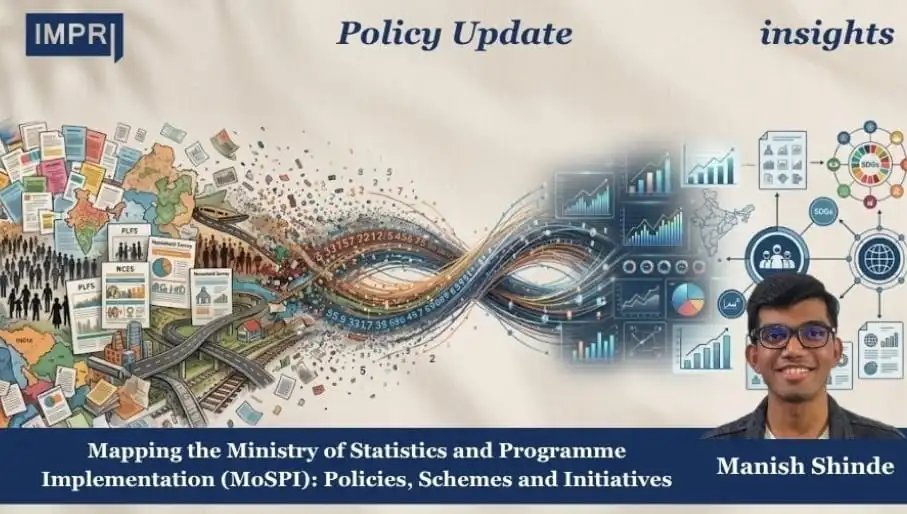
[Figure: Ministry of Statistics and Programme Implementation (MoSPI) Policies, Schemes and Initiatives 2026]
Policies and Schemes
- Capacity Development Scheme and Support for Statistical Strengthening (SSS): The Capacity Development (CD) Scheme is MoSPIs umbrella scheme for strengthening statistical capacity across the country. Its key sub-scheme, Support for Statistical Strengthening (SSS), funds State Directorates of Economics and Statistics (DES) to carry out statistical activities that States cannot otherwise afford human resource development, statistical infrastructure, IT investment, and improving the quality of State-level data. SSS traces its origins to the India Statistical Strengthening Project (ISSP), launched in 2010 as a Centrally Sponsored Scheme with World Bank support; it was later merged with the Building Statistical Systems at the Local Level (BSLLD) component and renamed SSS. States sign specific MoUs and prepare a State Strategic Statistical Plan (SSSP) to access funds under the scheme. MoSPI is currently revamping SSS in collaboration with the World Bank proposed National Programme for Improving Quality of Statistics in India (NPIQSI), and organised a Conference of State Ministers on “Strengthening of Statistical Systems” in April 2025 to build political buy-in for the revamp.
- National Accounts Statistics (NAS) and periodic base-year revisions: The National Accounts Division compiles India’s GDP, GVA, GNI and per-capita income estimates and publishes the annual National Accounts Statistics volume. Base years are revised periodically to reflect structural changes in the economy. After nearly a decade, MoSPI rolled out a new GDP series with base year 2022-23 (replacing 2011-12), released on 27th February 2026, alongside a revised CPI series with base year 2024 and a revised IIP series. This is only the eighth such base-year revision since Indias first national income estimate was compiled in 1949, and it is expected to be followed by India’s eventual adoption of the UNs SNA 2025 framework in a future revision.
- Consumer Price Index (CPI) and Index of Industrial Production (IIP): MoSPI releases monthly CPI data (rural, urban and combined), which the RBI uses as its primary inflation gauge for monetary policy, and IIP “quick estimates,” which track industrial output. Both indices are being rebased in line with the 2022-23/2024 revision cycle, drawing on updated expenditure weights derived from the HCES 2023-24 consumption basket.
- Periodic Labour Force Survey (PLFS): Launched in 2017 to replace the earlier quinquennial employment-unemployment surveys, the Periodic Labour Force Survey (PLFS) generates critical estimates of the Labour Force Participation Rate (LFPR), Worker Population Ratio (WPR), and Unemployment Rate (UR). Statistically, the survey employs two distinct measurement approaches: Current Weekly Status (CWS) is used to capture high-frequency, short-term activity for the quarterly urban bulletins (based on a 7-day reference period), whereas Usual Status (ps+ss) accounting for principal activity along with subsidiary economic roles over a 365-day reference period serves as the primary metric for comprehensive annual rural and urban reports. Operationally, MoSPI has instituted a structural transition away from traditional agricultural-year survey cycles (July-June) to calendar-year reporting (January-December), alongside ongoing technical efforts to move toward monthly high-frequency releases to provide timely labour market intelligence.
- Household Consumption Expenditure Survey (HCES): After the 2017-18 round was junked over data-quality concerns, MoSPI conducted the Household Consumption Expenditure Survey (HCES) afresh in 2022-23 (released June 2024) and again in 2023-24 (released December 2024). HCES estimates monthly per capita consumption expenditure (MPCE) and household budget shares, providing the foundational weighting diagram for CPI compilation. The recent rounds introduced significant methodological upgrades, notably shifting to a multi-visit data collection approach across three separate visits to curb recall error, and incorporating value imputation for free items received through social welfare programs (such as PMGKAY food grains) alongside out-of-pocket spending.
- Economic Census, ASI and ASUSE: The Economic Census enumerates all non-agricultural establishments in the country and forms the sampling frame for a range of follow-up enterprise surveys. MoSPI has been in the process of initiating the next (8th) round of the Economic Census, alongside its regular Annual Survey of Industries (ASI) covering the organised manufacturing sector, and the Annual Survey of Unincorporated Sector Enterprises (ASUSE), which captures India’s vast informal enterprise economy.
- Time Use Survey (TUS) and thematic social-statistics surveys: The Time Use Survey measures how Indians allocate time across paid work, unpaid care work, leisure and other activities data that is central to debates on the (under)valuation of unpaid domestic and care work, disproportionately performed by women. MoSPI has similarly begun running thematic one-off surveys through the NSS rounds, such as the first exclusive all-India AYUSH Survey (2022-23), reflecting a wider push to fill social-statistics gaps.
- Sustainable Development Goals National Indicator Framework (SDG-NIF): serves as the backbone of India’s statistical monitoring for the 2030 Agenda. MoSPI is the nodal statistical agency responsible for maintaining and periodically updating the comprehensive NIF and releasing the annual SDG National Indicator Framework Progress Report. Administratively, MoSPI maintains the master NIF to track official statistical progress, whereas NITI Aayog computes and publishes the composite SDG India Index based on a prioritized sub-selection of these indicators to drive competitive federalism. To cascade accountability down to the grassroots, MoSPI, in coordination with State Directorates of Economics and Statistics, has spearheaded the development of the Local Indicator Framework (LIF), enabling standardized, granular SDG tracking at the district and panchayat levels.
- Data Quality, Data Governance and Data Innovation initiatives: MoSPI has been pushing a broader “data governance” agenda exploring alternative and non-traditional data sources (night-lights data, e-commerce price data, administrative data linkages such as the Public Finance Management System) to supplement traditional surveys, developing a Data Quality Assurance Framework, and building out data dissemination infrastructure such as microdata catalogues and web-based survey data documentation (in line with the International Household Survey Network/IHSN toolkit). These efforts sit under the Ministry’s evolving vision for a more integrated National Data Innovation ecosystem.
- Twenty Point Programme (TPP): Originally launched in 1975 (and periodically restructured, most recently as TPP-2006), the TPP is a monitoring mechanism that tracks the physical progress of a basket of poverty-alleviation and social-sector schemes implemented by various Central Ministries covering areas such as rural housing, drinking water, health, education and employment generation through monthly and quarterly progress reports compiled by States and UTs.
- Infrastructure and Project Monitoring Division (IPMD): monitors the physical and financial progress of Central Sector infrastructure projects costing ₹150 crore and above across key sectors including Power, Coal, Steel, Railways, Petroleum & Natural Gas, and Roads. Operating through the Online Computerised Monitoring System (OCMS) and increasingly integrated with the PM Gati Shakti National Master Plan for spatial project tracking and GIS-based bottleneck identification, IPMD tracks real-time progress to flag cost overruns and commissioning delays for Cabinet-level reporting. Crucially, IPMD functions strictly as a monitoring and reporting body without executive powers, meaning it cannot directly clear administrative bottlenecks, enforce inter-ministerial resolutions, or penalize defaulting contractors.
- Members of Parliament Local Area Development Scheme (MPLADS): Launched in December 1993, the Members of Parliament Local Area Development Scheme (MPLADS) enables each MP to recommend developmental works worth ₹5 crore annually in their constituency, with mandatory earmarking for SC- (15%) and ST-inhabited (7.5%) areas. MoSPI formulates policy, prescribes monitoring protocols, and disburses the ₹5 crore entitlement in two equal installments of ₹2.5 crore, strictly subject to the physical progress and financial utilization thresholds of prior tranches. Under the revised 2023 operational guidelines, funds operate as non-lapsable annual entitlements routed through the SNA-SPARSH web module (Single Nodal Agency platform) for just-in-time central exchequer transfers directly to implementing districts, supported by the Integrated MPLADS Portal and the e-SAKSHI mobile app for end-to-end digital tracking.
- Natural Capital Accounting and Valuation of Ecosystem Services (NCAVES):was an EU-funded initiative implemented jointly by the UN Statistics Division (UNSD), UNEP, and the CBD Secretariat, with India serving as one of five global pilot countries alongside Brazil, China, South Africa, and Mexico. Under this umbrella, MoSPI’s Social Statistics Division institutionalized environmental-economic accounting aligned with the UN’s SEEA framework, releasing annual accounts through EnviStats India, which is bifurcated into Volume I (Physical Accounts) tracking material stocks and flows of natural resources like land, water, and minerals and Volume II (Ecosystem Services), dedicated to ecosystem extent, condition, and economic valuation. A core milestone of this initiative has been the pilot application of the System of Environmental-Economic Accounting Ecosystem Accounting (SEEA-EA) demonstrated through district-level ecosystem service models in Karnataka (assessing carbon retention, water provisioning, and soil erosion prevention) which subsequently informed the Indian Strategy for Environmental-Economic Accounts, 2022–2026.
- Index of Services Production (ISP): Is an index MoSPI is developing to track real volume and output trends in the services sector, mirroring how the Index of Industrial Production (IIP) measures industrial activity. While a Technical Advisory Committee report established the methodological framework to address a long-standing statistical blind spot given services’ dominant share of India’s GDP the ISP currently remains an experimental and internal index under active development, rather than an institutionalized, official monthly release. As part of its development and validation pipeline, MoSPI is actively pursuing harmonization efforts by integrating high-frequency administrative data, specifically GST return analytics and the Reserve Bank of India’s (RBI) services and balance of payments indicators, to ensure reliable sectoral coverage and deflator accuracy.
- Domestic Tourism Expenditure Survey (DTES) and National Household Travel Survey (NHTS):In July 2025, MoSPI initiated fieldwork for two dedicated surveys addressing longstanding official data gaps in domestic mobility. The DTES captures domestic tourism expenditure, visitor characteristics, and overnight trip profiles, whereas the NHTSA India’s first pan-India exercise of its kind targets daily household commuting patterns, transport modal choices, and short-distance mobility. Alongside these mobility metrics, city-level profiles from the Annual Survey of Unincorporated Sector Enterprises (ASUSE) are being leveraged to fill critical data voids in municipal-level economic planning and urban local body resource management
- Time Use Survey (TUS), Second Round (2024): Beyond the first TUS (2019), MoSPI completed the second pan-India Time Use Survey during 2024, continuing the effort to generate periodic (not one-off) data on unpaid care work and time allocation a growing priority given its relevance to gender-responsive budgeting and SDG 5 monitoring.
- ASUSE Million-Plus Cities Studies: Building on the regular ASUSE, MoSPI has begun publishing city-specific deep dives such as “Urban Unincorporated Enterprise Landscape: ASUSE 2025 – Insights from Million-Plus Cities,” offering a more granular, urban-focused read on India’s informal enterprise sector than the national-level survey alone.
- Compendium of Datasets and Registries in India: A newer MoSPI publication (2025) that catalogues the various administrative datasets and data registries maintained across government part of the Ministry’s broader “data governance” push to help researchers, other ministries and the public locate and use official microdata more easily.
- Expert Committee on Energy Statistics: MoSPI has constituted and released the report of an Expert Committee on Energy Statistics, aimed at improving the framework and quality of India’s official energy-sector statistics, an area flagged as a data gap in earlier annual reports.
- Statistics Day and public outreach: Observed annually on 29 June (P.C. Mahalanobis’s birth anniversary), National Statistics Day is when MoSPI releases its flagship annual publications the SDG-NIF Progress Report and its companion Data Snapshot and Handbook making it a recurring news hook for anyone tracking the Ministry’s output.
Additional Resources
MoSPI, GoI.
Official website.
MoSPI, GoI.
Annual Report 2024-25.
MoSPI, GoI.
Annual Report 2023-24.
PIB (2025).
Year-End Review 2025 — Ministry of Statistics and Programme Implementation.
PIB (2024).
Year-End Review 2024 — Ministry of Statistics and Programme Implementation.
MoSPI, GoI.
Support for Statistical Strengthening — Revised Operational Guidelines, 2024.
MoSPI, GoI.
Resources for State DES / SSS Scheme page.
MoSPI, GoI.
SSS Sub-Scheme — Achievement Booklet.
PIB/MoSPI (2026).
Press Note on New Series of GDP Estimates with Base Year 2022-23 (27 February 2026).
MoSPI, GoI (2026). FAQ: Understanding the New Series of GDP.
PIB/MoSPI (2025).
PLFS: Changes in 2025 — revamped sample design and shift to calendar-year cycle.
PIB/MoSPI (2026).
Press Note on PLFS Annual Report, 2025 (first calendar-year report).
MoSPI, GoI.
HCES 2023-24 — Factsheet.
MoSPI, GoI.
HCES 2023-24 — Detailed Report.
PIB (2025).
Release of SDG Publications on 19th Statistics Day (29 June 2025).
PIB (Archival).
Year-End Review — Twenty Point Programme and Infrastructure/Project Monitoring achievements.
About the Contributor
Manish Shinde is a researcher at IMPRI, New Delhi, and a final-year Bachelor’s student in Statistics at Fergusson College, Pune. His academic interests lie in Behavioural Economics, Quantitative Research, Quantitative Analysis and with a particular focus on data from the Ministry of Statistics and Programme Implementation (MoSPI).
Acknowledgements
The author expresses his gratitude to Dr. Arjun Kumar and other collaborators at IMPRI for peer-reviewing this article.
Reviewed by: Kaustav Majumdar & Anushree Khare
Disclaimer
All views expressed in the article belong solely to the author and not necessarily to the organisation.
Read more at IMPRI:
Coconut Promotion Scheme 2026: Strengthening India’s Coconut Sector through Productivity
Kerala’s Old-Age Pension Landscape: The Indira Gandhi National Old Age Pension Scheme (1995)