








Policy Update
Ritobrata Purkayastha
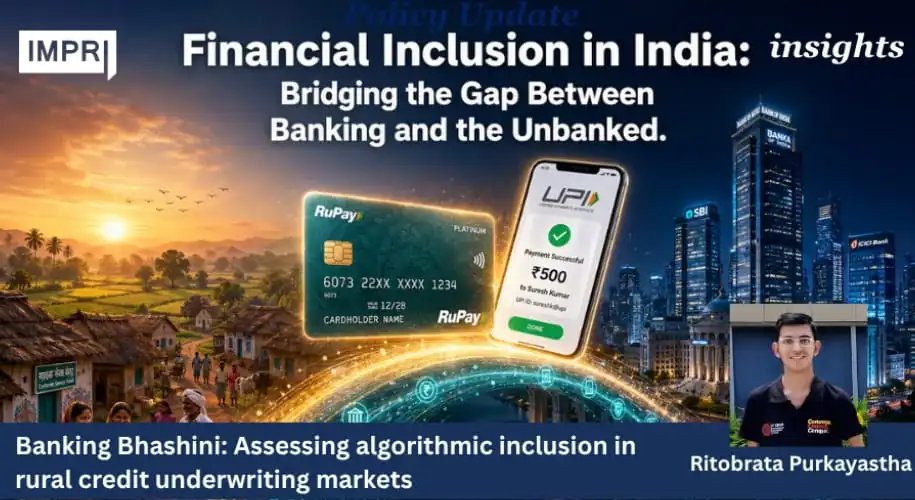
India’s financial inclusion landscape is undergoing a structural paradigm shift, transitioning from expanding basic brick-and-mortar banking access to deploying an intelligent, real-time digital public ecosystem. Traditionally, financial inclusion has been defined as the process of ensuring access to financial services, with timely, adequate, and affordable credit, primarily for vulnerable populations and low-income groups. However, actualizing this definition in rural credit markets has historically been hindered by two structural barriers: a lack of verifiable credit histories among thin-file borrowers and the linguistic exclusion of regional-language-speaking communities.
To address these challenges, India has leveraged its foundational Digital Public Infrastructure (DPI), commonly referred to as the JAM (Jan Dhan-Aadhaar-Mobile) Trinity. As of March 2026, over 144 crore Aadhaar numbers have been generated for secure biometric identification, and Jan Dhan accounts have grown to 58.16 crore, holding cumulative deposits totaling 3.02 lakh crore rupees. This massive database is supported by 125.87 crore wireless telephone subscribers, with 5G networks covering 99.9 percent of districts, providing the data and computational foundation necessary for advanced technological deployment.
Recognizing that linguistic barriers perpetuate structural financial exclusion, the Digital India BHASHINI Division (DIBD), operating under the Digital India Corporation of the Ministry of Electronics and Information Technology (MeitY), signed a landmark Memorandum of Understanding (MoU) with the Reserve Bank of India (RBI) in February 2026. This partnership, titled “BHASHINI for Seva / Sanchalan – A BHASHINI Sahayogi Program,” focuses on deploying customized natural language processing (NLP) models within the banking ecosystem. The cornerstone of this program is the co-development of “Banking BHASHINI,” a domain-specific artificial intelligence language model tailored to financial terminology, regulatory frameworks, and banking vocabulary across all 22 languages recognized under the Eighth Schedule of the Constitution of India. Concurrently, this voice-enabled front-end is integrated with the Unified Lending Interface (ULI), a technology platform launched as a pilot by the RBI in August 2023 to enable frictionless credit delivery. By combining voice-led linguistic democratization with consent-based alternative credit underwriting networks, the Banking BHASHINI framework aims to bridge the rural credit gap and redefine formal credit assessment.
Functioning
The operational architecture of the Banking BHASHINI model and its integration within the rural credit underwriting market relies on a multi-layered interface connecting natural language processing, API-driven data repositories, and alternative credit scoring algorithms.
At the primary user layer, Banking BHASHINI functions as a voice-first multilingual bridge. The platform utilizes over 300 pre-trained artificial intelligence models accessible via open APIs to convert spoken dialects into standardized text and vice-versa. For conversational interaction, the system executes real-time speech-to-text, machine translation, and text-to-speech synthesis, allowing rural borrowers to communicate with financial systems in their native tongue. The system’s underlying neural network architectures use end-to-end learning to bypass noisy environments, regional accents, and diverse speech patterns, which is a major advancement over traditional, hand-engineered NLP components. To ensure precise localization, the model ingests specialized datasets crowd-sourced through the BhashaDaan initiative, ensuring high contextual accuracy for complex financial terminology and regional dialects.
To facilitate credit applications, the linguistic layer is mapped directly to the Unified Lending Interface (ULI). The ULI operates as a consent-based digital public infrastructure that integrates financial institutions with diverse data service providers (DSPs) through standardized APIs. Once a borrower grants spoken, translated consent, the ULI automatically retrieves verified financial and non-financial data.
The data retrieved includes identity validation from the National Payments Corporation of India
Background
oration of India (NPCI), Aadhaar e-KYC, and DigiLocker. Financial footprints are mapped through Unified Payments Interface (UPI) transaction history, bank statements from the Account Aggregator network, and PAN validation. For commercial and agricultural metrics, the platform accesses Goods and Services Tax Network (GSTN) filings, state land registries, soil health reports, and satellite crop monitoring imagery. Additionally, cooperative logistics such as cattle registries and milk pouring logs from local cooperatives like Aavin are integrated to assess supplementary rural incomes. Once retrieved, these datasets are compiled by alternative credit scoring systems. These adaptive systems utilize machine learning algorithms to evaluate the borrower’s payment discipline, assessing their overall ability, stability, and intent to repay the loan.
Performance
The performance of the digital systems supporting the Banking BHASHINI and alternative underwriting ecosystem is highlighted by macro-level transactional data and micro-level algorithmic validation results.
| Digital Infrastructure Component | Performance Metrics (March 2026 / Present) | Macro-Economic Value / Volume | Source |
| JAM & Aadhaar Identity | Biometric profiles generated for authentication | Over 144 crore accounts | |
| Pradhan Mantri Jan Dhan Yojana | Dedicated financial inclusion bank accounts | 58.16 crore accounts (3.02 lakh crore deposits) | |
| Unified Payments Interface | Real-time payment processing (March 2026) | 2,264.11 crore transactions (29.53 lakh crore value) | |
| Direct Benefit Transfer (DBT) | Subsidy transfers directly to citizens | 49.09 lakh crore cumulative transfers | |
| DBT Efficiency Savings | Welfare leakage prevention (January 2026) | 4.31 lakh crore saved by purging ghost entries | |
| Account Aggregator Framework | Secured consent-based accounts linked | 252.9 million users linked (2.6 billion accounts) | |
| Unified Lending Interface | Regulated lenders onboarded (December 2025) | 64 lenders (41 banks and 23 NBFCs) | |
| ULI Lending Scale | Frictionless loan volume processed (April 2025) | Over 14 lakh loans (valued at 65,000 crore) |
Source: Compiled by author based on official data from the Ministry of Electronics and Information Technology & Press Information Bureau (2026) and Reserve Bank of India (2024).
On an operational scale, the nationwide pilot implementation of the ULI has reduced the turnaround time for credit appraisals in rural areas. Traditionally, assessing agricultural credit or micro-enterprise loans required physical site visits, local crop yield inspections, and manual documentation, taking approximately 8 to 10 days to process. ULI’s automated data flow allows lenders to access digitized land registries and remote sensing imagery, completing appraisal and doorstep disbursement within minutes without physical paperwork.
At the algorithmic level, alternative credit scoring models have demonstrated high predictive accuracy in identifying creditworthy thin-file borrowers. In an independent validation study published in 2026, machine learning classifiers were trained on 5,000 synthetic profiles of Indian individual borrowers and micro-enterprises, using gradient boosting classifiers calibrated with isotonic regression.
The individual borrower models achieved an Area Under the Curve (AUC) score of 0.7650 and a Brier score of 0.1950, while the micro-enterprise risk models yielded an AUC of 0.7840 and a Brier score of 0.1840. The application of these calibrated models resulted in a portfolio-level reduction in Expected Credit Loss of 51.7 percent compared to randomly selected accounts. This Expected Credit Loss is computed by multiplying the probability of default, the loss given default, and the exposure at default, demonstrating the risk-mitigation capabilities of alternative credit scoring.
Impact
The integration of voice-enabled natural language processing through Banking BHASHINI with consent-driven API data sharing is transforming rural finance by introducing flexible, localized, and highly accessible credit products.
First, alternative underwriting models are opening up formal credit channels for the estimated 190 million new-to-credit individuals, gig workers, and micro-entrepreneurs who lack traditional credit bureau files. By transitioning from credit scores like CIBIL to real-time transactional analysis, these models help bridge a credit gap valued at 130 to 170 billion USD. This access allows rural borrowers to secure competitive formal interest rates, bypassing predatory informal lenders who routinely charge annual percentage rates between 24 percent and 36 percent. This formalization supports the national Digital ShramSetu initiative, which seeks to integrate India’s 490 million informal workers into the mainstream economy using artificial intelligence, blockchain, and real-time skill verification.
Second, Banking BHASHINI is helping democratize digital access by removing language and literacy barriers. Utilizing specialized translation programs such as Lekhaanuvaad for document translation and Anuvaad for real-time text and speech conversion, the platform allows rural users to navigate digital applications using voice commands in their preferred dialect. This technology is being adopted across public and private sectors; for example, Snapdeal, the Ministry of Information and Broadcasting, and the Open Network for Digital Commerce (ONDC)—via its multilingual Saarthi application—have integrated BHASHINI models to make e-commerce and governance accessible to regional language speakers. Similarly, conversational voice assistants like Federal Bank’s “Feddy” run on platforms like WhatsApp and Alexa, enabling regional language speakers to check pre-approved loan status, open deposits, and transfer funds through simple spoken prompts.
Third, these technologies are transforming credit risk management by enabling continuous, adaptive underwriting. Traditional credit scoring systems rely on static historical snapshots, which often fail to account for normal seasonal fluctuations in rural businesses or agricultural operations. In contrast, adaptive models continuously track cash flow patterns, identifying seasonal income dips (such as dry periods in dairy farming or the sowing phase of crops) as normal cyclical variations rather than credit defaults. This allows lenders to offer personalized, flexible terms and automated refinancing options that adapt dynamically to the borrower’s real-world business performance.
Emerging Issues
Despite the benefits of automated underwriting, several emerging structural, algorithmic, and social concerns present challenges to the equitable rollout of these technologies in rural credit markets.
A major concern is the risk of systemic algorithmic bias and credit redlining. Because machine learning systems are trained on historical data, they can replicate and entrench pre-existing societal inequalities. In India, historical patterns of financial exclusion are closely aligned with geographic location, caste, gender, religion, and socio-economic status. If automated systems are trained on biased datasets without careful adjustment, they may develop proxy-based redlining behaviors. This can lead to the automated rejection of entire geographic areas or specific occupational profiles based on aggregate regional indicators, regardless of an applicant’s actual creditworthiness. For example, studies on credit scoring models show that female applicants often receive credit scores six to eight points lower than male applicants with identical financial profiles.
Furthermore, social context in India is not uniform; it varies dynamically across the country’s 28 states and eight union territories, both over time and at any given point in time. For instance, localized affirmative action programs, such as state-level interest subsidies for Scheduled Castes or Scheduled Tribes, or specialized credit programs for rural women’s self-help groups, are not uniformly distributed. Additionally, banking databases have been slow to adapt to legal changes, such as the decriminalization of same-sex relationships under Section 377; because formal marriage registrations for the LGBTQA+ community are not yet permitted, historical data gaps persist, which can lead to automated discrimination against non-traditional households.
Similarly, competitive pricing and algorithmic credit limits can introduce geographical inequities. As shown in the table below, two borrowers with comparable profiles can receive vastly different borrowing limits based on algorithmic geographic classification:
| Representative Profile | Geographic Classification | Income & Education Profiles | Algorithmic Limit Outcomes | Underwriting Bias Source | Source |
| Amarjit (Age 29, contractor) | Bathinda, Punjab (Semi-Urban) | Moderate income, secondary education | Restricted borrowing limit and higher interest rates | High regional collection-risk weighting and proxy-based geographic scoring. | |
| Srikanth (Age 30, gig freelancer) | Bengaluru, Karnataka (Urban) | Moderate income, secondary education | Extended borrowing limit and preferential terms | Low-risk urban classification and active UPI transactional history. |
Alternative credit underwriting models frequently introduce causality errors by relying on non-financial indicators scraped from smartphones. Many digital lending apps require extensive device permissions, accessing contact lists, call logs, and GPS location history. Underwriting models often use homophily metrics to flag an applicant as high risk if their contact list includes individuals who have defaulted on loans, which leads to high rates of false positives. Other algorithms misinterpret device data by assuming that the phone number receiving transactional SMS alerts is the sole account holder, or by calculating credit risk based on the applicant’s physical proximity to previously flagged collections areas.
While Banking BHASHINI’s voice-first models aim to democratize access, linguistic inaccuracies in translation engines present operational risks. For example, user feedback from May 2026 indicates that machine translation models for regional languages such as Meiteilon (Manipuri) can produce inaccurate and misleading translations, which can distort financial terms and lead to invalid loan agreements. Moreover, because of the digital literacy gap, rural and elderly borrowers remain highly vulnerable to automated fraud, voice-cloning deepfakes, and social engineering scams. Without human mediation at the first mile, these demographics can easily be manipulated into authorizing digital data access or signing predatory, high-interest contracts.
The consolidation of comprehensive personal data through the Account Aggregator framework and the ULI raises serious privacy concerns under the Digital Personal Data Protection Act of 2023. The Act requires that personal data sharing be based on informed, specific, and revocable consent. However, because of the power imbalance in credit markets, rural borrowers often face forced consent, where they must agree to extensive personal data profiling to secure a loan. This issue is amplified by regulatory changes that allow unregulated fintech companies direct access to credit information company databases, increasing the risk of unauthorized profiling and data leakage.
Way Forward
To establish a fair, transparent, and resilient rural credit underwriting ecosystem, policymakers, financial institutions, and technology providers must implement systemic safeguards, hybrid service delivery channels, and localized bias mitigation frameworks.
First, regulated lenders must implement a structured bias mitigation framework to address systemic discrimination and ensure algorithmic transparency. To move beyond opaque, black-box models, institutions should adopt the structured eight-step framework detailed in the table below:
| Framework Phase | Operational Step | Technical Action | Target Strategic Outcome | Source |
| Pre-Processing | 1. Analyze Training Datasets | Remove systemic outliers and regional policy-driven biases. | Prevents model from learning historical exclusion patterns. | |
| Pre-Processing | 2. Compare Protected Variables | Track underwriting outcomes across demographic variables (gender, religion). | Exposes systemic disparities in risk scoring. | |
| In-Processing | 3. Establish Metrics | Define quantitative fairness metrics customized for Indian realities. | Ensures consistent bias monitoring across segments. | |
| In-Processing | 4. Define Handling | Deploy algorithmic corrections and human-in-the-loop validation checkpoints. | Corrects biased automated outputs. | |
| Post-Processing | 5. Implement Exception | Create pathways to override false-positive risk flags. | Protects borrowers from unfair proxy-based rejections. | |
| Post-Processing | 6. Ensure Explainability | Implement explainable AI tools (such as SHAP-proxy engines). | Explains rejection reasons and how to improve. | |
| Governance | 7. Conduct Bias Audits | Run independent audits of underwriting algorithms at scheduled intervals. | Corrects new bias vectors in live systems. | |
| Governance | 8. Analyze Trends | Review scoring trends against real-world socio-economic developments. | Aligns algorithms with public inclusion policies. |
Second, to address the digital literacy gap, the financial ecosystem must maintain a hybrid phygital (physical-digital) service delivery model. Voice-enabled artificial intelligence models should not completely replace human assistance. Instead, conversational banking interfaces must be integrated with existing physical networks, such as local village Common Service Centres and Business Correspondents. By utilizing the extensive networks of commercial banks—such as Union Bank of India, which deploys 28,561 active Business Correspondents across rural and semi-urban districts—financial institutions can provide guided, secure access to digital lending systems, protecting vulnerable borrowers from predatory scams.
Third, the Reserve Bank of India must mandate strict security and testing standards for all alternative underwriting systems. This regulatory approach should include the following actions:
- Mandating the RBI Regulatory Sandbox: Regulated lenders and fintech developers must be required to test experimental alternative scoring models and API frameworks within the RBI Regulatory Sandbox. This allows developers to evaluate potential algorithmic bias, cybersecurity vulnerabilities, and compliance with data privacy regulations under active supervision before any nationwide rollout.
- Institutionalizing Advanced Cyber Defenses: Financial institutions must integrate machine-learning-based security systems, such as MuleHunter.AI, across cooperative networks and Regional Rural Banks (RRBs) to identify and freeze compromised mule accounts in real-time, protecting rural financial networks.
- Developing Tailored Portals for FPOs and SHGs: Banks should deploy specialized, collective lending pathways on the ULI platform optimized for Farmer Producer Organizations (FPOs) and women-led Self-Help Groups (SHGs). Group-based underwriting models reduce individual defaults, lower transaction friction, and ensure that the benefits of digital credit expansion are distributed equitably across rural communities.
Selected References and Important Links
- Digital India BHASHINI Division (DIBD). (2026). BHASHINI for Seva / Sanchalan Program Guidelines. bhashini.gov.in
- International Journal of Technology, Health and Sustainability. (2026). AI-Powered Alternative Credit Scoring System for MSMEs and Individual Borrowers in India. ijths.com
- Ministry of Electronics and Information Technology (MeitY). (2026). Digital Solutions and Linguistic Inclusivity in Indian Banking. pib.gov.in
- Reserve Bank of India (RBI). (2024). Unified Lending Interface (ULI) Pilot Framework. rbi.org.in
About the Contributor
Ritobrata Purkayastha is a Research & Editorial Intern at the IMPRI Impact and Policy Research Institute, New Delhi. He is currently pursuing a Bachelor of Science (B.Sc.) in Economics (3rd Year) at XIM University, Bhubaneswar. His research interests encompass monetary econometrics, public policy, and the application of data science and quantitative econometric tools to socio-economic challenges.
Disclaimer
All views expressed in the article belong solely to the author and not necessarily to the organisation.
Read more at IMPRI:
Coconut Promotion Scheme 2026: Strengthening India’s Coconut Sector through Productivity