


Policy Update
Gowri Kodali
Background
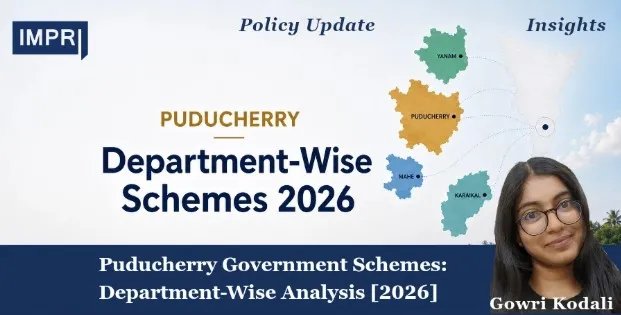
Puducherry is a Union Territory with a distinctive administrative geography. Unlike most states and Union Territories that form one continuous geographical unit, Puducherry consists of four separate regions—Puducherry, Karaikal, Mahe, and Yanam—located along different parts of India’s southern coastline. Puducherry and Karaikal are enclaves surrounded by Tamil Nadu, Mahe lies along the Malabar Coast of Kerala, while Yanam is situated within the East Godavari delta in Andhra Pradesh. This non-contiguous geographical separation makes inter-regional coordination of public services, infrastructure, and welfare delivery particularly critical to governance.
According to Census 2011 data published by the Directorate of Economics and Statistics, Puducherry had a population of about 12.48 lakh, with around 68.3 percent residing in urban areas. Its population density was 2,547 persons per sq km, highlighting the concentrated settlement patterns across its enclaves (Directorate of Economics and Statistics, Government of Puducherry, Census 2011).
The Government of Puducherry presented a ₹14,300 crore tax-free Budget for FY 2026–27 on 24 August 2026 (Government of Puducherry, Budget Speech 2026–27). Of the total expenditure, ₹12,115 crore is allocated for revenue expenditure and ₹2,185 crore for capital expenditure. The Union Territory estimates ₹7,890.41 crore from its own tax and non-tax revenue and receives additional fiscal support through central grants, Centrally Sponsored Schemes, and capital loans. The budget marks an increase of ₹700 crore over the ₹13,600 crore outlay for 2025–26.
The 2026–27 policy direction balances welfare protection with capital expansion, urban services, education, healthcare, and digital governance. The official portal of the Government of Puducherry lists 48 Departments and Directorates administering public services across the four regions.
PUDUCHERRY BUDGET 2026–27 – DEPARTMENT-WISE LIST (48 DEPARTMENTS)
Finance Department
Scheme: Puducherry State Budget 2026–27, Launch Year: 24 Aug 2026, Key Details: Tax-free Budget balancing social security commitments with capital creation and debt management, Coverage: All 48 departments across 4 regions, Latest Budget: ₹14,300 Cr (Revenue: ₹12,115 Cr; Capital: ₹2,185 Cr).
Accounts and Treasuries Department
Scheme: Budget Estimates, Allocation and Monitoring System (BEAMS) and Digital Treasury, Launch Year: Ongoing, Key Details: End-to-end digitised treasury transactions, automated bill processing, and expenditure tracking, Coverage: All 4 regional treasuries.
Planning and Research Department
Scheme: Multilateral Infrastructure Projects (PIULIP and PY-SHORE), Launch Year: Ongoing, Key Details: ADB/AFD-assisted urban water and sewerage project (PIULIP) and World Bank-assisted coastal resilience program (PY-SHORE), Coverage: Puducherry, Karaikal, Mahe, and Yanam, Latest Budget: PIULIP: ₹4,750 Cr; PY-SHORE: ₹1,433 Cr.
Agriculture and Farmers Welfare Department
Scheme: Crop Production Technology Scheme, PM-KISAN, and PKVY, Launch Year: Ongoing, Key Details: Production input subsidies, 200 ha organic farming under Paramparagat Krishi Vikas Yojana, and PM Fasal Bima settlements, Coverage: 28,430 farmers across all 4 regions, Latest Budget: ₹19.51 Cr production incentives; PM-KISAN: ₹3.74 Cr; PMFBY: ₹8.45 Cr (Government of Puducherry, Budget Speech 2026–27).
Animal Husbandry and Animal Welfare Department
Scheme: Livestock Modernisation and PONLAIT Dairy Expansion, Launch Year: Ongoing, Key Details: Distribution of 297 milking machines with 100% subsidy and a new automated ice-cream manufacturing facility, Coverage: Dairy farmers and cattle rearers across UT, Latest Budget: ₹34.35 Cr for PONLAIT plant; ₹2 Cr milking subsidy.
Fisheries and Fishermen Welfare Department
Scheme: Fishing Ban Relief, Lean Period Assistance, and Karaikal Fishing Harbour, Launch Year: Ongoing, Key Details: Marine fishing ban compensation, lean-season subsistence grants, old-age pensions for aged fishers, and modern harbour development, Coverage: Coastal fishers in Puducherry and Karaikal, Latest Budget: ₹130.17 Cr harbour project; Relief: ₹15.91 Cr; Lean season: ₹12.15 Cr; Pension: ₹32.75 Cr.
Co-operative Department
Scheme: PACS Computerisation under the national Sahkar Se Samridhi initiative, Launch Year: 2023, Key Details: Computerisation and core-banking linkages for 45 PACS, operating grants to fair-price consumer shops, and settlement of cooperative mill liabilities, Coverage: Cooperative credit societies and rural consumers, Latest Budget: ₹8.31 Cr fair-price grants; ₹39.01 Cr for sugar mill liabilities.
Civil Supplies and Consumer Affairs Department
Scheme: Targeted PDS and Chief Minister’s LPG Subsidy Scheme, Launch Year: Ongoing, Key Details: Subsidized LPG refills and free foodgrain distribution to Antyodaya Anna Yojana (AAY) and Priority Household (PHH) cardholders, Coverage: 6.34 lakh beneficiaries (~1.91 lakh families), Latest Budget: ₹31.20 Cr LPG subsidy outlay.
Electricity Department
Scheme: PM Surya Ghar Muft Bijli Yojana and Grid Modernisation, Launch Year: 2024, Key Details: 14 MW rooftop solar systems installed with state top-up subsidy up to ₹30,000 per household, and commissioning 110/22 kV power substations, Coverage: 3,984 households and domestic consumers, Latest Budget: ₹231.06 Cr substations; ₹27 Cr Central solar subsidy.
Industries and Commerce Department
Scheme: Ease of Doing Business Reforms and Thattanchavady IT/ITES SEZ, Launch Year: 2025, Key Details: EoDB Act 2025 regulatory simplification, Jan Vishwas compliance decriminalisation, and modern tech park development, Coverage: Industrial units, MSMEs, and technology firms, Latest Budget: ₹725 Cr SEZ investment (projecting 30,000 jobs).
Labour Department
Scheme: Building and Other Construction Workers Welfare (BOCW), Launch Year: Ongoing, Key Details: Direct welfare aid for maternity, marriage, and health, accompanied by regular job placement fairs, Coverage: Registered construction workers and job seekers, Latest Budget: ₹23.32 Cr BOCW assistance; 889 placements in 2025–26 fairs (Government of Puducherry, Budget Speech 2026–27).
Rural Development Department
Scheme: MGNREGS, PMGSY-III, and Lakhpati Didi, Launch Year: Ongoing, Key Details: 100 days guaranteed wage labour, last-mile rural road connectivity, and support for women SHG members to achieve sustainable annual household incomes under the Lakhpati Didi initiative, Coverage: 11.59 lakh person-days (88% women) and 13,127 Lakhpati Didis, Latest Budget: ₹52.73 Cr for 72 km under PMGSY-III.
Public Works Department
Scheme: Urban Water Supply, Drainage, and State Highways, Launch Year: Annual, Key Details: Construction of overhead storage tanks, drinking water distribution networks, urban stormwater drainage, and road improvements, Coverage: All 4 regions, Latest Budget: ₹47.12 Cr water works; ₹83.50 Cr drainage/flood; approximately ₹41 Cr for CRF roads.
Local Administration Department
Scheme: AMRUT 2.0, PM SVANidhi, and MLA Local Area Development Scheme, Launch Year: Ongoing, Key Details: Urban civic infrastructure, water body restoration, microcredit loans for vendors, and enhancement of constituency development funds, Coverage: Municipalities and commune panchayats, Latest Budget: MLA LAD increased to ₹3 Cr/member; ₹2.61 Cr loans to 900+ vendors.
Town and Country Planning Department
Scheme: Pradhan Mantri Awas Yojana – Urban (PMAY-U) and Master Planning, Launch Year: 2015, Key Details: Pucca housing construction for urban poor, master plan zoning, and automated building bye-law clearances, Coverage: Urban poor households and planned urban zones, Latest Budget: ₹14 Cr (839 houses completed under PMAY-U 1.0).
Transport Department
Scheme: Electric Mobility Policy and Public Transport Fleet Modernisation, Launch Year: Ongoing, Key Details: Phased rollout of electric buses, public EV charging network development, and acquisition of new air-conditioned buses, Coverage: Statewide transit passengers and vehicle owners, Latest Budget: Procurement of 20 AC luxury buses and urban electric buses.
Port Department
Scheme: Old Port Redevelopment and Eco-Cruise Terminal, Launch Year: 2026–27, Key Details: Restoration of the heritage port and establishment of a dedicated cruise terminal under the blue economy strategy, Coverage: Puducherry coastal harbour zone, Latest Budget: Financed under the ₹1,433 Cr PY-SHORE project.
Tourism Department
Scheme: Swadesh Darshan 2.0, PRASHAD, and Tourism Vision 2047, Launch Year: Ongoing, Key Details: Waterfront destination development, heritage preservation in White Town, and pilgrim amenities, Coverage: Puducherry and Karaikal circuits, Latest Budget: ₹20.29 Cr Karaikal Beach; ₹25.94 Cr Thirunallar; ₹22.50 Cr White Town.
Revenue and Disaster Management Department
Scheme: Rajiv Gandhi Social Security Scheme and NAKSHA Drone Survey, Launch Year: Ongoing, Key Details: Direct assistance to distressed families, disaster mitigation preparedness, and drone-based cadastral surveys with Survey of India, Coverage: Indigent households and landholders, Latest Budget: ₹7.18 Cr disbursed to 2,193 indigent families (Government of Puducherry, Budget Speech 2026–27).
Forest and Wild-Life Department
Scheme: Biodiversity Conservation and Coastal Ecosystem Restoration, Launch Year: Ongoing, Key Details: Operationalising Biodiversity Management Committees (BMCs), People’s Biodiversity Registers (PBRs), and coastal dune/mangrove restoration, Coverage: Ecologically sensitive coastal zones, Latest Budget: Integrated within World Bank PY-SHORE project.
Science, Technology and Environment Department
Scheme: Climate Action and Environmental Monitoring, Launch Year: Ongoing, Key Details: Industrial effluent surveillance, ambient air/water quality monitoring, and climate resilience planning, Coverage: Entire Union Territory, Latest Budget: Component of the ₹1,433 Cr PY-SHORE climate program.
Health and Family Welfare Services Department
Scheme: Ayushman Bharat PM-JAY, PM-ABHIM, and Vaya Vandana, Launch Year: Ongoing, Key Details: PM-JAY provides secondary and tertiary hospitalisation coverage; Vaya Vandana extends health coverage to senior citizens aged 70 years and above; and PM-ABHIM supports critical-care health infrastructure, including 50-bed critical care hospital blocks, Coverage: 49,240 hospitalised beneficiaries and senior citizens, Latest Budget: ₹92 Cr for critical care blocks; ₹38.07 Cr PM-JAY tertiary claims.
AYUSH Department
Scheme: Specialized AYUSH Hospitals and Wellness Centres Upgradation, Launch Year: Ongoing, Key Details: Expansion of traditional medical systems (Ayurveda, Yoga, Unani, Siddha, Homoeopathy) through dedicated inpatient hospitals and clinics, Coverage: Patients across Puducherry and Karaikal, Latest Budget: 30-bed hospital at Karaikal and 50-bed hospital at Villianur.
School Education Department
Scheme: Free Student Digital Devices, PM POSHAN, and Welfare Kits, Launch Year: Ongoing / 2026–27, Key Details: Midday meals, uniforms, textbooks, free laptops for Class XI–XII, and new free tablet scheme for Class IX–X students, Coverage: 65,856 midday meal students; 32,000+ device recipients, Latest Budget: ₹16.25 Cr for 16,250 tablets; ₹59.97 Cr for senior laptops.
Higher and Technical Education Department
Scheme: Perunthalaivar Kamarajar Financial Assistance Scheme, Launch Year: Ongoing, Key Details: Higher education tuition fee subsidies for CENTAC-sponsored professional seats (MBBS, engineering, nursing) and grants-in-aid to society colleges, Coverage: 4,903 professional college students, Latest Budget: ₹26.14 Cr tuition assistance.
Social Welfare Department
Scheme: Financial Assistance to Persons with Disabilities, Launch Year: Ongoing, Key Details: Graded monthly direct disability pensions (₹3,000 to ₹4,800/month) and supplementary nutritional support, Coverage: 20,767 persons with disabilities, Latest Budget: ₹88.62 Cr welfare transfers.
Women and Child Development Department
Scheme: Social Security Pensions, BPL Women-Head Assistance, and Baby Care Kits, Launch Year: Ongoing / 2026–27, Key Details: Pensions for senior citizens, widows, and destitutes; monthly assistance for women-headed BPL families increased to ₹2,500; ₹3,000 newborn kit, Coverage: 1.97 lakh pensioners; 63,000 women-headed households, Latest Budget: ₹563.33 Cr pension outlay.
Adi Dravidar Welfare and Scheduled Tribes Welfare Department
Scheme: Special Housing Subsidy, Marriage Aid, and Medical Assistance, Launch Year: Ongoing, Key Details: Integrated SC/ST housing subsidy increased from ₹5.5 lakh to ₹7 lakh, marriage gifts, and treatment grants for chronic illnesses, Coverage: Eligible SC/ST households, Latest Budget: ₹15.95 Cr for 1,150 housing units; ₹10.75 Cr illness aid (5,174 patients).
Welfare of Backward Classes and Minorities Department
Scheme: Karmaveerar Kamarajar Free Bicycle Scheme, Launch Year: Ongoing, Key Details: Distribution of free bicycles to Class IX students from Backward Classes and minorities to prevent school dropouts, Coverage: 8,861 Class IX students, Latest Budget: ₹5.55 Cr bicycle procurement outlay.
Hindu Religious Institutions and Wakf Department
Scheme: Temple Renovation and Oru Kala Pooja Scheme, Launch Year: Ongoing, Key Details: Restoration grants for heritage shrines and raising the annual grant for single-pooja temples from ₹20,000 to ₹30,000, Coverage: 225 financially weak temples and state trusts, Latest Budget: ₹9.70 Cr renovations; ₹67.50 L for Oru Kala Pooja.
Arts and Culture Department
Scheme: Cultural Heritage and Tagore Complex Revival, Launch Year: Ongoing, Key Details: Construction of the Tagore Cultural Complex, Bharathiar Open Air Theatre, and archaeological site museum at Arikamedu, Coverage: Cultural institutions, artists, and tourists, Latest Budget: ₹19.53 Cr allocated for Tagore Complex & Theatre.
Information Technology Department
Scheme: e-Office, AI Centre of Excellence, and Digital Internship Scheme, Launch Year: Ongoing / 2026, Key Details: Paperless governance expansion, foundation of AI CoE, and student tech placements with ₹10,000 monthly stipend, Coverage: All departments and 147 engineering/MCA interns, Latest Budget: 12-month stipend and digital infrastructure funding.
Department of Personnel and Administrative Reforms (DPAR)
Scheme: Common Civil Recruitment and Governance Reforms, Launch Year: Annual, Key Details: Consolidated merit-based recruitment drives and capacity development for administrative cadres, Coverage: UT administration and job aspirants, Latest Budget: 4,160 posts filled in 5 years; ~1,000 posts targeted for 2026–27.
Police Department
Scheme: Police Modernisation and CCTNS, Launch Year: Ongoing, Key Details: Construction of modern police stations, recruitment of Sub-Inspectors/constables, and absorption of Home Guards, Coverage: Entire Union Territory, Latest Budget: ₹4.12 Cr for new Lawspet Police Station; 195 officers recruited.
Fire Service Department
Scheme: Fire Service Strengthening and Equipment Upgradation, Launch Year: Annual, Key Details: Upgrading firefighting machinery, disaster response drills, and personnel intake, Coverage: All 4 regions, Latest Budget: Active recruitment process notified for 74 fire personnel.
Home Department
Scheme: Freedom Fighters Pension and Magisterial Coordination, Launch Year: Ongoing / 2026–27, Key Details: Law and order maintenance, prison administration oversight, and increasing freedom fighter monthly pension from ₹15,000 to ₹25,000, Coverage: Recognized freedom fighters and eligible dependants, Latest Budget: ₹6.46 Cr incremental pension budget.
Prisons Department
Scheme: Modern Prison Infrastructure and Karaikal Facility, Launch Year: 2026–27, Key Details: Modernization of central correctional facilities and construction of a new regional modern prison in Karaikal, Coverage: Correctional inmates, Latest Budget: ₹80 Cr estimated project outlay for Karaikal Prison.
Information and Publicity Department
Scheme: Media Outreach and IEC, Launch Year: Annual, Key Details: Multichannel publicity of government schemes, press liaison, and publication of development records, Coverage: Statewide public and media.
Commercial Taxes Department
Scheme: Goods and Services Tax (GST) Administration, Launch Year: 1 July 2017, Key Details: GST assessment, dealer registration, e-way bills, tax compliance, and revenue intelligence to plug leakages, Coverage: All registered commercial dealers and taxpayers, Latest Budget: 2026–27 budget estimate/target of ₹7,890.41 Cr in own tax and non-tax revenue.
Economics and Statistics Department
Scheme: GSDP Estimation and Socio-Economic Surveys, Launch Year: Annual, Key Details: State domestic product computation, census surveys, price index monitoring, and policy evaluation data, Coverage: All sectors across four regions, Latest Budget: Recorded 8.12% UT GSDP growth rate in 2025–26.
Elections Department
Scheme: Electoral Roll Management and Election Administration, Launch Year: Ongoing, Key Details: Continuous voter list revision, EPIC card distribution, EVM warehouse maintenance, and polling preparedness, Coverage: All 30 Assembly constituencies.
Drugs Control Department
Scheme: Pharmaceutical Regulation and Drug Quality Enforcement, Launch Year: Ongoing, Key Details: Pharmacy licensing, drug manufacturing inspections, and curbing substandard/spurious medicines, Coverage: Pharmacies and manufacturing units.
Food and Drugs Testing Department
Scheme: Chemical and Biological Testing Labs, Launch Year: Ongoing, Key Details: Statutory laboratory analysis of food, pharmaceutical, and cosmetic samples, Coverage: Entire Union Territory.
Food Safety Department
Scheme: Food Safety and Standards Authority of India (FSSAI) Compliance and Food Safety Surveillance, Launch Year: Ongoing, Key Details: Licensing of food business operators, quality enforcement, and street-vendor hygiene drives under FSSAI, Coverage: Food businesses and consumers.
Law Department
Scheme: Judicial Administration and Legislative Vetting, Launch Year: Annual, Key Details: Vetting of government ordinances and bills, judicial administration, and state litigation representation, Coverage: Government administration and courts.
Chief Vigilance Office
Scheme: Anti-Corruption Oversight and Preventive Vigilance, Launch Year: Ongoing, Key Details: Preventive anti-corruption inspections, inquiry into public grievances, and major procurement integrity audits, Coverage: All government departments.
Sainik Welfare Department
Scheme: Ex-Servicemen Welfare, Launch Year: Annual, Key Details: Educational stipends, marriage aid, emergency relief, and rehabilitation assistance for veterans and families, Coverage: Ex-servicemen community in UT.
Stationery and Printing Department
Scheme: Government Printing Press, Launch Year: Annual, Key Details: Printing official government gazettes, legislative bills, budget books, and departmental stationery, Coverage: All government departments.
Additional Major Infrastructure Priorities
Beyond individual departmental schemes, Puducherry’s current development strategy places strong emphasis on large infrastructure projects. Proposed and ongoing investments include elevated road corridors, airport expansion, drinking-water systems, sewage-treatment infrastructure, and externally aided urban projects.
The NH-32 elevated corridor between Indira Gandhi Square and Rajiv Gandhi Square has an estimated value of ₹436.18 crore, while another elevated corridor and four-laning project on NH-32 is estimated at around ₹1,500 crore. Expansion of Puducherry Airport, including extension of the runway from approximately 1,500 metres to 2,300 metres, has been projected at around ₹4,800 crore.
Taken together, these investments suggest an increasing policy emphasis on capital creation, urban resilience, and connectivity, alongside Puducherry’s continuing welfare and administrative commitments.
Conclusion
The Puducherry Budget 2026–27 reflects a broad policy focus across 48 departments, combining welfare commitments with investments in infrastructure, public services, and digital governance. With a total outlay of ₹14,300 crore, the budget continues support for social security, education, healthcare, agriculture and livelihood programmes while also prioritising transport, urban infrastructure and climate resilience.
The department-wise picture also highlights the administrative challenge of delivering schemes across the geographically separated regions of Puducherry, Karaikal, Mahe and Yanam. The effectiveness of these commitments will ultimately depend not only on budgetary allocations but also on timely implementation, inter-departmental coordination and equitable access across all four regions.
References
- Puducherry Government Portal – Hon’ble Chief Minister’s Budget Speech 2026–27 (Presented 24 August 2026)
https://www.py.gov.in/honble-chief-ministers-budget-speech-2026-2027
- Official Website of Finance Department, Government of Puducherry
- Official Directory of Departments & Directorates, Government of Puducherry
https://www.py.gov.in/department
- Directorate of Economics and Statistics, Government of Puducherry – Statistical Publications & GSDP Estimates
- Official State Portal, Government of Puducherry
https://www.py.gov.in/
- Pradhan Mantri Kisan Samman Nidhi (PM-KISAN) – Ministry of Agriculture & Farmers Welfare
- PM Surya Ghar Muft Bijli Yojana – Ministry of New and Renewable Energy
- Mahatma Gandhi National Rural Employment Guarantee Act (MGNREGA) – Ministry of Rural Development
- Pradhan Mantri Awas Yojana – Urban (PMAY-U) – Ministry of Housing and Urban Affairs
- PM Street Vendor’s AtmaNirbhar Nidhi (PM SVANidhi) – Ministry of Housing and Urban Affairs
https://pmsvanidhi.mohua.gov.in
About the Contributor
Gowri Kodali is pursuing a Master’s in Economics and currently works as a Research and Editorial Intern at the Impact and Policy Research Institute (IMPRI). She is also actively preparing for the UPSC Civil Services Examination, with a keen interest in public policy, governance and socio-economic development.
Acknowledgement
I sincerely thank the IMPRI team for providing the opportunity to research and write this Policy Update. I am grateful for the guidance and feedback that helped strengthen the analysis and presentation of this article.
Reviewers : Sandra Menon & Divya
Disclaimer
All views expressed in the article belong solely to the author and do not necessarily represent the views or policies of the organisation.
Read More at IMPRI:
The New Currency of Power: How Critical Minerals Are Reshaping India’s Economic Diplomacy.