





Manorama Bakshi
Arjun Kumar
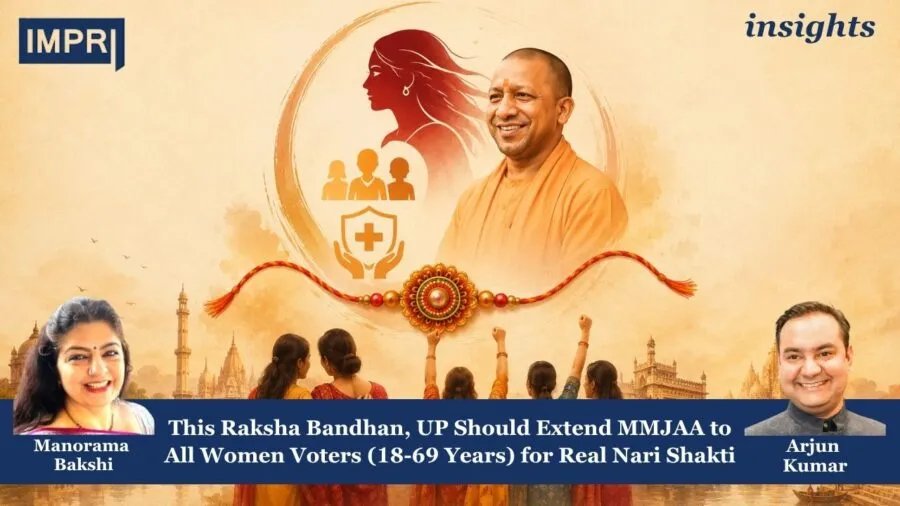
On Raksha Bandhan, threads of silk and cotton are tied across millions of households in Uttar Pradesh to signify care, responsibility, and mutual protection. Beyond these traditional rituals, the occasion provides an important moment to examine what long-term, structural security looks like for women in contemporary India.
The Government of Uttar Pradesh has marked the festival by offering free bus travel for women and an accompanying person on public transit services operated by UPSRTC. While free public transit provides immediate convenience for festive travel, building durable Nari Shakti (women’s power) requires addressing deeper everyday vulnerabilities. The single greatest threat to a woman’s security, dignity, and financial autonomy today is not transit costs, but the sudden shock of unexpected medical debt.
To transform symbolic protection into a lasting policy baseline, Uttar Pradesh can take a decisive step in this Raksha Bandhan by extending the Mukhyamantri Jan Arogya Abhiyan (MMJAA) to every registered woman voter aged 18 to 69 as an individual, residency-based entitlement.
The SDG Imperative and the Material Basis for Agency
Achieving the United Nations Sustainable Development Goals, specifically SDG 3 on Good Health and Well-being, Target 3.8 on Universal Health Coverage (UHC), and SDG 5 on Gender Equality requires guaranteeing financial risk protection alongside access to quality essential healthcare.
India is undergoing a significant shift in women’s public participation following the operationalization of the 106th Constitutional Amendment for legislative reservation. However, as noted in recent policy analysis published by the IMPRI Impact and Policy Research Institute, political representation alone cannot guarantee agency if a woman’s household remains financially vulnerable to health crises.
Women aged 18 to 69 represent both the active workforce and the primary caregivers across rural and urban Uttar Pradesh. While recent central scheme expansions provide universal top-up cover for senior citizens aged 70 and above under the Ayushman Bharat portal, women aged 18 to 69 bridge a critical gap. They navigate reproductive healthcare, occupational health risks, and chronic non-communicable diseases during their most active working and caregiving years. When an uninsured health crisis strikes, women routinely delay their own diagnostic checks and treatment or step away from gainful employment to provide full-time care, absorbing the financial fallout through unmanaged illness.
Closing the Gap: How UP Compares to Pioneer States
While Uttar Pradesh has made rapid gains in overall development indices, it has historically lagged behind national averages and pioneer states on health coverage indicators. According to National Family Health Survey baseline data (NFHS-5), household health scheme coverage in UP stood at 15.9 per cent, trailing the national average of 41 per cent and remaining significantly behind leading states like Rajasthan (which reached 83.7 per cent under its Chiranjeevi model), West Bengal (via Swasthya Sathi), and southern states like Tamil Nadu, Andhra Pradesh, and Kerala.
Despite generating over 5.38 crore Ayushman cards via the SACHIS Portal for SECC-qualifying households, Antyodaya cardholders, ASHA workers, and seniors aged 70 and above, millions of women voters aged 18 to 69 in lower-middle-class households belong to the “missing middle.” They do not meet strict BPL deprivation criteria for state benefits, yet lack the disposable income to purchase private commercial health policies.
By decoupling health insurance from restrictive poverty quotas and making MMJAA a universal entitlement for all women voters aged 18 to 69, Uttar Pradesh can leapfrog from a historic coverage lag into a national frontrunner for Universal Health Coverage.
Policy Autonomy and Fiscal Feasibility
Since MMJAA is 100 per cent state-funded by the Government of Uttar Pradesh, the State Cabinet holds full administrative authority to redefine eligibility without needing central legislative approval or matching fund negotiations.
Focusing the state-funded expansion specifically on all women voters aged 18 to 69 creates a complete continuum of care. It bridges young adulthood and middle age seamlessly into the central 70-plus senior citizen top-up framework. Using the active electoral roll and voter ID (EPIC) as the primary eligibility document simplifies verification and e-KYC integration on the National Health Authority backend.
Financially, providing universal MMJAA coverage to women voters aged 18 to 69 is realistic within Uttar Pradesh’s existing fiscal framework. Under trust-based insurance systems, the state funds an annual risk-pool premium of approximately ₹200 to ₹250 per enrolled individual per year, while covering actual claim outlays (which average ₹14,000 to ₹16,500 per treated patient episode).
Extending coverage to an estimated 4 to 4.5 crore women voters in the missing middle would require an annual state outlay of roughly ₹1,800 crore to ₹2,200 crore. This represents just 5 per cent of UP’s annual medical and public health budget of over ₹35,000 crore, as detailed on the official Uttar Pradesh Government Portal.
A Strategic Roadmap to Viksit Uttar Pradesh
To deliver this entitlement effectively, the state can execute a four-step roadmap:
- transition from shared household limits to individual MMJAA cards issued directly to women voters
- integrate active voter rolls for automatic e-KYC approval at local Common Service Centres
- ring-fence a protected share of the state health budget specifically for female secondary and tertiary care claims; and
- coordinate last-mile card delivery through Self-Help Groups and ASHA workers across all 75 districts.
Raksha Bandhan celebrates protection, but long-term security requires structural empowerment. Free bus transit offers short-term festive comfort, but universal health protection provides permanent socio-economic stability. As Uttar Pradesh sets its sights on becoming a $1-trillion economy and achieving the vision of Viksit Uttar Pradesh, guaranteeing universal health security under MMJAA to all women voters aged 18 to 69 will eliminate the primary driver of household poverty. By transforming healthcare from a conditional welfare benefit into an individual right, Uttar Pradesh can bridge historic development gaps, fulfill its SDG commitments, and establish a human-centric blueprint for a prosperous and resilient state.
About the Authors
Dr. Manorama Bakshi is Director & Head of Healthcare & Advocacy at Consocia Advisory, Founder & Director of the Triloki Raj Foundation, and a Senior Visiting Fellow at IMPRI.
Dr. Arjun Kumar is the Director of the IMPRI Impact and Policy Research Institute, New Delhi. He holds a Ph.D. in Economics from the Centre for the Study of Regional Development, School of Social Sciences, Jawaharlal Nehru University (JNU), New Delhi.
Disclaimer: All views expressed in the article belong solely to the author and not necessarily to the organisation.
Read more at IMPRI:
Khelo India (2016): A Policy Review of Its Evolution, Performance and Recent Reforms
Acknowledgement: This article was posted by Pallavi Lad, a Research and Editorial Intern at IMPRI.