




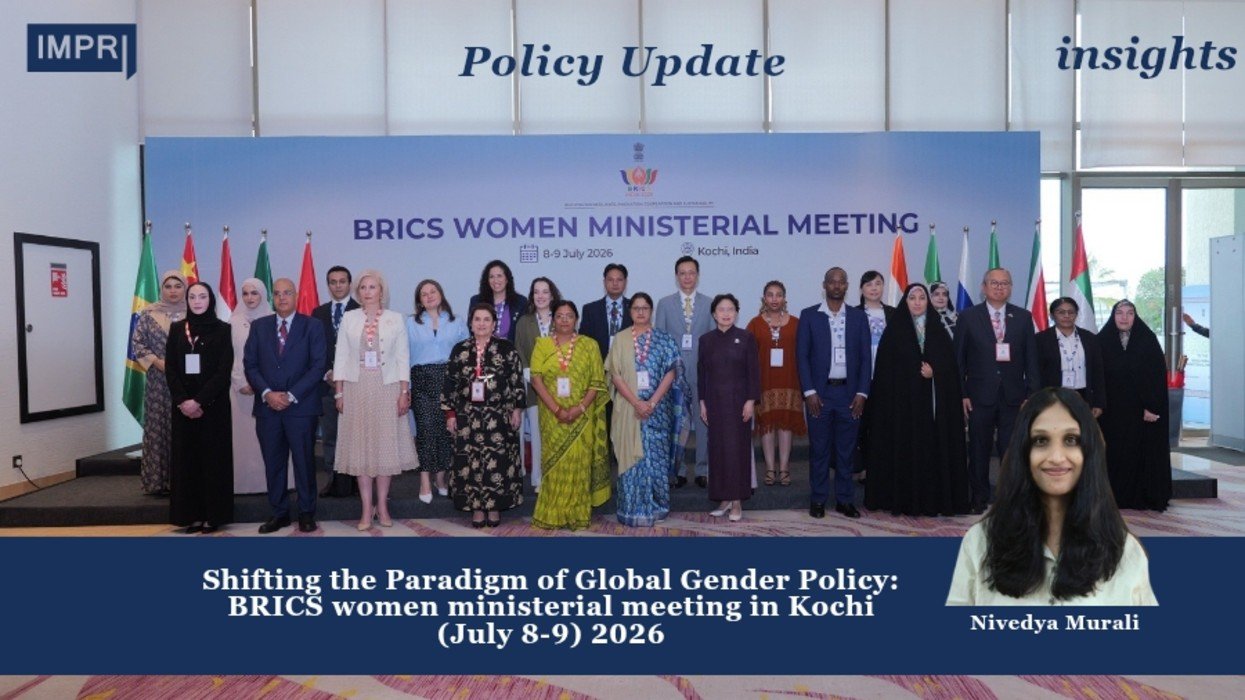
Policy Update
Nivedya Murali
Background
Bringing women to the forefront in the wider political and economic discourse is very crucial for the development of our country and to reach its vision of Viksit Bharat (Developed India ) by 2047. BRICS Women Ministerial Meeting which recently concluded in Kochi, Kerala ( July 6-9) is pointing towards the fact that BRICS under the Indian presidency is formulating a different approach towards women lead development and BRICS countries are leveling up in their agenda of achieving gender equality.
The core strategy seems to be increased coherence among the BRICS members for scaling up women led initiatives across many fronts.Both BRICS Women Working Group Meeting and the BRICS Women Ministerial Meeting which spanned over four days brought together ministers, senior policy makers,deputy ministers of BRICS members , all under one roof to discuss about the aspect of women empowerment ,gender equality,women led development,women entrepreneurship etc,all critical for advancement of women and having direct spill over effect towards the development of a country. The meeting concluded with decisions to enact a few important initiatives and the highlight among them was the adoption of the first-ever Joint Statement in the BRICS Women Track.
The meeting came to an end with the BRICS Countries committing to ensure deepening cooperation, strengthening institutional partnerships, promoting the exchange of knowledge and best practices, and advancing women-led development as a key driver of inclusive, resilient and sustainable growth.The relationship between gender equity and economic performance is complex and context-dependent, necessitating tailored strategies for each BRICS country that account for its unique cultural, economic, and social landscapes. Achieving gender equity is not only a moral imperative but also an economic necessity, and inclusive policies that address structural and cultural barriers are essential for sustainable economic growth in BRICS economies.(Gender equity and economic performance in BRICS: Challenges, opportunities, and policy recommendations
Jyotirmoy Koley)
Functioning
BRICS Women Ministerial Meeting is an initiative under BRICS Women’s Affairs and Heads of National Women’s Institutions whose primary goal is to provide impetus for gender equality and Women empowerment within the BRICS Countries through high level policy dialogues , discussions,deliberations and coordinated action on shared challenges and opportunities.The platform serves as a great leveler by effectuating wide ranging policies to increase women participation mainly facilitating for their increased contributions towards economic,social and political architecture of the country.
The main areas of focus include, women at forefront of economic affairs,facilitation of gender equality,to act against gender based violence and stopping the perpetuation of men exclusive policy environments which hinder the overall development of women .Wide arenas like women leadership role,digital inclusion and health care is also given preference.The joint declaration,adaptative frameworks and capacity building programmes initiated during the meeting will help the BRICS nations to collaborate with each other more effectively and hence in realisation of their greater vision of sustainable development goals.(BRICS,Think Thank Council,2025)
The decision can be consultative and can be tracked via periodic compliance audits which can enhance the effectiveness.Integrating the corporate network of the BRICS Women’s Business Alliance (WBA) with the newly formalised government-led “Women Track” ensures that policy choices directly resolve real-world economic barriers.The structural interplay between these bodies, reinforced during the July 2026 BRICS Women Ministerial Meeting in Kochi, India, provides a clear roadmap for this collaborative strategy.(PIB,2026)
Performance
Before BRICS Women Ministerial Meeting in Kochi,there was no specific track to look into the issues of women directly.Prior to this, the issue within BRICS critical to women where handled by The BRICS Women’s Business Alliance (WBA) , a dedicated forum aimed at enhancing women’s economic participation and entrepreneurship within BRICS nations(BRICS,WBA).
Established in 2020 under Russia’s BRICS Chairmanship, the WBA works in close collaboration with the BRICS Business Council and other economic cooperation mechanisms. It seeks to integrate women entrepreneurs into the BRICS economic framework, thereby driving inclusive and sustainable development.(BRICS,WBA).Gender inequality and women’s issues were then handled through fragmented priority areas focusing mostly on economic cooperation, entrepreneurship, and general networking.Now it is changing towards a more structured and systematic approach with integrated institutional mechanisms like digital repositories.
As India took over the presidency from Brazil on January 1,2026 it called for greater policy reforms within the BRICS mechanisms to enhance women engagements.The women ministerial meeting, one among the flagship objectives of that agenda brought forward women experts from various tracks to a dedicated intergovernmental working group for the first time within the BRICS framework.The Ministerial format also adopted a specific Joint Statement on the Women Track.
It is equally important for future presidencies to build upon the initiative launched under the Indian Presidency with sustained commitment, renewed enthusiasm, and access to the latest information.
Impact and Outcome of the Meeting
Before wrapping up, the summit witnessed the introduction of several key measures. Paramount among them was the adoption of first-ever Joint Statement in the Women Track, reflecting the shared commitment of BRICS Member Countries to strengthen cooperation in promoting women-led development in all spheres.( PIB,2026)
Other notable initiates to include,
1)The BRICS Digital Repository of Best Practices,will serve as a shared platform for documenting and exchanging successful policies, programmes and innovations on women’s empowerment across BRICS Member Countries(PIB,2026): This will bring in vital decisions under one dedicated database and will facilitate knowledge sharing connecting international policies and strategies for gender equality. In the long run, it will help foster collaboration and co-operation among leaders of various countries.
2)The BRICS Digital Capacity Building Guidelines aims to promote institutional collaboration, facilitate knowledge exchange and strengthen capacity building to accelerate women’s empowerment through sustained cooperation.( PIB,2026)
This aims at upskilling women in new technologies to increase the extent of digital inclusion in BRICS Countries and also to develop gender dimensions to emerging technologies.This will be of great help to women to start their own business and also to increase their opportunities in the new world order where technology is the new driver and technological know how the new currency.
As part of the programme, Union Ministers, dignitaries and foreign delegations also attended an exhibition showcasing India’s women-led development initiatives across diverse sectors. The exhibition featured initiatives undertaken by various Ministries and Departments, including rural livelihoods through SARAS and the Lakhpati Didi initiative, women’s participation in sports through ASMITA, women in STEM, financial inclusion initiatives, and flagship programmes of the Ministry of Women and Child Development such as SHE-Box, One Stop Centres and the Women’s Helpline.( PIB,2026)
Way Forward
The women ministerial meeting which recently concluded under India’s BRICS leadership is heading the right way. Forming a separate joint statement track will help to address the gender based issues more formally and officially, establishing a baseline for future accountability and continuous cooperation across an expanded 11-member bloc. With member nations spanning across vastly different geographical, cultural, and socio-economic realities, a formal text aligns divergent priorities toward a singular unified goal of women-led development.( Pib)
However the matter is treading on thin ice.Merely proclaiming a new track will never solve the vast number of issues.The idea can be termed successful only when the track becomes fully operational. Further, BRICS submit should focus more on gender based issues and should try to address the internal problems faced by women within the BRICS framework.The digital Repository of Best Practices should also include the major issues faced by women in BRICS Countries and the possible rectification measures to address them.
Non member countries and internationally recognised platforms for women equality and development at the global level can be included in future policy deliberations to widen the reach of the initiatives and to improve its effectiveness. Integrating the food and climate aspects without compromising the gender based approach can serve the platform well. As the relationship between BRICS and the Global South is considered complementary in nature, this ministerial meeting can be seen as a great opportunity to showcase the shared interests of developing nations.
For India, which aspires to be the voice of the Global South, it is important to utilise this momentum to lead the way and emerge as a crusader for gender equality through BRICS. Long term strategic intervention and structural reforms can also serve as the way forward.
Conclusion
The new initiative by Brics is a step on right direction .But policies remaining on papers without being implemented serve the purpose as abysmally as them being non existent.Hence the proper operationalisation of the adopted policy ideas and not their mere formalisation is the measure of its utility.Strategic and systematic steps which can increase the efficiency of BRICS Countries to deal with gender equity and women safety should be the priority and the adoption of the first ever Joint Statement under the BRICS Women Track can serve this vision well.
References
BRICS Think Tanks Council. (2025, September 30). BRICS Women’s Affairs and Heads of National Women’s Institutions Responsible Ministers Meeting https://bricsthinktankscouncil.org/mechanisms/brics-womens-affairs-and-heads-of-national-womens-institutions-responsible-ministers-meeting/
2) Ministry of Women and Child Development. (2026, July 9). BRICS Women Ministerial Meeting concludes in Kochi. Press Information Bureau, Government of India
3) BRICS,2026
https://www.brics2026.gov.in/the-brics-wo
4) Koley, J. (2025). Gender equity and economic performance in BRICS: Challenges, opportunities, and policy recommendations. International Journal of Research in Finance and Management, 8(2), 283–292.
About the Contributor
The author is a postgraduate student of Political Science at Madras Christian College, Chennai. Her academic interests span International Relations, Diplomacy, International Political Economy, South Asian politics, Public Policy, Gender Studies, Climate Politics, Human Rights, Global Governance, and History. She is currently a research intern at IMPRI, New Delhi.
Acknowledgement
The author extends her sincere gratitude to the IMPRI team for their valuable guidance throughout the process.
Disclaimer
All views expressed in the article belong solely to the author and do not necessarily represent the views or policies of the organisation.
Read More at IMPRI:
National Suicide Prevention Strategy (2022): A Policy Analysis
Modernising Borders: India’s Immigration and Foreigners Act (2025)