








Policy Update
Ashi Verma
Background
Jal Jeevan 2.0 represents a strategic goal to ensure universal access to safe and adequate drinking water through modern governance and technology. The Mission which was launched in August 2019 with the objective of providing tap water to every household by 2024. Every household uses water daily for various activities such as washing dishes and bathing resulting in the generation of wastewater. Previously, untreated water was flowing into agricultural fields or ponds; however, JJM 2.0 has focused on treating and reusing this water. A key achievement was providing 3.23 crore (FHTC) Functional Household Tap Connections in 2019, with a target of reaching 15.82 crore FHTC (representing 82% coverage) by March 2026.
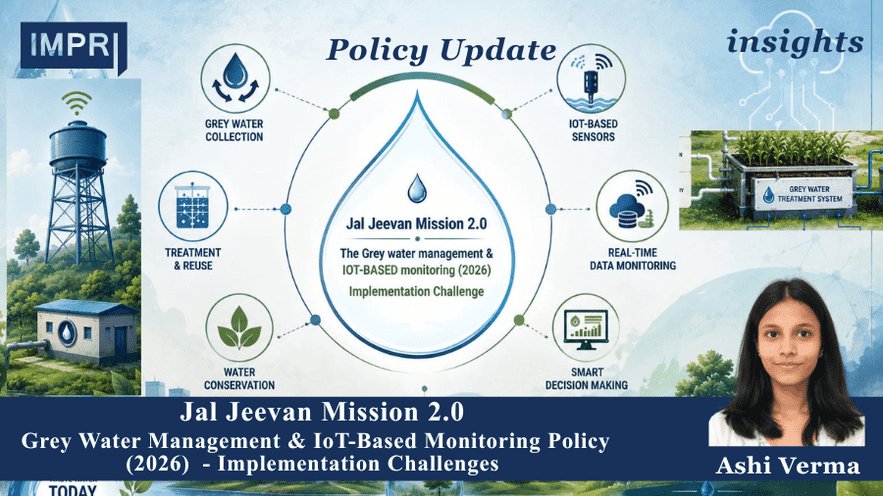
The initiative focuses not only on tap connections but also on sustainability, with the primary goal of delivering water to 19.36 crore rural households by December 2028. Alongside this, the management of “Grey water” poses a challenge: wastewater discharged from households is currently polluting agricultural fields and water bodies because it is released without treatment. To address this key issue, grey water management has been integrated into JJM 2.0, alongside the introduction of frameworks like IoT (Internet of Things) and Suklam Bharat for monitoring.
A major implementation challenge lies in ensuring the policy is effectively executed at the grassroots level; significant funding-related challenges also exist. Specific hurdles include a lack of technical capacity at the Gram Panchayat (GP) level and the availability of funds for Operation and Maintenance (O&M).
Figure.1
Source: Ministry of information and broadcasting (Government of India)
Functioning:-
The Jal Jeevan Mission operates on a bottom-up model starting from the village level rather than being imposed from above where the power to make decisions rests with the Gram Panchayat; the mission involves various stages in its policy formulation and implementation.

Figure.2
Source :- Ministry of Jal Shakti ( Government of India)
Institutional Structure:- The actual work takes place at the village level. The Central government formulates policies and provides funds, which are monitored via the ‘Sujalam Bharat’ dashboard. At the state level, the ‘State Jal Jeevan Mission’ targets the allocation of funds to districts, while the ‘District Water Mission’ is primarily responsible for ensuring that the work is completed on schedule. Within the village, the Gram Panchayat and the Village Water and Sanitation Committee (VWSC) jointly decide on the execution of the work and the routing of pipelines; they also bear the responsibility for Operation and Maintenance (O&M).
Planning & Village Participation: The Gram Panchayat and the VWSC jointly conduct surveys to determine the sources of water, such as groundwater, rivers, or rainwater harvesting, which is why the Jal Jeevan Mission is also described as a community-driven initiative. The 50% female members who run the Pani Samiti (VWSC) handle complaints and manage operations including organizing and overseeing the water supply to ensure it is properly delivered.
Service Delivery model:- The main focus of this model known as the ‘Service Delivery Approach’ is to ensure water supply through household taps rather than just a general pipeline connection; the goal is to provide 55 LPCD (liters per capita per day) of drinking water to every household throughout the year. It goes beyond merely providing a connection; it involves implementing a comprehensive water supply scheme in the village, including the installation of storage tanks and meters.
Grey – Water Management:- Grey-water management involves handling water that is not suitable for drinking or cooking but can be reused for other purposes. Managing greywater effectively helps maintain sustainability. It prevents the discharge of wastewater into fields and ponds where it often leads to mosquito breeding and the spread of diseases by treating it instead. Once treated, greywater can be utilized for irrigation in fields and gardens or for toilet flushing.
IOT & Digital Monitoring:- In today’s world, everything is going digitally.
IoT (Internet of Things) involves connecting everyday objects to the internet to collect, transmit, and monitor data in real-time. For instance, sensors installed on tubewells and water tanks allow us to track parameters like water pressure. Data from these sensors travels via mobile networks to a cloud server and is displayed on a dashboard, which officials at our state office can view in real-time on their mobile phones or websites. This enables them to monitor water usage and ensure there are no issues or shortages.
Digital monitoring “Allows you to track drip irrigation performance and usage directly from your mobile phone”
Performance:-
Jal Jeevan Mission 2.0 has focused on digital governance by March 2026 after according to a government PIB report from August 2026, tap water has reached 81.57% of households across the country.

1.Physical Progress:– When this mission was launched in 2019, only 17% of households had water connections; by 2026, connections had reached 15.80 crore households, marking a significant improvement.
Several states and territories such as Goa, Telangana, Gujarat, Andaman & Nicobar, and Nagar Haveli have achieved the target of providing 100% water connections.
2.Digital Governance ( Sujalam Bharat) :- Through the Sujalam Bharat platform, villages are being assigned a ‘Sujal Gaon ID‘; this facilitates the digital maintenance and management of everything from water sources to household tap water supplies.
3.Financial Performance:- The Union Cabinet approved Jal Jeevan Mission 2.0 in March 2026, increasing the budget to ₹8.69 lakh crore. The Central Government has provided financial assistance of ₹615.96 crore to several states for the 2026-27 period; the Centre’s share has increased by ₹1.51 lakh crore over the previous allocation of ₹3.59 lakh crore.
Impact :-
- Employment opportunity :- According to an International Labour Organization study report, this mission covering plumbing, pipeline networks, and water management has the potential to generate 59.9 lakh direct and 2.2 crore indirect employment opportunities.
- Improvement in Health :- According to World Health Organization estimates, the effective implementation of this scheme—by addressing issues related to contaminated water and sanitation—could prevent 400,000 deaths caused by diarrhea.
Infant Mortality Rate – According to Nobel Prize Winner Michael Kremer, a 30% reduction in deaths among children under the age of five is possible; approximately 136,000 children’s lives could be saved if this mission continues to run successfully.
- Women Empowerment:- Women previously had to travel to distant areas to fetch water, facing significant hardships; they are now being relieved of this arduous task. Nine crore women have been freed from this burden.
Women are able to leverage skill development, education, and other economic activities
- Administrative Reforms – Under this mission, agreements regarding reforms in water management at the rural level have been signed across several states. The objective is to empower Gram Panchayats to monitor water quality and ensure the long-term sustainability of water sources.
Emerging Issue:-
1.Grey Water Treatment & Sustainability :- At the village level, GP ( Gram Panchayat) lack the technical funds and personnel to handle Operation and Maintenance (O&M). Greywater treatment units are expensive to install at the household level; furthermore, while there is a target of 55 LPCD, the sustainability plan is weak, and there is a lack of coordination regarding the integration of greywater management and IoT systems.
2.Community Participation:- Although the Jal Jeevan Mission is described as a community-led initiative, decision-making at the ground level still remains in the hands of engineers and contractors.
Women’s participation remains largely confined to paper; there are still many backward areas where women have to travel long distances to fetch water. While some women do work within the VWSC committee, their overall level of women’s participation remains low.
3.Digital Divide & Data Gap :- Rural and backward areas still face a shortage of electricity and a lack of internet connectivity for the Sujalam Bharat dashboard; furthermore, village VWSC members lack training in checking and interpreting the data.
There are still issues arising here and there in this mission and challenges are emerging under the Goal of Jal Jeevan Mission 2.0.
Way Forward:-
Digital Infrastructure with Building Grass roots Ideas :- There should be a local youth trainer in the village Gram Panchayat to handle the dashboard and sensors. Network infrastructure should be set up in rural areas in collaboration with telecom companies to ensure that data does not go to waste.
Village Level:- In Village Ponds can be linked to agriculture, and funds can be generated through greywater user fees and MGNREGA coverage.
Community Ownership:- Women must be given financial decision-making power, and the VWSC rather than the engineer should have access to the dashboard, enabling the community to independently monitor performance every six months.
Trusted IOT & Ecosystem :- The primary focus of Jal Jeevan Mission 2.0 is IoT-based monitoring. Installing sensors in village water supply systems allows real-time data to be transmitted to the ‘Sujalam Bharat’ dashboard, providing continuous information on water inflow, flow rate, pressure, and quality.
Conclusion:-
Jal Jeevan Mission 2.0 goes beyond merely delivering water to households; it emphasizes sustainable water management. Through greywater reuse and IoT-based monitoring, the government has sought to create a techno-community model that tracks every drop of water and facilitates the reuse of wastewater.
However, implementing this on the ground is not straightforward. While technology provides data, issues regarding data reliability, privacy, and accountability remain unresolved. Furthermore, the infrastructure for greywater treatment—encompassing funding, training, and operations & maintenance (O&M)—is weak at the Panchayat level. Most importantly, although JJM is described as “community-led,” actual decision-making continues to be top-down.
References:–
- Jal Jeevan Mission 2.0 Press Release ( PIB)
https://www.pib.gov.in/PressReleasePage.aspx?PRID=2247224®=6&lang=1 - Ministry of Jal Shakti, Department of Drinking Water and Sanitation. (2024). _Jal Jeevan Mission: Operational Guidelines 2024_. Government of India. https://jaljeevanmission.gov.in/sites/default/files/JJM_Operational_Guidelines_2024.pdf
- Ministry of Jal Shakti. (2025). _Jal Jeevan Mission Dashboard & Sujalam Portal https://ejalshakti.gov.in/jjmreport/JJMIndia.aspx
- Centre for Science and Environment. (2012). _Excreta Matters: 71 Cities – A CSE Survey
https://www.cseindia.org/excreta-matters-3848 - Ministry of Electronics and IT. (2022). _India Data Governance Framework
https://www.meity.gov.in/writereaddata/files/India%20Data%20Governance%20Framework.pdf - NITI Aayog. (2019). _Composite Water Management Index. https://www.niti.gov.in/sites/default/files/2019-08/Composite-Water-Management-Index-Report-and-Brochure-.pdf
- Ministry of Jal Shakti. (2023). _Guidelines for Source Sustainability. https://jaljeevanmission.gov.in/sites/default/files/Source_Sustainability_Guidelines.pdf
- Ministry of Rural Development. (2024). Convergence Guidelines: JJM with MGNREGA https://jaljeevanmission.gov.in/sites/default/files/Convergence_Guidelines_JJM.pdf
About the Contributor
Ashi Verma is pursuing a B.A. Program (History and Political Science) from Maitreyi College (NCWEB) South Campus, Delhi University, with a major in Political Science. She is passionate about governance, public policy, social issues, and digital innovation, with a keen interest in research, academic writing, and data documentation. Through research and policy analysis, she aims to contribute to evidence-based policymaking and create meaningful social impact.
Acknowledgements
I am deeply grateful to IMPRI (Impact and Policy Research Institute) for providing me with the academic platform and resources to undertake this study on Jal Jeevan Mission 2.0: Grey Water Management and IoT-Based Monitoring. I also acknowledge the Ministry of Jal Shakti, Government of India, and NITI Aayog for making their reports and guidelines publicly available, which formed the core of this analysis.
Names of the reviewers:- Kavin Aditya and Vishal Kumar
Disclaimer: All views expressed in the article belong solely to the author and not necessarily to the organisation.
Read more at IMPRI:
Viksit Ude Desh ka Aam Naagrik (UDAN) (2026): A Policy Initiative for Regional Air Connectivity