








Policy Update
Debjani Chhatarjee
Background
After the bifurcation of Andhra Pradesh in 2014, the state faced major governance challenges in coordinating departments and delivering timely public services to over 49.5 million citizens (CAG, 2017) Isolated departmental systems and periodic reporting created data silos, delaying critical decisions in disaster response, welfare delivery, and grievance redress. Poor inter-departmental coordination hindered accountability, transparency, and performance tracking. Furthermore, the lack of integrated, real-time data severely limited predictive capacity, preventing proactive disaster management and evidence-based policymaking.
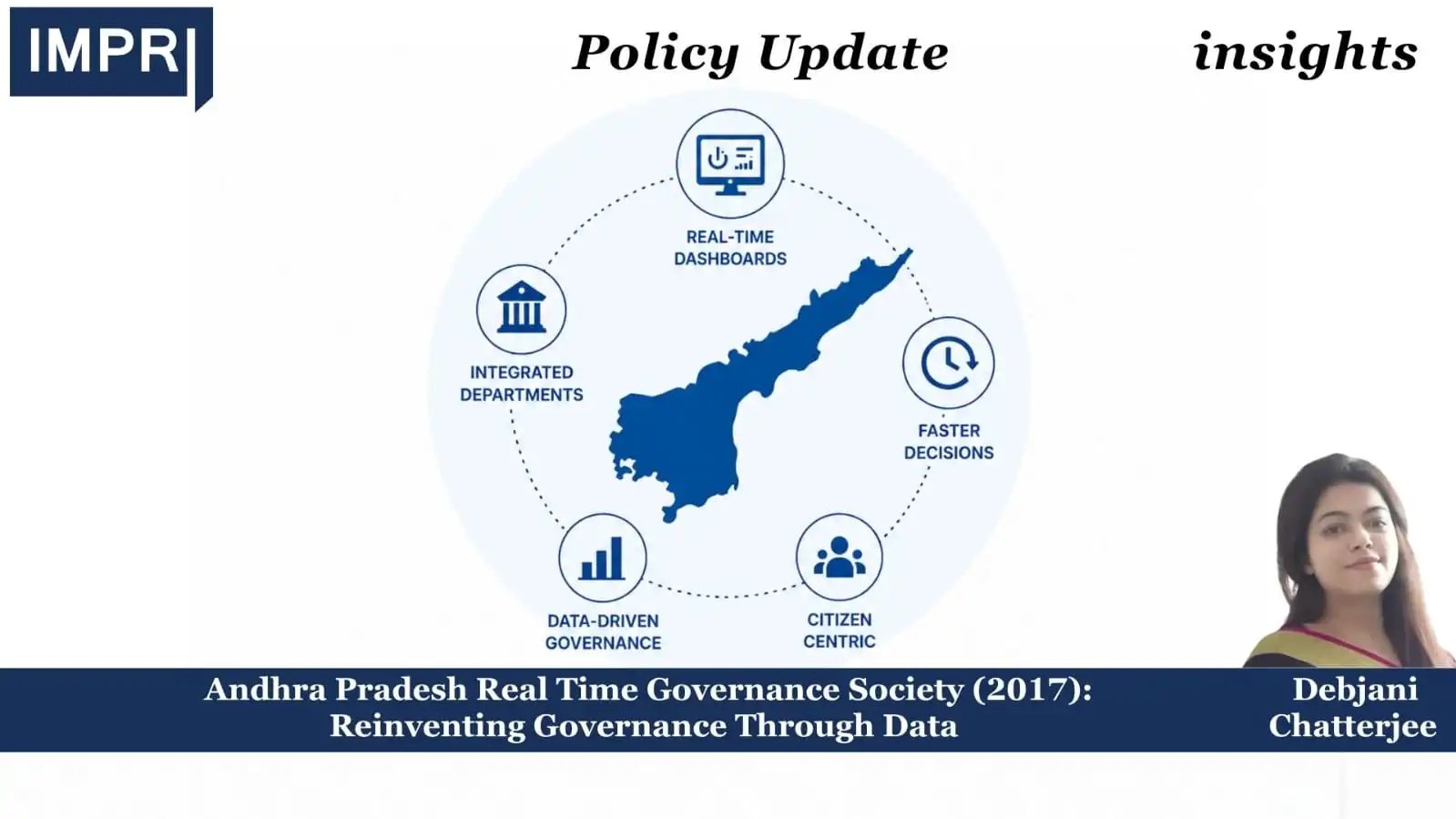
To tackle these challenges, Andhra Pradesh established the Real-Time Governance Society (RTGS) in 2017 under the Chief Minister’s Office, unifying departmental databases, CCTV, IoT sensors, weather systems, and citizen feedback into a single decision-support platform. RTGS aims to enable real-time, evidence-based decision-making, integrate fragmented government data, enhance grievance redressal, improve disaster preparedness through predictive analytics, and boost administrative accountability using performance dashboards to reach 80% citizen satisfaction. Covering over 50 million citizens across 26 departments and 106 Heads of Departments, this initiative leverages AI analytics alongside the 1100 Parishkara Vedika call center—capable of handling 1.5 million daily calls with 2,000+ operators (Government of Andhra Pradesh, 2017) —to deliver proactive, citizen-centric governance.
Functioning
- Centralized Governance Platform: RTGS functions under the Chief Minister’s Office (CMO) as the state’s integrated command and control centre, enabling real-time governance across departments.
- Integrated Data Ecosystem: The platform consolidates data from departmental Management Information Systems (MIS), CCTV cameras, IoT sensors, drones, GPS devices, satellite imagery, weather stations, and citizen feedback systems into a unified digital platform.
- AI-Driven Analytics: RTGS applies Artificial Intelligence (AI), Machine Learning (ML), Big Data Analytics, and Geographic Information Systems (GIS) to analyse real-time data, identify emerging issues, and support evidence-based policy decisions.
- Performance Monitoring: It continuously tracks key governance indicators, including welfare scheme implementation, departmental performance, infrastructure projects, and service delivery through real-time dashboards and Key Performance Indicators (KPIs).
- Grievance Redressal: Through the 1100 Parishkara Vedika and integrated grievance platform, citizen complaints are digitally registered, routed to the concerned departments, tracked until resolution, and monitored for service quality.
- Disaster Management: The AWARE (Andhra Weather and Early Warning) system integrates weather, hydrological, and satellite data to provide early warnings for cyclones, floods, and other natural disasters.
- Decision Support: By transforming fragmented government data into actionable intelligence, RTGS enables proactive governance, faster administrative response, improved inter-departmental coordination, and citizen-centric public service delivery.
- Database Integration: RTGS integrates People Hub (citizen database), Land Hub (digital land records), Bhudhaar (unique land identification), and the Core Dashboard (real-time monitoring of government programmes). Together, these platforms connect departmental data, support evidence-based decision-making, improve service delivery, and strengthen coordinated governance across the state.
| Layer | Components | Function |
| Data Layer | People Hub, Land Hub, Bhudhaar, CCTV, IoT, Weather Data | Collects real time administrative and citizen data |
| Integration Layer | State Data Lake | Integrates data from multiple departments |
| Analytics Layer | AI, Machine Learning, Predictive Analytics | Generates insights and early warnings |
| Decision Layer | RTGS Dashboard, CMO, Departments | Supports monitoring and executive decision making |
| Service Layer | Mana Mitra, AI4PGRS, Citizen Services | Delivers public services and grievance redressal |
Performance
Since its establishment in 2017, RTGS has evolved into Andhra Pradesh’s integrated digital governance platform. By 2026, the State Data Lake integrated 55 databases across 41 government departments and autonomous organisations, while the Mana Mitra platform delivered 1,126 public services through 35 departments, serving 5.82 million citizens and facilitating 34.2 million digital transactions.
Key Performance Index
| Indicator | Latest Performance (2026) |
| Departments Integrated | 41 |
| Databases Integrated | 55 |
| Services Delivered | 1,126 |
| Citizens Served | 5.82 million |
| Digital Transactions | 34.2 million |
| AI Use Cases | 98 |
| Operational AI Applications | 29 |
| Citizen Grievances Processed | 1.76 million+ |
| Estimated Annual Pension Savings | ₹84.22 crore |
- Administrative Performance
AI-enabled analytics strengthened administrative oversight by identifying 17,547 pension anomalies, 1.61 lakh deceased rice-card beneficiaries, approximately 96,000 ineligible Jagjeevan Jyothi beneficiaries, and 1.28 lakh duplicate housing sanctions, improving welfare targeting and reducing fiscal leakages.
- Citizen Service Performance
The AI4PGRS (Artificial Intelligence for Public Grievance Redressal System) has processed over 1.76 million grievances since June 2024 through WhatsApp, online portals, voice messages, and mobile applications, improving accessibility and accountability in public service delivery.
- Disaster Governance Performance
The AWARE platform integrates meteorological, hydrological, satellite, and IoT data to provide real-time early warnings for cyclones, floods, and other disasters, strengthening preparedness and response capacity.
- Technology & Data Integration
RTGS integrates departmental MIS, CCTV, drones, GPS, IoT sensors, satellite imagery, and AI analytics into a unified decision support system. By 2026, 98 AI use cases had been identified, with 29 already operational across governance sectors.
- Year-wise Progress (2017–2026)
RTGS progressed from a real time monitoring platform (2017–19) to an integrated governance ecosystem (2020–23) and, following its revival in 2024, evolved into an AI-driven governance platform (2024–26) with Data Lake integration,Whatsapp Mana Mitra Platform, AI4PGRS, and predictive governance applications.
- Key Insights
The overall KPI trend indicates continuous institutional expansion, increasing digital service coverage, stronger AI adoption, and improved welfare monitoring. However, the absence of publicly available gender disaggregated, rural urban, district level outcome, and citizen satisfaction data remains a key limitation for comprehensive impact evaluation.
Impact
- Administrative Impact:
RTGS has significantly strengthened Andhra Pradesh’s administrative capacity by enabling real time monitoring, faster decision making, and better coordination across government departments. Integrated dashboards, data analytics, and digital workflows have improved program supervision and executive oversight, while the 24×7 Parishkara Vedika has made grievance management more transparent and accountable. The platform has also enhanced disaster preparedness through GIS, satellite imagery, IoT, and weather-based monitoring. Overall, RTGS has institutionalised evidence-based governance, although independent assessments of its long-term administrative efficiency and effectiveness remain limited.
- Citizen Service Impact:
RTGS has improved citizen access to public services by expanding digital service delivery and grievance redressal. Through the Mana Mitra platform, the government provides 1,126 services across 35 departments. As of 2026, the platform has served 5.82 million citizens and processed 34.2 million digital transactions. The AI enabled Public Grievance Redressal System (AI4PGRS) has also handled more than 1.76 million grievances since June 2024 through WhatsApp, mobile applications, websites, and voice messages. However, official data on grievance resolution time, service quality, and citizen satisfaction are still not publicly available.
- Disaster Governance Impact:
RTGS has strengthened disaster governance by integrating GIS, satellite imagery, weather forecasts, CCTV feeds, drones, and IoT sensors for real time monitoring. This has improved early warning, situational awareness, and coordination during emergencies. However, independent evidence measuring its long term impact on disaster losses and response efficiency remains limited.
- Institutional Impact:
RTGS has improved coordination among departments by creating a common digital platform for data sharing and performance monitoring. Real time dashboards allow departments and district administrations to monitor projects, welfare schemes, and public grievances more efficiently.
- Technology & Innovation Impact:
RTGS has advanced digital governance by integrating artificial intelligence, data analytics, GIS, and interoperable databases into public administration. The platform now connects 55 databases across 41 departments, with 98 AI use cases identified and 29 operational. These innovations support evidence based decision making, though their long term governance impact requires independent evaluation.
- Governance Impact:
RTGS has strengthened governance by improving transparency, accountability, and administrative responsiveness through real time monitoring and integrated decision making. It has encouraged greater coordination across departments and supported evidence based policymaking. However, independent evidence on its long term impact on governance quality and public trust remains limited.
Policy Evaluation Scorecard
| Dimension | Evidence Level | Basis |
| Administrative Efficiency | High | Real time monitoring, integrated dashboards, departmental coordination |
| Citizen Service Delivery | High | 1,126 services, 35 departments, Mana Mitra |
| Welfare Monitoring | High | AI identified anomalies and duplicate beneficiaries |
| Disaster Governance | Moderate | GIS, satellite imagery, IoT, SEOC integration |
| Technology and Innovation | High | 55 databases, 98 AI use cases, 29 operational |
| Institutional Coordination | High | 26 departments, 106 HoDs |
| Outcome Measurement | Limited | Few independent evaluations and outcome indicators |
Overall, RTGS has changed the way governance is delivered in Andhra Pradesh by making it more digital, integrated, and data driven. Government data show clear improvements in service delivery, welfare monitoring, AI adoption, and institutional coordination. At the same time, the next phase of RTGS should focus on publishing more outcome based indicators, conducting independent impact evaluations, and improving public reporting. This will help measure not only how the system works, but also how much it improves the lives of citizens.
Emerging Issues
1. Data Governance and Privacy
- RTGS integrates large volumes of citizen data across multiple departments, increasing privacy and data security risks.
- Data sharing protocols and institutional accountability remain insufficiently documented in the public domain.
- The growing use of artificial intelligence raises concerns about transparency, algorithmic bias, and informed consent.
- Alignment with the Digital Personal Data Protection Act, 2023 and stronger data governance standards will be essential to build public trust and ensure responsible use of data.
2. Interoperability and Data Quality
- Integrating data from multiple departments increases the risk of inconsistent, incomplete, and duplicate records.
- Differences in data standards and formats can reduce interoperability across government platforms.
- Inaccurate or outdated data may affect policy decisions, beneficiary identification, and service delivery.
- Regular data validation, common data standards, and stronger coordination among departments are needed to improve data quality and ensure reliable evidence based governance.
3. Digital Inclusion
- Dependence on digital platforms may exclude citizens with limited internet access, digital literacy, or smartphone ownership.
- Rural communities, older persons, and other vulnerable groups may face greater barriers in accessing online public services.
- Language and accessibility challenges can further limit the effective use of digital governance platforms.
- Expanding digital infrastructure, improving digital literacy, and maintaining offline service channels are essential to ensure that RTGS delivers inclusive and equitable public service delivery.
4. Institutional Capacity
- Effective implementation depends on the digital skills and administrative capacity of government officials at all levels.
- Uneven technical expertise across departments may affect the quality of data management and service delivery.
- Continuous training, change management, and dedicated technical support are essential to sustain RTGS and improve its long term institutional effectiveness.
5. Technology and Cybersecurity Risks
- Increasing reliance on integrated digital platforms raises the risk of cyber attacks, data breaches, and system failures.
- Weak cybersecurity measures could disrupt essential public services and reduce public trust.
- Regular security audits, stronger cyber resilience, and continuous system upgrades are essential to protect critical government data and digital infrastructure.
6. Evidence and Evaluation Gap
- Most available evidence is based on government reports, with limited independent evaluation of RTGS outcomes.
- Publicly available data on service quality, citizen satisfaction, and cost effectiveness remain limited.
- Regular third party impact assessments and transparent performance reporting are needed to measure long term governance outcomes and strengthen policy credibility.
7. Financial Sustainability
- Maintaining RTGS requires continuous investment in digital infrastructure, technology upgrades, cybersecurity, and skilled personnel.
- Rising operational costs may affect long term sustainability without stable financial planning.
- Periodic cost effectiveness assessments can help ensure efficient use of public resources and improve fiscal sustainability.
8. Political and Institutional Sustainability
- Long term success depends on sustained political commitment and institutional ownership beyond changes in government.
- Frequent policy or leadership changes may affect continuity and implementation.
- Embedding RTGS within permanent administrative systems can strengthen institutional stability and ensure consistent governance outcomes.
Way Forward
1. Create a State Digital Governance Authority:
RTGS is currently led by the Chief Minister’s Office. The government should establish an independent State Digital Governance Authority to manage RTGS, set data standards, monitor performance, and coordinate departments. This will ensure continuity even when governments change.
2. Make Impact Evaluation Mandatory:
RTGS performance is mainly measured through government dashboards and operational data. Every year, an independent institution or university should evaluate citizen satisfaction, grievance resolution time, service quality, and financial savings. The evaluation report should be published to improve transparency and public trust.
3. Introduce a State Data Governance Framework:
The government should develop a clear data governance policy in line with the Digital Personal Data Protection Act, 2023. The policy should define who can access data, how departments can share data, how long data should be stored, and how citizens’ privacy will be protected.
4. Expand the Use of Predictive AI:
RTGS should use AI not only to monitor government programmes but also to predict future risks. AI can be used to identify flood-prone areas, detect crop stress, forecast disease outbreaks, identify welfare fraud, and improve traffic management. This will help departments act before problems become serious.
5. Publish a Citizen Governance Dashboard:
The government should launch a public dashboard showing district-wise service delivery, grievance resolution status, and major government performance indicators. Citizens should also be able to rate government services through RTGS platforms. This will improve transparency and accountability.
6. Improve Data Quality:
The government should adopt common data standards across all departments and conduct regular data-quality audits. This will reduce duplicate records and improve the accuracy of AI-based decisions and welfare targeting.
7. Build Digital Skills of Government Officials:
District officials and frontline staff should receive regular training on AI, data analytics, and RTGS applications. Training should be linked with annual performance reviews so that digital tools are used effectively across all districts.
8. Develop a National Replication Model:
The Government of Andhra Pradesh should document RTGS’s best practices, technology standards, and implementation process. This can help other states adopt similar systems while making changes based on their local needs.
| Short Term Priorities | Long Term Priorities |
| ✓ Data Governance Framework | ✓ Digital Governance Authority |
| ✓ Independent Evaluation | ✓ Outcome Based KPIs |
| ✓ Cybersecurity Audits | ✓ Annual Performance Reports |
| ✓ Common Data Standards | ✓ RTGS Statewide Expansion |
| ✓ Public Governance Dashboard | ✓ National RTGS Framework |
| ✓ API Based Integration | ✓ Interstate Adoption |
| ✓ AI Predictive Models | ✓ AI Governance |
| ✓ Capacity Building | ✓ Institutional Sustainability |
The Andhra Pradesh RTGS has made governance more data-driven by improving monitoring, coordination, and decision-making. It has created a strong digital platform to support public service delivery and disaster management. However, there is still limited independent evidence on its long-term impact on governance outcomes and citizen satisfaction. Going forward, regular policy evaluation and stronger data governance will be important to ensure that RTGS delivers sustainable and citizen-centred governance.
Selected references and important links
About the Contributor
Debjani Chatterjee is a policy researcher with a background in Finance and Political science. Her work focuses on leveraging data analytics to support evidence based policy research.
Acknowledgement
My sincere thanks to the Impact and Policy Research Institute (IMPRI) for the opportunity to prepare this policy update article. IMPRI’s dedication to connecting research with actionable policy practice provides an invaluable platform for learning.
Reviewed by Madhuritha D and Ashi Verma
Disclaimer
The opinions expressed in this article are strictly those of the author and do not reflect the official position or views of the organization.
Read more at IMPRI –
India’s Parliamentary Diplomacy with North Macedonia: Significance of the Presidential Visit (2026)
Regional Proxy Competition and the Constraints of Global Governance in Sudan