







Policy Update
CB Kavin Adithya
Background
India isn’t just looking at the usual big players in Europe anymore. Lately, it’s turning more eyes toward Southeast Europe and the Western Balkans. Why? Because New Delhi wants to shake up its diplomatic strategy and spread its influence , build more varied partnerships in a Europe that keeps changing shape. North Macedonia, for instance, has started to matter more. It sits in a key spot in the Balkans, has solid democratic foundations, and opens new doors for India in trade, technology, education, research, and sustainable growth.
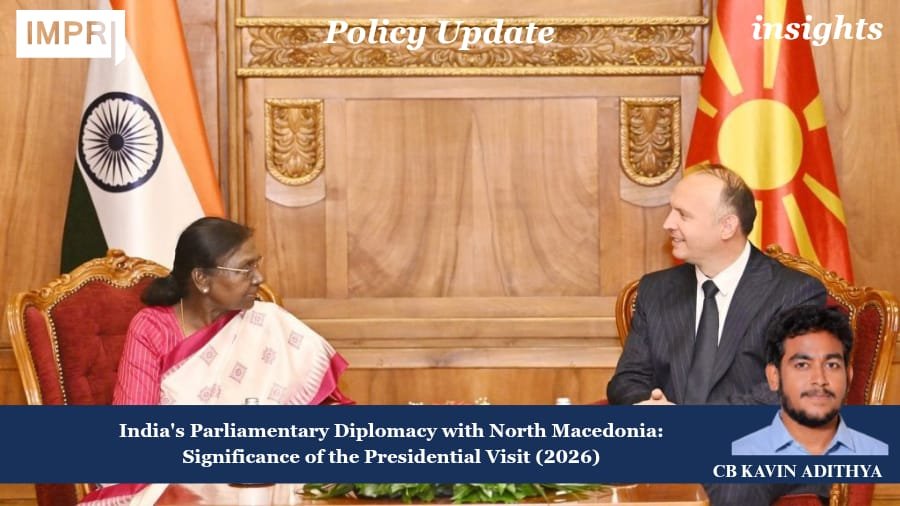
India and North Macedonia first set up diplomatic ties back in 1995, but for a long time, not much really happened between them especially when it came to high-level politics or boosting trade. That changed when President Droupadi Murmu made her State Visit to North Macedonia on July 20–21, 2026. It was actually the first time an Indian President visited the country, and it marked a pretty big step forward. This visit wasn’t just symbolic; it gave both sides a real chance to talk face-to-face, deepen political understanding, and explore fresh possibilities for long-term collaboration.
Murmu’s stop in North Macedonia was part of a bigger tour that also included Moldova and Romania, which shows India’s growing interest in building connections in Southeast Europe. When she met with President Gordana Siljanovska-Davkova, they didn’t just stick to politics and they talked about everything from strengthening ties between their parliaments, to boosting trade and investment, to big-picture topics like digitalization, artificial intelligence, climate change, education, science, and research. Honestly, the range of topics says a lot. Both sides seem focused on stepping beyond the old ways of doing diplomacy and building a much broader, multi-faceted partnership.
This visit matters for India’s wider approach to Europe. North Macedonia sits in a key spot in the Western Balkans, a region that’s becoming more important strategically. For India, that opens up another line for connecting with Europe. On the flip side, North Macedonia stands to gain a new partnership with a major Asian economy and broader international cooperation.Looking ahead, the 2026 Presidential Visit isn’t just a symbolic move. It puts India–North Macedonia relations squarely in the spotlight and sets the stage for deeper ties in the future.
Functioning
The 2026 Presidential Visit created the conducive environment to advance a comprehensive agenda of political, economic, and cooperative engagements, going well beyond ceremonial activities. In this regard, the most significant aspect of the President’s visit to the Republic of North Macedonia was her statement about the importance of parliaments, their role in democracy, and the necessity for increased people-to-people and parliamentary exchanges between India and North Macedonia.
The enhanced parliamentary diplomacy may yield considerable political dividends for both countries, as parliaments emerge as key players in the international relations of small states, with potential for frequent and frank exchanges on legislative, institutional, public policy, or democratic development issues.
In addition, the meetings with President Gordana Siljanovska-Davkova and the subsequent political, economic, security, and development consultations are also expected to generate fruitful political outcomes. Both leaders identified several areas for mutually beneficial collaboration, including information technology, pharmaceuticals, agriculture, agro-processing, biotechnology, tourism, hospitality, and creative industries. However, identifying key areas for collaboration will enable India and North Macedonia to elevate their bilateralism to new levels, beyond the donor-recipient paradigm.
Moreover, business diplomacy also appeared to be at the centre of the President’s engagement with North Macedonia, which was further enhanced by the India-North Macedonia Business Forum. The forum served as an excellent platform to facilitate consultation and networking between business communities, envoys, companies, and other stakeholders involved in, or interested in fostering, economic ties between the two countries.
The topics of discussion included India’s technology sectors (including artificial intelligence (AI), digitalisation, 5G, cyber security, and green energy), as well as start-up businesses, and cooperation in technology, research, education, and innovation fields. Therefore, increased business community engagement, at senior and junior levels, as well as institutional interactions between universities and research institutes, will play a crucial role in advancing the bilateral ties.
Technical cooperation is shaping up to be another key part of the India–North Macedonia partnership. It’s a chance to actually build something real an innovative economy that draws on India’s strengths in IT and other cutting-edge industries. As India keeps growing its technical education and training through the ITEC Programme, there’s a clear opening to forge real connections with North Macedonia in higher education, technical skills, and overall capacity development. That’s how you move past just talking about “strategic ties.” On top of that, India can jump in and start working at a deeper level with institutional partnerships, joint research, and collaboration around AI, digitalization, cybersecurity, and whatever’s next in tech. So, the 2026 Presidential Visit isn’t just a formality. It could really push the relationship further, letting the two countries focus less on geopolitical maneuvering and more on tackling the real development and security issues they both deal with.
Performance
The Presidential Visit took an important milestone in widening the area of engagement between India–North Macedonia relations from a mainly diplomatic dialogue to structured institutional cooperation. The visit itself may not have yielded a comprehensive bilateral understanding but set out files for cooperation on governance, trade, technology, capacity building and sustainable development. Thus, the value of the visit is less in the quantity of announcements and if it manages to develop long-term mechanisms for cooperation.
One of the most important accomplishments was the identification of parliamentary diplomacy as a supplementary facet of bilateral relations. Both countries recognized that interaction between elected representatives can foster policy learning, strengthen democracy and improve parliamentary cooperation through exchange programs between legislators and parliamentary institutions. This kind of engagement ensures continuity in bilateral relations because institutional partnerships outlast political leadership changes.
It also revitalized enthusiasm for economic complicity. The scope of the dialogue at the India–North Macedonia Business Forum revolved around enhancing investment over trade. This marks a wider recognition that sustainable economic relations need a more cohesive spirit between businesses, research institutions, startups and technology enterprises. The priority sectors discussed include digital innovation, Artificial Intelligence, pharmaceuticals and healthcare, and agro-processing & renewable energy. These sectors align with the economic priorities of both countries and offer avenues for sustainable commercial collaboration.The developmental aspect of bilateral ties was also reinforced through capacity-building
programmes.
The fact that India has chosen to expand the Indian Technical and Economic Cooperation (ITEC) training slots to North Macedonia also with specialised programmes on Artificial Intelligence speaks volumes regarding the significance of knowledge sharing in India’s foreign policy. These programmes can enhance professional skills and build institutional networks that facilitate future collaboration in governance, technology, and public administration.Climate and sustainability also came up as areas of significant engagement.
North Macedonia’s desire to join platforms such as the International Solar Alliance (ISA), the Coalition for Disaster Resilient Infrastructure (CDRI), and the Global Biofuels Alliance demonstrates the increasing significance of development partnership in India’s foreign relations.North Macedonia’s desire to join platforms such as The International Solar Alliance (ISA), the Coalition for Disaster Resilient Infrastructure (CDRI) and the Global Biofuels Alliance.These Demonstrates the increasing significance of development partnership in India’s foreign relationsCollaboration in these programs can provide access to technical knowledge, promote renewable energy use, and build resilience to climate-related issues.
Impact
The 2026 visit has provided a boost to India’s diplomatic outreach in Southeast Europe, a region that had earlier been on the sidelines of India’s geopolitical interests in foreign policy and diplomacy. It signals India’s readiness to expand its European connections on the basis of the European dimension and a multipolar world.
The visit also gives positive spin to India’s perception as an enabling development partner, which combines political consultation with capacity building, technology cooperation and sustainable development. This results in boosting India’s diplomatic immunity, thereby offering avenues for greater cooperation between India and other countries in the Western Balkans.
For North Macedonia, enhanced interaction with India facilitates access to one of the world’s fastest-growing major economies; a prospect for exploring more options in fields such as technology, education, pharmaceuticals and innovation. More exchange with Indian academia and industry could thus contribute to strengthen skills, diversify investments and build economic resilience.
Stronger India–North Macedonia relations at the regional level can also open up avenues for India to potentially scale up its ties with the entire Southeast European region. Strengthening diplomatic and economic relations with the region can aid in trade diversification, supply-chain resilience, and more cooperation in burgeoning industries.
It also indicates the evolving nature of Indian foreign policy, where diplomatic engagement is increasingly tied to economic interests, technology partnerships and development collaboration. This engagement could potentially develop into a long-term strategic partnership that advances mutual progress,regional tranquility, and stronger India–Europe relations, if aided by enduring political determination and efficient execution.
Emerging Issues
Tensions between the two sides have increased in certain respects, while there are a number of latent problems that may affect India–North Macedonia relations in their long-term development, despite recently revived diplomatic attentions.The need for strategic prioritisation is a pertinent one. India has relations with a number of European nations, and then there’s North Macedonia and its own regional and European agendas.
Balancing foreign-policy priorities Ensuring that bilateral engagement receives sustained focus in the face of competing foreign-policy priorities.Uncertainty geopolitics in the Western Balkans was another. Political change, regional tensions as well as the evolution of the European security environment can direct smaller states priorities within the region. Both sides may have to adapt their diplomatic strategies on the fly as a result of these events, which is a good reason to avoid such things in the first place.
It remains important for policies to be consistent. Engaging politically at a high level is a way to create momentum, but change in governments or foreign-policy focus within a government can potentially affect the continuation of bilateral undertakings. So in order to maintain consistency political cycles must be transcended.Greater public understanding of the relationship is needed as well. India and North Macedonia have far less historical interaction at the societal level compared to some of India’s other European relationships.
Absent wider public consciousness, bilateral relations risk being confined to the official/elite realm.Another emergent issue concerns the adaptability of cooperation. “Given how quickly global priorities are shifting especially in such spheres as artificial intelligence, climate change, energy security, and digital governance, both countries will have to regularly adjust their areas of engagement rather than rely on traditional diplomatic frameworks.” And the relationship needs to develop a clear long-term strategic identity. Clarifying the shared priorities between the two sides and defining the overarching purpose of their bilateral relationship will be up for negotiation as the two sides transition from occasional diplomatic engagement to a stable, mutually predictable partnership.
Way Forward
To Develop long term bilateral action plan with clear time lines, implementing agencies and review mechanism. Broaden engagement beyond traditional areas of cooperation to include emerging sectors such as cooperation in semiconductor technologies, digital public infrastructure, cyber security, biotechnology, clean energy.Strengthen the involvement of MSMEs, startups and Women-led enterprises through focused business networking platforms and investment facilitation.
Facilitate academic mobility through joint degree programmes, research fellowships, language training and student exchange schemes.Enhance business to business relations through sector specific trade missions and by linking industry associations. Deepen collaboration in multilateral forums on topics including climate governance, disaster resilience, sustainable development, and global institutional reforms.Encourage cultural diplomacy, tourism marketing, film collaboration, heritage exchange and people-to-people programs to foster greater mutual understanding.
The Presidential Visit(2026) has set the path for a more multifaceted and forward-looking relation between India and North Macedonia.Continued political will, substantive delivery and better inter-institutional cooperation will be critical to transforming diplomatic generosity into material economic, strategic, and developmental gains to allow both countries to forge a resilient relationship adaptive to a changing global order.
References
Ministry of External Affairs. (2026a, July 21). The President of India addresses the Assembly of North Macedonia. Government of India. https://www.mea.gov.in/
Ministry of External Affairs. (2026b, July 21). The President of India in North Macedonia holds a bilateral meeting with the President of North Macedonia and leads delegation-level talks. Government of India. https://www.mea.gov.in/
Ministry of External Affairs. (2026c). Annual report 2025–26. Government of India. https://www.mea.gov.in/annual-reports.htm
Ministry of External Affairs. (n.d.). India–North Macedonia bilateral relations. Government of India. https://www.mea.gov.in/
President’s Secretariat. (2026a, July 21). President of India in North Macedonia; holds bilateral meetings with the President of North Macedonia and leads delegation-level talks. Rashtrapati Bhavan. https://presidentofindia.nic.in/
President’s Secretariat. (2026b, July 21). President of India addresses India–North Macedonia Business Forum. Rashtrapati Bhavan. https://presidentofindia.nic.in/
World Bank. (2025). North Macedonia overview.https://www.worldbank.org/en/country/northmacedonia
European Commission. (2025). North Macedonia 2025 report. European Commission. https://neighbourhood-enlargement.ec.europa.eu/
Ministry of Foreign Affairs of the Republic of North Macedonia. (n.d.). India. Government of the Republic of North Macedonia. https://mfa.gov.mk/
Contributor:
Kavin Adithya C.B. is a Research and Editorial Intern at IMPRI (Impact and Policy Research Institute). He is currently pursuing an M.A. in International Relations at Loyola College, Chennai. His academic and research interests include International Relations, International Political Economy, Defence and Security Studies, Public Policy, Geopolitics, and Human Rights. He is passionate about analysing contemporary global affairs and strengthening his research and policy analysis skills through academic writing and public policy engagement.
Acknowledgement:
The author sincerely expresses gratitude to the reviewers and the editorial team for their valuable comments, constructive suggestions, and continuous guidance throughout the preparation of this article. Their insightful feedback significantly enhanced the clarity, organisation, and analytical quality of the manuscript. The author also acknowledges the support and encouragement received during the research and writing process, which contributed to the successful completion of this work.
Disclaimer:
All views expressed in the article belong solely to the author and not necessarily to the organisation.
Reviewers: Ashi Verma & Shruti Sethi for I sincerely thank the reviewers for their valuable time, careful evaluation, and constructive comments. Their insightful suggestions have helped improve the quality, clarity, and overall presentation of this article. I greatly appreciate their thoughtful feedback and the opportunity to revise the manuscript accordingly.