







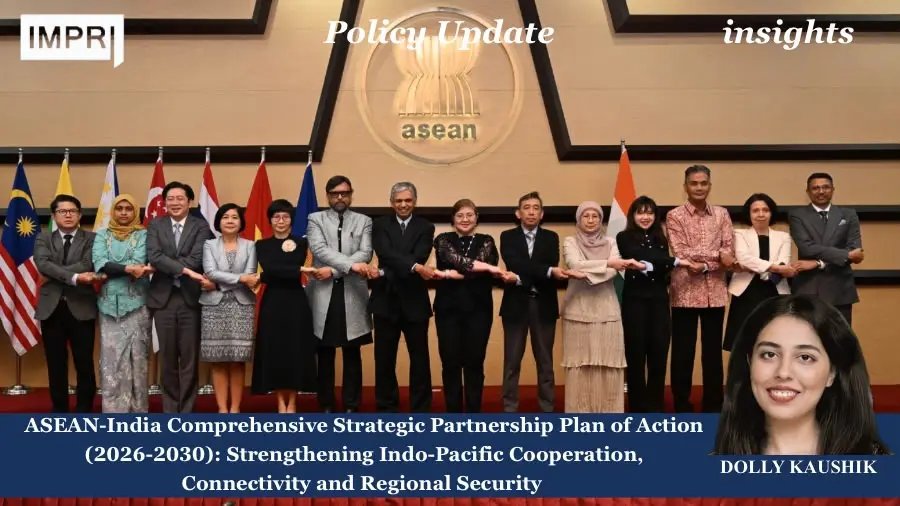
Policy Update
Dolly Kaushik
Background
India-ASEAN relations have grown into one of the central drivers of Indo-Pacific stability and economic integration. Over three decades, bilateral engagement has moved from early dialogue mechanisms to a full Comprehensive Strategic Partnership.
This evolution began with India’s inclusion as a Sectoral Partner in 1992, a step that signaled New Delhi’s turn toward Southeast Asia following its domestic economic reforms. India was elevated to Full Dialogue Partner status in 1996, which laid the groundwork for annual summit-level interactions established in 2002.The relationship reached formal Strategic Partnership status in 2012 at the Commemorative Summit in New Delhi, and was elevated further to Comprehensive Strategic Partnership status at the 19th ASEAN-India Summit in Phnom Penh in 2022 (ASEAN Secretariat, 2025; MEA, 2025).
Earlier Plans of Action, covering 2010–2015 and 2016–2020, focused mainly on building basic transport corridors, expanding bilateral trade, and setting up institutional security dialogues. The subsequent Plan of Action for 2021–2025, along with its dedicated CSP Annex introduced in 2023, shifted priorities toward post-pandemic economic recovery, public health cooperation, and digital resilience (ASEAN Secretariat, 2025; MEA, 2025).
Building on this foundation, the newly adopted Plan of Action for 2026–2030 explicitly links bilateral cooperation to the ASEAN 2045: Our Shared Future framework, setting out a roadmap for sustainable economic growth, green energy transitions, and resilient regional supply chains (ASEAN Secretariat,2025).
India’s principal policy driver behind this momentum is its Act East Policy, launched in 2014 as an active evolution of the 1991 Look East Policy. While the original policy centered on trade and market access, Act East added stronger political commitment, proactive diplomacy, and defence initiatives. By aligning its Indo-Pacific Oceans Initiative with the ASEAN Outlook on the Indo-Pacific, India has moved beyond routine diplomatic exchanges toward active strategic alignment with the bloc, positioning the partnership as central to its regional strategy.
Functioning
The India-ASEAN CSP runs on a multi-tiered diplomatic structure backed by dedicated financial instruments meant to sustain long-term cooperation. At the top are the annual ASEAN-India Summit and the Post Ministerial Conference Plus One (PMC+1), which set the broad political direction and assess regional progress (MEA, 2025; ASEAN Secretariat, 2026).
Below the ministerial level, policy execution is coordinated through the ASEAN-India Senior Officials’ Meeting (AISOM) and the standing ASEAN-India Joint Cooperation Committee (AIJCC), based in Jakarta. The AIJCC brings together India’s Ambassador to ASEAN and the ten ASEAN permanent representatives to oversee project implementation, manage disbursements from the cooperation funds, and monitor compliance with summit mandates.
Technical coordination is undertaken through regular talks between India’s Inter-Ministerial Group on Connectivity and the ASEAN Connectivity Coordinating Committee, which align national and regional connectivity goals.
Funding for cooperative projects runs through four dedicated mechanisms. The ASEAN-India Fund supports general socio-economic, cultural, and developmental cooperation. The ASEAN-India Green Fund finances environmental sustainability, climate adaptation, and biodiversity projects. The ASEAN-India Science and Technology Development Fund backs joint research, technology transfer, and researcher mobility. The ASEAN-India Fund for Digital Future supports digital connectivity, cybersecurity, and technological innovation across the region (MEA, 2025).
Under the 2026–2030 Plan of Action, monitoring has become tighter. Formal progress reports are now submitted annually to the PMC+1 (ASEAN Secretariat, 2026), a shift toward more consistent, structured accountability across all areas of cooperation.
Performance
The partnership’s performance through the 2021–2025 cycle showed steady, measurable growth. Both sides converted broad frameworks such as the ASEAN Outlook on the Indo-Pacific into scheduled, deliverable outcomes. ASEAN has remained a major trade partner throughout, accounting for roughly 11% of India’s global trade.
Bilateral trade rose from USD 121 billion in FY2023–24 to USD 123 billion in FY2024–25, reaching USD 128 billion by the close of FY2025–26 (Ministry of Commerce and Industry [MoCI], 2026). This growth was supported by regulatory negotiation, most notably successive rounds of the AITIGA Joint Committee meetings aimed at modernizing the trade pact and addressing non-tariff barriers.
Beyond trade, concrete sectoral outcomes were delivered across security, technology, and disaster management. Key milestones include the Maritime Cooperation Joint Statement and the Digital Transformation Joint Statement, both adopted at the 20th ASEAN-India Summit in Jakarta (MEA, 2025), and the MoU signed between India’s National Disaster Management Authority (NDMA) and the ASEAN Coordinating Centre for Humanitarian Assistance (AHA Centre) in October 2024 (MEA, 2025).
Successive summit declarations also delivered capacity-building outcomes, including training slots for renewable-energy professionals and technical immersion programs extended to partner nations such as Timor-Leste (MEA, 2025)
| Financial Year | Total Bilateral Trade | Share of India’s Global Trade | Key Growth Driver / Milestone |
| 2023–24 | USD 121 Billion | ~11% | Post-pandemic recovery and baseline manufacturing exchange |
| 2024–25 | USD 123 Billion | ~11% | AITIGA modernization talks and the NDMA-AHA pact |
| 2025–26 | USD 128 Billion | ~11% | Peak performance under the 2021–2025 Plan of Action |
Source: Compiled by the author based on data published by the Ministry of Commerce and Industry (MoCI) and the Ministry of External Affairs (MEA).
Impact
At the strategic level, the ASEAN Secretariat has characterized the 2021-2025 Plan of Action as “fully and robustly implemented,” indicating that execution kept pace with commitments across major areas of engagement. The framework helped steer bilateral cooperation toward post-pandemic economic recovery, public health coordination, and digital connectivity, integrating Indian industries further into regional value chains.
However, when checked against the trade data, this robust institutional impact reveals lingering structural asymmetries. While aggregate trade figures reached USD 128 billion (MoCI, 2026), the partnership continues to grapple with a structural trade deficit heavily tilted in favor of several ASEAN economies, driven largely by raw material imports versus high-value manufactured exports (ORF, 2025).
Despite these challenges, the qualitative record of the 2021–2025 cycle built real institutional trust, working-level ties, and disaster-response capacity. Its trade performance, by contrast, points to the need for the AITIGA modernization now underway to secure more balanced market access and deeper integration for Indian manufacturing and MSMEs.
The lessons from the 2021–2025 cycle have directly shaped the design of the 2026–2030 Plan of Action. By building in stricter monitoring, prioritizing supply chain resilience, and launching initiatives such as the ASEAN-India Year of Maritime Cooperation, both sides have signaled an intent to move beyond trade metrics toward deeper, more balanced economic integration.
Emerging Issues
Despite the partnership’s steady institutional progress, bilateral economic ties still face persistent friction points. Chief among them is the asymmetry within the ASEAN-India Trade in Goods Agreement (AITIGA).
Policy analyses on the trade pact review note that while India has eliminated tariffs on roughly 75% of its tariff lines, covering close to 88.7% of trade volume, reciprocal market access from key ASEAN member states has not matched this depth, leaving Indian exporters constrained by non-tariff barriers and trade restrictions (Delhi Policy Group, 2025; ORF, 2025).
This imbalance shows up clearly in the trade data. Government figures indicate that India’s merchandise exports to ASEAN contracted by 5.77% to USD 38.96 billion in FY2024-25, while imports from the region grew by 5.65% to USD 84.16 billion. This widened gap follows an earlier peak bilateral deficit of USD 43.57 billion in FY2022–23.
To address this, India has pushed to convert the long-running AITIGA review into a deadline-bound outcome (PIB, 2026). This intent is formally written into clause 2.1.2 of the 2026–2030 Plan of Action, which sets AITIGA modernization as a firm commitment rather than a side discussion (ASEAN Secretariat, 2026). This push was reinforced when New Delhi hosted the 13th AITIGA Joint Committee meeting in July 2026, advancing sub-committee negotiations on market access and trade facilitation (PIB, 2026).
Timor-Leste’s integration as ASEAN’s newest full member adds a further layer of complexity. The 2026–2030 Plan of Action includes a dedicated clause supporting this membership pathway, meaning both sides must manage this integration alongside the ongoing AITIGA negotiations for the rest of the decade.
Way Forward
The effectiveness of the 2026–2030 Plan of Action will depend on both sides moving beyond routine diplomatic engagement to act on its specific forward-looking commitments.
First, completing the long-stalled AITIGA modernization process should take absolute precedence over expanding into newer domains. Resolving existing trade asymmetries and building trust in baseline economic exchanges is a prerequisite for deeper technological and digital integration.
Once this economic foundation is secured, the bilateral engagement is well-positioned to scale its collaboration across several emerging frontiers outlined in the 2026–2030 framework. A new area of cooperation is civilian nuclear energy under clause 2.3.5 (ASEAN Secretariat, 2026). Driven by potential Department of Atomic Energy (DAE) and ASEAN Centre for Energy (ACE) collaborations, along with small modular reactor (SMR) regulatory dialogues, this shift creates an avenue for high-tech industrial ecosystems and advanced manufacturing.
Another emerging priority is AI governance and multilingual digital safety. Clause 2.12 of the Plan of Action explicitly promotes cooperation in multilingual AI safety testing, creating opportunities for developing trusted and inclusive digital architectures across linguistically diverse societies (ASEAN Secretariat, 2026).
Maritime cooperation will gain further momentum through the designation of 2026 as the ASEAN–India Year of Maritime Cooperation. The initiative reinforces maritime security, blue economy collaboration, and maritime domain awareness as central pillars of the partnership (ASEAN Secretariat, 2026, Section 2.6). To institutionalize this defence alignment further, the proposed Second ASEAN-India Defence Ministers’ Meeting offers a vital mechanism to translate this awareness into joint operational readiness (PIB, 2025).
Building physical and transnational connectivity remains essential for translating diplomatic agreements into tangible economic integration. On the ground, the infrastructure deliverable to monitor is the progression of the India-Myanmar-Thailand (IMT) Trilateral Highway, alongside its prospective eastward extensions into Cambodia, Lao PDR, and Vietnam. Accelerating these multimodal transport corridors serves to physically anchor regional value chains, directly supporting the broader economic corridors envisioned under the updated Plan of Action and reinforcing the wider architecture of Indo-Pacific connectivity.
References
ASEAN Secretariat. (2025). Chairman’s statement of the 22nd ASEAN–India Summit. https://asean.org/chairmans-statement-of-the-22nd-asean-india-summit/
ASEAN Secretariat. (2025). Overview: ASEAN–India comprehensive strategic partnership, as of October 2025. https://asean.org/wp-content/uploads/2025/10/Overview-ASEAN-India-as-of-October-2025-ERD3-cleared-1.pdf
ASEAN Secretariat. (2023). Plan of action to implement the ASEAN–India comprehensive strategic partnership (2021–2025), with 2023 annex. https://asean.org/wp-content/uploads/2023/07/05_Final-ASEAN-India-PoA-with-Annex-1.pdf
ASEAN Secretariat. (2026). Plan of action to implement the ASEAN–India comprehensive strategic partnership (2026–2030), adopted text. https://asean.org/wp-content/uploads/2026/03/Final-POA-to-Implement-ASEAN-India-CSP-2026-2030-adopted.pdf
Delhi Policy Group. (2025). Preparing for a review of the ASEAN–India Trade in Goods Agreement (AITIGA). https://www.delhipolicygroup.org/publication/policy-briefs/preparing-for-a-review-of-the-asean-india-trade-in-goods-agreement-aitiga.html
Ministry of External Affairs, Government of India. (2025). Brief on India–ASEAN relations, July 2025. https://www.mea.gov.in/Portal/ForeignRelation/India-ASEAN-july-2025.pdf
Ministry of External Affairs, Government of India. (2025). Overview of ASEAN–India relations, June 2025. https://www.mea.gov.in/Portal/ForeignRelation/BRIEF-ON-ASEAN-INDIA.pdf
Observer Research Foundation. (2025). Resetting India–ASEAN trade in 2025. https://www.orfonline.org/expert-speak/resetting-india-asean-trade-in-2025
Press Information Bureau, Government of India. (2025). India hosts 10th meeting of AITIGA Joint Committee to review ASEAN–India Trade in Goods Agreement. https://www.pib.gov.in/PressReleasePage.aspx?PRID=2156828
Press Information Bureau, Government of India. (2025). Prime Minister’s participation in the 22nd ASEAN–India Summit. https://www.pib.gov.in/PressReleasePage.aspx?PRID=2182724
Press Information Bureau, Government of India. (2026). India hosts 13th ASEAN–India Trade in Goods Agreement Joint Committee meeting to advance ASEAN–India trade pact review. https://www.pib.gov.in/PressReleasePage.aspx?PRID=2282336®=48&lang=1
About the Contributor
Dolly Kaushik is a postgraduate student of Public Administration with an interdisciplinary academic foundation in Life Science. Her work explores the geopolitical dimensions of emerging technologies, global governance, and international affairs. She is currently a research intern at IMPRI, New Delhi
Acknowledgement
The author extends her sincere gratitude to the IMPRI team for their valuable guidance throughout the process. I also extend my sincere thanks to Devanandana and Vyomini for their valuable feedback.
Disclaimer
All views expressed in the article belong solely to the author and do not necessarily represent the views or policies of the organisation.
Read More at IMPRI:
Energy Security Shock: India’s Response to the Strait of Hormuz Crisis
Research, Development and Innovation (RDI) Scheme: Strengthening India’s Innovation Ecosystem