







Policy Update
Shivanshi
Background
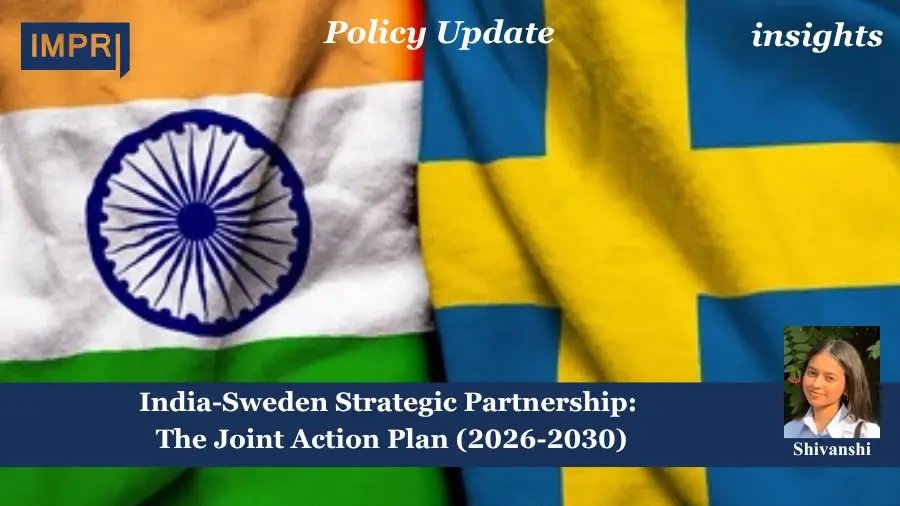
India-Sweden relations had been steadily deepening for close to a decade before the 2026 upgrade, anchored by the first India-Sweden Joint Action Plan (2018), the India-Sweden Innovation Partnership, and joint leadership of the Leadership Group for Industry Transition (LeadIT) since 2019, alongside existing defence and technology dialogues that had already given the relationship real substance. On 17 May 2026, Prime Minister Narendra Modi travelled to Gothenburg to meet Swedish Prime Minister Ulf Kristersson, and the two countries used the occasion to formally elevate this relationship to a Strategic Partnership.
Sweden’s relevance as a partner stems from specific comparative strengths, advanced manufacturing, precision engineering, green industrial technologies, and a dense innovation ecosystem, that align closely with India’s priorities in clean industrial transition, defence co-production, and digital infrastructure. The two countries adopted the India-Sweden Joint Action Plan 2026-2030.
This came just months after the India-EU Summit of January 2026 in New Delhi and the conclusion of the India-EU Free Trade Agreement, and both leaders were fairly explicit that they saw the Sweden partnership as an extension of that broader European opening. European Commission President Ursula von der Leyen was present for parts of the visit too, which underlines how much this bilateral moment was being read as part of India’s wider EU engagement.
What distinguishes the 2026-30 framework is less the areas of cooperation, most of which already existed, than the decision to consolidate them under a single strategic architecture with defined institutions and timelines. The partnership is organised around four pillars: Strategic Dialogue for Stability and Security; Next-Generation Economic Partnership; Emerging Technologies and Trusted Connectivity; and Shaping Tomorrow Together, which covers people, planet, health and resilience.
The choice of these four pillars reflects where India-Sweden cooperation had already gained the most traction, security dialogue building on existing NSA-level contact, economic ties on a mature trade base, technology on the AI and innovation partnerships already underway, and sustainability on LeadIT, rather than an entirely new set of priorities. The Gothenburg summit was followed just two days later by the third India-Nordic Summit in Oslo, where India used this period to consolidate several Nordic relationships at once rather than treating Sweden in isolation.
Functioning
On the security side, the plan formalises regular contact between India’s National Security Council Secretariat and Sweden’s Office of the National Security Advisor, along with a standing cyber policy dialogue. There’s also a push to raise defence dialogue to ministerial level and to explore innovation cooperation through the existing Joint Working Group on Defence. The plan specifically references encouraging further Swedish investment in India’s defence corridors, building on investment that Swedish firms are already making there. Track 1.5 diplomacy gets a mention too, through platforms like the India Nordic Dialogue and the India Trilateral Forum, alongside newer parliamentary friendship groups on both sides.
The economic pillar is arguably the most concrete of the four, if only because it comes with a specific numerical target: both countries want to double bilateral trade and investment within five years. To work toward that, they’ve scheduled a Trade and Investment Summit in India for 2027, branded “India–Sweden: Stronger Together – towards 2047,” and they’re leaning on the “Make in India” and “Made with Sweden” tags to push co-production rather than simple export growth.
A Trade Facilitation Mechanism is meant to handle both government-to-government and business-to-government coordination, and there is a fairly practical commitment buried in the plan to restore direct air links between the two countries, which has obvious knock-on effects for business travel, tourism, and people-to-people ties generally.
Technology is where the plan gets most ambitious in scope. The centrepiece is an upgraded Joint Innovation Partnership 2.0, paired with a new virtual India-Sweden Joint Science and Technology Centre. Between them, these are supposed to cover a fairly sprawling list, AI, 6G, quantum computing, critical minerals, sustainable mining, and space and geospatial research. The Sweden–India Technology and Artificial Intelligence Corridor, or SITAC, will connect Business Sweden with the India AI Mission.
This builds directly on the momentum from India’s AI Impact Summit in New Delhi back in February 2026, which the Swedish side referenced with some enthusiasm in the joint statement. On space specifically, Sweden’s Institute of Space Physics is contributing a scientific instrument to India’s upcoming Mission, giving ISRO a concrete collaborative anchor point rather than just aspirational language about “space cooperation.”
The fourth pillar, on sustainability and people, ties together several older initiatives under one roof. Both countries will continue co-leading the Leadership Group for Industry Transition, and they are specifically expanding green steel collaboration under the Sweden-India Industry Transition Partnership. There’s also language on advanced mining and mineral-processing technology, cleantech and fossil-free solutions, and cooperation on drinking water infrastructure and quality monitoring.
On the people’s side, “Study in Sweden” and “Work in Sweden” get folded in as talent-mobility mechanisms. Implementation is intended to run through the existing Joint Committee structures under each pillar, such as the Joint Committee for Science and Technology, with periodic ministerial-level review built into the Strategic Dialogue mechanism, giving the plan a built-in cycle for tracking progress.
Performance
Because the partnership was only announced in May 2026, there isn’t yet a multi-year track record to draw on in the usual sense, this is very much a framework at the starting line rather than one with completed project cycles behind it. What the Joint Statement and Action Plan do establish is a clear set of near-term indicators to track progress against.
The trade and investment doubling target runs on a five-year horizon, with the 2027 Trade and Investment Summit in India serving as the first major checkpoint. The India-Sweden Joint Science and Technology Centre (ISJSTC), and the upgraded Joint Innovation Partnership 2.0 are expected to formally launch in the period following this summit, giving both governments a natural point to demonstrate early traction.
Further ahead, LeadIT is set to enter a new four-year phase, LeadIT 3.0, expected to be announced at COP31, extending India and Sweden’s joint leadership on industrial decarbonisation well into the next decade. It’s worth noting this partnership doesn’t start from zero: it builds directly on the India-Sweden Innovations Accelerator and the 2017 intellectual property cooperation MoU between Sweden’s Patent and Registration Office and India’s patent authority, both of which are now folded into the renewed framework, giving the new plan a running head start rather than a blank slate.
Impact
The most immediate impact of the Gothenburg summit is structural: India-Sweden cooperation now sits under one coherent four-pillar architecture with named institutions attached to each strand, rather than being spread across a series of standalone MoUs accumulated over the years. This gives both countries’ agencies a shared roadmap to coordinate around, and should make it easier to sustain momentum between high-level visits.
The partnership is also thoughtfully positioned within India’s wider European engagement, both leaders repeatedly connected it to the newly concluded India-EU Free Trade Agreement, suggesting Sweden is well placed to serve as an early and willing partner in translating India’s expanded EU market access into concrete bilateral technology and industrial outcomes.
On the security front, the reaffirmed condemnation of terrorism, including specific reference to the Pahalgam attack of April 2025, and Sweden’s reiterated support for India’s permanent UN Security Council membership reflect a partnership where strategic alignment is being actively maintained alongside the economic and technology agenda. Taken together, the AI corridor (SITAC), and the green steel work under LeadIT give the technology and sustainability pillars particularly tangible early anchor points to build from.
Emerging Issues
As with any newly launched framework, several elements of the Action Plan are set up as open, evolving tracks rather than fully detailed from day one, which is a natural feature of a partnership still in its early operational phase. Geographic distance and the absence of direct flight connectivity have historically limited business and people-to-people volumes between the two countries.
Aligning Indian and Swedish regulatory standards, particularly on data protection, AI governance, and industrial certification, will require sustained technical negotiation given the two countries operate under different regulatory traditions (India’s domestic framework versus Sweden’s EU-aligned one). Sweden’s cooperation commitments, particularly on trade and AI, are partly shaped by EU-level frameworks, meaning some elements of the partnership’s pace will depend on developments at the India-EU level rather than bilateral decisions alone.
Way Forward
The Gothenburg summit gives the India-Sweden relationship a real institutional foundation to work with: four pillars, several newly named bodies, and a series of checkpoints running out to 2027 and beyond. The task ahead for both countries is to build on this momentum: bringing the ISJSTC and SITAC to full operational readiness, using the 2027 Trade and Investment Summit to showcase early wins on the trade-doubling goal, and carrying the space and green-industry collaborations forward as models for what the partnership can achieve at scale.
Given how closely this partnership has been tied to the India-EU Free Trade Agreement in both governments’ framing, its progress over the coming years is likely to serve as a useful indicator for India’s broader European strategy and, if the current trajectory holds, a strong example of how quickly a long-standing bilateral relationship can be translated into a modern, technology-forward strategic partnership. The five-year trade and investment doubling target is a clear headline goal; specific interim targets are likely to be worked out as the Trade Facilitation Mechanism becomes active and the 2027 Summit approaches.
More broadly, the India-Sweden partnership offers a framework for how India is approaching relations with capable middle powers, anchoring technology and industrial cooperation to a like-minded partner’s specific strengths rather than pursuing broad-based engagement, a model that may increasingly define India’s outreach to other advanced economies beyond its major-power relationships.
References
Government of Sweden, 2026, “Joint Statement on the India–Sweden Summit,” Government Offices of Sweden. https://www.government.se/statements/2026/05/joint-statement-on-the-indiasweden-summit/
Government Offices of Sweden, 2026, “Strategic partnership between India and Sweden – cutting-edge collaboration with historical ties,” Government Offices of Sweden. https://www.government.se/press-releases/2026/05/strategic-partnership-between-india-and-sweden–cutting-edge-collaboration-with-historical-ties/
Ministry of External Affairs (MEA), Government of India. (2026). Joint Action Plan 2026–2030 for the Implementation of the India–Sweden Strategic Partnership .https://www.mea.gov.in/bilateral-documents?dtl/41173/Joint_Action_Plan_20262030__for_the_implementation_of_the_IndiaSweden_Strategic_Partnership
Prime Minister’s Office (PMO). (2026). Prime Minister Holds Bilateral Talks with Prime Minister of Sweden. Press Information Bureau, Government of India. https://www.pib.gov.in/PressReleasePage.aspx?PRID=2262096
About the Contributor
Shivanshi is a Research & Editorial Intern at the Impact and Policy Research Institute (IMPRI) and a recent graduate in Political Science from Miranda House, University of Delhi. Her research interests include public policy, international relations, and governance.
Acknowledgement
The author extends sincere gratitude to IMPRI India for its valuable guidance and support.
Reviewers
Nayanshi Jain and Pallavi Lad
Disclaimer
All views expressed in the article belong solely to the author and not necessarily to the organisation.
Read more at IMPRI
India–Brazil Strategic Partnership (2026): Strengthening Security, Technology and Sustainability
India’s Draft Digital Competition Bill, 2024: Reforming Digital Markets