




Policy Update
Madhuritha D
Background
India and Vietnam share warm and long-standing bilateral relations that were formally established in 1972. Over the decades, this partnership has grown from cultural and historical linkages to a robust strategic alliance. In 2007, India established its first Strategic Partnership within the ASEAN region with Vietnam, a milestone that underscored Vietnam’s importance in India’s Act East Policy. This was further elevated to a Comprehensive Strategic Partnership in 2016, expanding cooperation across defence, trade, connectivity, and people-to-people ties.
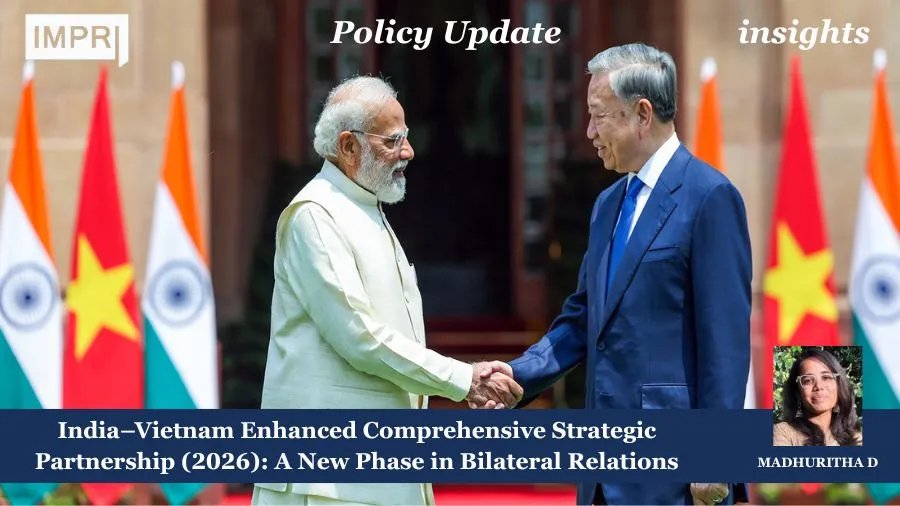
The recent visit of President To Lam on 6 May 2026, marks the initiation of the next level of this partnership. The discussions focused on deepening collaboration in key areas such as trade and investment, defence and maritime security, cultural exchange, education, and emerging technologies. As both nations navigate an increasingly complex Indo-Pacific and face strategic pressures from China in the Indian Ocean and Southeast Asia, this renewed engagement reaffirms collaborative approach and Vietnam’s role as a central pillar in India’s regional strategy.
Functioning
The Enhanced Comprehensive Strategic Partnership stands as the next level and new generation bilateral relations between the two countries which focuses on various aspects especially relating to trade, defence and technology. This enhanced partnership resulted in 13 Memorandum of Understandings and 5 announcements to further deepen the bilateral ties and also to navigate the emerging issues in the global order.
The announcements include:
| S.No | Announcements |
| 1 | Elevation of bilateral ties to Enhanced Comprehensive Strategic Partnership |
| 2 | New trade goal of USD 25 billion by 2030 |
| 3 | Vietnam joining the Indo Pacific Oceans Initiative (IPOI) |
| 4 | Export of Indian grapes to Vietnam and Vietnamese Durian to India |
| 5 | Establishment of the Site Interpretation Centre at UNESCO World Heritage Site at My Son |
Source: Ministry of External Affairs, Government of India, 2026.
The major MoUs include:
| Title | Brief description |
| MoU on Mutual Cooperation between IREL (India) Ltd. and Institute for Technology of Radioactive and Rare Elements (ITRRE) of Vietnam | MoU formalizes the long-standing commitment on both sides to expand bilateral cooperation in the areas of rare earth elements, among other new-age technologies. |
| MoU between Central Drugs Standard Control Organization (CDSCO), Ministry of Health and Family Welfare of India and Drug Administration of Vietnam (DAV), Ministry of Health of Vietnam on Cooperation in the field of Medical Products Regulation | The MoU seeks to establish a framework for cooperation in the field of medical products regulation, including pharmaceuticals, biological products, medical devices, and cosmetics. |
| MOU between Reserve Bank of India (RBI) and State Bank of Vietnam (SBV) on Cooperation in the area of Payment Systems and Innovation in Digital Payments | The MoU aims to establish a framework for cooperation in the area of financial innovation and digital payments. |
| MoU between Nalanda University, Rajgir, and Ho Chi Minh National Academy of Politics (HCMA), Hanoi | This MoU strengthens the longstanding initiatives of India to facilitate capacity building & training to Vietnam. |
Source: Ministry of External Affairs, Government of India, 2026
The two sides agreed to reinforce cooperation between the two rapidly growing economies at the level of governments and businesses to increase two-way trade, investment, and technological partnership. The leaders emphasized the need to further enhance it in a balanced and mutually beneficial manner and agreed on a new trade goal of 25 billion USD by 2030 (Ministry of External Affairs, 2026).
This relationship also incorporates knowledge sharing in the medical industry, training for Vietnamese armed forces by India, and joint action on cyber security. The two parties agreed to facilitate greater collaboration and partnership in critical and emerging technology areas such as Digital Public Infrastructure, 6G, Artificial Intelligence, space and nuclear technology, marine sciences, biotechnology, pharmaceuticals, advanced materials and critical minerals. Cooperation will focus on practical initiatives such as joint research, R&D centers, and product development as mutually beneficial (Ministry of External Affairs, 2026).
Additionally, the partnership also incorporates the reaffirmation of the importance of maintaining peace, stability, security and freedom of navigation and overflight in the South China Sea, while pursuing the peaceful resolution of disputes in accordance with international law, particularly the 1982 United Nations Convention on the Law of the Sea (UNCLOS), along with the joining of Vietnam in Indo-Pacific Oceans Initiative (IPOI) ensuring maritime security and rule based maritime order across regions.
This partnership also recognized the relevance of Mission LIFE (Lifestyle for Environment) and institutions such as the International Solar Alliance (ISA) in combating climate change and working towards a sustainable future. Viet Nam expressed its interest in joining the Global Biofuels Alliance (GBA). The leaders also acknowledged the importance of the Coalition for Disaster Resilient Infrastructure (CDRI) in promoting international cooperation in disaster risk reduction and resilience. Thus, this proves to be a holistic partnership including trade, defence, environmental problems, people-to-people ties, and health, with well-defined goals and collaborations.
Performance
Since the enhanced partnership was established on 4 May 2026, it is early to evaluate the performance. However, comparing the current status and future visions will give a comprehensive view on the deepened strategic relations between the two countries.
Through the Comprehensive Strategic Partnership established in 2016, India and Vietnam had strong bilateral relations, especially in trade, where India stood one amongst the top ten trading partners of Vietnam.
Source: Ministry of Commerce and Industry, Government of India.
The above chart shows the total trade flow between India and Vietnam, which has performed well, with total trade reaching approximately $18 billion in the financial year 2025-2026. The enhanced partnership aimed to increase the total trade to $25 billion by 2030. This increase in trade will provide India with an opportunity to engage effectively with the Southeast Asian nation, reiterating the significance of the Act East Policy and acting as a major gateway for the rest of the region in developing partnerships beyond the major powers.
Under the 2016 Comprehensive Strategic Partnership, defence and security emerged as a cornerstone. India extended a $500 million Line of Credit for defence procurement (Ministry of External Affairs, 2022) and has been training Vietnamese personnel under the ITEC and e-ITEC programs. Having recognized this, the leaders agreed to an MoU between Nalanda University of India and Ho Chi Minh National Academy of Politics, which helps in promoting people-to-people ties and a long-term partnership.
In 2022, India gifted an in-service missile corvette, INS Kirpan, to the Vietnam People’s Navy, and both sides conducted the bilateral naval exercise VINBAX and Bongkeo (Ministry of External Affairs, 2026). The 2026 Joint Vision Statement now aims to expand this to co-development and co-production of defence equipment, joint R&D, and cybersecurity cooperation, moving from buyer-seller to strategic manufacturing partners.
In industry and connectivity, India has committed $300 million under a separate Line of Credit for projects in Vietnam (Ministry of External Affairs, 2024), including the upgradation of Vietnam’s shipyards and development of industrial parks. The new partnership targets enhanced collaboration in semiconductors, critical minerals, clean energy, and pharmaceuticals, with a focus on resilient supply chains. This ensures holistic developmental support rather than providing credits and aid leading to dependency. Notably, it strengthens relations through welcoming the co-chairing of the ASEAN Defence Ministers’ Meeting-Plus Experts’ Working Group (ADMM-Plus EWG) on Cybersecurity for the 2027 – 2030 cycle.
Additionally, the two countries have partnered through the $5 million Army Software Park in Nha Trang inaugurated in 2021 (Embassy of India, Hanoi, 2021). Vietnam has also been a beneficiary of India’s Quick Impact Projects under the Mekong-Ganga Cooperation, which is highly celebrated by the locals for the effective implementation and specialised developmental initiatives. The 2026 framework adds commitments on AI, digital public infrastructure, and capacity building.
Thus, while the 2016 partnership institutionalized cooperation in defence, industry, knowledge and digital domains, the Enhanced Comprehensive Strategic Partnership sets a multi-dimensional platform and measurable goals to scale these from assistance to co-creation, positioning both nations for deeper consonance of interests and strategic convergence in the Indo-Pacific.
Impact
Building on diplomatic relations since 1972 and the 2016 Comprehensive Strategic Partnership, this upgrade cements Vietnam as India’s most comprehensive ASEAN partner. It reinforces a shared vision for a free, open, and rules-based Indo-Pacific through enhanced maritime security and rule-based world order. By moving from assistance-based cooperation to co-development and co-production, it aligns with India’s Act East Policy and Vietnam’s foreign policy of diversification.
Ministries on both sides now have clear mandates in semiconductors, critical minerals, clean energy, digital public infrastructure, and cyber security, and reducing policy ambiguity in the bilateral relations. The partnership also assists India in engaging more effectively with ASEAN and creating a strategic relationship beyond geography. It facilitates substantive cooperation in the ASEAN-India Year of Maritime Cooperation 2026 and fosters further synergies between IPOI and the ASEAN Outlook on the Indo-Pacific (AOIP).
Moreover, citizens stand to benefit through expanded ICCR and ITEC scholarships, digital skills and also through the training and capacity building initiatives offered by the existing and recently collaborated institutions and universities. Cultural exchanges around Buddhist and Cham heritage, and academic partnerships are aimed to deepen social ties. Therefore, this enhanced partnership exhibits an integrated approach towards the existing and emerging problems in the regional as well global order providing new avenues for both countries to expand their capacities.
Emerging issues
- Escalating tensions in West Asia may drive up global energy prices and disrupt maritime trade routes critical to both India and Vietnam. This would create inflationary pressure, particularly impacting Vietnam’s manufacturing sector and India’s broader economy. Higher oil and logistics costs could undermine the trade and industrial goals set by the 2026 partnership.
- China’s assertiveness in the South China Sea and actions that undermine a maritime rules-based order pose a direct threat to India-Vietnam maritime cooperation. As both nations rely on open sea lanes and rule based framework, it disrupts the advanced maritime initiatives in the region.
- Despite strong political and strategic alignment, implementation gaps in trade, connectivity, and defence industrial cooperation remain a key challenge to the India-Vietnam Enhanced Comprehensive Strategic Partnership as there is limited direct shipping and air links, and slow progress in defence co-production.
- While Vietnam follows a strict defense policy of four no’s which are no military alliances, no siding with one country against another, no foreign military bases, and no using force in international relations, it creates uncertainty in the depth of actual military interoperability with India.
- The trade deficit is heavily in favor of Vietnam, with Indian imports from Vietnam amounting to $11.6 billion while exports reaching only $6.6 billion approximately. This imbalance reflects structural gaps in market access, product diversification, and utilization of trade agreements.
Way forward
- Prioritizing the launch of direct maritime routes and increasing flights between major hubs to close the geographical gap. Aligning on resilient supply chains in electronics, semiconductors, and pharmaceuticals can reduce dependence on single sources.
- Institutionalizing a multi-model corridor involving the ports in Southern India such as Chennai, Vizag to different ports in Vietnam. This helps in unburdening one single hub while developing recently integrated ports for better sea connectivity and resilient supply chains.
- Promoting the Buddhist pilgrimage connecting India and Vietnam’s heritage sites to deepen spiritual tourism to enhance people-people connections other than educational and technological cooperation. Expanding activities such as museums and exhibitions substantiate citizen-centric cooperation and exhibit the traditional linkages of India with Vietnam and ASEAN.
- Establishing joint trade promotion councils, utilizing existing FTAs fully, and encouraging Indian investment in Vietnamese manufacturing can create more balanced, resilient, and sustainable economic ties in achieving the $25 billion trade target ensuring mutual benefits while avoiding implementation gaps and red tapism witnessed earlier.
- Promoting UPI linkage with Vietnam’s NAPAS will enable instant, low-cost digital payments for tourists and businesses. It will boost tourism, ease cross-border trade, and deepen fintech collaboration
- To close implementation gaps, the Enhanced CSP needs dedicated joint working groups with clear timelines for trade, defence, connectivity, and technology. Regular ministerial reviews, business forums, and think-tank dialogues shall ensure regulated progress.
References
Joint Statement on Enhanced Comprehensive Strategic Partnership between the Republic of India and the Socialist Republic of Vietnam (May 06, 2026) | Ministry of External Affairs, Government of India. https://www.mea.gov.in/bilateral-documents?dtl/41108/Joint_Statement_on_Enhanced_Comprehensive_Strategic_Partnership_between_the_Republic_of_India_and_the_Socialist_Republic_of_Vietnam_May_06_2026
List of outcomes: State visit of President of the Socialist Republic of Vietnam to India. (2026, May 6). Ministry of External Affairs, Government of India. https://www.mea.gov.in/bilateral-documents?dtl/41107/List_of_Outcomes_State_Visit_of_President_of_the_Socialist_Republic_of_Vietnam_to_India_May_05__07_2026
Observer Research Foundation. (2026, May 14). A new phase in the India-Vietnam strategic partnership.orfonline.org. https://www.orfonline.org/english/research/a-new-phase-in-the-india-vietnam-strategic-partnership
Government of India. (2026). Briefs on India – Vietnam relations. https://www.mea.gov.in/Portal/ForeignRelation/Ind-Vietnam-26-new.pdf
Bilateral Relations | Embassy of India Hanoi, Vietnam. (n.d.). https://www.indembassyhanoi.gov.in/page/bilateral-relations/
Loan, K. (2026, May 15). Viet Nam-India relations: From CSP to enhanced CSP. en.baochinhphu.vn. https://en.baochinhphu.vn/viet-nam-india-relations-from-csp-to-enhanced-csp-111260511105930566.htm
Trivedi, S. (2026, May 6). India, Vietnam review defence ties; push for deeper maritime, industrial cooperation. The Hindu. https://www.thehindu.com/news/national/india-vietnam-elevate-ties-to-enhanced-comprehensive-strategic-partnership-set-25-billion-trade-target/article70946765.ece
Chaudhury, D. R. (2026, May 6). India, Vietnam elevate ties to “Enhanced Comprehensive Strategic Partnership.” The Economic Times. https://economictimes.indiatimes.com/news/india/india-vietnam-elevate-ties-to-enhanced-comprehensive-strategic-partnership/articleshow/130867377.cms?from=md
About the Contributor
Madhuritha D is a Research and Editorial Intern at IMPRI. She is currently pursuing her Master’s in Political Science at Madras Christian College, Chennai. Her internships across think tanks and research organizations involved contributing to strategic reports and policy research. Her academic interests include gender, international relations, and policy analysis.
Acknowledgements
I would like to extend my gratitude to IMPRI for this opportunity. I also extend my sincere thanks to Ambika Sharma and Kavin Adithya CB for their constructive reviews and editorial support.
Disclaimer
All views expressed in the article belong solely to the author and not necessarily to the organization.
Read More at IMPRI
The Great Green Wall In 2026: Advancing Climate Adaptation And Global Climate Governance In Africa