








Policy Update
Asmatwali
Background
India and Japan trace their contemporary partnership to the 1952 Peace Treaty, progressively upgraded into a “Global Partnership” (2000), a “Global and Strategic Partnership” (2006), and the “Special Strategic and Global Partnership” (SSGP) in 2014, anchored since 2005 by annual leaders’ summits alternating between New Delhi and Tokyo [Ministry of Foreign Affairs of Japan (MOFA Japan), 2026].
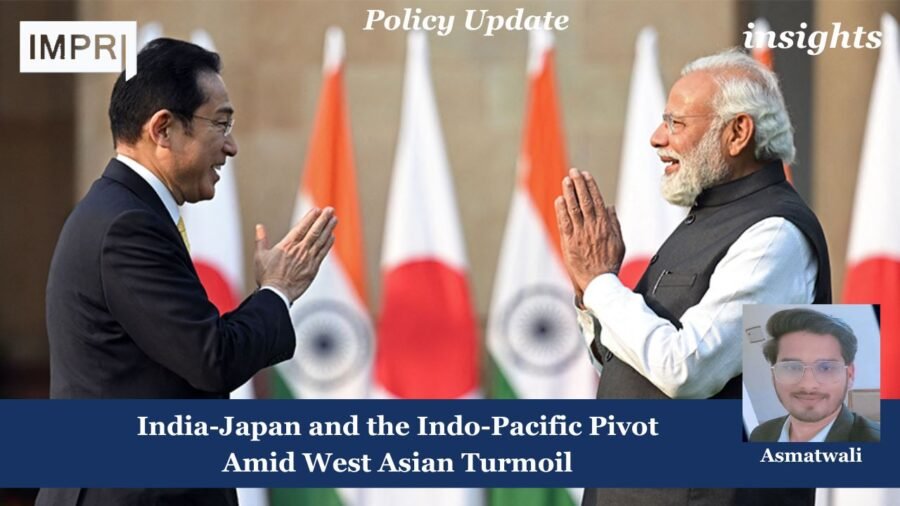
The 16th India-Japan Annual Summit, held in New Delhi from 1 to 3 July 2026, was the first official visit to India by Japan’s new Prime Minister, Sanae Takaichi, and produced a Joint Statement reaffirming the SSGP and elevating cooperation across defence, economic security, energy, technology and connectivity [Prime Minister’s Office, Government of India (PMINDIA), 2026a; Ministry of External Affairs, Government of India (MEA), 2026a].
The summit was built on Prime Minister Modi’s August 2025 visit to Tokyo, where Japan doubled its ten-year private investment target for India from 5 trillion yen to 10 trillion yen (MOFA Japan, 2026), and on the Japan-India Joint Declaration on Security Cooperation signed with Takaichi’s predecessor, Shigeru Ishiba (Prime Minister’s Office of Japan, 2026).
Crucially, the summit unfolded against an exceptionally volatile backdrop in West Asia. Since late February 2026, a US-Israel military campaign against Iran and Iran’s retaliatory closure of the Strait of Hormuz disrupted roughly a fifth of the world’s seaborne oil trade and a comparable share of global liquefied natural gas flows (U.S. Energy Information Administration, 2026; House of Commons Library, 2026).
India’s Ministry of External Affairs had earlier activated Operation Sindhu to evacuate thousands of Indian nationals from Iran and Israel as hostilities intensified, underscoring New Delhi’s direct diaspora and energy exposure to the conflict (MEA, 2025). This turbulence, layered atop tariff uncertainty from Washington and deteriorating Sino-Japanese relations, has sharpened the strategic and economic logic of the India-Japan partnership.
Functioning
The SSGP now functions through three converging tracks formalised at the 2026 summit: defence and security; economic partnership, covering economic security, energy resilience, technology and connectivity; and people-to-people exchange [PMINDIA, 2026a; Press Information Bureau, Government of India (PIB), 2026]. On security, the two governments advanced the Unified Complex Radio Antenna (UNICORN) co-development project, deepened maritime domain awareness sharing, and continued service-level exercises such as JIMEX, with support from Japan’s policy revisions that permit greater transfer of defence equipment and technology (MEA, 2026a; MOFA Japan, 2026).
The centrepiece of the economic track was a dedicated Fact Sheet 2.0 on India-Japan Economic Security Cooperation, setting out a roadmap for semiconductors, critical minerals, artificial intelligence and information and communications technology, aimed at reducing dependence on concentrated, geopolitically vulnerable supply chains (MEA, 2026b; PMINDIA, 2026b). This was reinforced by an Energy Resilience understanding linking Japan’s Partnership on Wide Energy and Resources Resilience with India’s regional energy-security efforts and the Quad’s Indo-Pacific energy-security initiative, together with cooperation on strategic petroleum reserves (PIB, 2026; Fortune, 2026).
Institutionally, the partnership also operates through the Embassy of Japan in New Delhi and the Embassy of India in Tokyo, which coordinate implementation of summit outcomes, visa and mobility facilitation, and public diplomacy such as “Japan Month” cultural programming (Embassy of Japan in India, 2026; Embassy of India, Tokyo, 2026). At the doctrinal level, the relationship converges Japan’s Free and Open Indo-Pacific vision with India’s Indo-Pacific Oceans Initiative and the newer Mutual and Holistic Advancement for Security and Growth Across Regions (MAHASAGAR) framework, both of which foreground resilience against coercive economic practices (MOFA Japan, 2026; MEA, 2026a).
Performance
Bilateral trade stood at roughly USD 27.5 billion in FY 2025-26, while Japanese investment in India totalled about USD 3.2 billion between April and December 2025, against the eventual 10 trillion-yen decade-long target (Indian Defence News, 2026; MOFA Japan, 2026). Around 1,400 Japanese firms currently operate in India, backed by an existing USD 75 billion bilateral currency swap arrangement (PMINDIA, 2026a).
On critical minerals, India committed 7,280 crore rupees to build 6,000 tonnes-per-annum of rare-earth magnet manufacturing capacity in coordination with Japan under a bilateral Mineral Security Partnership, a direct response to Chinese export restrictions affecting both economies through 2025-26 (MEA, 2026b; Indian Defence News, 2026). The two sides also formalised a Digital Partnership and an AI cooperation framework, and reported progress on the Mumbai-Ahmedabad High-Speed Rail and Northeast India connectivity projects supported by Japanese official development assistance (PIB, 2026; PMINDIA, 2026a). People-to-people exchange targets were revised upward to 500,000 bilateral exchanges, including 50,000 skilled Indian professionals in Japan under the Specified Skilled Worker framework (MOFA Japan, 2026; Embassy of Japan in India, 2026).
Impact
The Iran-Israel conflict and the Strait of Hormuz closure have directly shaped how the India-Japan relationship is functioning in practice. With Brent crude prices spiking sharply through March 2026 and threatening prolonged shortages, both India and Japan faced acute energy-security exposure, given that roughly nine-tenths of Japan’s crude historically transits the strait and India draws heavily on Gulf supplies (Ministry of Economy, Trade and Industry of Japan, 2026; TRENDS Research & Advisory, 2026).
India secured a temporary US Treasury waiver in March 2026 to purchase stranded Russian oil cargoes to stabilise domestic fuel prices, while MEA’s Operation Sindhu evacuation of Indian nationals illustrated the human dimension of this exposure (U.S. Department of the Treasury, 2026; Ministry of External Affairs of India, 2025).
This shared vulnerability lent urgency to the summit’s energy-resilience and strategic petroleum reserve commitments, and to India’s prospective membership of the International Energy Agency, functioning as a hedge against future West Asian shocks (MEA, 2026b; House of Commons Library, 2026). The turmoil has also revived interest in alternative connectivity corridors that bypass traditional chokepoints, including the India-Middle East-Europe Economic Corridor, even as India continues to balance an expanding relationship with Israel against its historically close ties with Iran and the Gulf states (TRENDS Research & Advisory, 2026; Fortune, 2026).
Simultaneously, China’s export curbs on rare-earth materials and deteriorating Sino-Japanese relations following Prime Minister Takaichi’s remarks on Taiwan have pushed Tokyo further toward India as a hedge, amplifying the strategic weight both governments attach to the SSGP (Fortune, 2026; MOFA Japan, 2026).
Emerging Issues
i. Energy vulnerability: Both India and Japan remain structurally exposed to West Asian supply shocks; strategic reserve cooperation and IEA integration remain at an early, non-binding stage (MEA, 2026b; House of Commons Library, 2026).
ii. China’s economic coercion: Rare-earth and raw-material export restrictions targeting Indian and Japanese firms underscore the urgency but also the difficulty of building genuinely resilient supply chains within short timeframes (Indian Defence News, 2026; Fortune, 2026).
iii. Strategic autonomy versus alignment: India’s simultaneous engagement with Israel, Iran, and the Gulf states, alongside deepening ties with the Quad and Japan, requires continuous diplomatic recalibration, as evidenced by the scale of the Operation Sindhu evacuation (MEA, 2025).
iv. Diaspora and mobility risk: Recurrent instability in West Asia directly affects Indian nationals residing in the region and complicates the expansion of the Japan-bound skilled-worker mobility track (MEA, 2025; MOFA Japan, 2026).
v. Project execution lag: Flagship infrastructure commitments, such as the Mumbai-Ahmedabad High-Speed Rail, have historically faced delays; sustained implementation capacity will determine whether summit-level announcements translate into outcomes (PMINDIA, 2026a).
Way Forward
The India-Japan partnership is positioned to evolve from a development- and investment-led relationship into a comprehensive architecture of strategic and economic resilience, with the Indo-Pacific and West Asian theatres increasingly treated as interconnected policy domains (MEA, 2026a; PMINDIA, 2026b). Sustaining this trajectory requires converting the Fact Sheet 2.0 commitments on economic security and energy resilience into time-bound, monitorable outcomes across semiconductors, critical minerals, artificial intelligence and strategic petroleum reserves, while deepening coordination through the Quad and ASEAN-linked platforms to operationalise the Free and Open Indo-Pacific-MAHASAGAR convergence (MOFA Japan, 2026; PIB, 2026).
As India and Japan approach 75 years of diplomatic relations in 2027, durability will depend on New Delhi’s capacity to manage multi-vector engagement with West Asia, the Quad and China without compromising strategic autonomy, and on Tokyo’s willingness to translate its economic security doctrine into concrete, India-facing investment and technology transfer (Embassy of India, Tokyo, 2026; Embassy of Japan in India, 2026). Read together, the 2026 summit outcomes suggest that India-Japan relations are increasingly functioning as a stabilising axis for the wider Indo-Pacific precisely because, and not despite, the turbulence emanating from West Asia.
References
Embassy of India, Tokyo. (2026). India-Japan bilateral relations. Government of India. https://www.indembassy-tokyo.gov.in/
Embassy of Japan in India. (2026). Foreign policy news. https://www.in.emb-japan.go.jp/itpr_en/index.html
Fortune. (2026, July 2). India and Japan just made “economic security” a shared mission. https://fortune.com/2026/07/02/india-japan-economic-security-china-quad/
House of Commons Library. (2026, July). Israel/US-Iran conflict 2026: Reopening the Strait of Hormuz. UK Parliament. https://commonslibrary.parliament.uk/research-briefings/cbp-10636/
Indian Defence News. (2026, May 11). India and Japan advance economic security cooperation, strengthen strategic industrial ties. https://www.indiandefensenews.in/2026/05/india-and-japan-advance-economic.html
Ministry of External Affairs, Government of India. (2025, June 18). India launches Operation Sindhu to evacuate Indian nationals from Iran. https://www.mea.gov.in/press-releases.htm
Ministry of External Affairs, Government of India. (2026a, July 2). 16th India-Japan Annual Summit (1-3 July 2026, New Delhi). https://www.mea.gov.in/press-releases.htm
Ministry of External Affairs, Government of India. (2026b, July 2). Fact Sheet 2.0: India-Japan Economic Security Cooperation. https://www.mea.gov.in/bilateral-documents.htm
Ministry of Foreign Affairs of Japan. (2026). Japan-India relations. https://www.mofa.go.jp/region/asia-paci/india/index.html
Press Information Bureau, Government of India. (2026, July 2). List of outcomes: Prime Minister of Japan’s visit to India for the 16th India-Japan Annual Summit. https://www.pib.gov.in/PressReleasePage.aspx?PRID=2280591
Prime Minister’s Office of Japan. (2026, July 2). Japan-India leaders’ meeting and working luncheon. Kantei. https://japan.kantei.go.jp/105/diplomatic/202607/indiasummit.html
Prime Minister’s Office, Government of India. (2026a, July 2). 16th India-Japan Annual Summit joint statement. PMINDIA. https://www.pmindia.gov.in/en/news_updates/16th-india-japan-annual-summit-joint-statement/
Prime Minister’s Office, Government of India. (2026b, July 2). Fact sheet: India-Japan economic security cooperation. PMINDIA. https://www.pmindia.gov.in/en/news_updates/fact-sheet-india-japan-economic-security-cooperation/
TRENDS Research & Advisory. (2026, April 27). The impact of the U.S.-Israel-Iran conflict on the global economy. https://trendsresearch.org/insight/the-impact-of-the-u-s-israel-iran-conflict-on-the-global-economy/
U.S. Energy Information Administration. (2026, May). Global energy security data. U.S. Department of Energy. https://www.eia.gov/outlooks/steo/report/energysecurity/article.php
Ministry of Economy, Trade and Industry of Japan. (2026, June 30). Crude oil import statistics and energy stockpiling updates (Press release). Government of Japan. https://www.meti.go.jp/english/statistics/tyo/oil/index.html
U.S. Department of the Treasury. (2026, March 5). Russia-related General License 133: Authorising the delivery and sale of crude oil and petroleum products of Russian Federation origin loaded on vessels as of March 5, 2026, to India. Office of Foreign Assets Control. https://ofac.treasury.gov/recent-actions/20260305_33
About The Contributor
Asmatwali is a research and editorial intern at IMPRI. He is a scholar in the Department of West Asian and North African Studies at Aligarh Muslim University. Earlier, he worked on two project reports based on semi-structured interviews for the think tank JINF, Japan.
Acknowledgement
The author expresses sincere gratitude to IMPRI (Impact and Policy Research Institute) for providing the author with the opportunity to prepare this policy update article and for fostering a rigorous learning environment that connects research with public policy practice. He also extends his sincere thanks to Lubina Dua & Dolly Kaushik for their valuable feedback, useful suggestions, and support in shaping this article in the required policy-update format.
Disclaimer: All views expressed in the article belong solely to the author and not necessarily to the organization
Read more at IMPRI:
Sectoral Priorities in the West Bengal Budget 2026–27: A Focus on Welfare and Infrastructure