






Policy Update
Yashkirti Pal
BACKGROUND
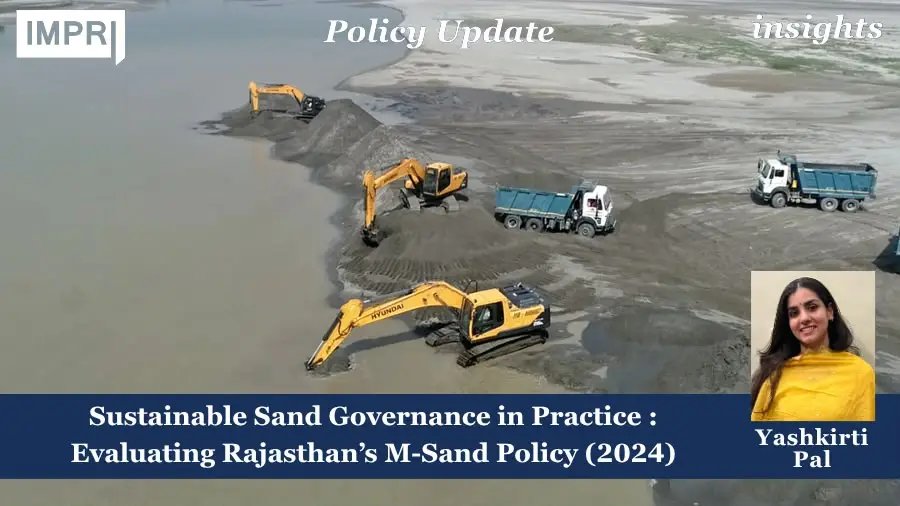
Sand is a critical input in the construction industry and is second only to water in terms of global consumption (UNEP,2019). The increasing demand for sand driven rapid urbanization and infrastructure development has led to unsustainable extraction practices, particularly riverbed mining, across India. Rajasthan, a state characterised by arid conditions and fragile ecosystems, has been significantly impacted by illegal sand mining and environmental degradation, particularly in regions such as the Chambal and Banas basins.
In response, the Government of Rajasthan introduced the M-Sand Policy 2024 to promote manufactured sand (M-sand) as an alternative to natural river sand, as a policy intervention to balance developmental needs with environmental sustainability. Manufactured sand, produced by crushing rocks or mining overburden, offers an alternative that reduces pressure on natural ecosystems.
The sand crisis in Rajasthan is rooted in persistent mismatch between supply and demand, compounded by regulatory inefficiencies and environmental constraints. Legal mining restrictions, often imposed due to environmental concerns and judicial interventions (Deepak Kumar vs. State of Haryana & Others), have constrained formal supply channels and inadvertently contributed to the proliferation of illegal mining networks. These informal operations, often described as sand mafias, operate outside regulatory frameworks and undermine governance mechanisms (Mahadevan, 2019).
A 2021 report by the Comptroller and Auditor General of India found that in Rajasthan alone, illegal sand mining had caused revenue losses exceeding ₹500 crore between 2017-2020. The environmental consequences of such practices are severe and include riverbank erosion, lowering of groundwater tables, and destruction of habitats and biodiversity. According to the United Nations Environment Programme (2019), unsustainable sand extraction can destabilize river ecosystems and increase vulnerability to floods. In Rajasthan’s semi-arid ecological context, these impacts are particularly pronounced, making policy intervention both urgent and necessary.
Manufactured sand, on the other hand, is produced by crushing hard rocks such as granite or basalt into fine aggregates that meet specific gradation and quality standards. Unlike natural river sand, which is subject to seasonal availability and environmental constraints, M-sand can be produced in a controlled and consistent manner, reducing illegal activities. The promotion of M-sand is grounded in multiple policy rationales.
It reduces dependence on river ecosystems, thereby mitigating ecological damage associated with riverbed mining. It also enhances resource efficiency by utilizing mining waste such as overburden, which would otherwise remain underutilised. Additionally, M-sand offers a standardized product with predictable quality, which is advantageous for construction applications. Studies have shown that when processed properly, M-sand can perform as well as or even better than natural sand in structural applications (Dash et al., 2016). These characteristics make M-sand a viable and increasingly necessary alternative in the context of sustainable construction practices.
FUNCTIONING
The Rajasthan M-Sand Policy 2024 adopts a comprehensive approach that combines regulatory reform, market incentives, and sustainability objectives. The operational policy officially grants M-sand manufacturing units full industry status, making them eligible for extensive benefits under the Rajasthan Investment Promotion Scheme. Administratively, the policy eases entry barriers by completely waiving the traditional requirement of prior industrial experience for setting up crushing units and expanding the maximum number of designated M-sand plots available for allocation per district. The policy aims to significantly increase M-sand production, targeting approximately 30 million tonnes annually by the year 2028-29, thereby addressing the demand-supply gap in the construction sector. These changes are intended to lower entry barriers and encourage wider participation in the sector.
To guarantee market adoption, the policy implements a phased, mandatory demand-side intervention in all public sector works. The introduction of mandatory usage norms in public sectors construction projects, requiring that a specified proportion, ranging from 25 to 50 percent, of sand consumption be met through M-sand. This represents a deliberate demand-side intervention designed to create a stable and predictable market for M-sand producers. All certified manufacturers are required to strictly adhere to the Bureau of Indian Standards specification, ensuring structural compliance codes.
Financial incentives, included reduced royalty rates and subsidies under the Rajasthan Investment Promotion Scheme, further enhance the attractiveness of investment in M-sand production. Additionally, the policy promotes the use of mining overburden and construction and demolition waste, thereby aligning with principles of resource efficiency and circular economy. By expanding legal supply channels and formalizing production, the policy seeks to curb illegal sand mining activities.
PERFORMANCE
The quantitative indicators reveal a significant acceleration in industrial scaling, driven by aggressive state-backed land auctions. By mid-2025, the Principal Secretary of Mines finalised a high-priority action plan that successfully delineated over 109 specialised mineral plots for e-auction, setting aside 77 plots specifically for M-sand production units and 32 plots for managing overburden dumps.
This administrative push has expanded the state’s processing footprint far beyond its baseline of 36 legacy units. Current tracking networks confirm that policy is pacing towards its long-term target of expanding annual production by 20 percent each year to hit a cumulative output of 30 million tonnes per annum by 2028-29. This massive volume directly offsets the state’s estimated baseline demand for riverbed aggregates, effectively easing the historic supply shortages caused by long-standing judicial restrictions and Supreme Court environmental bans.
The policy exhibits several strengths that position it as a progressive intervention in the domain of resource governance. Its emphasis on integrating waste materials into production processes reflects a shift toward circular economy practices, which are increasingly recognised as essential for sustainable development. The introduction of mandatory usage norms is particularly significant, as it ensures demand creation and addresses one of the key challenges faced by alternative materials. The simplification of regulatory procedures and reduction of entry barriers are likely to enhance competition and expand production capacity. Moreover, the potential environmental benefits of reducing riverbed mining are substantial and could contribute to the restoration of degraded ecosystems.
IMPACT
The Rajasthan M-Sand Policy 2024 can be understood through multiple governance objectives that reflect the complexity of the sand economy. At its core, the policy seeks to advance environmental sustainability by reducing dependence on riverbed mining and protecting fragile ecosystems. Simultaneously, it aims to promote economic development by generating employment opportunities and attracting investment in the mining and construction sectors. The policy represents an effort to reform governance structures by formalizing sand supply chains and reducing the scope for illegal activities. Furthermore, it emphasizes resource optimization by encouraging the utilization of mining waste and construction debris, thereby minimizing resource wastage and promoting efficient use of materials.
The Rajasthan M-Sand Policy reflects broader national trends in promoting manufactured sand as a sustainable alternative. Several states, including Karnataka, Tamil Nadu, and Maharashtra, have implemented similar policies with varying degrees of success. However, Rajasthan’s approach is distinctive in its emphasis on mandatory usage requirements and its integration of mining waste and construction debris into the production process. These features represent a more holistic approach to resource management and position the state as a potential leader in this domain.
EMERGING ISSUES
However, the policy also faces several challenges that may limit its effectiveness. One of the primary concerns is the implementation deficit that often characterises public policy in India, particularly in areas requiring strong monitoring and enforcement mechanisms. Ensuring compliance with mandatory usage norms may prove difficult in the absence of robust institutional capacity. Additionally, there are persistent perceptions among builders and contractors regarding the inferior quality of M-sand, especially for applications such as plastering, which may hinder its widespread adoption. Infrastructure constraints, including transportation logistics and uneven spatial distribution of production units, may further limit accessibility in certain regions. The environmental implications of M-sand production also warrant attention, as the crushing process is energy-intensive and may contribute to dust and air pollution if not properly regulated. Finally, governance risks such as cartelization among producers and regulatory capture cannot be ignored, particularly in sectors with a history of informality and weak oversight.
To enhance the effectiveness of the policy, several measures can be considered. Strengthening quality assurance mechanisms through standardized certification systems (UNEP, 2019) and the establishment of testing laboratories is essential to build confidence among users. Improving supply chain infrastructure, including transportation networks and digital tracking systems, can enhance accessibility and efficiency. Capacity-building initiatives targeting engineers, contractors, and other stakeholders can facilitate the adoption of M-sand in construction practices (UNEP, 2019). Environmental regulations must be strictly enforced to mitigate the negative impacts of production processes, and lifecycle assessments should be conducted to evaluate the overall sustainability of M-sand. Finally, improving data transparency through public dashboards and monitoring systems can support evidence-based policymaking and enhance accountability.
CONCLUSION
The Rajasthan M-sand Policy 2024 represents a significant shift toward sustainable and engineered resource governance in response to the challenges posed by unsustainable sand extraction. By combining environmental objectives with economic incentives and regulatory reforms, the policy attempts to address the complex and interrelated issues of ecological degradation, illegal mining, and infrastructure demand. In this sense, it deserves recognition as a forward-looking governance document.
However, the ultimate success of the policy will depend on effective implementation, stakeholder acceptance, and institutional capacity. The gap between policy ambition and ground-level outcomes is not unique to this domain. What distinguishes successful M-sand transitions in other states is not policy sophistication but implementation consistency: sustained government procurement commitments, active quality surveillance, and price-competitiveness management. If these challenges are adequately addressed, the policy has the potential to serve as a replicable model for sustainable resource management not only within India but also in other regions facing similar challenges.
REFERENCES
Government of Rajasthan (2024). Rajasthan M-Sand Policy, 2024
https://istart.rajasthan.gov.in/public/Policies/2024/rajasthan-m-sand-policy-2024.pdf
Dayananda, N. ENVIRONMENTAL IMPACT OF SOIL AND SAND MINING: A REVIEW.
https://www.academia.edu/35813661/ENVIRONMENTAL_IMPACT_OF_SOIL_AND_SAND_MINING_A_REVIEW
UNEP 2019. Sand and sustainability: Finding new solutions for environmental governance of global sand resources.
https://unepgrid.ch/storage/app/media/documents/Sand_and_sustainability_UNEP_2019.pdf
Mahadevan, P. (2019). SAND MAFIAS IN INDIA. Global Initiative Against Transnational Organized Crime, 27.
https://static1.squarespace.com/static/5b7ea2794cde7a79e7c00582/t/64bfaca64c690c29a0f270e1/1690283174539/sand+mafias+india.pdf
Rajagopala, K. (2026, April 2). Sandmining mafia are the modern dacoits of Chambal: Supreme Court. The Hindu. https://www.thehindu.com/sci-tech/energy-and-environment/sandmining-mafia-are-the-modern-dacoits-of-chambal-supreme-court/article70815857.ece
Hass, J. (2021). Buried in Sand: Understanding Precarity in the Context of the Political and Criminal Economy in India.
https://ruor.uottawa.ca/server/api/core/bitstreams/5467bf38-0ac0-4967-aefa-aa7b9fddc5df/content
The Wire. (2025, March 5). CBI Says It Can’t Probe Rajasthan Sand Mining Due to Resource Constraints, HC Summons Director
https://thewire.in/law/unexpected-rajasthan-hc-cbi-director-praveen-sood-illegal-mining.
Dash, Manoj & Patro, Sanjaya & Rath, A.. (2016). Sustainable Use of Industrial-waste as Partial Replacement of Fine Aggregate for Preparation of Concrete – A Review. International Journal of Sustainable Built Environment.
https://www.researchgate.net/publication/302595118_Sustainable_Use_of_Industrial-waste_as_Partial_Replacement_of_Fine_Aggregate_for_Preparation_of_Concrete_-_A_Review
The Hindu (2025). Rajasthan finalises action plan for M-sand plot auctions to curb illegal mining.
https://www.thehindu.com/news/national/rajasthan/rajasthan-finalises-action-plan-for-m-sand-plot-auctions-to-curb-illegal-mining/article69587513.ece
About the Contributor
This policy update article was written by Yashkirti Pal, a Research and Editorial Intern at IMPRI.
Disclaimer
All views expressed in the article belong solely to the author and not necessarily to the organization.
ACKNOWLEDGEMENT
The author would like to thank the IMPRI faculty for giving her this platform and opportunity to share her work. She would also like to thank Nagul Pranav Ks for his valuable feedback.
Read More at IMPRI:
Regulating Foreign Influence: Assessing the Strategic Implications of India’s FCRA Reforms in 2026
Unified Lending Interface: RBI’s Digital Push for Faster Credit Access (2025)