







Policy update
Purbaa Jagannath
Background
Affordable childcare is increasingly recognised as a prerequisite for women’s economic empowerment and higher female labour force participation. Despite the rapid growth of its economy, India’s female labour force participation rate (FLFPR) has remained one of the lowest among South Asian countries, at 23.3 percent in 2017-18. Unpaid domestic and care responsibilities have been a recurring finding across successive labour market surveys; in the PLFS of 2023-24, 43.04 percent of women who had not taken part in the labour market cited household activities related to childcare as their reason for staying out of the workforce.
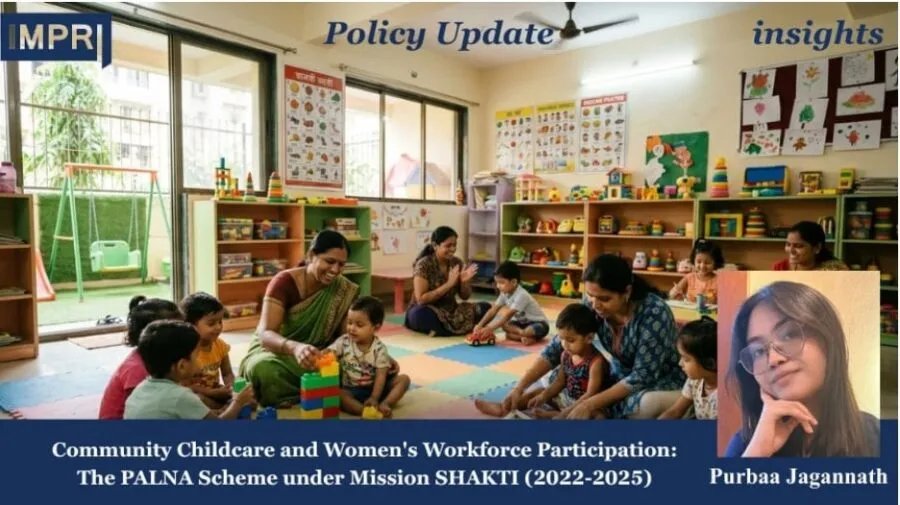
Against this backdrop, the traditional joint family safety net that once absorbed childcare work is becoming rapidly inadequate amid increasing nuclearisation of households. In response, the Ministry of Women and Child Development (MWCD) reorganised the erstwhile National Crèche Scheme into the Palna Scheme, placed under the Samarthya sub-scheme of the umbrella Mission Shakti programme (2021-22 to 2025-26).
Palna is a Centrally Sponsored Scheme providing structured day care services to children aged 6 months to 6 years, funded on a 60:40 Centre-State basis (90:10 in Northeastern and Special Category States, and 100 percent Centre-funded in Union Territories without legislatures). Importantly, the scheme frames childcare not as a private, individualised responsibility but as a structural entitlement crèches open to all mothers, regardless of employment status.
The scheme operates through two delivery modes. Standalone Crèches, largely carried forward from the earlier scheme, continue to function independently. Anganwadi-cum-Crèches (AWCCs) were introduced more recently, layering crèche services onto India’s existing Anganwadi network. Services under both modes are designed in line with Mission Poshan 2.0, encompassing nutrition, immunisation, growth monitoring, and early stimulation alongside care and supervision.
Functioning
The AWCC model is Palna’s key innovation. Rather than building new crèche infrastructure, it extends the existing Anganwadi Centres the largest childcare institution network in the world, according to the Ministry — by hiring an additional crèche worker and helper.
This brings full-day crèche services (7.5 hours a day, 26 days a month) on top of the existing half-day Anganwadi framework. Standalone Crèches, by contrast, continue to run independently, each staffed by one crèche worker and one helper, catering to up to 25 children at a time. Crucially, crèche hours are not set centrally; they are meant to be locally flexible, based on the working hours of the majority of mothers in the area.
A detailed Standard Operating Procedure for AWCCs covering administrative hierarchy, staff roles, infrastructure norms, safe drinking water, child-friendly toilets, and ventilation was formally released at a National Programme on Anganwadi-cum-Crèche in New Delhi.
A second, less visible strand of Palna targets the private and organised sector. It monitors compliance with Section 11A of the Maternity Benefit Act, which requires establishments with 50 or more workers to provide crèche facilities. States and UTs have been directed to launch digital portals, in collaboration with their Labour and Employment Departments, that allow establishments to register their crèches and report compliance to the Department of WCD and the public.
One structural feature carries significant implications for service quality: crèche workers and helpers are not engaged as government employees but are paid a graded honorarium, which affects staff retention.
Performance
Implementation has steadily increased, but remains relatively small relative to what was intended. The Ministry set a target of 17,000 new Anganwadi-cum-Crèches for 2024-25. The Minister of State for Women and Child Development told the Rajya Sabha that, as of March 2025, 11,395 AWCCs had been approved across 34 States and Union Territories, a number that rose to 14,599 by July 2025. On the Standalone Crèche side, 1,249 Palna centres were operational as of December 2024, having assisted 1,64,730 children as beneficiaries since inception.
| Indicator | Figure | As of |
| Functional Standalone Palna Centres | 1,249 | Dec 2024 |
| Cumulative Beneficiary Children Assisted | 1,64,730 | Dec 2024 |
| Anganwadi-cum-Crèches (AWCCs) Approved | 11,395 | Mar 2025 |
| AWCCs Approved (34 States/UTs) | 14,599 | Jul 2025 |
| FY 2024-25 Target for New AWCCs | 17,000 | Target |
Table 1: Palna Scheme Implementation Snapshot, 2022-2025. Source: Author’s compilation based on Press Information Bureau, Ministry of Women and Child Development; IBEF (2025), Mission Shakti Scheme; and Manorama Yearbook (2025), citing Rajya Sabha reply of the Minister of State for Women and Child Development, July 23, 2025.
Fiscal results are less encouraging. A PRS Legislative Research analysis of Union Budget documents shows that actual spending on Mission Shakti in 2021-22 and 2023-24 averaged about 30 percent lower than what was budgeted pointing to persistent delays in fund release and weak absorption capacity at the state level. In the Union Budget 2023-24, the Samarthya component, under which Palna sits, received ₹2,521 crore out of a total MWCD allocation of ₹3,144 crore; overall allocation to Mission Shakti has risen in subsequent years, even as states continue to flag gaps in real-time data needed to track the scheme’s on-ground reach against its targets a concern independent bodies such as NITI Aayog have also raised.
International experience underscores what sustained public investment in childcare can achieve. Sweden’s universal, heavily subsidised public childcare system is widely credited with helping sustain one of the world’s highest female labour force participation rates. France’s école maternelle and crèche network similarly combines near-universal coverage with quality standards that have kept maternal employment comparatively high. Brazil’s expansion of public daycare (creches) has been linked in several studies to measurable increases in maternal labour supply, particularly among lower-income women. These examples suggest that the scale, consistency, and quality of public investment not merely the existence of a scheme determine how much impact childcare provision has on women’s workforce participation, offering a useful benchmark against which Palna’s rollout can be assessed.
Impact
The case for institutionalising care work as a step toward more equal economic participation for women rests against a backdrop of real, measurable gains: FLFPR climbed from 23.3 percent in 2017-18 to 32.8 percent in 2021-22, 37.0 percent in 2022-23, and 41.7 percent in 2023-24, according to successive PLFS Annual Reports.
However, attributing this rise solely to Palna would overstate the evidence. Labour economists who have analysed the PLFS series note that much of the growth has been concentrated among rural women, largely in unpaid family work and self-employment patterns more indicative of economic stress and shifting survey responses around domestic-duty work than of an expansion in institutional childcare.
Palna’s own footprint remains small relative to the scale of the FLFPR shift: the number of functional standalone centres and approved AWCCs (still under 15,000 by mid-2025) has not grown at a pace that could plausibly explain macro-level trends. That said, the scheme does appear to make a difference in urban and formal-sector settings. By moving crèche provision from the private sphere into the public domain, and by linking mandatory crèche provision to the Maternity Benefit Act for larger private employers, it creates institutional pathways that would not otherwise exist particularly for working mothers in nuclear households without extended family support in the informal sector.
Emerging Issues
Palna’s promise is tempered by several structural gaps.
Limited Coverage
Even if the scheme reaches its target of 17,000 new AWCCs by 2024-25, this remains modest set against the scale of the Anganwadi network and the demand it implies with roughly 98 million women in the labour force since 2017-18.
Human Resource Challenges
The precarious, part-time nature of crèche workers’ and helpers’ roles without formal employment, benefits, or job security poses an inherent threat to sustainability. It risks high staff turnover and, in turn, poor care standards, undermining the scheme’s credibility with working parents.
Urban-Rural Implementation Gap
Palna was partly designed to address an urban childcare gap, particularly where joint-family support has eroded fastest. Yet its primary delivery mechanism, the Anganwadi, is a rural-rooted network; adapting it to urban infrastructure requirements has taken longer to scale.
Financial Constraints
Persistent underspending — averaging almost 30 percent short of budget between 2021-22 and 2023-24 — points to weak state-level capacity to plan, identify land or space, and recruit staff, all prerequisites for establishing new centres.
Regulatory Compliance Gaps
Implementation of Section 11A of the Maternity Benefit Act’s crèche mandate for private establishments remains at a fledgling stage, with digital compliance portals still in their infancy in several states.
Weak Monitoring and Evaluation
Because impact evaluation has not been rigorous or disaggregated, it is difficult to establish whether women’s entry into the labour market resulted from access to crèches, or whether the crèche network was a driving force behind this broader labour market shift.
Way Forward
Several actions could accelerate and deepen Palna’s rollout.
States should be supported to consistently meet or exceed annual AWCC targets, with deliberate focus on urban wards, industrial clusters, and peri-urban migrant settlements areas facing the steepest decline in family-based childcare support and the lowest density of AWCCs.
The honorarium-based pay and career structure for crèche workers and helpers should be reviewed and moved toward a more structured system linked to national Early Childhood Care and Education (ECCE) training and certification pathways, to improve retention and service quality.
States and the Centre should invest in public-facing, real-time district-level monitoring dashboards tracking functional status, capacity utilisation, and fund absorption closing the data gap flagged by NITI Aayog and PRS. Convergence with the POSHAN Tracker could support this real-time monitoring by building on existing digital infrastructure rather than creating a parallel system.
Maternity Benefit Act crèche requirements need reinforcement through active compliance monitoring via the digital portal and targeted outreach to mid-size establishments, turning a statutory requirement into an operational reality.
MWCD should commission independent, carefully designed impact evaluations that connect crèche access to women’s labour market transitions disaggregated by rural/urban and formal/informal status to inform better targeting of future expansion.
Beyond government delivery alone, partnerships with urban local bodies and CSR initiatives, public-private partnerships in industrial clusters, and employer incentives for establishing workplace crèches could extend coverage faster than the AWCC model alone, particularly in urban and industrial contexts where Palna’s rural-origin delivery network is weakest.
Finally, convergence with skilling and livelihood missions such as the National Rural Livelihoods Mission (NRLM) could help translate rising female labour force participation into better-quality employment outcomes, addressing the value of work and not only headcount.
Selected References and Important Links
Ministry of Women and Child Development (2022), Mission Shakti Guidelines for Implementation during the 15th Finance Commission Period, 2021-22 to 2025-26, Government of India.
Press Information Bureau (2025), National Programme on Anganwadi-cum-Crèche (Palna Component of Mission Shakti), Ministry of Women and Child Development.
https://www.pib.gov.in/PressReleasePage.aspx?PRID=2119769®=48&lang=2
PRS Legislative Research (2024), Demand for Grants 2024-25 Analysis: Ministry of Women and Child Development.
Ministry of Statistics and Programme Implementation (2024), Periodic Labour Force Survey (PLFS) Annual Report, July 2023-June 2024.
IWWAGE (2024), Trend in Female Labour Force Participation in India.
Economic Advisory Council to the Prime Minister (2024), Female Labour Force Participation Rate, Working Paper.
IBEF (2025), Mission Shakti Scheme, Objectives and Key benefits.
https://www.ibef.org/blogs/mission-shakti-scheme-objectives-and-key-benefits
Manorama Yearbook (2025), Palna Scheme, citing Rajya Sabha reply of the Minister of State for Women and Child Development, July 23, 2025.
https://www.manoramayearbook.in
About the Contributor
Purbaa Jagannath is an intern with IMPRI, contributing to the Policy Update series. Her research interests lie in gender and development policy, women’s economic empowerment, and the care economy in India. She is currently pursuing her Master’s in Social Work at the Tata Institute of Social Sciences, Mumbai.
Acknowledgements
The author extends sincere gratitude to the IMPRI team for their guidance and support, along with the reviewers. I extend my thanks to my reviewers Nayanshi jain and Pallavi Lad for reviewing and adding suggestions.
Disclaimer
All views expressed in the article belong solely to the author and not necessarily to the organization.
Read More at IMPRI
Planting Doubts: The Promise and Pitfalls of India’s Green Credit Scheme (2023)