







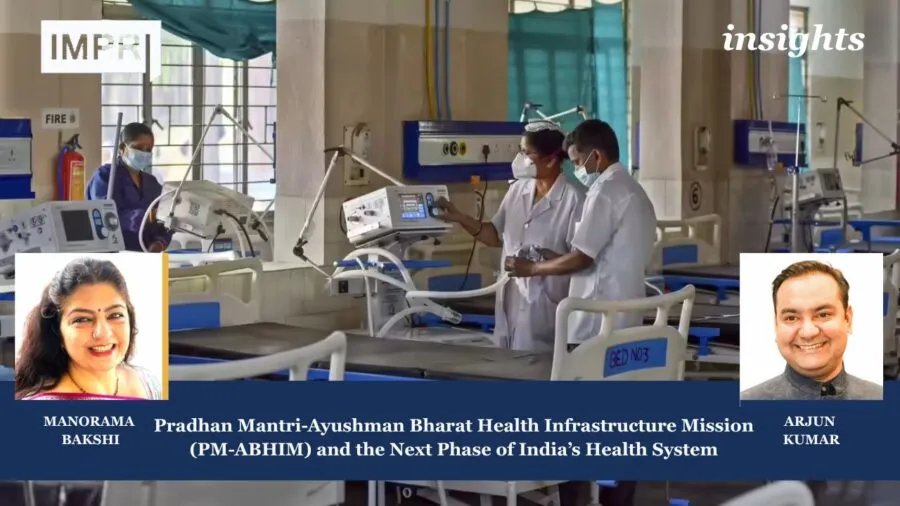
Manorama Bakshi
Arjun Kumar
For decades, India’s public health system relied largely on demand-side interventions such as expanding insurance coverage and beneficiary support. While these measures improved financial access to healthcare, they frequently encountered a structural constraint: the lack of adequate supply-side infrastructure. Insurance alone cannot ensure healthcare access if intensive care units, diagnostic laboratories, and emergency facilities remain unavailable within reasonable geographic reach.
Recognizing this gap, the Government of India launched the Pradhan Mantri Ayushman Bharat Health Infrastructure Mission (PM-ABHIM) on October 25, 2021, with a capital outlay of ₹64,180 crore for FY 2021-22 to FY 2025-26. As India’s largest health infrastructure initiative since the National Health Mission, the mission seeks to strengthen institutional resilience by creating the physical infrastructure necessary for a responsive and accessible healthcare system, contributing to the vision of Viksit Bharat 2047.
The Post-Pandemic Catalyst: Inception and the Core Need
The COVID-19 pandemic exposed critical weaknesses in health systems worldwide and underscored the importance of robust public health infrastructure. In India, the crisis revealed three major structural gaps: inadequate diagnostic capacity that delayed disease detection, weak integration between primary and tertiary healthcare resulting in overcrowded higher-level facilities, and insufficient critical care infrastructure that disrupted routine medical services during emergencies. PM-ABHIM was conceived to address these vulnerabilities by strengthening healthcare delivery across the primary, secondary, and tertiary levels. Building on the National Health Policy, 2017, the mission promotes a decentralized health system capable of responding effectively to future public health emergencies while improving routine healthcare delivery.
The Three-Tier Infrastructure Blueprint
PM-ABHIM translates its vision into a comprehensive three-tier infrastructure strategy through the Centrally Sponsored Scheme (CSS), under which over ₹32,928.82 crore has been approved for states and Union Territories. Rather than providing broad financial assistance, the mission specifies investments across three interconnected levels of healthcare delivery.
At the primary level, the mission focuses on expanding community-based healthcare through the construction of 9,519 rural building-less Sub-Health Centres and 5,456 Urban Ayushman Arogya Mandirs (U-AAMs). These facilities strengthen the frontline healthcare network by bringing essential primary care services closer to rural communities and densely populated urban settlements.
The second tier strengthens India’s disease surveillance and diagnostic capabilities through 3,382 Block Public Health Units (BPHUs) and 730 Integrated Public Health Laboratories (IPHLs), with the objective of establishing advanced diagnostic capacity in every district. This decentralized network reduces dependence on metropolitan laboratories, shortens diagnostic turnaround times, and improves preparedness for disease outbreaks.
The third tier focuses on emergency preparedness through the establishment of 602 Critical Care Blocks (CCBs) in districts with populations exceeding five lakh. Integrated within District Hospitals and Government Medical Colleges, these 50 to 100-bed facilities are equipped with intensive care units, independent oxygen plants, and dedicated infectious disease zones. By separating emergency response from routine healthcare services, these facilities ensure that future public health crises do not disrupt maternal, child, or surgical care.
Financial Architecture and Implementation
The original mission allocation of ₹64,180 crore has been reinforced through successive budgetary support. In the Union Budget 2026-27, the PM-ABHIM allocation increased from ₹2,845 crore under the Revised Estimates of FY 2025-26 to ₹4,770 crore, reflecting a 67.66% increase. Of this, ₹570 crore has been allocated to the Central Sector component, while ₹4,200 crore has been earmarked under the Centrally Sponsored Scheme to support state-level infrastructure development.
On-Ground Performance and Regional Trailblazers
As public health is a State subject, the success of PM-ABHIM depends on cooperative federalism and effective implementation by state governments. To facilitate execution, the National Health Authority (NHA) and the Union Ministry of Health have supported states through standardized infrastructure designs and expedited Detailed Project Report (DPR) approvals.
Several states have emerged as implementation leaders. Bihar and Uttar Pradesh, which historically faced significant infrastructure deficits, have secured approvals for 2,546 and 1,670 units respectively, substantially expanding their primary healthcare networks. Rajasthan has mobilized 1,112 units to strengthen health access, while Jharkhand has approved 893 units, extending services into difficult tribal regions. Jammu and Kashmir, having achieved universal health card saturation under the AB-PMJAY SEHAT expansion, has complemented insurance coverage with investments in laboratories and critical care infrastructure, creating a more integrated healthcare system.
A Reality Check on Execution
Despite these achievements, the transition from financial allocation to physical infrastructure has encountered implementation bottlenecks. Independent analyses, including those by the National Institute of Public Finance and Policy (NIPFP), indicate that between FY 2022-23 and FY 2025-26, only about 47% of the planned allocation under the Centrally Sponsored Scheme had been released to states.
This is reflected in the uneven progress across different components of the mission. Urban Ayushman Arogya Mandirs have achieved approximately 68% completion, followed by Sub-Health Centres (39%), Integrated Public Health Laboratories (32%), and Block Public Health Units (31%). In contrast, Critical Care Blocks, the most resource-intensive component of the mission, have recorded only 3% completion. Parliamentary reviews attribute these delays primarily to land acquisition challenges, prolonged DPR approvals, and delays in state-level matching contributions. While primary healthcare facilities have progressed relatively quickly, tertiary infrastructure continues to require sustained administrative and financial support to meet the mission’s original timelines.
The Shared Ecosystem: Complementary National Health Matrices
PM-ABHIM forms one pillar of a broader health ecosystem that combines infrastructure, financial protection, digital integration, and affordable medicines.
Its physical infrastructure is complemented by the Pradhan Mantri Jan Arogya Yojana (PM-JAY), which by mid-2026 had generated over 44.14 crore health cards and financed more than 12 crore hospitalizations worth approximately ₹1.8 lakh crore. Claims data indicate that cardiovascular diseases, cancer, kidney disorders, neonatal complications, and major orthopaedic procedures account for a significant share of healthcare expenditure. The expansion of Critical Care Blocks under PM-ABHIM directly strengthens the system’s capacity to manage these high-burden conditions.
The mission is further reinforced by the Ayushman Bharat Digital Mission (ABDM), which has crossed 90 crore active ABHA accounts, enabling digital health records and seamless information sharing across healthcare facilities. At the same time, the Pradhan Mantri Bhartiya Jan Aushadhi Pariyojana (PMBJP), with over 14,000 Jan Aushadhi Kendras, continues to reduce out-of-pocket expenditure by providing quality generic medicines at substantially lower prices.
Preventive healthcare remains equally important within this ecosystem. More than 1.86 lakh Ayushman Arogya Mandirs are operational across the country, having conducted over 401 million hypertension screenings and 398 million diabetes screenings, strengthening early detection and management of non-communicable diseases at the primary care level. Together, these initiatives illustrate that PM-ABHIM is not a standalone infrastructure programme but part of a broader strategy to improve healthcare access, affordability, continuity of care, and long-term system resilience.
The Lifestyle Pivot: Preventive Healthcare as a National Strategy
While expanding hospitals and critical care infrastructure remains central to PM-ABHIM, India’s long-term health strategy increasingly recognizes that reducing the disease burden requires a stronger emphasis on prevention. This preventive approach aligns with the government’s broader vision of promoting healthy lifestyles through initiatives such as Yoga and Mission LiFE (Lifestyle for Environment), encouraging behavioural changes that reduce the incidence of non-communicable diseases. Greater awareness of healthy nutrition, reduced consumption of processed foods, and early screening for chronic illnesses complement investments in physical infrastructure by lowering future healthcare demand. Simultaneously, integrating basic mental health services into primary healthcare helps identify stress, anxiety, and depression at an early stage, strengthening community-based care and improving overall health outcomes.
The Strategic Way Ahead: Turning Infrastructure into Outcomes
As PM-ABHIM moves beyond its initial implementation phase, the focus must gradually shift from infrastructure creation to operational efficiency.
The first priority is addressing the human resource gap. New laboratories, critical care facilities, and wellness centres can deliver their intended benefits only if they are supported by adequate numbers of doctors, specialists, nurses, laboratory technicians, and allied health professionals. Expanding medical education and strengthening incentives for service in public health facilities will therefore remain critical.
Second, digital integration across the health system must be deepened. Linking diagnostic laboratories, hospitals, and primary care facilities through the ABHA ecosystem can improve continuity of care, enable seamless access to medical records, and support more efficient service delivery.
Finally, greater community participation can strengthen accountability. Empowering local institutions such as Panchayats and Jan Arogya Samitis to monitor healthcare facilities can improve maintenance, ensure uninterrupted availability of medicines and equipment, and make service delivery more responsive to local needs.
Sustaining the Momentum
Recognizing the implementation challenges, the Union Government has continued to reinforce its commitment to PM-ABHIM. The substantial increase in the mission’s allocation in the Union Budget 2026-27, together with continued coordination between the Centre and States, reflects an effort to accelerate project implementation, improve fund utilization, and address procedural bottlenecks. The emphasis on strengthening district- and block-level infrastructure signals a long-term commitment to building a resilient public health system capable of responding to both routine healthcare needs and future public health emergencies.
Conclusion: The Foundation of a Resilient Health System
A resilient healthcare system is fundamental to a nation’s long-term economic and social development. While financial protection through health insurance improves access to treatment, sustainable healthcare ultimately depends on the availability of quality infrastructure, skilled personnel, reliable diagnostics, and accessible primary care.
PM-ABHIM represents a significant shift in India’s healthcare strategy by complementing demand-side financing with sustained investments in supply-side capacity. Through the expansion of Ayushman Arogya Mandirs, Integrated Public Health Laboratories, Block Public Health Units, and Critical Care Blocks, the mission seeks to strengthen every tier of the public health system. Its integration with PM-JAY, the Ayushman Bharat Digital Mission, and the Pradhan Mantri Bhartiya Jan Aushadhi Pariyojana further reinforces a comprehensive healthcare ecosystem that combines infrastructure, financial protection, digital innovation, and affordable medicines.
Although implementation challenges remain, particularly in completing large infrastructure projects, PM-ABHIM lays the foundation for a more resilient, decentralized, and equitable healthcare system. By strengthening institutional capacity alongside financial protection, the mission advances India’s broader objective of ensuring accessible, affordable, and quality healthcare for all, while contributing to the vision of a healthy and prosperous Viksit Bharat 2047.
About the Authors
Manorama Bakshi is a distinguished public health expert and policy advocate.
Arjun Kumar is Director, IMPRI Impact and Policy Research Institute, New Delhi.
Disclaimer: All views expressed in the article belong solely to the author and not necessarily to the organisation.
Read more at IMPRI:
The 90-Crore ABDM Mark: What’s Next?
The Real Glass Ceiling: Why the Right to Health is the Material Basis for Nari Shakti
The Portable Social Shield: Anchoring India’s $10-Trillion Ambition in Universal Health Coverage
Acknowledgement: This article was posted by Shreeya Dixit, a Research and Editorial Intern at IMPRI