






Policy Update
Mehul Rastogi
Background
India and South Korea have historically shared a nuanced relationship throughout the years. The Comprehensive Economic Partnership Agreement (CEPA), which came into effect in 2010, committed both countries to lowering or eliminating import tariffs on a wide range of goods over the next 10 years and expand opportunities for investments and exchanging services. This negotiation provided a legal and institutional foundation for India–South Korea economic ties.
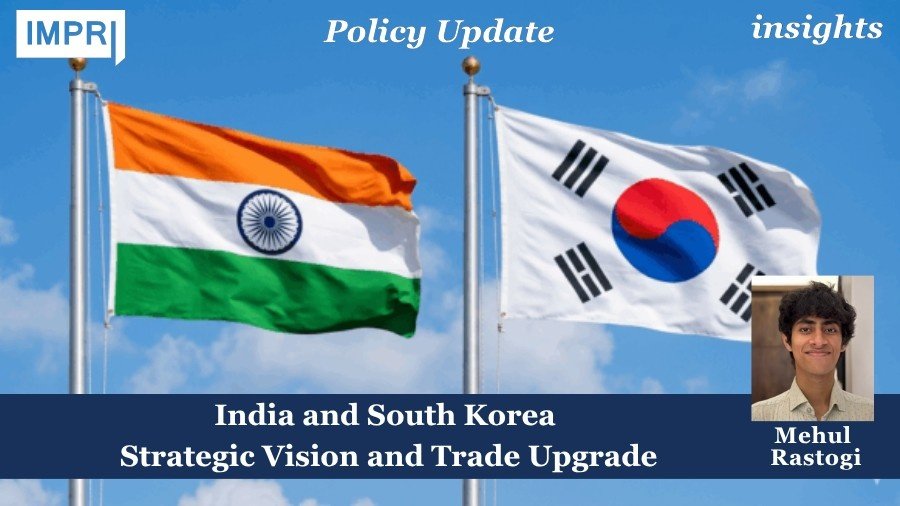
President of the Republic of Korea (ROK) Lee Jae Myung paid a visit to India on April 19-21, 2026, after a gap of 8 years, to deepen their strategic partnership with a focus on –
· Defence Cooperation
· Economic security
· Industrial Collaboration
· Emerging Technologies
· Partnership in Shipbuilding, Shipping & Maritime Logistics
· Cooperation in the Field of Sustainability
· Energy Resource Security
The initiative combines a formal CEPA upgrade track with a suite of sectoral Memoranda of Understanding (MoUs). It produced 25 outcomes anchored in the Joint Strategic Vision for 2026–2030 where both sides agreed to launch an Industrial Cooperation Committee chaired by their respective industry ministers, expand ministerial dialogues, and strengthen coordination across finance, science, and technology.
Functioning
CEPA Track Upgrade
- India and the ROK agreed to fast-track the upgrade of CEPA. The CEPA 2.0 expects to address non-tariff barriers, boost services exports, and rebalance trade flows. Modi announced the establishment of a Korean Industrial Township to ease market entry for Korean SMEs. Previously, the bilateral trade between India and the ROK stood at US$ 18.35 billion from April 2025 till November 2025. Indian exports stood at around US$ 4.05 billion, major items exported include nuclear reactors, boilers, machinery and mechanical appliances, mineral fuels, mineral oils and products of their distillation. While the imports from Korea to India stood at US$ 14.31 billion during FY26 (till November 2025), including electrical machinery and equipment, iron and steel, nuclear reactors, boilers and machinery, plastic and plastic articles, mineral fuels and oils. The new target both countries have agreed upon is to nearly double bilateral trade from its current $27 billion to $50 billion by 2030. To help operate this trade Modi announced the establishment of a Korean Industrial Township to ease market entry for Korean SMEs. President Lee also expressed his concern that only 700 Korean companies are currently present in India, suggesting the figure could be ten times higher.
Sectoral Memorandum of Understanding/Frameworks
- Additionally, the new strategic partnership also yielded 15 new MoUs and Frameworks, each targeting a specific sector. Both countries agreed on ‘MoU for Cooperation in the Field of Maritime Heritage’ and ‘India-ROK Comprehensive Framework for Partnership in Shipbuilding, Shipping & Maritime Logistics’, suggesting a strong partnership in shipbuilding and Maritime Development. A notable initiative is that an office of the ‘Korea Marine Equipment Association’ has been opened in Mumbai. Also, HD Korea Shipbuilding and Offshore Engineering, supported by India’s Maritime Development Fund, will develop a large greenfield shipyard in southern India, focusing on block fabrication facilities and a new dry dock for large and specialised vessels.
- ‘Framework for India-Korea Digital Bridge’ set a major milestone for India’s digital diplomacy by setting the Unified Payments Interface (UPI) as a reality in South Korea. The partnership aims to provide Indian travellers with the same “scan-and-pay” ease in Seoul that they enjoy back home. It will collaborate with National Corporation Payments of India (NPCI) International Payments Limited (NIPL), and the Korea Financial Telecommunications & Clearings Institute (KFTC), which will mark a strategic shift in cross-border finance.
- The ‘MOU on Cooperation in the Field of Climate and the Environment’ under Article 6.2 of the Paris Agreement and the climate/environment MoU establish mechanisms for investment‑driven mitigation projects and cooperative carbon market approaches linking trade policy to NDC delivery.
- Furthermore, both countries decided to establish the ‘Annual Steel Dialogue’ to promote synergies between the robust steel industries of the two countries. Also, to launch an ‘India-ROK Economic Security Dialogue’ aimed at enhancing resilience in supply chains, promoting market diversification and advancing cooperation in cutting-edge technologies.
Performance
South Korea occupies the 13th position in foreign direct investment (FDI) equity inflows into India with a cumulative FDI amount of US$ 6.90 billion from April 2000 to September 2025. They currently rank 25th as an export destination and 10th as an import destination. Before the strategic initiative, India had a USD 10.26 billion trade deficit with South Korea, having USD 14.31 billion in imports till November 2025 from April 2025.
While India’s imports stood at only US$ 4.05. President Lee Jae Myung plans to drop trade barriers and import tariffs to fix the widening deficit gap. In April-August 2025, India’s merchandise exports to South Korea rose by approximately 9.69%, supported by reduced tariffs and improved market access under the India-Korea Comprehensive Economic Partnership Agreement (CEPA), indicating robust trade growth and strengthening economic linkages.
The major commodities India exports to South Korea include Aluminium and Thereof, Nuclear reactors, boilers, machinery, mechanical appliances, Mineral Fuels and Mineral oils, Iron, Steel, Lead and copper. From 2022-2025, exports of Nuclear Reactors, Boilers, Machinery and mechanical appliances from India to South Korea have exponentially risen from US$ 291.251 million to US$ 1,014.033 million. But Aluminium, the highest exported commodity, has sharply fallen in exports from US$ 1,176.554 million to US$ 506.3 million. This indicates that Indian aluminium exporters face strict regulatory, environmental, and quality certification standards in South Korea. These strict non-tariff barriers make it difficult for Indian industrial outputs to compete against other international suppliers, even when preferential tariffs exist.


The major commodities India imports from South Korea are Electric machinery and Equipment, Sound recorders and reproducers, nuclear reactors, Iron, Steel, Plastic, mineral fuels, and mineral oils. Electric machinery and equipment, and parts thereof, represent the highest category of imports from South Korea. Between 2022 and 2025, the import value rose significantly from US$ 4,414.058 million to US$ 5,554.088 million.


It can be observed that there is a persistent trade imbalance between the two countries. India has significantly lower exports in USD than imports from South Korea. There is a need for South Korea to prioritise tariff liberalisation for Indian pharmaceuticals, textiles, and agricultural products.
Impact
Growth in Imports and Exports – South Korea has moved into the top tier of India’s import sources; imports for India grew by 3.79% from Jan–Mar 2026 vs Jan–Mar 2025, signalling a steady rise in Korean goods into India. The current bilateral trade volume has gradually increased and now stands at approximately US$ 27 billion.
Shipbuilding & maritime logistics: The Comprehensive Framework for Partnership in Shipbuilding, Shipping & Maritime Logistics and Korea Marine Equipment Association’s (KOMEA’s) Mumbai office signals capacity building and supply‑chain linkages. If implemented, port modernisation and shipyard investments could raise Indian shipbuilding output and local supplier content; early indicators are project MoUs and B2B memoranda.
Digital payments & finance: The NPCI–KFTC MoU for phased integration of UPI and Korean QR systems is concrete and deliverable, which reduces transaction costs and boosts tourism and SME cross‑border commerce. It will ensure that MSME’s from both countries can leverage these digital rails to engage in cross-border trade more effectively. It is also impacting the tourism sector of both countries. Tourists and visiting business travellers can transact seamlessly, increasing tourist spend and informal cross‑border retail flows; SMEs selling cross‑border can accept local QR payments without complex gateway setups.
Emerging Issues
Persisting Trade Imbalance – An estimated of US$ 14 – 15 billion trade deficit becomes a defining constraint on the bilateral agenda. South Korea’s rising position among India’s Import sources and a 3.79% growth from last year shows that import momentum is outpacing export gains. SME’s end up facing high onboarding costs and payment/settlement frictions that reduce their ability to scale exports to Korea. To counter this, the Ministry of Commerce should prioritise CEPA chapters that deliver reciprocal market access for the Indian priority sectors reciprocal market access for Indian priority sectors.
Non-Binding nature of MoUs – The 15 MoUs signed in April 2026 across ports, steel, SMEs, payments, climate and culture seem politically significant but these instruments are largely framework agreements without automatic enforcement, budgetary commitments or mandatory timelines. Also, the absence of published KPIs and MIS dashboards prevents parliamentary oversight and public tracking of progress. To counter this, there should be a creation of a time‑bound workplan within 90 days, specifying lead agencies, budget sources, pilot milestones and quarterly KPIs; publish these workplans on a central portal.
Implementation Gaps in Industrial Projects – High‑profile announcements, such as the POSCO–JSW 6 MMT steel JV and the shipyard development frameworks, illustrate the pipeline potential, but converting announcements into operational plants requires land allocation, environmental clearances, financing, local supply‑chain readiness and workforce planning.
Way Forward
The April 2026 India and Republic of Korea strategic vision and trade upgrade combines a binding CEPA upgrade track with a broad set of 15 MoUs and strategic dialogues to accelerate trade, investment and technology cooperation. The central challenge now is converting these diplomatic outcomes into measurable economic rebalancing. The objective now should be to –
- Secure reciprocal, enforceable CEPA outcomes that expand Indian market access
- Operationalise MoUs into funded, time‑bound projects
- Build transparent monitoring and risk‑management systems that sustain political support.
- Mobilising and blending finance packages and state participation for capex projects to pre‑approve industrial land parcels in partner states.
References
1. Press Release Page | Press Information Bureau
3. CEPA | Embassy of India, Seoul
4. India–South Korea Partnership: What the New Five-Year Roadmap Means | India’s World
6. Forging a strategic partnership with India beyond trade – The Korea Times
7. India and South Korea Launch “Digital” for Seamless Payments
8. List of Outcomes: State Visit of President of Republic of Korea to India | Prime Minister of India
9. Exploring India Korea Trade and Economic Relations | IBEF
10. trade-analytics.commerce.gov.in/public
About the Contributor
Mehul is currently working as a Research and Editorial Intern, graduated with a degree in Liberal Arts and a specialisation in Economics, and a minor in political science. His work has basically revolved around Developmental Economics and Labour Economics.
Acknowledgement
The author extends his sincere gratitude to Yashkirti, Kavin Adithya, and the IMPRI team for their invaluable guidance throughout the process.
Disclaimer
All views expressed in the article belong solely to the author and not necessarily to the organisation.