








Nayanshi Jain
Context
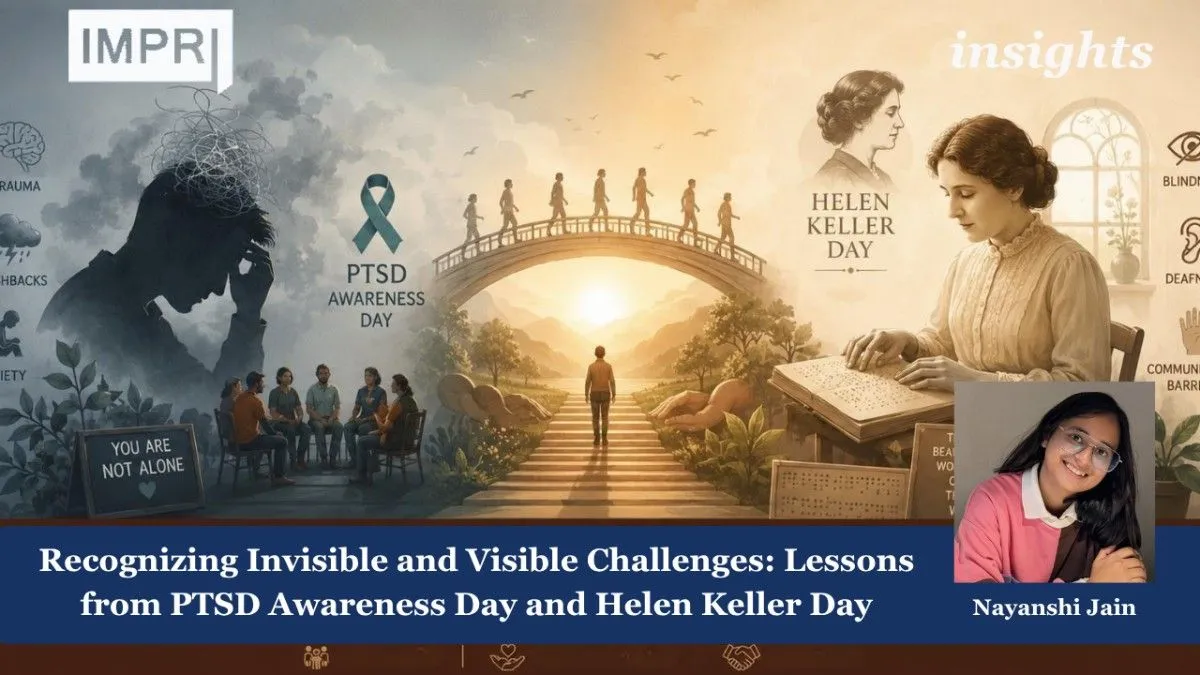
June 27 serves as a powerful reminder that adversity can take many forms. In the United States, the date is marked by two significant observances- National PTSD Awareness Day and Helen Keller Day. One draws attention to the invisible scars left by trauma, while the other honours a woman who overcame profound sensory disabilities to become a global symbol of perseverance and social change. Despite addressing different challenges, both observances celebrate the capacity of individuals to endure, adapt, and thrive.
National PTSD Awareness Day seeks to draw attention to Post-Traumatic Stress Disorder, a condition that can develop after exposure to traumatic events. The observance aims to increase awareness, reduce stigma, and encourage access to mental healthcare. PTSD can affect anyone exposed to trauma, including military veterans, survivors of violence, disaster victims, and first responders. Despite growing awareness, mental health challenges often remain invisible and misunderstood.
Helen Keller Day, observed on her birthday, commemorates the extraordinary achievements of Helen Keller (1880-1968), who became deafblind at nineteen months of age and went on to become an author, educator, disability rights advocate, and the first deafblind person to earn a Bachelor of Arts degree through her determination and the guidance of her teacher Anne Sullivan. Her life transformed global perceptions of disability by demonstrating that physical limitations need not define an individual’s potential.
Viewed together, these observances reveal a broader truth: the pursuit of an inclusive society requires equal attention to visible disabilities and invisible psychological injuries. Whether through mental health services, disability-inclusive policies, or accessible institutions, governments and communities must work towards ensuring that every individual can participate fully and with dignity in social and economic life.
Understanding PTSD: The Invisible Wound
Mental health has emerged as one of the defining public policy challenges of the twenty-first century, and Post-Traumatic Stress Disorder (PTSD) occupies a critical place within this discourse. PTSD is a psychiatric condition that develops following exposure to traumatic events such as armed conflict, natural disasters, sexual violence, domestic abuse, serious accidents, or childhood adversity. While the triggering event may be temporary, its psychological consequences can persist for years, affecting both individual well-being and societal productivity.
Individuals living with PTSD often experience intrusive flashbacks, severe anxiety, depression, emotional distress, hypervigilance, and persistent sleep disturbances. These symptoms can disrupt education, employment, social relationships, and physical health. Unlike many physical illnesses, PTSD frequently remains invisible, contributing to misunderstanding, delayed diagnosis, and social stigma.
The relevance of PTSD has grown as societies confront multiple crises. Ongoing conflicts, forced displacement, humanitarian emergencies, climate-related disasters, and the lingering psychological effects of the COVID-19 pandemic have exposed millions to traumatic experiences worldwide. Contemporary conflicts in Ukraine and Gaza, for instance, have subjected civilians to prolonged violence, displacement, and uncertainty, significantly increasing the risk of trauma-related mental health conditions.
Likewise, climate-induced disasters- from the catastrophic floods in Pakistan to extreme weather events across different regions have demonstrated that the psychological consequences of crises often persist long after physical reconstruction begins. These experiences have reinforced calls for integrating mental health and psychosocial support into humanitarian relief and disaster-management frameworks. Yet, despite the growing recognition of trauma as a global public health challenge, mental health services continue to receive only a small share of national healthcare budgets in many countries.
The socioeconomic costs of untreated PTSD are substantial. Reduced workforce participation, increased healthcare expenditure, lower educational attainment, and diminished quality of life impose significant burdens on individuals, communities, and economies. Addressing PTSD is therefore not only a healthcare priority but also a developmental and economic imperative.
Against this backdrop, National PTSD Awareness Day serves as an important platform for education, advocacy, and public engagement. The observance seeks to challenge misconceptions surrounding trauma-related disorders, reduce stigma, and encourage individuals to seek timely support. By promoting open conversations about mental health and strengthening awareness of available resources, it reinforces a broader message: psychological well-being is an essential component of human development and social resilience. Ultimately, the day calls for trauma-informed policies, stronger healthcare systems, and supportive communities that enable survivors not merely to cope, but to recover and thrive.
PTSD as a Public Policy Challenge
The growing prevalence of PTSD has transformed mental health from a private concern into a pressing public policy issue. While often understood as a clinical condition, PTSD carries significant social and economic consequences, affecting labour productivity, educational attainment, healthcare expenditure, and community well-being. The increasing frequency of armed conflicts, humanitarian crises, climate-related disasters, and public health emergencies has further highlighted the need for trauma-informed policymaking.
A major challenge remains the inadequate capacity of mental healthcare systems. According to the World Health Organization (WHO), nearly one billion people worldwide live with a mental disorder, yet governments allocate, on average, less than 2% of their health budgets to mental health. The shortage of mental health professionals is particularly acute in low and middle-income countries, where access to specialized care remains limited.
In India, the National Mental Health Survey (2015–16) estimated a treatment gap of nearly 83% for mental health conditions, meaning that a vast majority of individuals requiring care do not receive adequate treatment. The country also faces a significant shortage of mental health professionals, with fewer than one psychiatrist available per 100,000 people— well below global recommendations.
The implications of trauma extend beyond healthcare systems. PTSD can contribute to absenteeism, reduced workplace productivity, and long-term economic losses. Recognizing this, many organizations are increasingly adopting trauma-informed workplace policies, including employee assistance programmes, mental health leave provisions, and counselling services. Educational institutions have also emerged as important sites of intervention, with counselling centres, peer-support initiatives, and mental health awareness programmes helping identify and address psychological distress at an early stage.
Innovative policy approaches are attempting to bridge these gaps. Community-based mental health programmes have proven effective in expanding access to care in underserved regions. Reflecting this shift, the WHO advocates person-centred and rights-based mental health services that are integrated with broader support systems such as education, employment, housing, and social protection. Tele-mental health services have also increased the availability of counselling and psychiatric consultations, particularly in remote areas. In India, initiatives such as Tele-MANAS, launched in 2022, seek to provide free and accessible mental health support through a nationwide tele-counselling network. Integrating mental healthcare into primary healthcare systems has likewise gained prominence as a cost-effective strategy for reducing stigma and improving early diagnosis and treatment.
These efforts align with the WHO Comprehensive Mental Health Action Plan 2013-2030, which advocates universal access to quality mental healthcare, stronger governance mechanisms, and rights-based approaches to service delivery. They also contribute directly to Sustainable Development Goal 3, which calls for ensuring healthy lives and promoting well-being for all. As awareness of PTSD grows, policymakers must move beyond viewing mental health solely as a healthcare concern and recognize it as a critical component of human development, social inclusion, and sustainable economic progress.
Helen Keller: A Symbol of Possibility
Helen Keller’s life represents far more than a story of individual perseverance; it embodies the transformative potential of inclusive education, accessible institutions, and human-centred public policy. Born on 27 June 1880 in Alabama, Keller lost both her sight and hearing at nineteen months of age following a severe illness. In an era when persons with disabilities faced widespread exclusion from education and public life, her prospects appeared limited by social attitudes and institutional barriers.
Keller’s advocacy helped bring greater visibility to the challenges faced by persons with disabilities at a time when disability was often associated with dependence and exclusion. Through her writings, public lectures, and international travels, she promoted access to education, vocational training, and social participation. Her work influenced disability organizations across the world, including the American Foundation for the Blind, with which she remained closely associated for over four decades.
The impact of Keller’s legacy can be seen in the evolution of disability rights movements throughout the twentieth century. Activists such as Ed Roberts, widely regarded as a pioneer of the Independent Living Movement in the United States, and Judith Heumann, often called the “mother of the disability rights movement,” built upon the broader foundation of visibility and advocacy that figures like Keller helped establish. Their efforts contributed to landmark legislation, including the Americans with Disabilities Act, which transformed accessibility standards in education, employment, transportation, and public services.
Keller’s influence also extends to the international arena. Contemporary frameworks such as the United Nations Convention on the Rights of Persons with Disabilities (CRPD), adopted in 2006, reflect principles that she championed throughout her life: equal opportunity, accessibility, participation, and dignity. The Convention marked a significant shift from viewing disability through a charitable lens to recognizing it as a matter of human rights and social justice.
Today, Helen Keller Day serves not only as a commemoration of an extraordinary individual but also as a reminder of the progress achieved through decades of advocacy. It highlights how the efforts of one individual can inspire broader movements that reshape institutions, influence policy, and expand opportunities for millions of people around the world. Her legacy endures not because she overcame disability, but because she helped change how societies understand and respond to it.
Disability Inclusion in the 21st Century
Over the past few decades, disability has increasingly been recognized not as a limitation of the individual but as a challenge created by barriers within society. This shift in perspective has transformed approaches to inclusion, emphasizing equal rights, accessibility, and participation rather than charity or welfare alone.
Important progress has been achieved in the fields of education, technology, and law. Inclusive education models have enabled students with disabilities to learn alongside their peers, fostering both academic development and social integration. Technological innovations, ranging from artificial intelligence-powered assistive tools to accessible digital platforms, have expanded opportunities for communication, mobility, and independent living. Recent advances such as AI-driven screen readers, real-time captioning, voice-assisted navigation, and image-description technologies have further enhanced accessibility, demonstrating the potential of digital innovation to reduce barriers and promote greater autonomy. At the same time, legal reforms in many countries have strengthened protections against discrimination and promoted equal access to public services.
However, inclusion remains an unfinished project. Persons with disabilities continue to encounter inaccessible infrastructure, discriminatory hiring practices, and limited access to quality education. These barriers often translate into lower employment rates, higher poverty levels, and reduced participation in public life. The digital revolution has further exposed inequalities, as inaccessible websites, online learning platforms, and digital services prevent many individuals from fully benefiting from technological advancements. The persistence of the digital divide highlights that technological progress alone cannot guarantee inclusion unless accessibility is embedded into design and implementation from the outset.
Recognizing these challenges, the international community has adopted a rights-based framework for disability inclusion. The United Nations Convention on the Rights of Persons with Disabilities (CRPD) affirms that persons with disabilities are entitled to the same rights and freedoms as all other citizens. Similarly, the Sustainable Development Goals emphasize inclusive and equitable development, acknowledging that meaningful progress cannot be achieved while large segments of the population remain excluded.
The pursuit of disability inclusion in the twenty-first century therefore requires more than legal reforms. It demands a societal commitment to designing institutions, technologies, and opportunities that enable every individual to participate fully and with dignity.
Connecting PTSD Awareness and Helen Keller’s Legacy
Although National PTSD Awareness Day and Helen Keller Day address different issues, their simultaneous observance highlights an important shift in how societies understand human vulnerability. Historically, both psychological trauma and disability were often viewed through narrow lenses- one as a personal weakness and the other as an individual limitation. Contemporary research and policy, however, increasingly recognize that outcomes are shaped not only by individual circumstances but also by social environments, institutional responses, and public attitudes.
The comparison is particularly significant because it reflects the evolution of two major policy paradigms. In the case of PTSD, the focus has gradually moved from treating trauma solely as a clinical issue to recognizing its broader social and economic implications. Similarly, disability policy has evolved from a charity-based approach to a rights-based framework that emphasizes accessibility, participation, and equal opportunity. In both cases, the central question has shifted from “What is wrong with the individual?” to “What barriers prevent individuals from fully participating in society?”
The two observances also reveal how definitions of capability have changed over time. Helen Keller’s achievements challenged assumptions about what persons with disabilities could accomplish, while growing awareness of PTSD has challenged the misconception that psychological suffering reflects personal inadequacy. Together, they illustrate that human potential cannot be measured solely by physical ability, sensory capacity, or mental health status.
Another important connection lies in the growing recognition of intersectionality. Individuals may simultaneously experience disability, trauma, poverty, displacement, discrimination, or social exclusion. As a result, effective policy responses increasingly require integrated approaches that address multiple dimensions of vulnerability rather than treating challenges in isolation.
Viewed together, these observances offer a broader lesson for policymakers and societies alike: progress depends not only on medical advances or legal protections but also on redefining how we perceive human difference. By challenging outdated assumptions about disability and mental health, both National PTSD Awareness Day and Helen Keller Day contribute to a more inclusive understanding of citizenship, participation, and human capability in the twenty-first century.
Lessons for India and Emerging Economies
The themes highlighted by National PTSD Awareness Day and Helen Keller Day resonate strongly with the developmental challenges faced by India and other emerging economies. As these countries strive to achieve rapid economic growth, the simultaneous pursuit of mental well-being, disability inclusion, and social equity has become increasingly important. The experiences of trauma survivors and persons with disabilities demonstrate that sustainable development cannot be measured solely through economic indicators; it must also be evaluated through the extent to which societies enable all individuals to participate fully and with dignity.
A key lesson lies in strengthening mental healthcare systems. India’s Mental Healthcare Act, 2017 established a progressive rights-based framework by guaranteeing access to affordable and quality mental healthcare, promoting community-based services, and recognizing the rights of persons with mental illness. However, implementation challenges, including inadequate funding, shortages of mental health professionals, uneven regional access, and persistent social stigma continue to limit its impact. Expanding access to affordable counselling and psychological support should therefore be treated as a public policy priority rather than a supplementary welfare measure.
Disability inclusion presents a parallel challenge. Despite legal protections and policy commitments, accessibility gaps remain widespread across transportation systems, public infrastructure, educational institutions, and employment sectors. Inclusive development requires universal design principles, accessible public services, and stronger implementation of disability rights frameworks. Equally important is the promotion of inclusive education, which equips individuals with disabilities to participate meaningfully in social and economic life.
The rapid digitization of governance and service delivery introduces another critical dimension. While digital technologies can democratize access to education, healthcare, and financial services, inaccessible digital platforms can reinforce existing inequalities. Ensuring digital accessibility must therefore become an integral component of digital public infrastructure and e-governance initiatives.
Perhaps the most significant lesson concerns the role of institutions. Schools, universities, workplaces, and public healthcare systems must evolve into compassionate institutions capable of responding to diverse human needs. Trauma-informed educational environments, accessible campuses, inclusive hiring practices, and employee mental health support programmes can collectively foster resilience and social inclusion.
For India and other emerging economies, the path forward lies not merely in expanding services but in reimagining institutions through the lens of dignity, accessibility, and inclusion. Such an approach aligns closely with the Sustainable Development Goals and reflects a broader understanding of development—one that measures progress not only through economic growth but also through the well-being, participation, and capabilities of its people.
The Way Forward
The lessons emerging from National PTSD Awareness Day and Helen Keller Day underscore the need for policies that address both psychological well-being and disability inclusion. As societies confront evolving social, economic, and humanitarian challenges, policymakers must move beyond awareness campaigns and focus on strengthening institutional responses.
First, governments should prioritize mental health within public healthcare systems by increasing investment, expanding access to counselling services, and integrating trauma-informed care into primary healthcare and disaster-response frameworks. Early intervention and community-based mental health programmes can help reduce treatment gaps and improve long-term outcomes.
Second, disability inclusion must be embedded across all sectors through accessible infrastructure, inclusive education, and equitable employment opportunities. As digital technologies become central to everyday life, ensuring digital accessibility should become a core component of governance and public service delivery.
Third, educational institutions, workplaces, and public agencies should adopt inclusive and trauma-sensitive practices that recognize diverse needs and foster supportive environments. Such measures not only improve individual well-being but also strengthen social cohesion and economic productivity.
Ultimately, the success of these efforts will depend not only on stronger laws and policies but also on effective implementation, adequate funding, and sustained public awareness. By embedding inclusion and mental well-being into the design of institutions and public services, countries can build more resilient societies capable of responding to both visible and invisible challenges.
About the Contributor
Nayanshi is a Research and Editorial Intern at IMPRI and a student of Economics and Political Science at St. Stephen’s College, Delhi. Her research interests lie in international political economy, monetary and financial systems, public policy, developmental economics, welfare economics, behavioural economics and sustainable development.
Disclaimer: All views expressed in the article belong solely to the author and not necessarily to the organisation.
Read More at IMPRI:
India–Italy Special Strategic Partnership
Acknowledgement
The author extends sincere thanks to the IMPRI team for their guidance.
She also extends her sincere thanks to Shruti Sethi and CB Kavin Adithya for their valuable feedback, useful suggestions, and support in shaping this article.
This article was posted by Yashkirti Pal, a Research and Editorial Intern at IMPRI.