







Policy Update
Riddhi Suthar
Background
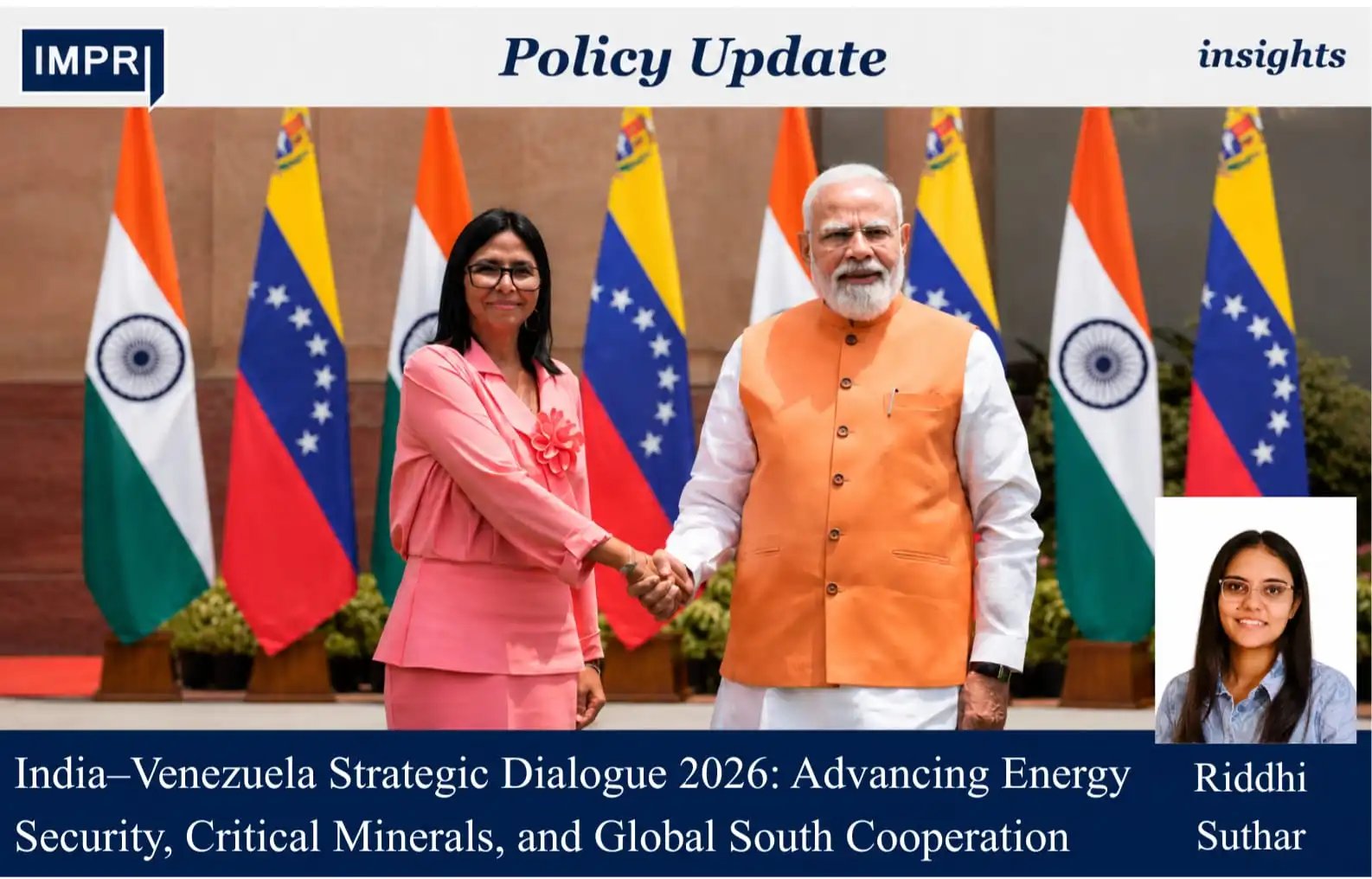
The high-level meeting between Prime Minister Narendra Modi and the acting president Delcy Rodríguez at Hyderabad House, New Delhi, on 4 June 2026, marks a significant step toward transforming the bilateral relationship into a broader strategic partnership focused on energy security, critical minerals, trade diversification, technology cooperation, and Global South leadership. Later, Oil Minister Hardeep Puri called on Gomez with top officials and CMDs of state-run energy companies.
Soon, an Indian technical team will travel to Venezuela to further investigate possibilities. According to Puri, Indian oil companies operating in Venezuela are seeking to explore fresh prospects. Both countries aim to broaden economic ties beyond oil into sectors such as pharmaceuticals, agriculture, healthcare, transportation, and technology. India and Venezuela also share an interest in strengthening South-South cooperation and advocating for developing-country priorities in global governance institutions.
Functions
Energy Security Cooperation
The primary pillar of this partnership is energy cooperation. As evidence of the rapid expansion of energy cooperation, India’s average monthly crude imports from Venezuela increased from 64.027 thousand metric tonnes (TMT) during FY 2025–2026 to 1,047.148 TMT during April–May FY 2026–2027. Indian public-sector enterprises, including ONGC Videsh and other state-owned energy firms, are expected to explore new investment opportunities in Venezuelan oil fields and related infrastructure projects.
Critical Minerals Cooperation
Venezuela possesses significant reserves of strategic minerals, including gold, iron ore, bauxite, and rare earth resources. India aims to secure critical mineral supplies to support its target of 500 GW of non-fossil fuel electricity capacity by 2030. As India accelerates its transition toward renewable energy and advanced manufacturing, securing access to strategic minerals has become a national priority.
Trade Diversification
The dialogue also seeks to expand economic engagement beyond hydrocarbons. India exported goods worth approximately US$720 million to Venezuela in FY 2024–25, while imports were dominated by crude oil and petroleum products. Both countries have identified pharmaceuticals, agriculture, healthcare, transportation, and digital technologies as important sectors for cooperation.
Global South Cooperation
From a broader geopolitical perspective, the initiative strengthens South-South cooperation. This includes cooperation in multilateral forums, advocacy for reforms in global governance institutions, and collaboration on sustainable development challenges. India regards Venezuela as a valued partner in Latin America. It recognises that strengthening bilateral cooperation with the country is of significant importance for advancing the interests and aspirations of the Global South.
Performance
Indian imports of Venezuelan crude increased from 283,000 barrels per day (bpd) in April 2026 to 427,000 bpd in May 2026, representing an increase of approximately 51% within a month. Venezuela exported approximately 1.25 million bpd globally in May 2026, with India accounting for nearly 34%of total exports. India became Venezuela’s second-largest oil buyer in 2026.
Indian public-sector companies have invested around US$1 billion in Venezuelan energy projects since 2008, creating a foundation for future investments in mining, infrastructure, and technology. India exported goods worth approximately US$720 million to Venezuela in FY 2024–25. India’s exports of pharmaceutical products to Venezuela were US$110.98 million during 2024, according to the United Nations COMTRADE database on international trade.
Both countries agreed to initiate 3 pilot projects in Agriculture, Pharmaceuticals and Digital infrastructure in 2025. India and Venezuela also signed a Memorandum of Understanding (MoU) on Digital Public Infrastructure (DPI) cooperation in February 2025. India’s exports of vehicles and transport equipment to Venezuela were approximately US$12.07 million in 2024. India exported agricultural products such as cereals worth approximately US$5.7 million.
Impact
The most immediate impact has been on India’s energy security. India’s Strategic Petroleum Reserves have a total capacity of 5.33 MMT, sufficient to meet around 9.5 days of crude oil demand at full capacity. Given India’s dependence on imported oil, partnerships with suppliers such as Venezuela play an important role in strengthening the country’s long-term energy security. The dialogue has also contributed to broadening the economic relationship beyond traditional oil trade.
Total bilateral trade between the two countries in FY 2025–26 stood at US$678.94 million. This indicates that economic engagement has moved beyond diplomatic intent to measurable commercial outcomes. The MoU on Digital Public Infrastructure (DPI) cooperation in 2025 and the initiation of three pilot projects in agriculture, pharmaceuticals, and digital infrastructure. If successfully implemented, these pilot initiatives could serve as practical examples of development cooperation among Global South countries.
The proposed deployment of an Indian technical delegation to assess mineral opportunities demonstrates growing institutional commitment. In the long term, successful collaboration could support India’s clean-energy transition. Therefore, the long-term impact of the India–Venezuela Strategic Dialogue will depend on translating diplomatic commitments into concrete investments, operationalising pilot initiatives, and institutionalising cooperation beyond hydrocarbons.
Emerging Issues
One of the most significant challenges facing the India–Venezuela partnership is the uncertainty arising from international sanctions on Venezuela’s energy sector. The sanctions regime imposed by the United States on Venezuela’s state-owned oil company, PDVSA, has repeatedly disrupted the bilateral energy relationship.
In 2019, imports of Venezuelan crude were halted by Indian refiners such as Reliance Industries and Nayara Energy following the tightening of U.S. sanctions against PDVSA. Following a brief relaxation of regulations, India progressively resumed purchases. However, following changes to U.S. licensing agreements pertaining to Venezuelan oil exports, imports once more became uncertain in 2024.
Although cooperation expanded to multiple sectors, only one MoU on Digital Public Infrastructure (2025) and three pilot projects have been initiated. No major agreements have yet materialised in critical minerals, healthcare, or agriculture. There haven’t been any formal mining agreements or investment commitments concluded with Venezuela, despite India’s target of achieving 500 GW of non-fossil electricity capacity by 2030.
Implementation progress remains difficult to track, especially in non-energy sectors, because the Strategic Dialogue lacks a dedicated MIS dashboard, annual review mechanism, or measurable Key Performance Indicators.
Way Forward
Expanding cooperation in relatively low-risk sectors such as pharmaceuticals, agriculture, and digital technologies is essential to reduce overdependence on hydrocarbons or governments of both countries should develop alternative settlement mechanisms that comply with international regulations. There is also the need to set annual targets and timelines for implementing sectoral projects. For India, the most promising investment opportunities lie in the Orinoco Belt, particularly in the Carabobo and Junínblocks, which contain significant undeveloped reserves requiring capital, technology, and infrastructure rehabilitation.
public-sector enterprises already possess an operational foothold in the country. As of March 2025, ONGC Videsh had invested approximately US$770 million in Venezuelan assets, including around US$529 in the San Cristóbal field and US$240 million in the Carabobo-1 project. Encourage joint ventures between Indian firms and Venezuelan entities, as critical minerals cooperation remains exploratory. Developing legally compliant alternative payment arrangements can help in overcoming sanctions and regulatory uncertainty. For institutional monitoring, establishing an India–Venezuela Joint Monitoring Committee, developing sector-wise indicators and publishing annual performance reports is crucial.
References
- Press Information Bureau (PIB). (2026, June 4). The Acting President of the Republic of Venezuela meets the Prime Minister. Government of India.
https://www.pib.gov.in/PressReleasePage.aspx?PRID=2269100 - Press Information Bureau (PIB). (2026, June 5). Union Minister Shri Hardeep Singh Puri meets Acting President of Venezuela Delcy Rodríguez; discusses strengthening energy cooperation. Government of India.
https://www.pib.gov.in/PressReleasePage.aspx?PRID=2269161 - Ministry of External Affairs. (n.d.). India–Venezuela Bilateral Relations. Government of India.
https://www.mea.gov.in/Portal/ForeignRelation/Venezuela_Bilateral_Brief__1023.pdf - Embassy of India, Caracas. (n.d.). India–Venezuela Relations. Government of India.
https://www.eoicaracas.gov.in/page/india-venezuela-relations/ - Ministry of Power. (n.d.). 500 GW Non-Fossil Fuel Target. Government of India.
https://www.powermin.gov.in/en/content/500gw-nonfossil-fuel-target - Directorate General of Commercial Intelligence and Statistics (DGCI&S). (n.d.). Ministry of Commerce and Industry, Government of India.
https://www.dgciskol.gov.in/
- United Nations Statistics Division. (n.d.). UN Comtrade Database.
https://data.un.org/Data.aspx?d=ComTrade - Office of Foreign Assets Control (OFAC). (n.d.). Venezuela-Related Sanctions. U.S. Department of the Treasury.
https://ofac.treasury.gov/sanctions-programs-and-country-information/venezuela-related-sanctions
- Oil and Natural Gas Corporation Videsh Limited (ONGC Videsh). (n.d.).
https://ongcvidesh.com/ - Petróleos de Venezuela, S.A. (PDVSA). (n.d.).
https://www.pdvsa.com/ - Ministry of People’s Power for Foreign Trade. (n.d.). Government of Venezuela.
https://www.mincoex.gob.ve/
- Reuters. (2026, February 5). India says it is open to the commercial merits of crude supply from Venezuela.
https://www.reuters.com/business/energy/india-says-it-is-open-commercial-merits-crude-supply-venezuela-2026-02-05/ - The Economic Times. (2026, June 4). India eyes Venezuelan upstream, downstream energy sectors; Modi–Gómez explores partnership in critical minerals, mining too.
https://m.economictimes.com/industry/indl-goods/svs/metals-mining/india-eyes-venezuelan-upstream-downstream-energy-sectors-modi-gomez-explore-partnership-in-critical-minerals-mining-too/amp_articleshow/131515095.cms - World Oil. (2026, June 4). Venezuela emerges as a key supplier in India’s post-Hormuz strategy.
https://www.worldoil.com/news/2026/6/4/venezuela-emerges-as-key-supplier-in-india-s-post-hormuz-strategy/ - The Tribune. (2026, June 5). India and Venezuela vow deeper energy partnership amid global crude supply worries.
https://www.tribuneindia.com/news/india/india-venezuela-vow-deeper-energy-partnership-amid-global-crude-supply-worries/ - Hindustan Herald. (2026, June 5). India–Venezuela Energy Partnership 2026: Strategic Reset Amid Global Uncertainty.
https://hindustanherald.in/india-venezuela-energy-partnership-2026/ - Trading Economics. (n.d.). India Exports of Pharmaceutical Products to Venezuela.
https://tradingeconomics.com/india/exports/venezuela/pharmaceutical-products
About the Contributor
Riddhi Suthar is a researcher and policy enthusiast with interests in public policy, governance, international relations, maritime affairs, and strategic studies. Their work focuses on evidence-based policy analysis, geopolitical developments, and emerging global challenges, with particular attention to India’s strategic and developmental priorities. She is engaged in analytical writing, policy research, and academic discussions related to governance, security, and international affairs.
Acknowledgement
The author extends sincere gratitude to the IMPRI team for their expert guidance and constructive feedback throughout the process.
Reviewed by Shreeya Dixit and Ameya Satam
Disclaimer
All views expressed in the article belong solely to the author and not necessarily to the organisation.
Read More at IMPRI:
India’s Cultural Diplomacy in the Digital Age: OTT Platforms, AI Translation, and Soft Power