









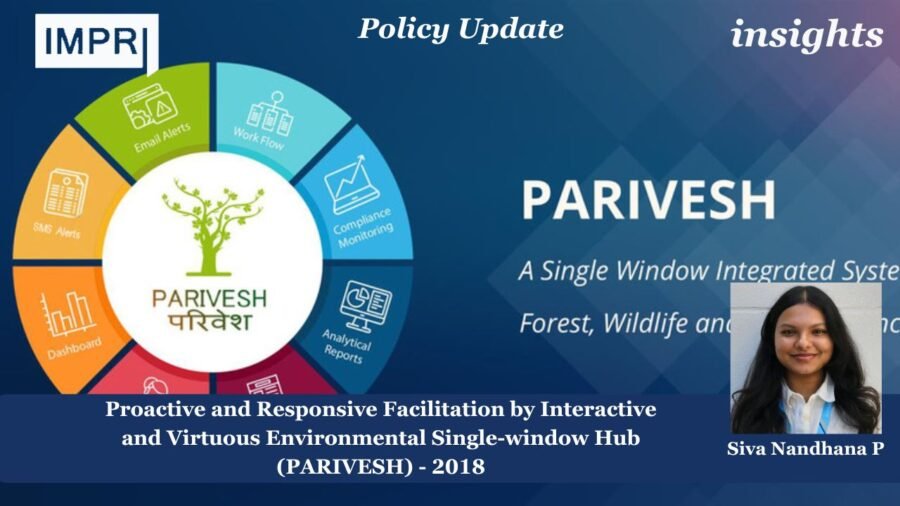
Policy Update
Siva Nandhana P
Background
The Proactive and Responsive facilitation by the Interactive, Virtuous, and Environmental Single-window Hub (PARIVESH) represents a strategic institutional refurbishment in India’s environmental governance framework. The extensive nomenclature represents the comprehensive policy ambition of the Ministry of Environment, Forest, and Climate Change (MoEFCC) to integrate administrative efficiency (Responsive), digital guidance (Pro-Active and Interactive), and ethical oversight (Virtuous) within a unified digital ecosystem (MoEFCC, 2018).
PARIVESH was developed directly aligning itself with the nation’s ‘Digital India’ mission, fundamentally capturing the policy philosophy of ‘Minimum Government and Maximum Governance’ by leveraging technology to streamline regulatory functions (MoEFCC, 2018). Its implementation marked a decisive shift from manual and fragmented systems towards a centralised and digital workflow. This aims to enhance the transparency and predictability required for modern infrastructural and industrial development.
A primary functional objective of PARIVESH was to unify fragmented statutory clearance processes under a single digital interface. Before its establishment, project proponents were required to navigate complex and often sequential application procedures across various regulatory domains. PARIVESH integrated four critical statutory clearance mechanisms, providing a unified platform for online submission and monitoring:
- Environmental Clearance (EC): Required under the Environment Impact Assessment (EIA) Notification, 2006.
- Forest Clearance (FC): Required for the diversion of forest land under the Forest (Conservation) Act, 1980.
- Wildlife Clearance (WL): Necessary for projects located within or near Protected Areas, regulated by the Wildlife (Protection) Act, 1972.
- Coastal Regulation Zone (CRZ) Clearance: Governed by the CRZ Notification, 2011, for development activities in sensitive coastal stretches (NIC n.d.).
The emphasis here is to be ‘Pro-Active’ and ‘Responsive’ as reflected in its nomenclature by a fundamental strategic pivot to regulatory authority. This approach shifts the MoEFCC from a traditionally reactive regulatory body towards a role of the digital facilitator, using digital tools, particularly those introduced in PARIVESH 2.0, to guide project proponents toward optimal, low-impact sites before formal application submission.
This planning reduces subsequent regulatory friction, lowers the rate of objections, and is intended to align with environmental safeguarding, with the mandate of ‘Ease of Doing Responsible Business’ (Modak, 2018). Furthermore, the explicit inclusion of CRZ is a crucial structural reform in the context of India’s growing climate adaptation strategy. India faces escalating vulnerabilities in its 7,500 km coastline due to cyclones, sea-level rise, and salinity intrusion (MoEFCC, 2022)
Functioning
The transition from PARIVESH 1.0 to PARIVESH 2.0 marks a sophisticated leap in India’s environmental governance. This evolved from a NET/SQL-based tracking system into a high-fidelity RegTech ecosystem. While the original version successfully digitised the paperwork trail, it lacked the spatial intelligence and data-sharing capabilities vital for complex environmental appraisals. The 2.0 version corrects these deficiencies by embedding Geographic Information Systems (GIS) and advanced data analytics directly into the regulatory workflow, moving the process beyond simple document storage toward automated, evidence-based decision support.
A cornerstone of this transformation is the integration of the Decision Support System (DSS) and the Know Your Approval (KYA) module. These tools utilise geospatial layers to cross-reference project sites against sensitive ecological zones, such as protected forests and eco-sensitive areas, in real-time. By mandating rigorous DGPS (Differential GPS) surveys and requiring submissions in KML (Keyhole Markup Language) format that are standardised to the GCS-WGS84 datum, the system places the burden of high-fidelity data generation on the project proponent. This “proactive operationalization” ensures that the data reaching appraisal committees is auditable and scientifically robust, significantly reducing the reliance on subjective human discretion.
Additionally, the system has tightened data integrity by enforcing mandatory entity validation through PAN and CIN identifiers. This eliminates the “fragmented data handling” caused by multiple registrations and provides a “single source of truth” for every proponent. By automating these critical checks and integrating with Union and State APIs, PARIVESH 2.0 creates a streamlined, transparent appraisal environment that accelerates regulatory outcomes without compromising ecological scrutiny.
Performance
The performance of PARIVESH can be analysed in two spheres: the reduction in Turnaround Time (TAT) and Internal Accountability.
Average environmental clearance (EC) times plummeted from over 150 days in 2019 to under 90 days by 2021, with high-priority sectors achieving results in as little as 60 days (MoEFCC, 2018). This operational velocity is reflected in the system’s ability to process a massive workload; in 2021 alone, 7,787 environmental clearances were granted (MoEFCC 2018), and the platform currently tracks over 10,000 diverse land-use proposals ranging from national highways to small-scale industries (Das et al. 2022).
Beyond speed, PARIVESH has institutionalised standardisation and internal accountability. It enforces a singular, automated workflow across all central, regional, and state-level bodies, effectively eliminating previous procedural inconsistencies (Das et al. 2022).
To prevent bureaucratic inertia, the system uses automated SMS and email alerts to notify officials and higher authorities when stipulated processing deadlines are exceeded (MoEFCC 2018; NIC n.d.). This centralised oversight, monitored via a management dashboard, provides the regulatory certainty necessary for large-scale investment by reducing the time value of money lost during prolonged reviews. Ultimately, PARIVESH 2.0 transforms environmental clearance from a reactive administrative hurdle into a proactive, data-driven planning process.
Table 1: Compliance Architecture in PARIVESH 2.0
| Compliance Requirement | Mechanism (PARIVESH 2.0) | Regulatory Outcome | Source |
| Periodic Reporting | Submission of six-monthly compliance reports online | Standardised and traceable documentation | (Gajare and Gajare, 2025) |
| Real-Time Monitoring | OCEMS connectivity validation and trend checks | Early detection of operational non-compliance | (Gajare and Gajare, 2025) |
| Public Disclosure | Requirement for public-facing compliance pages | Enhanced stakeholder transparency and accountability | (Gajare and Gajare, 2025) |
| Clearance Validity Check | Automatic verification of the regional office report currency | Prevents misuse of outdated assessments | (PIB,2024) |
Emerging Issues
Despite its architectural advancements, PARIVESH still grapples with significant UI/UX deficiencies and institutional friction that hinder its full potential. While the system provides technical transparency, it is often described as “functionally opaque” due to a cumbersome interface, poor discoverability, and the use of non-standard nomenclature that alienates non-expert stakeholders (Das et al. 2022; Nandi, 2023). Issues like inadequate document tagging and the absence of automated notification features for project updates have led to “decision fatigue,” making it difficult for the public to track the lifecycle of environmental clearances (Das et al. 2022).
Beyond the interface, the transition to version 2.0 has faced institutional resistance, particularly concerning mandatory e-KYC and unique identification via PAN/CIN (Nandi, 2023). Historically, the reliance on parallel, non-integrated systems like “e-office” has caused significant data fragmentation, preventing the platform from becoming a true “Single Source of Truth”. Furthermore, the migration process itself poses a threat to historical transparency; experts warn that supplementary documents and public records available in PARIVESH 1.0 may not have been fully migrated to the 2.0 platform, potentially creating gaps in institutional memory and public accountability (Standard, 2024; Nandi, 2023). Addressing these structural leakage points remains a critical challenge for the MoEFCC as it strives for end-to-end digital adoption.
Way Forward
To solidify PARIVESH as India’s foundational land-use infrastructure, the strategic focus must shift from deployment to continuous quality enhancement. A primary hurdle is the portal’s “functional opacity,” which requires a transition toward human-centered design. This involves streamlining navigation through better document indexing and replacing cryptic technical jargon with descriptive context for various approval stages. By integrating modern notification systems, the platform can evolve from a passive repository into a proactive communication tool that keeps stakeholders updated in real-time.
The strategic heart of version 2.0 lies in its Geospatial and Decision Support Ecosystem. By fully operationalising GIS linkages, PARIVESH moves beyond simple clearance and functions as a proactive planning tool. This allows developers to identify and avoid ecologically sensitive zones, such as Protected Areas or Critically Polluted Areas, especially during the initial design phase, achieving true natural resource optimisation. This spatial intelligence, combined with seamless API-based integration across state and union agencies, is essential for creating a single database of information. Such an auditable, transparent system is not just an administrative win; it is a prerequisite for attracting global climate finance, as international investors prioritise robust, data-driven governance frameworks (MoEFCC, 2022).
Looking ahead, future-proofing the system involves institutionalising risk-based regulation. By validating consultant accreditation and using advanced analytics to automatically flag high-risk proposals, regulators can concentrate their scrutiny where it is most critical. Ultimately, while PARIVESH has successfully dismantled traditional procedural bureaucracy, its long-term viability depends on a sustained commitment to resolving UI/UX friction and achieving deep interoperability across all government verticals.
References
Das, Pakhi, Shashank Srinivasan, Nancy Alice, Ashwathy Satheesan, Nandini Mehrotra, and Anand Srinivasan. 2022. “The PARIVESH Portal: Pros, Cons, And How To Use.” https://sanctuarynaturefoundation.org/article/the-parivesh-portal:-pros,-cons-and-how-to-use.
Gajare, Tanaji, and Harshal T. Gajare. n.d. “EC Compliance Report 2025 – Expert PPS Guide – Perfect Pollucon Services.” Retrieved December 29, 2025. https://www.ppsthane.com/blog/ec-compliance-report-moef-guidelines-parivesh.
Modak, Prasad. 2018. “Parivartan through Parivesh (A New Transformation in India’s Environmental Clearance System).” https://prasadmodakblog.com/2018/08/11/parivartan-through-parivesh-a-new-transformation-in-indias-environmental-clearance-system/.
MoEFCC. 276 AD. “Year-End Review 2024: Ministry of Environment, Forest and Climate Change.” https://www.pib.gov.in/www.pib.gov.in/Pressreleaseshare.aspx?PRID=2088406.
MoEFCC. 2018. “‘PARIVESH’ – an Environmental Single Window Hub for Environment, Forest, Wildlife and CRZ Clearances Launched.” https://www.pib.gov.in/Pressreleaseshare.aspx?PRID=1542607®=3&lang=2.
MoEFCC. 2022. “National CAMPA.” https://nationalcampa.nic.in/annualReport.php?tabType=resources-tab.
Nandi, Jayashree. 2023. “New Parivesh Portal Will Put Project Proposals’ Details, Clearances in Public Domain, Clarifies Centre | India News.” https://www.hindustantimes.com/india-news/indias-environment-ministry-to-provide-project-proposal-details-on-revamped-parivesh-portal-in-compliance-with-transparency-law-101682277192652.html.
NIC. n.d. “PARIVESH | National Informatics Centre | India.” Retrieved December 29, 2025. https://www.nic.gov.in/project/parivesh/.
Standard, Business. 2024. “Parivesh 2.0 Portal to Be Default Platform for All Environment Clearances.” https://www.business-standard.com/economy/news/parivesh-2-0-to-be-default-platform-for-all-environment-clearances-124020400439_1.html.
About the Contributor:
Siva Nandhana P is a Research Intern at Research Intern at Impact and Policy Research Institute (IMPRI).
Acknowledgement
The author sincerely appreciates the contributions made by fellow IMPRI interns and the mentors, Ms Asthaba Jadeja and Bhaktiba Jadeja.
Disclaimer: All views expressed in the article belong solely to the author and not necessarily to the organisation.
Read More at IMPRI