





Policy Update
Nagul Prana K.S.
Background
Source:https://www.orfonline.org/
In recent years, economic connectivity has become an increasingly important part of global geopolitics. Countries are now using trade corridors, infrastructure projects, and regional partnerships not only for economic growth but also to strengthen their strategic influence. This growing relationship between economics and geopolitics is commonly referred to as geoeconomics.
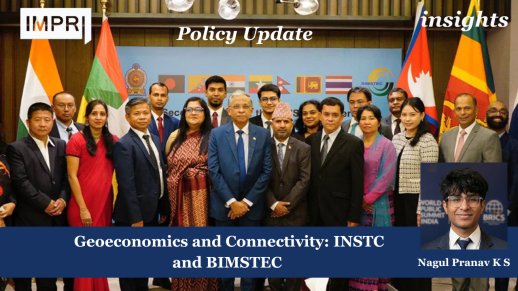
India has also adopted this approach through initiatives such as the International North South Transport Corridor (INSTC) and the Bay of Bengal Initiative for Multi Sectoral Technical and Economic Cooperation (BIMSTEC). These initiatives aim to improve regional connectivity, reduce trade costs, and expand India’s strategic outreach across Eurasia and the Bay of Bengal region.
The INSTC was conceptualised in 2000 as a multimodal transport corridor connecting India with Iran, Russia, and Central Asia through sea, rail, and road routes. BIMSTEC, established in 1997, includes seven countries, namely India, Bangladesh, Sri Lanka, Myanmar, Thailand, Nepal, and Bhutan, and focuses on cooperation in areas such as connectivity, trade, energy, and security.
These initiatives have become increasingly important in the context of shifting global supply chains, geopolitical tensions, and the growing importance of regional economic integration.
The growing importance of BIMSTEC also reflects India’s attempt to strengthen regional cooperation through platforms that are less affected by political tensions. Unlike SAARC, which has remained largely inactive due to strained India Pakistan relations, BIMSTEC provides India with an opportunity to strengthen connectivity and economic integration with Southeast Asia through its Act East and Neighbourhood First policies.

Source: https://www.orfonline.org/research/the-bimstec-master-plan-for-transport-connectivity
Functioning
The INSTC functions as a multimodal transport network linking Indian ports with Iran’s Chabahar Port and further extending towards Central Asia and Russia through rail and road connectivity. Compared to traditional maritime routes through the Suez Canal, the corridor is expected to significantly reduce transportation time and freight costs.
According to several studies and government assessments, the INSTC can reduce transit time by nearly 40 percent, bringing it down from around 40 to 45 days to nearly 25 to 30 days. Freight costs are also expected to decline by approximately 30 percent.
Chabahar Port plays an important role in this connectivity framework. The Government of India has continuously invested in the development of the port as part of its regional connectivity strategy. Between FY 2016 17 and FY 2023 24, around ₹400 crore was allocated for the development of Shahid Beheshti Port at Chabahar, out of which approximately ₹201.51 crore had been utilised by 2024.
BIMSTEC functions as a regional platform connecting South Asia and Southeast Asia. Connectivity has emerged as one of its most important pillars. The emphasis on connectivity also demonstrates how BIMSTEC is evolving beyond a traditional regional organisation into a platform focused on economic integration, supply chain resilience, and strategic cooperation in the Bay of Bengal region. In 2022, BIMSTEC adopted the Master Plan for Transport Connectivity, which identified nearly 267 connectivity projects worth around USD 124 billion aimed at improving regional infrastructure and transport networks.
However, both initiatives continue to face practical challenges. Delays in infrastructure development, geopolitical uncertainties, and coordination issues among stakeholders have slowed implementation.
INSTC Trade Efficiency Comparison
| Route | Approximate Transit Time | Estimated Cost Reduction |
| Traditional Suez Canal Route | 40 to 45 days | Baseline |
| INSTC Route | 25 to 30 days | Around 30 percent lower freight cost |
Source: ORF and MEA Reports
Chabahar Port Financial Allocation and Utilisation
| Financial Year | Allocation or Investment | Remarks |
| 2016 17 to 2023 24 | Around ₹400 crore allocated | Development of Shahid Beheshti Port |
| By 2024 | Around ₹201.51 crore utilised | Infrastructure and operational development |
Source: PIB 2024
Performance
Over the last few years, India has increased its focus on strengthening regional connectivity through both INSTC and BIMSTEC.
The operationalisation of the INSTC has gained momentum due to changing geopolitical and trade conditions, especially after disruptions in global supply chains. Trial cargo movements through the corridor have demonstrated shorter transit durations compared to conventional maritime routes. India has also expanded diplomatic engagement with Iran and Russia to improve corridor efficiency and logistics coordination.
India signed a long term agreement with Iran in 2024 for the development and operation of Chabahar Port. The agreement is expected to strengthen India’s access to Afghanistan and Central Asia while bypassing Pakistan.
Budget allocations also reflect India’s strategic interest in connectivity initiatives. The Union Budget 2024 25 maintained an allocation of ₹100 crore for Chabahar Port under the Ministry of External Affairs budget. India has also increased broader external affairs and connectivity related expenditure in recent years to strengthen regional engagement.
BIMSTEC has also witnessed greater political attention. However, despite the adoption of major connectivity frameworks, implementation remains uneven across member states. Political instability in Myanmar has emerged as a major challenge because Myanmar acts as a geographical bridge connecting South Asia with Southeast Asia. Continued instability has affected infrastructure projects, transport corridors, and regional connectivity initiatives under BIMSTEC. The adoption of the BIMSTEC Master Plan for Transport Connectivity marked a major step towards improving regional integration. The plan includes road, rail, maritime, and aviation connectivity projects over a 10 year period from 2018 to 2028.
Despite these developments, implementation remains uneven. Several projects continue to face delays because of financing constraints, institutional weaknesses, and geopolitical complexities.

Source: https://www.orfonline.org/research/chabahar-port
BIMSTEC Connectivity Plan Statistics
| Component | Statistics |
| Total Connectivity Projects | Around 267 projects |
| Estimated Investment | Around USD 124 billion |
| Time Period | 2018 to 2028 |
Source:https://www.livemint.com/
Source:BIMSTEC Master Plan for Transport Connectivity 2022
Impact
The INSTC and BIMSTEC have significant implications for India’s geoeconomic strategy.
The INSTC improves India’s connectivity with Eurasian markets and offers an alternative trade route that reduces dependence on traditional maritime channels. In the context of global supply chain disruptions and geopolitical uncertainties, this has become strategically important for India’s trade and energy security.
The corridor also strengthens India’s engagement with Central Asia and Russia while improving access to emerging markets. Increased trade efficiency through reduced transit time and lower freight costs can contribute to long term economic gains.
BIMSTEC strengthens India’s regional influence in the Bay of Bengal region. It provides a platform for enhancing economic cooperation, connectivity, and regional integration among neighbouring countries. The initiative also complements India’s Neighbourhood First and Act East policies. BIMSTEC’s growing importance also highlights India’s strategic shift towards sub regional cooperation frameworks that are more connectivity oriented and economically driven. In contrast to SAARC, which has struggled because of persistent political tensions between India and Pakistan, BIMSTEC offers greater scope for functional cooperation in trade, transport, and maritime connectivity.
Together, these initiatives demonstrate how India is increasingly integrating economic connectivity with strategic and foreign policy objectives. Connectivity corridors are no longer viewed only as infrastructure projects; they are now becoming instruments of geopolitical influence and regional positioning.
India’s expanding Eurasian connectivity through INSTC and regional partnerships.

Source:https://www.icwa.in/
Emerging Issues
- Infrastructure gaps continue to delay the implementation of several transport, rail, and logistics projects under INSTC and BIMSTEC, particularly in regions where port and multimodal transport infrastructure remains underdeveloped.
- Geopolitical uncertainties, especially sanctions on Iran and regional political tensions, continue to affect connectivity initiatives and trade routes.
- Large scale connectivity projects require sustained funding and investment over long periods of time.
- BIMSTEC still lacks strong enforcement and coordination mechanisms for faster implementation of projects.
- Differences in customs procedures, transport regulations, and logistics systems affect smooth connectivity across regions.
Way Forward
India needs to accelerate infrastructure development and strengthen coordination with partner countries to fully realise the potential of these initiatives. Greater investment in logistics infrastructure, port development, and multimodal transport systems will be necessary to improve efficiency.
There is also a need to strengthen institutional mechanisms within BIMSTEC so that agreements can be implemented more effectively. Better coordination among member countries, along with increased private sector participation, can improve project execution.
As global geopolitical and economic conditions continue to evolve, initiatives such as INSTC and BIMSTEC are likely to become increasingly important for India’s regional strategy, trade diversification, and long term geoeconomic positioning.
References
- BIMSTEC Secretariat. (2022). BIMSTEC master plan for transport connectivity. https://bimstec.org/connectivity
- Economic Survey of India. (2023). Infrastructure and connectivity developments. Government of India. https://www.indiabudget.gov.in/economicsurvey/
- Maritime India Vision 2030. (2021). Connectivity and trade infrastructure report. Government of India. https://wwwcdn.imo.org/localresources/en/OurWork/Environment/Documents/Air%20pollution/Maritime%20India%20vision%202030.pdf
- Ministry of External Affairs. (2022). BIMSTEC and regional cooperation initiatives. Government of India. https://mea.gov.in/bimstec.htm
- Ministry of External Affairs. (2023). International North South Transport Corridor (INSTC). Government of India. https://mea.gov.in/
- Observer Research Foundation. (2024). The BIMSTEC master plan for transport connectivity. https://www.orfonline.org/research/the-bimstec-master-plan-for-transport-connectivity-a-stocktaking
- Press Information Bureau. (2024). Development of Chabahar Port. Government of India. https://pib.gov.in/PressReleseDetailm.aspx?PRID=2037450
- PRS Legislative Research. (2022). India’s connectivity and trade infrastructure overview. https://prsindia.org/
- Reuters. (2024, May 13). India signs long term agreement with Iran on Chabahar Port development. https://www.reuters.com/world/india/india-sign-10-year-pact-with-iran-chabahar-port-management-et-reports-2024-05-13/
- Wikimedia Commons. (2024). North South Transport Corridor route map. https://commons.wikimedia.org/wiki/File:North_South_Transport_Corridor_(NSTC).jpg
About the Contributor
Nagul Pranav K S is a Political Science Honours student at the University of Delhi with a strong interest in international relations, geoeconomics, regional connectivity, and public policy. He is currently a Research and Editorial Intern at IMPRI Impact and Policy Research Institute, where he contributes to policy update articles and research focused on strategic affairs, connectivity initiatives, and global governance themes.
Acknowledgement
I would like to extend my sincere gratitude to the team at IMPRI India for their guidance and support.
Disclaimer
All views expressed in the article belong solely to the author and not necessarily to the organisation.
Read More at IMPRI
Evaluating the India-Vietnam Plan of Action (2024-2028) through Indo-Pacific Vision