








Policy Update
Varisha Sharma
Introduction
The Strait of Malacca, through which over 80,000 vessels transit annually, constitutes one of the world’s most strategically consequential maritime chokepoints. Stretching for approximately 900 kilometres between the Malay Peninsula and the Indonesian island of Sumatra, this narrow sea lane connects the Indian Ocean to the South China Sea and serves as the primary artery for maritime commerce between East Asia, South Asia, the Middle East, and Europe.
According to data collated by the Centre for Strategic and International Studies and corroborated by the U.S. Energy Information Administration, the strait facilitates roughly 24 percent of all global seaborne trade and, as of 2025, constituted the world’s largest oil transit chokepoint, surpassing even the Strait of Hormuz in daily oil that passes through (Faisal, 2024).
More than 102,500 vessels transited the strait in 2025, and the waterway carries approximately 75 percent of China’s seaborne crude oil imports (Ballast Markets, 2025 ). Given this extraordinary commercial and strategic salience, ensuring the security of the Malacca Strait has become a cardinal priority for maritime powers with interests in the Indo-Pacific. Among such powers, India and Singapore occupy a distinctive position. Both states possess deep historical, cultural, and economic ties that stretch back centuries, and both have evolved a robust framework of bilateral naval cooperation that is increasingly oriented toward the challenges posed by piracy, maritime crime, and great-power competition in the strait and its surrounding waters.
The Strategic Significance of the Strait of Malacca
Any assessment of India-Singapore naval cooperation in the Malacca Strait must be grounded in an understanding of the region’s strategic significance. The strait’s narrowest point, near Singapore, is only about 2.8 kilometres wide, making it susceptible to congestion, accidents, and exploitation by non-state actors. It is traversed by tankers, container ships, dry bulk carriers, and liquefied natural gas carriers serving virtually every major economy in Asia and beyond (Faisal, 2024).
The security threats confronting the Malacca Strait are both persistent and evolving. Piracy and armed robbery have long plagued the waterway. In the first half of 2025 alone there were 80 incidents of piracy and armed robbery recorded compared to 21 in the same period of 2024, representing an 83% surge (Seedeen, 2026).
Beyond non-state threats, the Malacca Strait has become increasingly important in the geopolitical power competition. China’s strategic vulnerability to interdiction in the strait, the “Malacca Dilemma” as articulated by former Chinese President Hu Jintao, has driven an expansion of the People’s Liberation Army Navy (PLAN) in the area. It grew from approximately 200 vessels in 2010 to over 340 by 2024, including three aircraft carriers and more than 70 submarines (Ballast Markets, 2025).
This expansion has heightened the strategic stakes of the strait for India, which views the Malacca bottleneck as a potential leverage point in any future conflict with China, and for Singapore, which has consistently insisted on freedom of navigation for all states regardless of geopolitical alignment (White, 2025).
For India specifically, the Malacca Strait is not merely a region of strategic opportunity but a corridor of vital economic interest. Approximately 60% of India’s sea-based trade and a significant portion of its liquefied natural gas imports pass through the strait (Patnayak, 2025). The Indian Navy maintains a substantial presence in the Andaman and Nicobar Islands, located approximately 600 kilometres from the strait’s western entrance, a positioning that gives India both proximity to the waterway and a natural gateway to the Indo-Pacific.
Background: Evolution of Indo-Singapore Naval Relations
The relationship between India and Singapore carries the weight of a colonial legacy. From 1826 to 1867, Singapore was administered as part of British India, and the port city’s position near the Malacca Strait was central to the British Empire’s strategic management of Indian Ocean trade. India was among the first countries to recognise Singapore’s independence in 1965, and the two states quickly developed substantive bilateral ties underpinned by a sizable Indian diaspora, shared legal and institutional inheritances, and complementary economic interests.
The formal architecture of defence cooperation began to take shape in the aftermath of the Cold War, when India’s “Look East Policy” (1991) redirected New Delhi’s diplomatic and strategic attention toward Southeast Asia. Singapore, as the High Commission of India in Singapore has noted, positioned itself as India’s de facto regional sponsor in ASEAN, and bilateral defence ties deepened at a pace that outstripped India’s relationships with other Southeast Asian partners.
In 1994, the Singapore-India Maritime Bilateral Exercise (SIMBEX), previously called Exercise Lion King, was formally established, inaugurating what would become the Indian Navy’s longest uninterrupted bilateral naval exercise with any foreign partner (Singapore Ministry of Defence [MINDEF], 2025). Over the three decades since its inception, SIMBEX has evolved from a modest anti-submarine warfare drill into a complex, multi-domain exercise encompassing anti-air and anti-surface warfare, gunnery exercises, maritime security operations, and professional exchanges between the two navies (MINDEF Fact Sheet, 2018). The exercise stands as the most enduring operational symbol of the India–Singapore naval partnership.
The Defence Cooperation Agreement of 2003 granted Singapore’s army and air force the right to conduct training on Indian territory, a concession that reflected the extraordinary trust underpinning the relationship. This agreement was renewed and upgraded in 2015 as the Enhanced Agreement for Defence Cooperation, coinciding with the elevation of bilateral relations to a Strategic Partnership during Prime Minister Narendra Modi’s official visit to Singapore (India-Singapore Joint Statement, 2015). This strategic partnership formalised agreements on sharing White-Shipping Information (the exchange of data on non-military vessel movements) between the two navies, a significant step toward maritime domain awareness in the strait and adjacent waters.
In November 2017, the two countries went further, signing a naval cooperation agreement that expanded bilateral maritime security arrangements to include joint exercises, mutual logistics support, and, crucially, reciprocal access rights: ships of either navy were permitted to refuel, restock, and rearm at each other’s military bases. Singapore’s Defence Minister Dr. Ng Eng Hen articulated the spirit of the arrangement explicitly, stating that Singapore would “encourage the Indian Navy to visit Changi Naval Base more often.” This access arrangement is of particular operational significance given Changi Naval Base’s status as Southeast Asia’s largest naval facility and its position at the eastern entrance to the strait (Som, 2017).
The most significant recent institutional development was the elevation of bilateral ties to a Comprehensive Strategic Partnership (CSP) during Prime Minister Modi’s visit to Singapore in September 2024. This was followed by the adoption of a CSP Roadmap covering eight priority areas including defence and security cooperation, digitalization and others, during Prime Minister Lawrence Wong’s official visit to India in September 2025. The roadmap provides the highest-level strategic framework yet for the bilateral relationship and explicitly situates naval cooperation within India’s Indo-Pacific vision.
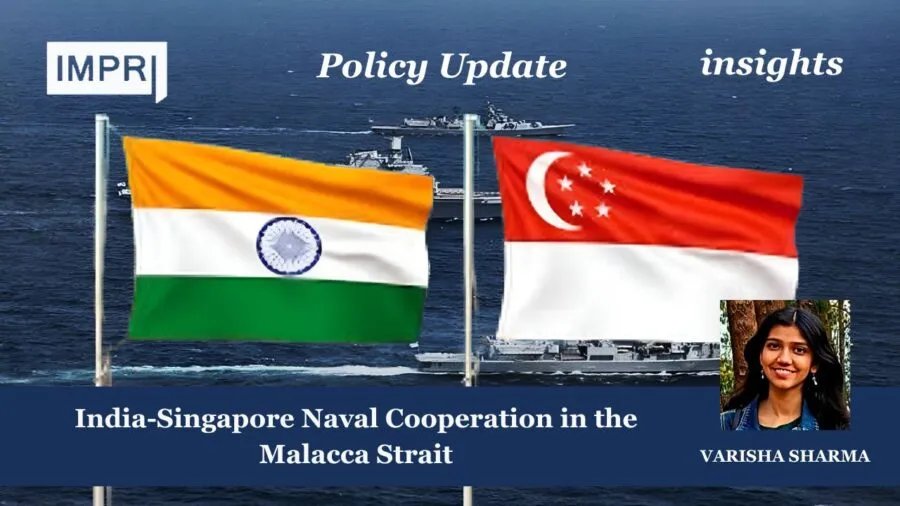
The most consequential recent development in India-Singapore naval cooperation was the formal acknowledgement, for the first time, of India’s aspiration to participate in the Malacca Strait Patrol (MSP) framework. During Prime Minister Lawrence Wong’s official visit to New Delhi from 2 to 4 September 2025, the joint statement issued by the two governments included a sentence reading, “Singapore acknowledges with appreciation India’s interest in the Malacca Straits Patrol” (Bhardwaj, 2025; Bhaumik, 2025).
The MSP is a multilateral framework established in 2004 comprising the four littoral states of the Strait of Malacca-Indonesia, Malaysia, Singapore, and Thailand, to combat piracy through coordinated naval patrols. India has sought engagement with this framework since at least 2004, but has consistently encountered resistance from littoral states wary of setting precedents for external-power involvement in their sovereign waters (Patnayak, 2025; Bhardwaj, 2025). Singapore’s formal acknowledgement of India’s interest in September 2025 represented the first time any MSP member state had publicly validated India’s aspiration.
SIMBEX: The Core of India-Singapore Naval Ties
Initiated in 1994 under the rubric of anti-submarine warfare, the Singapore-India Maritime Bilateral Exercise(SIMBEX) has expanded in scope, complexity, and strategic resonance over three decades. As the Indian High Commission in Singapore stated in 2019, “SIMBEX is the longest uninterrupted naval exercise that India has with any other country” (The Economic Times, 2019), a remarkable distinction given the breadth of India’s bilateral and multilateral naval engagements.
The exercise has developed in several important ways over the years. In 2003, during SIMBEX, the Republic of Singapore Navy became the first Southeast Asian navy to successfully fire a torpedo against a moving submarine, demonstrating the growing sophistication of joint operations (MINDEF Fact Sheet, 2018). New standard operating procedures signed in 2006 expanded the original anti-submarine warfare mandate to encompass anti-air and anti-surface warfare exercises. By the time of the 28th edition in 2021, held in the southern South China Sea, the exercise included guided-missile destroyers, anti-submarine warfare corvettes, P-8I maritime patrol aircraft, Fokker-50 patrol aircraft, submarines, and F-16 fighter aircraft.
SIMBEX, 2022
Source: Press Release Bureau
The 30th edition of SIMBEX in September 2023 marked another milestone, with both navies deploying submarines alongside surface vessels and maritime patrol aircraft in the southern South China Sea. The Diplomat described the exercise as “a demonstration of a strong political and strategic commitment by both India and Singapore to strengthen their military and security ties” (Rajagopalan, 2023). The 31st edition in October 2024 was held at Visakhapatnam, involving INS Shivalik and RSS Tenacious with advanced anti-submarine, anti-surface, and anti-air exercises in the Bay of Bengal.
The 32nd edition of SIMBEX, held from 28 July to 1 August 2025, was hosted by Singapore at RSS Singapura-Changi Naval Base. The sea phase was conducted in the southern reaches of the South China Sea, with the Indian Navy represented by the Shivalik-class frigate INS Satpura, while the RSN deployed the Formidable-class frigate RSS Supreme and the Victory-class missile corvette RSS Vigilance.
The Republic of Singapore Air Force participated with an S-70B Seahawk naval helicopter, two Fokker-50 maritime patrol aircraft, and two F-15SG fighter aircraft. Complex warfare serials included gunnery firing, air defence exercises, and maritime security drills. Commanding Officer of RSS Supreme, Lieutenant Colonel Aaron Koh, described SIMBEX as “a testament to the long-standing bilateral ties between the Republic of Singapore Navy and the Indian Navy” (MINDEF, 2025)
Impact: India-Singapore Naval Cooperation in the Broader Indo-Pacific Context
India–Singapore naval cooperation does not exist in isolation; it is embedded in a broader architecture of Indo-Pacific security partnerships that India has cultivated since the 2000s. Singapore serves as the hub of its political, economic and security strategy in the whole of East Asia. In the contemporary strategic environment, this role has been reinforced by the convergence of Indian and Singaporean interests in a rules based maritime order.
SIMBEX complements a range of other multilateral maritime frameworks in which both India and Singapore participate: the Indian Ocean Naval Symposium (IONS), the ASEAN-India Maritime Exercise (AIME), and India’s MILAN multilateral exercise, among others. The inaugural AIME, held in May 2023, brought together naval vessels from India, the Philippines, Indonesia, Singapore, Malaysia, Thailand, Brunei, and Vietnam in the South China Sea, a landmark event that represented India’s first multilateral naval exercise with ASEAN as a bloc, overcoming long-standing hesitancies on both sides (Rajagopalan, 2023). Singapore’s active participation in this exercise underscored its role as a facilitator of India’s regional maritime engagement.
The defence relationship’s strategic value to Singapore is equally significant. As Singapore’s Defence Minister Dr. Ng Eng Hen stated after the 6th Defence Ministers’ Dialogue in October 2024, Singapore “supports and wishes for India to play a stronger role in the Asia-Pacific region” and knows that “their security is one which is shared” (MINDEF, 2024).
Emerging Issues
While the cooperation has strengthened immensely there remain some issues unresolved. The Malacca Strait Patrol framework is managed primarily by Indonesia, Malaysia, Singapore and Thailand. While Singapore has acknowledged India’s bid to join, its joining depends on the rest of the littoral states. Further, since the Strait of Malacca is crucial for China’s energy imports, these naval exercises have led to a complex diplomatic position for Singapore which aims to balance its economic interests with China and strategic interests with India at the same time.
Future Trajectories of Cooperation
Looking ahead, India-Singapore naval cooperation in the Malacca Strait is likely to deepen along several trajectories. Future exercises are expected to incorporate cyber defence, space-based surveillance, and unmanned aerial and underwater systems. SIMBEX 2025 was used as a testbed for advanced systems integration, with India’s P-8I maritime patrol aircraft operating with Singaporean naval and air platforms, and data-sharing protocols and encrypted communications channels tested under operational conditions.
Further, the institutional framework of cooperation is likely to expand through the CSP Roadmap’s defence pillar, which provides a ministerially mandated structure for annual monitoring and progressive deepening. Third, and most consequentially, India’s aspirations for engagement with the MSP framework may gradually be realised through informal coordination mechanisms rather than formal membership. India’s “coordination” language offers a diplomatically viable pathway: a framework in which Indian naval assets share intelligence, coordinate patrol schedules, and respond jointly to incidents without acquiring formal membership that might alarm Indonesian or Malaysian sensitivities (Patnayak, 2025).
Finally, as SIMBEX 2025 demonstrated, both navies are exploring trilateral and multilateral extensions of their bilateral cooperation, potentially involving Australia, Japan, and the United States, to reinforce a rules-based maritime order in the Indo-Pacific. India’s participation in the Quad, alongside the United States, Japan, and Australia, and Singapore’s own robust defence relationships with these same powers create a web of overlapping partnerships that may eventually produce more integrated maritime security architecture for the Malacca Strait and the broader Indo-Pacific.
Conclusion
India-Singapore naval cooperation in the Malacca Strait represents one of the most consequential bilateral security partnerships in contemporary Asia. Over three decades, from the modest anti-submarine exercises of SIMBEX’s early editions to the landmark CSP Roadmap of 2025, the two navies have built a relationship of extraordinary depth, continuity, and strategic convergence. Singapore’s formal acknowledgement of India’s interest in the Malacca Strait Patrol in September 2025 was a watershed diplomatic moment, validating India’s three-decade aspiration to be recognised as a legitimate security provider in a waterway of global consequence.
Yet structural constraints such as ASEAN sovereignty sensitivities, the closed character of the MSP framework, and the reluctance of Indonesia and Malaysia, remain. However, the path forward looks hopeful and the evolving India-Singapore Naval Partnership remains important to realising a stable, open, and rules-based maritime order in the Malacca Strait and the Indian Ocean at large.
References
Ballast Markets. (2025, May 12). The Malacca Strait: Piracy, politics, and $5 trillion in trade. https://content.ballastmarkets.com/blog/2025-05-12-malacca-strait-5-trillion-trade/
Bhardwaj, S. (2025, September 11). India’s Malacca Strait Move: Strategic Signal or Regional Overreach?. NUS Institute of South Asian Studies. https://www.isas.nus.edu.sg/papers/indias-malacca-strait-move-strategic-signal-or-regional-overreach/
Bhaumik, A. (2025, September 4). India secures Singapore’s support to its plan to join patrolling in Malacca Strait. Deccan Herald. https://www.deccanherald.com/india/india-secures-singapores-support-to-its-plan-to-join-patrolling-in-malacca-strait-3712849
Faisal, M. (2024). Maritime security and safety in the Strait of Malacca: An analysis of threats and mitigation strategies. SSRN. https://doi.org/10.2139/ssrn.5074160
India–Singapore Joint Statement. (2015, November 24). Joint statement on a strategic partnership between India and Singapore. Ministry of External Affairs, Government of India. https://www.hcisingapore.gov.in/NewEnergy
Patnayak, P.L. (2025, October 16). Why India Should Be Included in the Malacca Strait Patrol. Observer Research Foundation. https://www.orfonline.org/expert-speak/why-india-should-be-included-in-the-malacca-strait-patrol
Ministry of Defence, Singapore [MINDEF]. (2018, November 20. Fact sheet: Singapore-India Maritime Bilateral Exercise. https://www.mindef.gov.sg/news-and-events/latest-releases/20nov18_fs2/
Ministry of Defence, Singapore [MINDEF]. (2024, October 22). Singapore and India to strengthen defence relations. https://www.mindef.gov.sg/news-and-events/latest-releases/22oct24_nr/
Ministry of Defence, Singapore [MINDEF]. (2025, August 2). Singapore and Indian navies conclude annual maritime bilateral exercise. https://www.mindef.gov.sg/news-and-events/latest-releases/02aug25-nr/
Seedeen, R. (2026, March 9). The Era of Rising Piracy and the Need for Australia- China Maritime Cooperation. AustChina Institute. https://www.aci.org.au/publications/insight_rising-piracy-need-for-maritime-cooperation
Rajagopalan, R.P. (2023, September 22). India, Singapore Kick off SIMBEX Military Exercise. The Diplomat. https://thediplomat.com/2023/09/india-singapore-kick-off-simbex-military-exercise/
Som, V. (2017, November 29). India’s Warships Can Now Refuel And Rearm At Singapore Naval Base. NDTV. https://www.ndtv.com/india-news/wary-of-china-india-gets-rights-to-use-singapores-latest-navy-base-1781527
The Economic Times. (2019, May 15). Indian warships take part in international maritime defence exhibition in Singapore. The Economic Times. https://economictimes.indiatimes.com/news/defence/indian-warships-take-part-in-international-maritime-defence-exhibition-in-singapore/articleshow/69339675.cms
White, T. (2025, September 8). India-Singapore: Strategic Roadmap and Cooperation in the Malacca Strait. Canakya. https://cnky.in/india-singapore-strategic-roadmap-and-cooperation-in-the-malacca-strait/
About the Contributor
Varisha Sharma is a research intern at IMPRI and a final year student of Political Science Honours at Miranda House, University of Delhi. Intellectually driven and curious, her interest in International Relations stems from her love for traveling and learning about new cultures.
Acknowledgement
I would like to extend my sincere gratitude to the team at IMPRI India for their guidance and support.
Disclaimer
All views expressed in the article belong solely to the author and not necessarily to the organisation.
Read More at IMPRI:
Securing Supply Chains: The India-Australia Critical Minerals Partnership