





Event Report
Professor Vibhuti Patel
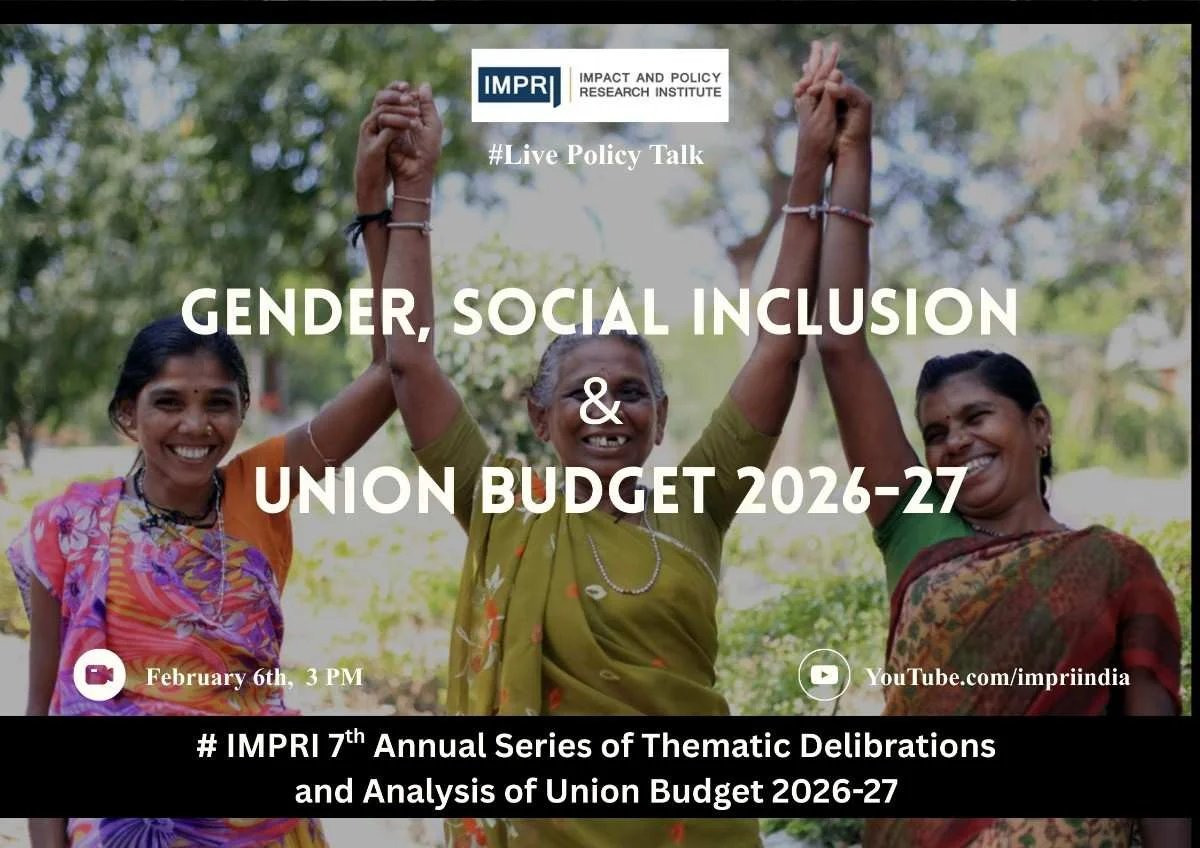
On February 6, 2026, the IMPRI Gender Impact Studies Centre (GISC) hosted a panel discussion as part of its 7th Annual Series of Thematic Deliberations. The session, titled “Gender, Social Inclusion and Union Budget 2026–27,” was moderated by Professor Vibhuti Patel.
The panel critically examined the budget’s alignment with the needs of women, children, and marginalized communities, concluding that the fiscal framework primarily serves a supply-side, “ease of doing business” agenda while neglecting vital human development sectors.
Macroeconomic Perspectives and Regional Disparities
Professor Paramita Saha Professor, Department of Economics, Tripura University, Tripura provided a comprehensive analysis of the Economic Survey 2026, noting a projected GDP growth of 7.5% driven largely by the service sector. However, she raised “alarm bells” regarding a widening balance of payment deficit and global geopolitical volatility. She characterized the budget as one of “continuity and consolidation,” focused on manufacturing hubs like Biopharma SHAKTI and capital expenditure (CAPEX) of ₹12.2 lakh crore.
Prof. Saha specifically highlighted the meager allocation for the North Eastern Region, noting that the Department of Development of North Eastern Region (DoNER) received only 0.13% of the total budget, which fails to address the region’s unique gendered needs. She further critiqued the Gender Budget Statement (GBS), observing that revised estimates are consistently lower than budget estimates, signaling a chronic underutilization of funds.
The Social Sector Architecture and Livelihood Shifts
Professor Neha Shah, Associate Professor at the L. J. Institute of Management Studies (L. J. University in Ahmedabad argued that social sector investment is an economic imperative, as a healthy and educated workforce drives sustainable demand. She expressed grave concern over the stagnation of social spending, with health and education remaining at 1.9% and 2.4% of the total budget, respectively—figures far below national policy targets.
A central point of contention was the replacement of MGNREGA with the Viksit Bharat–Guarantee for Rozgar and Ajeevika Mission (VB-GRAMG). Prof. Shah noted that this shift dismantles the legal “right to work,” replaces it with a budget-capped mission, and shifts 40% of the financial burden to states. This is predicted to disproportionately impact intersectionally vulnerable women and gender-diverse persons. Additionally, the budget was found to be silent on social security for platform-based gig workers.
Digitalization as a Barrier in Agriculture and Entitlements
Ms. Neeta Hardikar Director, ANANDI (Area Networking and Development Initiatives), Gujarat reflected on the existential realities of women in agriculture, who constitute 77–80% of rural female workers but remain structurally marginalized. She found the mandatory digitalization of anti-poverty schemes (e.g., eKYC and facial recognition for NMMSS) to be exclusionary. Her ground-level research indicated that:
- The gender digital divide excludes women from supervisory positions.
- Digital monitoring in rural areas often leads to a denial of work due to poor connectivity, forcing workers to walk home without pay.
- The National Food Security Act (NFSA) has seen a surge in the deletion of ration cards due to faulty digital data.
Structural Exclusions of the Marginalized
Ms. Supriya Sonar, Grassroot Leadership and Knowledge Building, CORO INDIA (CORO INDIA) deconstructed the budget’s rhetoric, noting that while terms like “Lakhpati Didi” were prevalent, concerns for Dalits, Adivasis, NT-DNTs, and PVTGs were largely missing. Key highlights included:
- Minority Affairs: Significant mid-year budget revisions have led to real-term reductions in education and leadership schemes.
- WASH (Water, Sanitation, and Hygiene): The Namaste scheme for mechanizing sanitation saw its budget cut from ₹130 crore to ₹110 crore, ignoring the needs of Safai Karmacharis.
- Frontline Workers: Honorariums for ASHA and Anganwadi workers remain inadequate and stagnant.
Gender-Based Violence and the Care Economy
Ms. Aarohi Damle , Senior Researcher at the Center for Inquiry into Health and Allied Themes (CEHAT) in Mumbai(CEHAT) examines the chronic underutilization of the Nirbhaya Fund, noting that 74% of allocated funds remained unspent in recent cycles. She dissected Mission Shakti, pointing out:
- Sambal: Funding for One Stop Centres (OSCs) and Women Helplines remains stagnant at ₹629 crore, which is insufficient for 24/7 infrastructure.
- Samarthya: While focusing on empowerment and Palna (Creches), the sub-scheme suffers from delayed payments to CSOs and a lack of gender-disaggregated data.
Dr. G. Uma (IGNOU) elaborated on the care economy, noting the budget’s proposal to train 1.5 lakh multi-skilled caregivers. While she appreciated the focus on mental health and STEM education, she questioned the implementation of proposed girls’ hostels in every district, citing potential mobility and cultural barriers for rural families.
The Kerala Model: A “Ray of Hope”
The panel concluded by highlighting the Government of Kerala’s Gender and Child Budget as a transformative standard.
- Fiscal Commitment: Kerala’s gender budgeting accounts for 22% of its total plan outlay (₹5,586.99 crore).
- Comprehensive Inclusion: The state maintains a specific Transgender Budget and ensures 100% budgetary allocation for children’s education from pre-primary to graduation for all children, regardless of gender.
Conclusion and Call to Action
Professor Vibhuti Patel summarized the insights by calling for a national campaign to prioritize:
- Universalization of food security and the right to public-funded education.
- Regularization and standardized wages for ASHA, Anganwadi, and Mid-Day Meal workers.
- A review of how digitalization denies basic rights to the poorest of the poor.
- Mandatory gender-disaggregated data for all sectors to ensure accountability in the GBS.
Acknowledgment: This Event Report is written by Professor Vibhuti Patel – Visiting Distinguished Professor at the IMPRI.